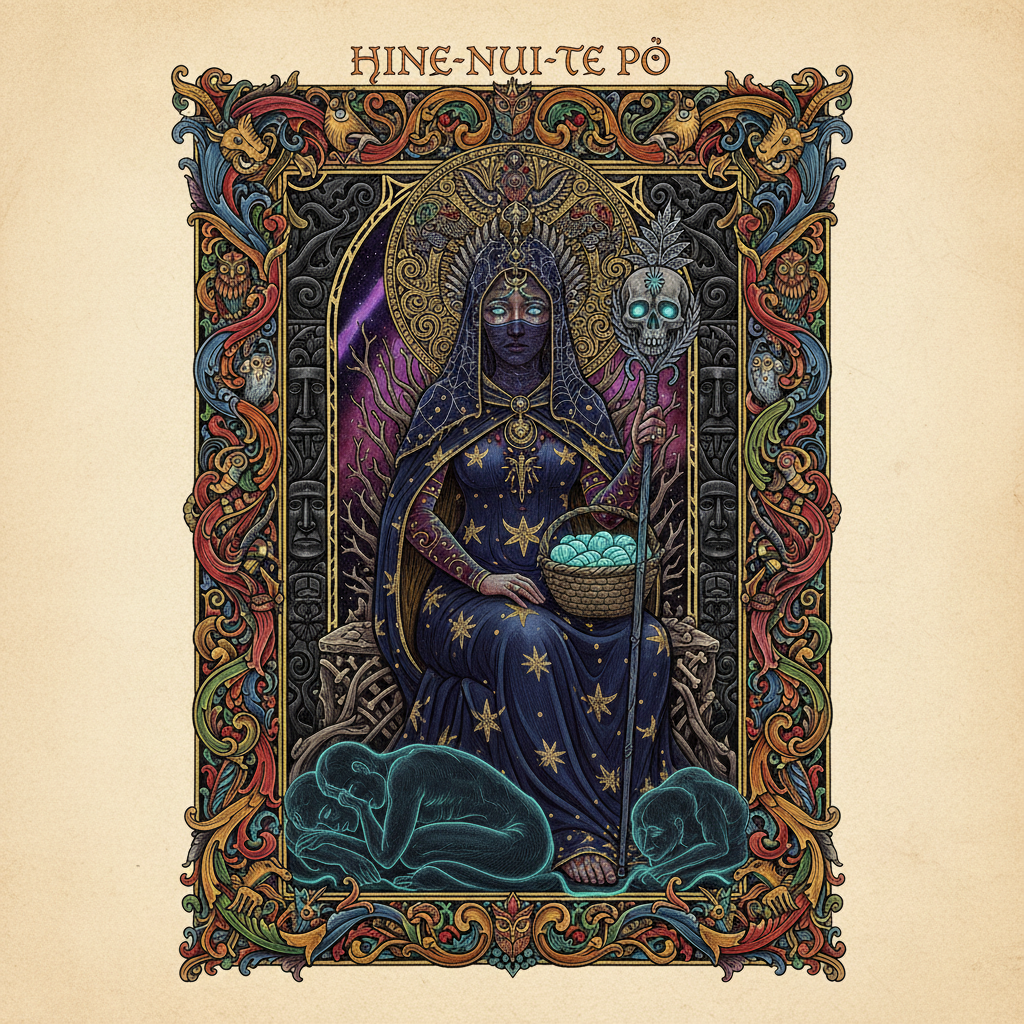
Combat Profile
Te Pō's Embrace
Hine-nui-te-pō draws all living souls inexorably toward the underworld, dealing massive damage and permanently removing defeated enemies from resurrection.
Eternal Darkness
Hine-nui-te-pō's presence shrouds the battlefield in perpetual night, reducing all enemies' attack power and causing them to fear the inevitable end.
Sleep -- Maui nearly defeats her while she sleeps. A moment of unconscious vulnerability is the one crack in the absolute fortress of death
“She lay sleeping, and her hair was like the rays of the setting sun spread upon the horizon. And Maui entered, and the fantail laughed — and that laughter was the last sound any mortal hero would hear at the threshold of the immortal.”
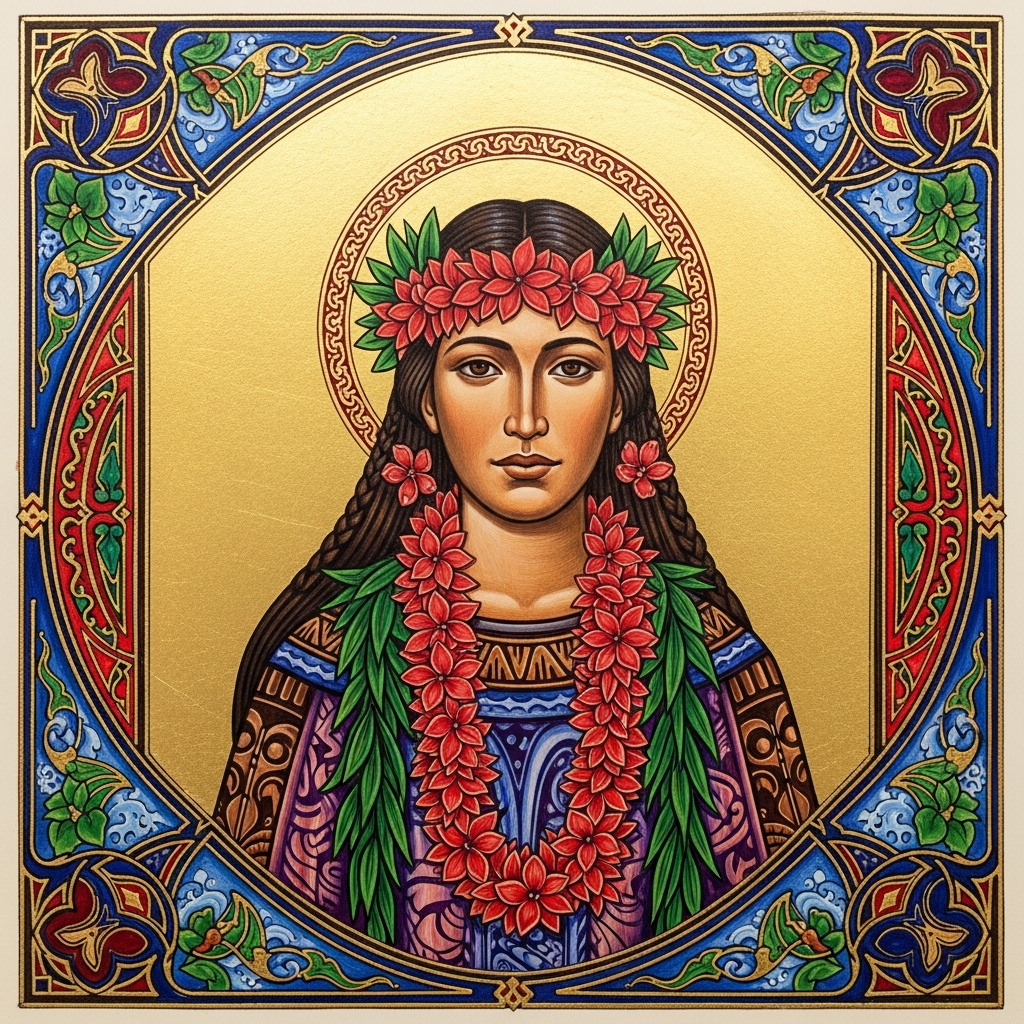
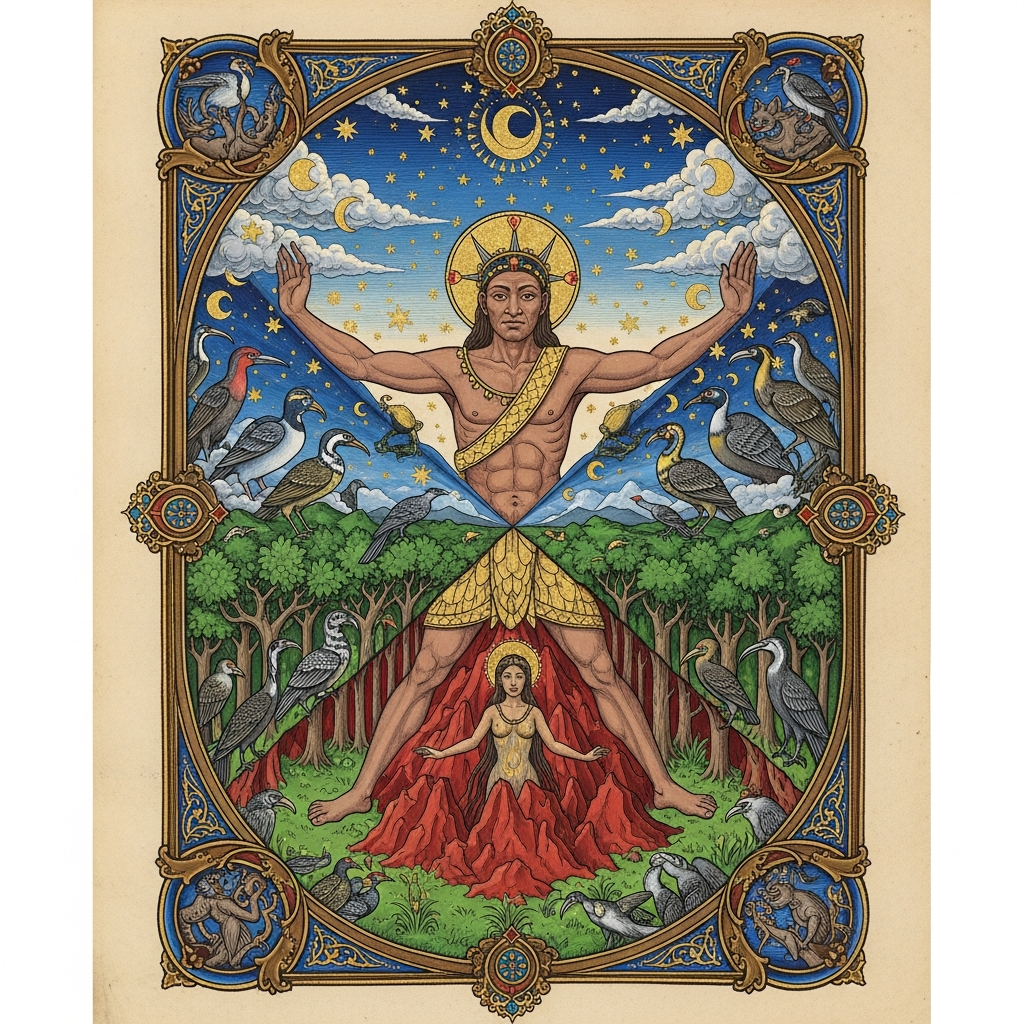
Lore: Hine-nui-te-pō is the final form of the goddess who began as Hine-ahu-one (Earth-Formed Maiden), the first woman shaped by Tane from the red clay of Papatuanuku, and continued as Hine-titama (Dawn Maiden), Tane’s daughter who became his wife. When Hine-titama asked the other gods who her father was and learned that Tane — her husband — was also her creator and father, she was seized with such shame and horror that she fled to Te Pō, the realm of night and death. There she declared to Tane: “Stay in the world of light to raise our children. I will go to the darkness to receive them when they die.” She descended into the underworld and became Hine-nui-te-pō — Great Woman of the Night — transforming her shame into purpose, her grief into the gift of a resting place for all who die.
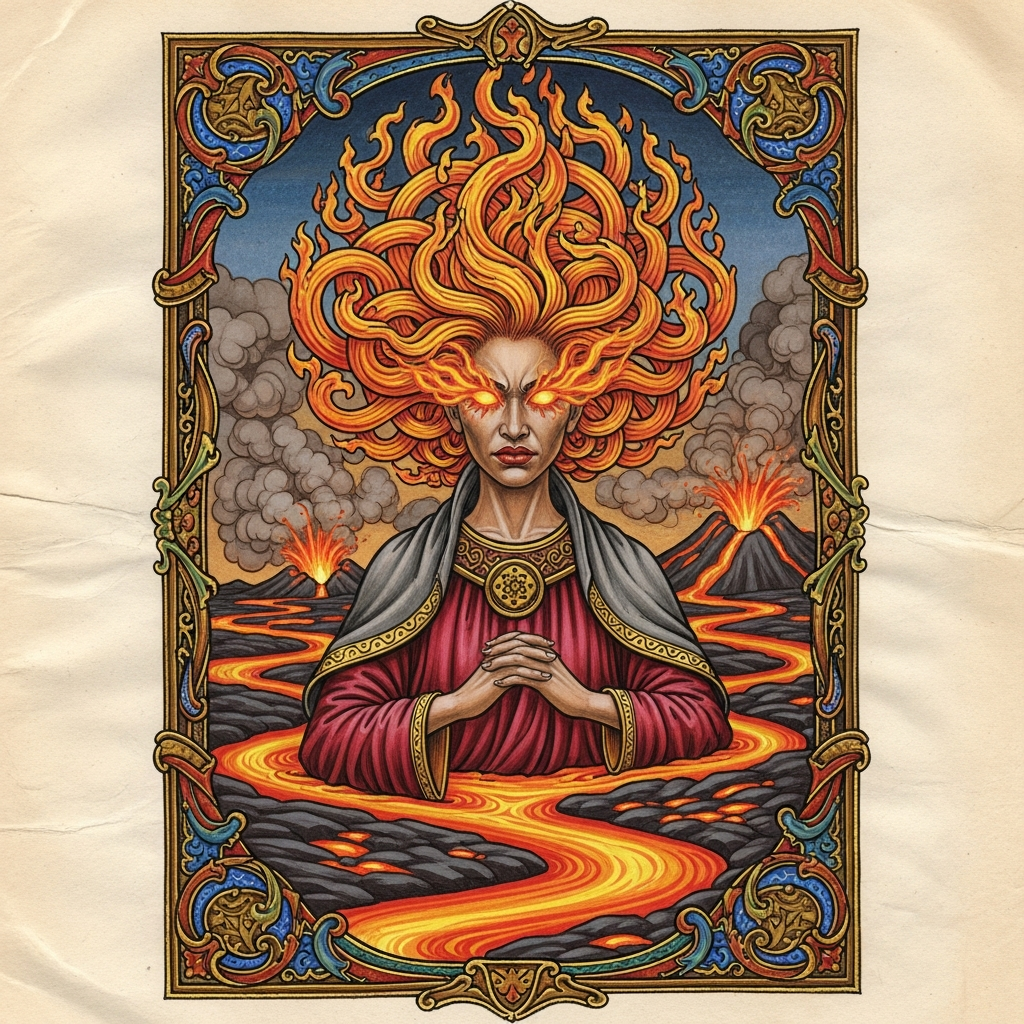
She is not evil. She is inevitable. The dead sleep under her guardianship, cradled in the darkness they came from before birth. Her hair at the horizon is the red and gold of sunset, that daily reminder that light must always give way to night. The obsidian flints of her birth canal are the teeth of the earth, the boundary between the world of light and the world below, the border no living being crosses twice.
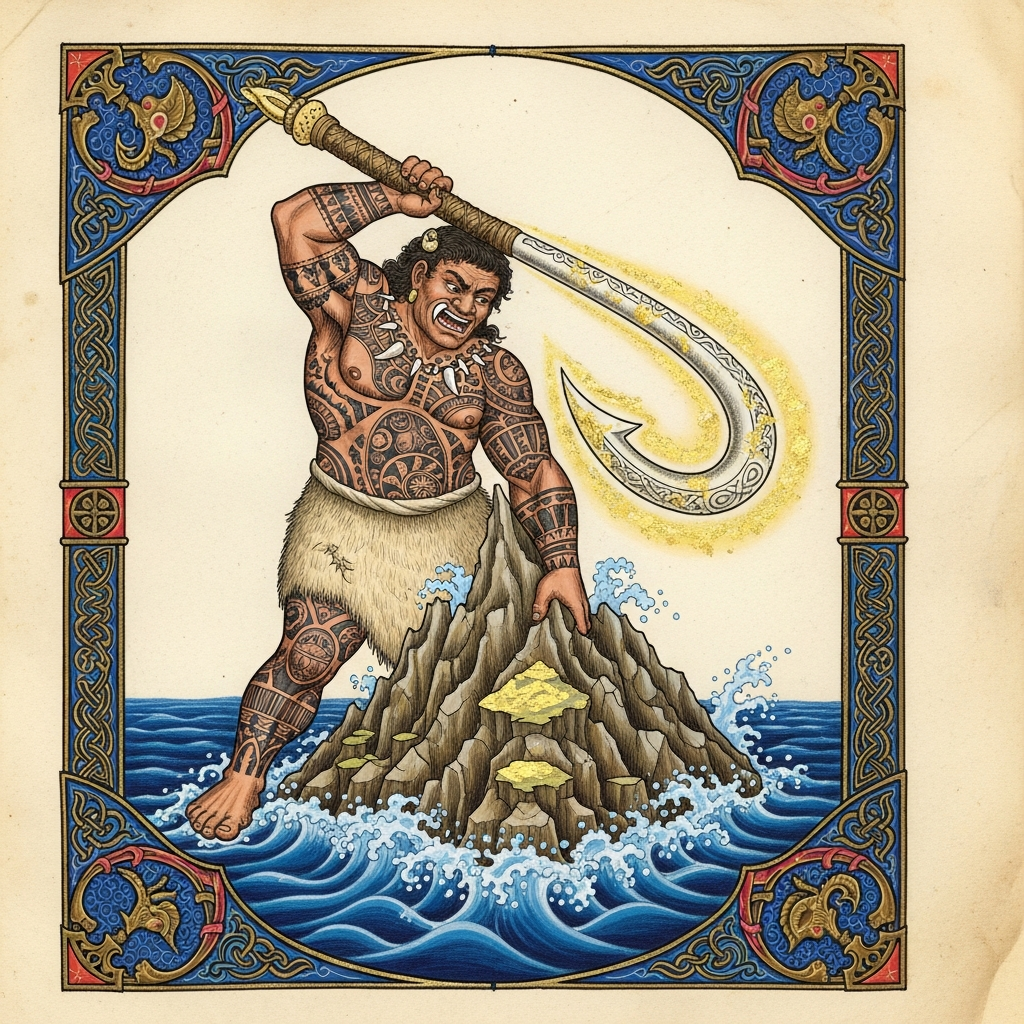
Maui’s attempt to win immortality by crawling through her sleeping body — entering through her birth canal and emerging from her mouth, reversing the death-passage — is the most audacious act in Polynesian mythology. The fantail bird (piwakawaka), unable to suppress its chittering laugh at the absurdity of the sight, woke her. She crushed him. And so death remained. The Maori understand this as the moment human mortality was made permanent and absolute: not by divine decree from above, but by the failure of the cleverest being who ever lived to outthink the fundamental architecture of existence.
Parallel: The goddess of death who guards the underworld appears across world mythology: Hel (Norse), Persephone (Greek), Ereshkigal (Sumerian). But Hine-nui-te-pō differs from all of them in her origin: she is not born a death goddess, and she does not rule the underworld by conquest or assignment. She chose to go there, transforming her personal shame into the cosmic function of receiving the dead. This trajectory — from innocent creation to conscious self-sacrifice into darkness — has no precise parallel in any tradition, but it resonates most powerfully with the descent of the Egyptian Osiris: death not as defeat but as transformation, the necessary passage that makes regeneration possible. The Maori tradition teaches that death is not a punishment or an accident. It is the choice of a woman who loved her children too much to let them enter darkness without someone to receive them.
2 min read
None -- she is the end of all counters. Even Maui, the greatest trickster in all Polynesia, fails to outmaneuver her. Hine-nui-te-pō is the one force in the Polynesian cosmos that cannot be tricked, bribed, or overpowered
Grey, *Polynesian Mythology*; Best, *Maori Religion and Mythology*; Orbell, *The Illustrated Encyclopedia of Maori Myth and Legend*; Tregear, *Maori-Polynesian Comparative Dictionary*