Combat Profile
Wayfinder's Covenant
grants safe passage across treacherous waters and reveals hidden navigation routes to those who honor the forest and offer proper reciprocal gifts.
Sacred Timber Bond
all wooden vessels and forest materials within the user's presence are sanctified, ensuring their durability and the forest's consent to their use.
Hubris -- his initial failure to seek permission from the forest spirits before cutting the tree means the work is undone each night, a supernatural correction that continues until he learns to ask
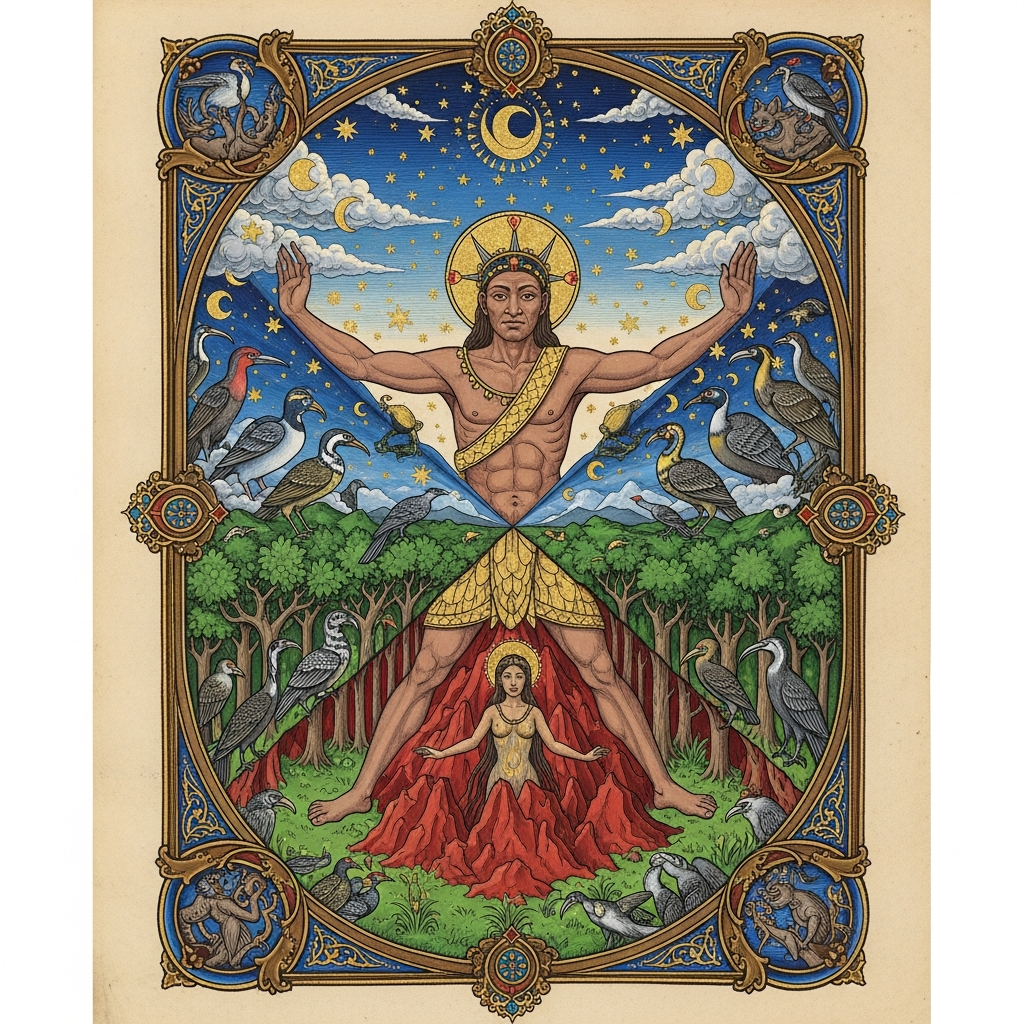
“He came at night and hid and watched, and saw the insects and the birds and the forest creatures working together in the moonlight, fitting the boards back together, singing the tree whole. And he understood that you do not take from the forest. You ask.”
Lore: Rata (known as Laka in Hawaiian tradition) is the hero-navigator whose story teaches the most important principle of Polynesian ecological theology: that creation requires relationship. Rata sets out to build a great ocean-going canoe to avenge his father or rescue captive family members (the versions vary across the tradition), and he selects a magnificent tree in the forest of Tane. He cuts it down without ceremony, without prayer, without the proper rituals of acknowledgment that Tane’s domain requires. He shapes the hull and leaves it. When he returns the next morning, the tree has been restored — standing whole, every chip replaced, as if he had never touched it. He cuts it again. Again it is rebuilt. This continues until Rata hides at night and witnesses the forest spirits — birds, insects, the denizens of Tane’s realm — working in concert to undo what he has taken without asking.
Confronted with this evidence, Rata does not fight. He acknowledges what he has done and asks for permission properly. The forest spirits, having corrected him, become his collaborators. They help him build the canoe in a single night — one of the great acts of supernatural craft in Polynesian mythology, the forest itself shaping itself into a vessel worthy of the ocean. The canoe is then launched, and Rata’s voyage can begin.
The story is not merely about manners. It encodes the Polynesian understanding of kaitiakitanga — guardianship, the reciprocal relationship between people and the natural world. In Maori theology, the forest is Tane’s domain. Every tree is under his authority. To take a tree without acknowledgment is not merely disrespectful; it is a violation of the sacred covenant between the human world and the divine natural order. The proper ritual of asking — karakia before cutting, offerings to the spirit of the tree, acknowledgment of the forest’s loss — is not superstition. It is the practice by which Polynesian communities maintained sustainable relationships with the environments they depended on across millennia of island living.
Parallel: The motif of the hero who must learn to ask permission before taking from nature has no precise parallel in the major Abrahamic traditions (where Genesis grants humanity dominion over the earth without the requirement of reciprocity), but it resonates powerfully with indigenous traditions worldwide — the Lakota practice of thanking the buffalo before the hunt, the Aboriginal Australian relationship with songlines that encode obligations to specific landscapes, the Japanese Shinto practice of satoyama forest management governed by shrine protocols. The closest mythological parallel may be the story of Erysichthon in Greek mythology: the king who cut down Demeter’s sacred grove without permission and was punished with insatiable hunger until he devoured himself. Where Erysichthon is destroyed, Rata is corrected and redeemed — the Polynesian version trusts that even those who violate sacred order can learn, if they are willing to be taught.
2 min read
The forest spirits (haumia atua) who undo his work each night are not his enemies but his teachers; his story ends not in defeat but in transformation
Grey, *Polynesian Mythology*; Orbell, *The Illustrated Encyclopedia of Maori Myth and Legend*; Best, *Maori Religion and Mythology*; Te Ara Encyclopedia of New Zealand