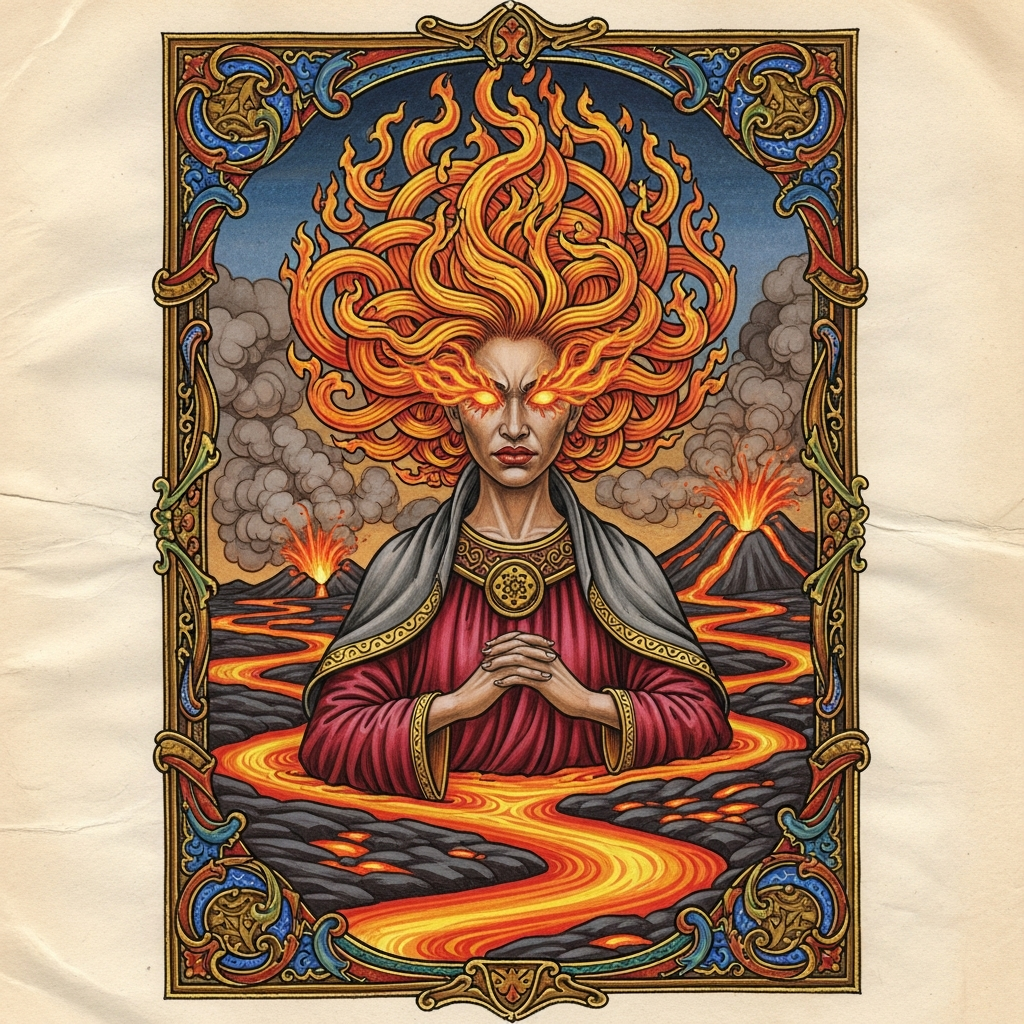
Kapo and the Return from Death's House
Traditional Hawaiian period — pre-contact, approximately 1200-1778 CE · A Hawaiian village on Oahu or the Big Island; the underworld of Milu beneath the islands
Contents
Kapo, sister of Pele and goddess of healing and sorcery, is called on when a man in a Hawaiian village is found cold and unbreathing at dawn. The kahuna who performs the healing rite must find the man's soul before it crosses from the vestibule of Milu's underworld into the true dark where no soul returns. A prayer is spoken, an offering made, a physical intervention performed. The soul comes back across the boundary. The man breathes.
- When
- Traditional Hawaiian period — pre-contact, approximately 1200-1778 CE
- Where
- A Hawaiian village on Oahu or the Big Island; the underworld of Milu beneath the islands
The man is found cold at the edge of the taro field.
He had gone out before dawn to check the irrigation channels — a thing he did every morning, the same walk in the same dark — and did not come back for breakfast. His wife finds him lying on his side in the mud at the field’s edge, his face turned toward the mountain, his body cold. She cannot rouse him. She calls his name several times and touches his face and his hands and puts her ear near his mouth and feels no breath.
She runs to the kahuna.
The kahuna — the healer, the ritual specialist, the person in this village trained in both medicine and prayer over a period of years under another kahuna — comes immediately. He does not rush in the sense of running, but he does not pause to put on formal garments or prepare a slow ceremony. Time is the variable that matters most. He kneels beside the man and presses his hands against the neck and the wrists and the center of the chest and listens with a quality of attention that is also a form of prayer.
He determines that the man has been cold for less than half a day.
This is the margin. This is the difference between a healing and a death. The Hawaiian tradition understands the recently dead not as gone but as departed — the soul, called the uhane, has left the body but may not yet have crossed fully into Milu’s domain. It lingers in the vestibule, the borderland that is neither fully dead nor alive, and if it can be called back before it goes deeper, the man will breathe again.
The kahuna stands. He calls for what he needs.
Kapo comes into this story not as a figure who appears but as a presence that is invoked.
She is the sister of Pele, the daughter of Haumea, a goddess of healing and sorcery and the darker arts of prayer. She is associated with the ‘awa plant — the root from which the ritual intoxicant is made — and with the hula in its original sacred form, and with forms of power that the Hawaiians grouped under the word kahuna ‘ana’ana, the black arts that include both curse and cure. She is not gentle. She is not warm in the way that healing goddesses of other traditions are warm. She is effective, which is a different thing.
The kahuna lights the bundle of ti leaves at the offering stand. He places the image of Kapo — the ki’i akua, the carved god-figure — where the dying man’s head is directed. He prepares the ‘awa and drinks a portion himself and pours a portion on the earth. He begins the prayer.
The prayer is not a general petition. It is a specific address: to Kapo, to Kane who governs water and life, to Ku who governs the masculine principle and the western boundary between life and death. It names the man by his full genealogical name — not just his use-name but the whole chain of ancestors he descends from, because the prayer must reach through all of them to find him. It describes where he is: in the vestibule of Milu, in the thin place between the living and the dead, perhaps seated on the ground looking back toward the village without knowing how to get there.
Come back, the prayer says, in the way that Hawaiian prayer says things — not as a request but as a directional instruction. The path is here. This is the way. The voice you hear is the rope.
The intervention is also physical.
Hawaiian healing tradition does not separate the spiritual address from the physical work. The kahuna works on the body while praying, pressing on the chest with a rhythmic motion that the tradition describes as forcing the old breath out and making room for new breath to enter. He rubs the arms and legs vigorously — not to warm them, exactly, but to recall them to themselves, to remind the body that it has a circulation, a pulse, a temperature. He works the jaw. He opens the mouth and presses on the tongue and ensures the passage of air.
The woman who found her husband watches from several steps away. She does not interfere and does not look away. She knows that what she is watching is the kahuna working at both levels at once — calling the soul back from the vestibule while simultaneously keeping the body able to receive it, because a soul returned to a body that cannot breathe will not stay.
This is the technical knowledge that makes a kahuna a kahuna. The prayer without the physical skill is incomplete. The physical intervention without the prayer will not reach a soul that has wandered. The practitioner must hold both simultaneously, speaking with the mouth and working with the hands, which requires a quality of divided attention that takes years to develop.
Kapo’s presence in the healing rite is not visible.
The air changes. This is how the tradition describes it: the air around the man becomes different in a way that is not wind, not temperature, but quality. The kahuna feels it in his hands. He does not stop working. He increases the depth of his prayer, moving from the general invocation into the specific language of soul-retrieval, the portion of the prayer that names the stages of the underworld path and orders the soul to turn around at each one.
Milu’s domain has structure. It is not a single undifferentiated dark but a layered space with regions, some closer to the surface of the living world and some so deep that no prayer reaches them. The recently dead are in the upper regions, and they can still hear the voices of the living above them, and they can still find the way back if someone speaks the right words with the right authority. The kahuna is doing this. He is the rope let down into the well.
The man coughs.
It is not the sound of a man waking from sleep. It is rougher than that, more surprised, the sound of a chest that has not worked for several hours suddenly required to work again. The kahuna does not stop. He keeps the rhythm on the chest, keeps the prayer going, one hand pressing and releasing while the other holds the man’s jaw open and the prayer continues through his teeth.
The man draws a breath.
He does not know he was gone.
This is common in the Hawaiian accounts: people who return from the vestibule of Milu do not remember the underworld. They remember going to sleep, or losing consciousness, or nothing at all, and then they remember the kahuna’s hands and voice and the smell of burning ti leaves and the cold mud under their face. The journey is not available to memory. Only the gap is.
He is brought inside. His wife feeds him fish broth. The kahuna stays through the rest of the morning and gives instructions: what the man may eat, what he must avoid, how many days he must rest, what prayers he must offer at the heiau for the remainder of the month. The soul has been recalled but it is not fully reseated. It requires careful handling, the way a plant pulled from the ground and replanted requires water and shade while the roots re-establish.
Kapo does not require thanks, exactly. The ti-leaf bundle at the offering stand is replaced. The ‘awa is poured. The kahuna says the completion prayers that close the working and release the invoked presence. The ki’i akua is wrapped and stored.
The man lives another thirty years. He has grandchildren who know the story. He tells it not as a miracle but as a technical fact: there is a window, and the kahuna knew it, and the kahuna worked both sides of it at once, and the window was open just long enough.
This is the Hawaiian contribution to the theology of death: the conviction that death is not always final at the moment it appears to be final. The geography of Milu has a vestibule. The soul is slow to commit. A practitioner with the right knowledge and the right relationships — to Kapo, to Kane, to the patient’s own genealogical chain — can make a claim on the soul before it crosses the point where claims no longer reach.
Kapo’s power in this tradition is precisely her ambiguity. She governs both healing and sorcery because they are the same knowledge used in different directions: what you can summon from death’s house, you can also send there. The kahuna who calls a soul back from Milu is using the same knowledge as the kahuna who dispatches an enemy to Milu. The difference is direction, not technique.
The tradition does not pretend this is comfortable. It simply says it is true.
Martha Beckwith’s 1940 synthesis of Hawaiian mythology documents Kapo as a healer and sorcery-deity whose influence extends through the hula tradition, the kahuna systems, and the family of Pele. Kapo is invoked in healing contexts as a figure who governs the borderline between life and death from the same authority that governs it as a threat.
The Hawaiian practice of chest compression in healing contexts — documented by David Malo and Mary Kawena Pukui in their accounts of kahuna lapa’au practice — preceded Western cardiopulmonary resuscitation by at least several centuries. The precise medical mechanism was understood differently, but the physical intervention and its timing were functionally similar: apply rhythmic pressure to the sternum, keep the airway open, continue until breathing resumes or it becomes clear that it will not.
What the Hawaiian tradition added to this physical practice was the parallel spiritual address — the soul-retrieval prayer that worked on the assumption that consciousness was recoverable from a location near but not yet in death. Whether the two interventions were causally connected, or whether one was necessary and the other cultural, is a question the tradition itself does not ask. They did both, and the window was as often open as not.
Scenes
A kahuna at a healing altar before dawn — the ti-leaf bundle burning, the carved ki'i akua on the wooden post, the man laid out on a mat in the open air of the heiau courtyard
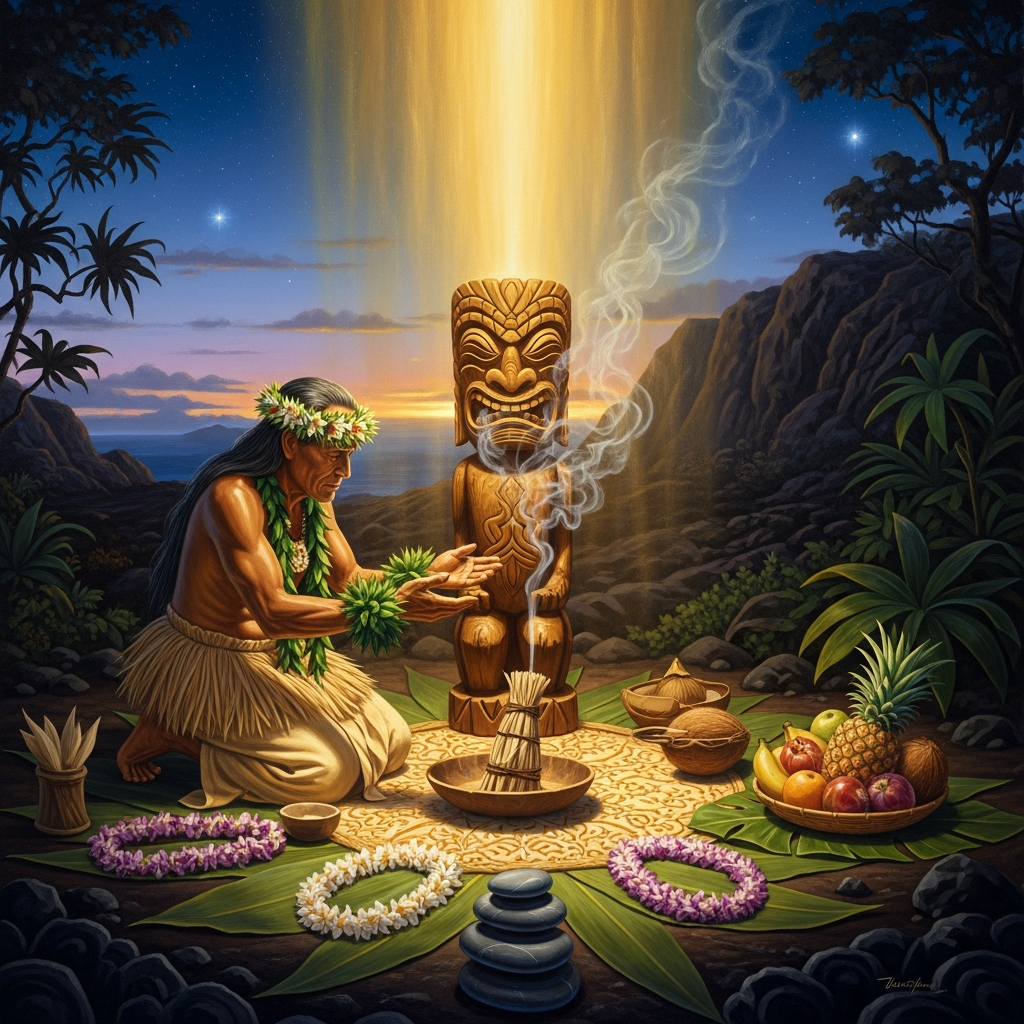 Generating art…
 Kapo invoked in the kahuna's prayer — sister of Pele, goddess of dark sorcery and healing, her presence felt as a change in the temperature of the air around the dying man
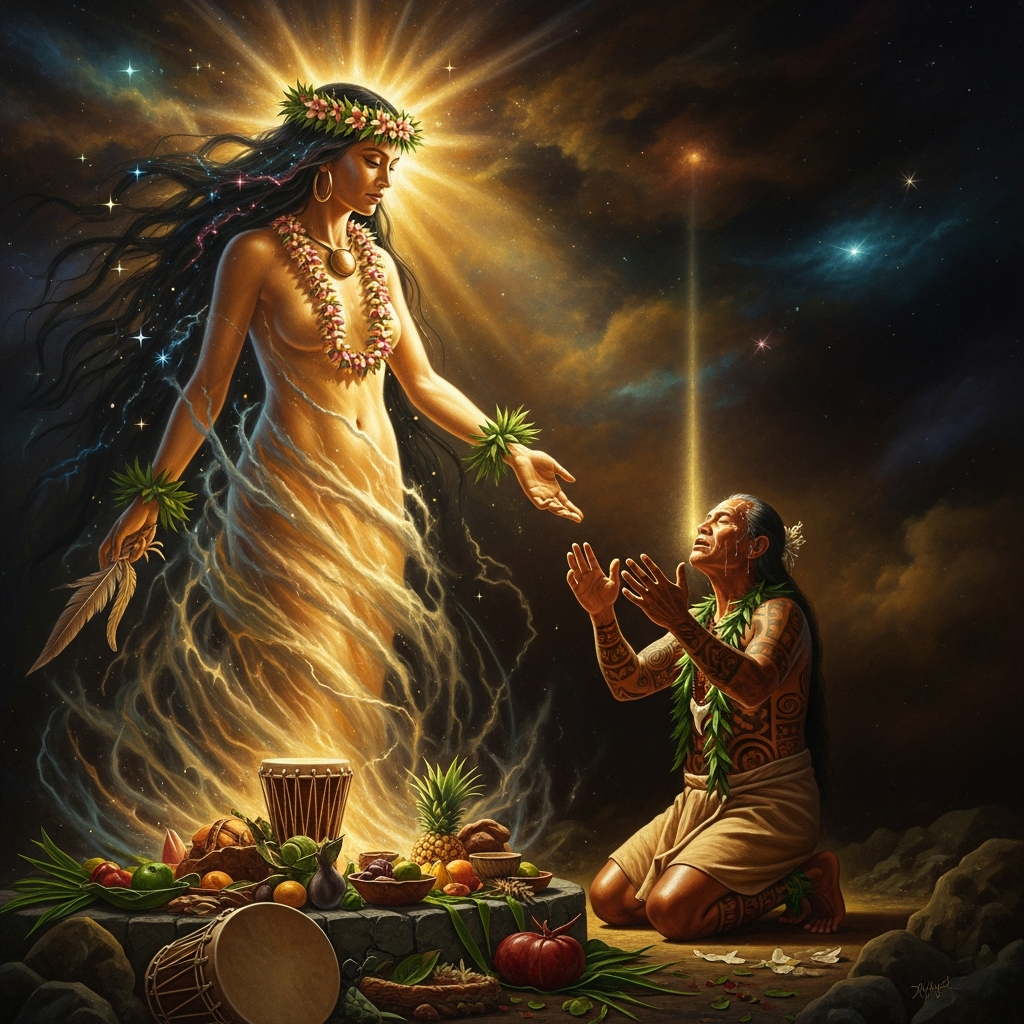 Generating art…
 The threshold of Milu's domain beneath the sea — the man's soul at the boundary, the kahuna's voice reaching it from the world above like a rope let down into a well
 Generating art…
 Echoes Across Traditions
Entities
- Kapo
- Milu
- Pele
- Kane
- the kahuna lapa'au

Sources
- Martha Beckwith, *Hawaiian Mythology* (1940), chs. 8, 31 — Kapo traditions and Hawaiian underworld beliefs
- E.S. Craighill Handy and Mary Kawena Pukui, *The Polynesian Family System in Ka-u, Hawaii* (1958)
- David Malo, *Hawaiian Antiquities (Moolelo Hawaii)* (1903, translated by Nathaniel B. Emerson)
- Mary Kawena Pukui, E.W. Haertig, and Catherine Lee, *Nana I Ke Kumu (Look to the Source)* (1972)
- Patrick V. Kirch, *On the Road of the Winds: An Archaeological History of the Pacific Islands* (2000)