Pele and Poliʻahu: Fire Against Snow
Mythic time · oral tradition recorded ~1860–1940 · Mauna Kea and Mauna Loa, Hawaiʻi Island — the snow-capped peak and the burning one, fifty kilometres apart
Contents
On the slopes of Mauna Kea, the volcano goddess wagers her lava against the snow goddess's freezing winds — and loses, and the geology of Hawaiʻi is what is left of their argument.
- When
- Mythic time · oral tradition recorded ~1860–1940
- Where
- Mauna Kea and Mauna Loa, Hawaiʻi Island — the snow-capped peak and the burning one, fifty kilometres apart
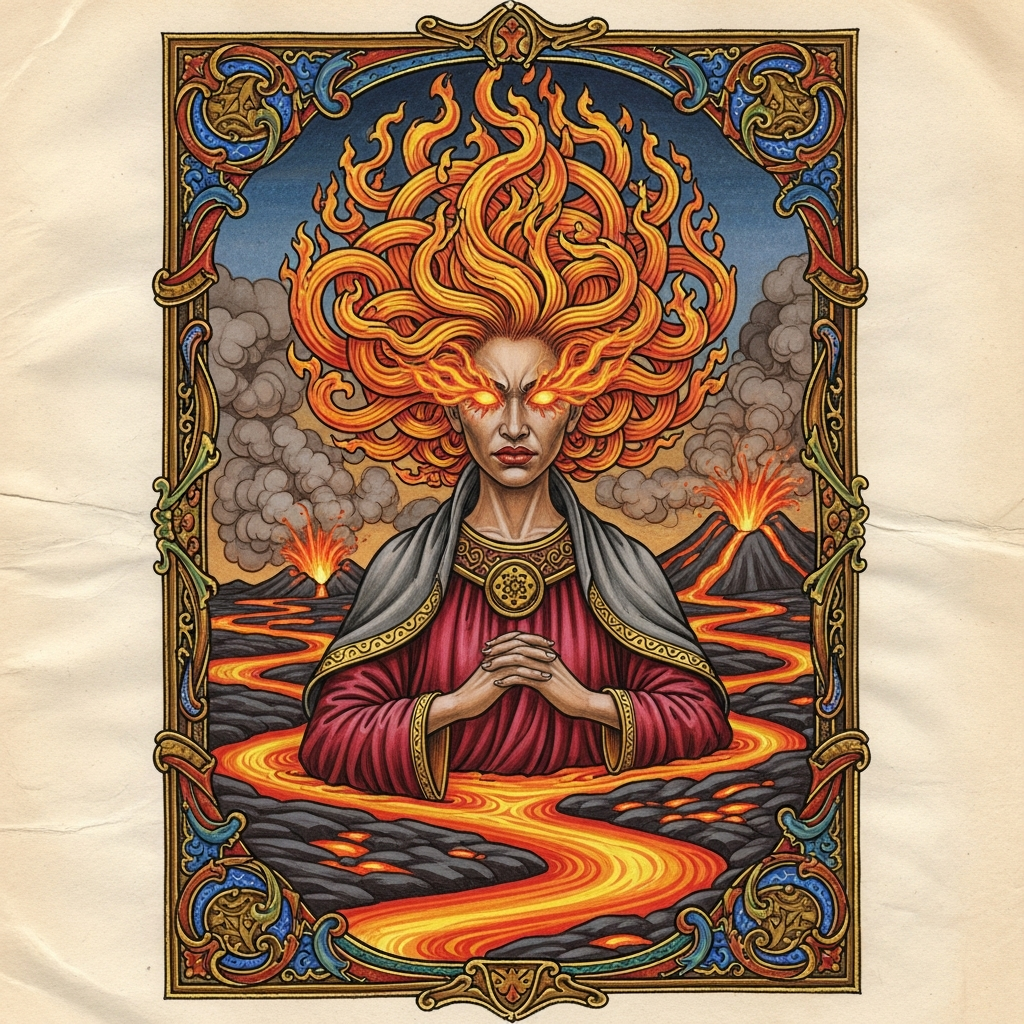
Pele lives in fire.
Her home is the crater of Halemaʻumaʻu in the caldera of Kīlauea, on the south slope of Mauna Loa. She came from Kahiki — the ancestral homeland the Hawaiians remember south and west, beyond the horizon — fleeing her older sister, the sea. Her sister keeps following her. Every island Pele tries to settle on, the sea catches up and drowns the fire-pit, until Pele reaches Hawaiʻi Island, the youngest and largest, where the volcano goes deep enough that her sister cannot reach her.
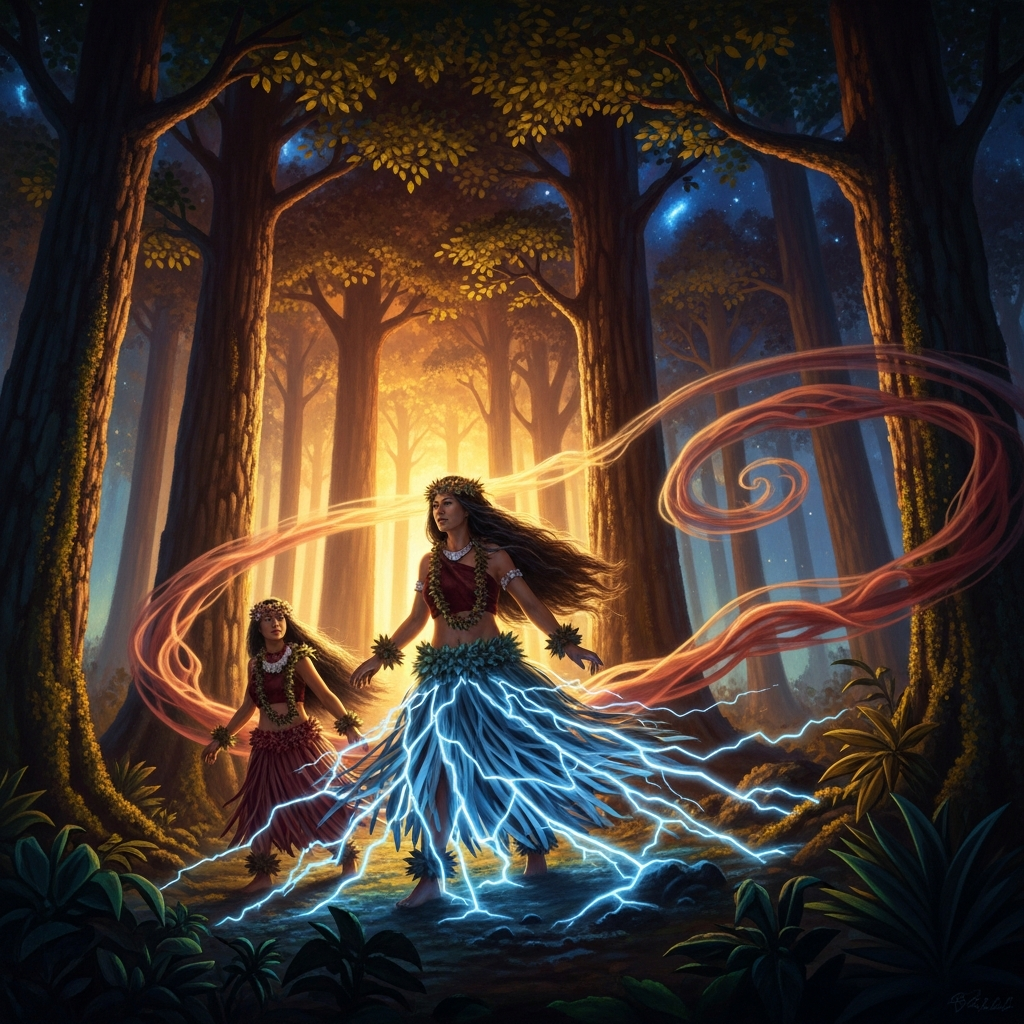
She dug the pit with her paʻoa, a digging-stick made of lightning. She lives in it with her sisters and her brothers — Hiʻiaka the youngest, Lonomakua the keeper of fire, Kamohoaliʻi the shark — and she comes out at night, sometimes as an old woman with a small white dog asking travelers for food, sometimes as a young woman with red eyes asking them to dance.
Travelers who feed her keep their houses. Travelers who do not, do not.
Poliʻahu lives in snow.
She lives at the summit of Mauna Kea, fifty kilometres north — the tallest mountain in the Pacific, taller than Everest if you measure from its base on the ocean floor. She wears a kapa hau, a cloak of woven snow. Her sisters live with her: Lilinoe the mist, Waiau the alpine lake, Kahoupokane the kapa-beater whose pounding makes the thunder. They are akua wahine of the high cold, the keepers of the freshwater that comes down the mountain in springs and feeds every taro patch on the windward side of the island.
Poliʻahu does not come down from the summit. She does not need to.
The two goddesses share the same island and avoid each other for centuries.
Then Pele falls in love with a chief.
The chief’s name varies — Kahawali in some tellings, Aiwohikupua in others — but the structure is constant: he is famous for his hōlua sledding, the sport in which a man rides a wooden sled at terrifying speed down a stone-paved slope built into the side of a mountain. Pele watches him from the crater. She comes up to the slope in disguise, as a beautiful young woman with hair the colour of a cooling ember, and asks to race him.
He gives her a sled. She loses.
She asks again. He gives her his sled, the better one. She loses again. He laughs. He turns to walk away.
That is when she lets the fire show.
Behind him, the slope is moving.
He looks back and the paving stones are flowing. The lava has come up under the sled-track and is pouring down it like a river that is also a road. His sled, his attendants, his chiefly canopy — gone in the first wave. He runs. He runs the way a man runs from something that is faster than weather, and he reaches the sea, and he does not stop.
He runs over the water. Pele’s lava reaches the shoreline behind him, hissing, and stops at the line of breakers. He keeps going.
She turns from the coast and sees, on the slope of Mauna Kea above her, a figure in white kapa watching.
Poliʻahu is not afraid of her.
That is the part Pele cannot bear. Every other akua on the island lowers eyes when Pele’s hair catches on fire; every chief has fed her dog. Poliʻahu just watches, the white cloak catching wind, the lake Waiau at her feet still as glass.
Pele opens the mountain.
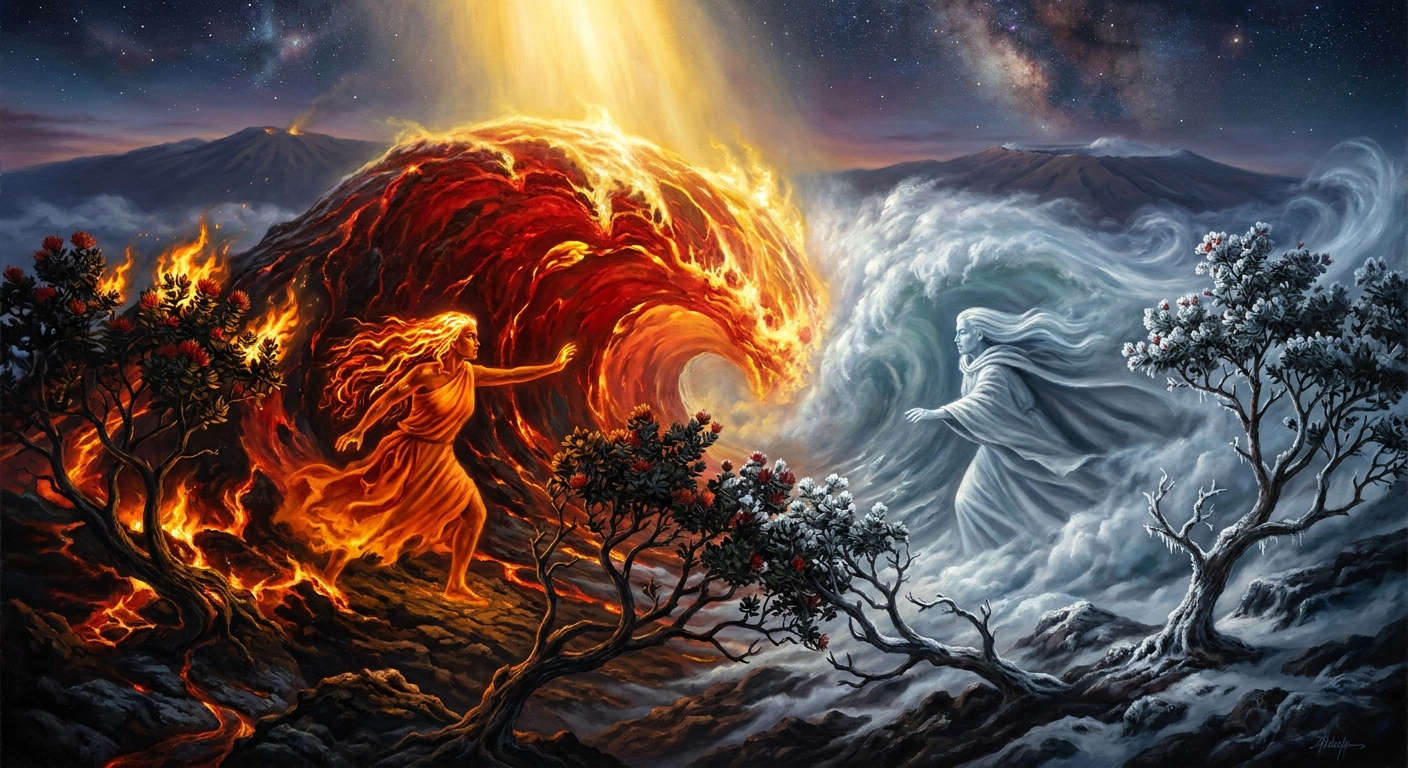
A flow comes out of the south flank of Mauna Kea — Pele has reached up into her rival’s mountain, into the rock beneath the snow, and lit it. Lava begins to climb the slope toward the summit, melting snow in plumes of steam fifty metres high. The ʻōhiʻa trees on the lower slopes catch fire in waves. The sky above the mountain turns the colour of a bruise.
Poliʻahu lifts her cloak.
The freezing wind comes down off the summit.
It is not cold the way cold is on the lower islands. It is high cold, the cold that lives above thirteen thousand feet on a mountain in the middle of the Pacific, where the air is thin and the stars are hard. It comes down the slope like a wall. Where it meets the lava the lava stops. The basalt freezes mid-pour. The trees that were burning rim with frost in the same instant they were charring. The plume of steam collapses into ice-crystals that fall as snow on rock that is still red underneath.
Pele pushes harder. Poliʻahu pushes back. The slope between them becomes a thermal seam — fire on one side, ice on the other, neither giving — and the seam holds.
It holds for a long time.
Pele withdraws.
She does not lose, exactly. Pele does not lose. But she goes back south, to her own crater, and Poliʻahu goes back to her summit, and the line where they met becomes one of the strangest pieces of geology on earth: a slope where lava flows from the south are stopped, repeatedly, by glacial conditions on the north — the only Pacific volcano with a glacier on its peak, the only crater rim that has been snowed on during eruption. The contact zone is what scientists now call the periglacial belt of Mauna Kea.
The Hawaiians do not need scientists to tell them what it is. It is where the goddesses argued. The argument cooled. The cooled argument is the ground.
You can stand on it. You can pick up a piece of frozen lava with frost-cracks in it. You are holding their treaty.
Pele is still active. Halemaʻumaʻu erupted in 2018, in 2020, in 2021, and again in 2024 — Native Hawaiian families brought ʻōhelo berries and ti-leaf bundles to the crater rim during each eruption, the same offerings their ancestors brought five centuries ago. The goddess is not a metaphor for the volcano. The volcano is the body she happens to be wearing.
Poliʻahu is still on Mauna Kea. The summit holds the largest cluster of astronomical observatories in the northern hemisphere, and the proposed Thirty Meter Telescope has met decades of Native Hawaiian opposition — because the summit is not unoccupied land. It is a goddess, asleep in white cloth, and you do not build a fourteen-story telescope on her chest without asking.
The rivalry is not over. It is not over because the geology is not over. The fire is still under the mountain. The snow is still on top of it. The seam between them is still the line where the islands are deciding what to be.
Scenes
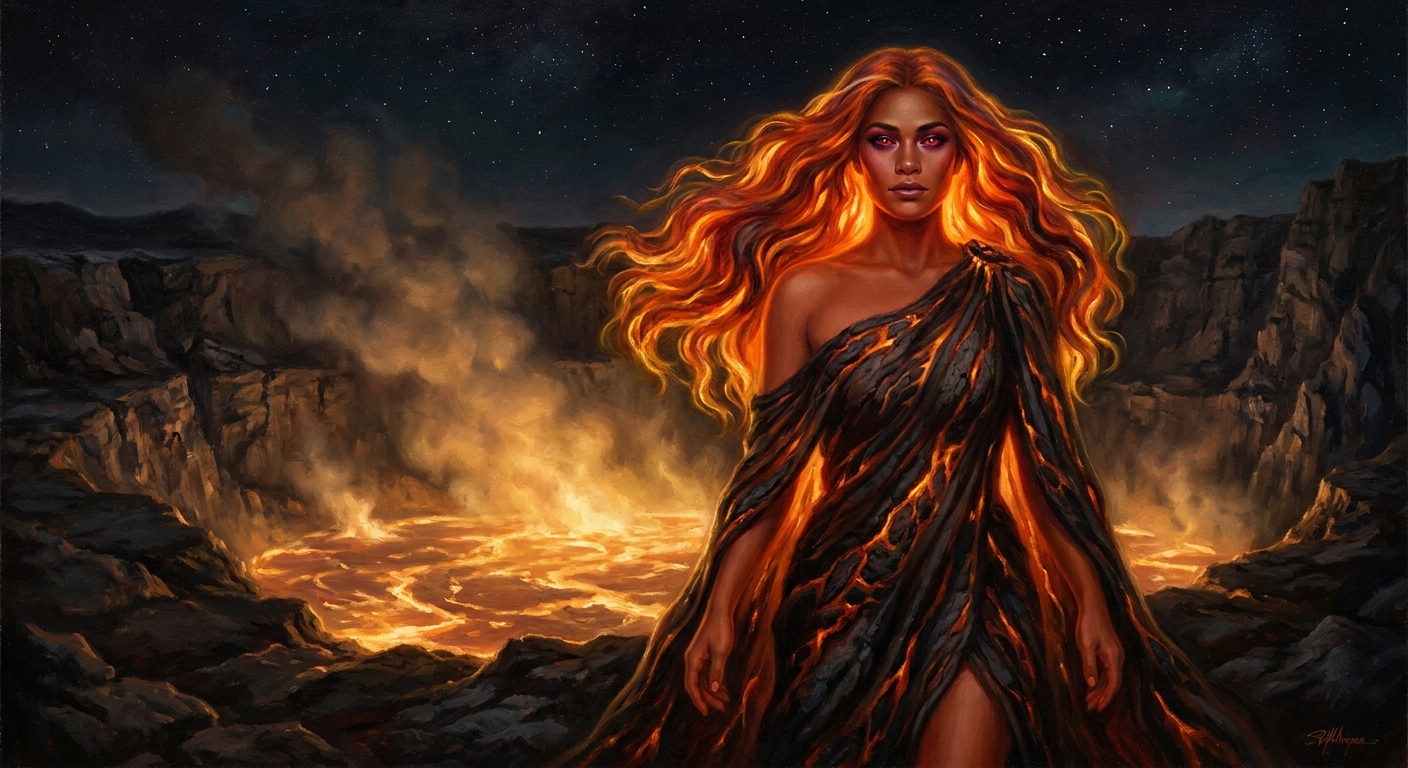
Pele in her crater at Halemaʻumaʻu — hair the colour of a forge, eyes the colour of an ʻōhelo berry, the lava behind her her own pulse
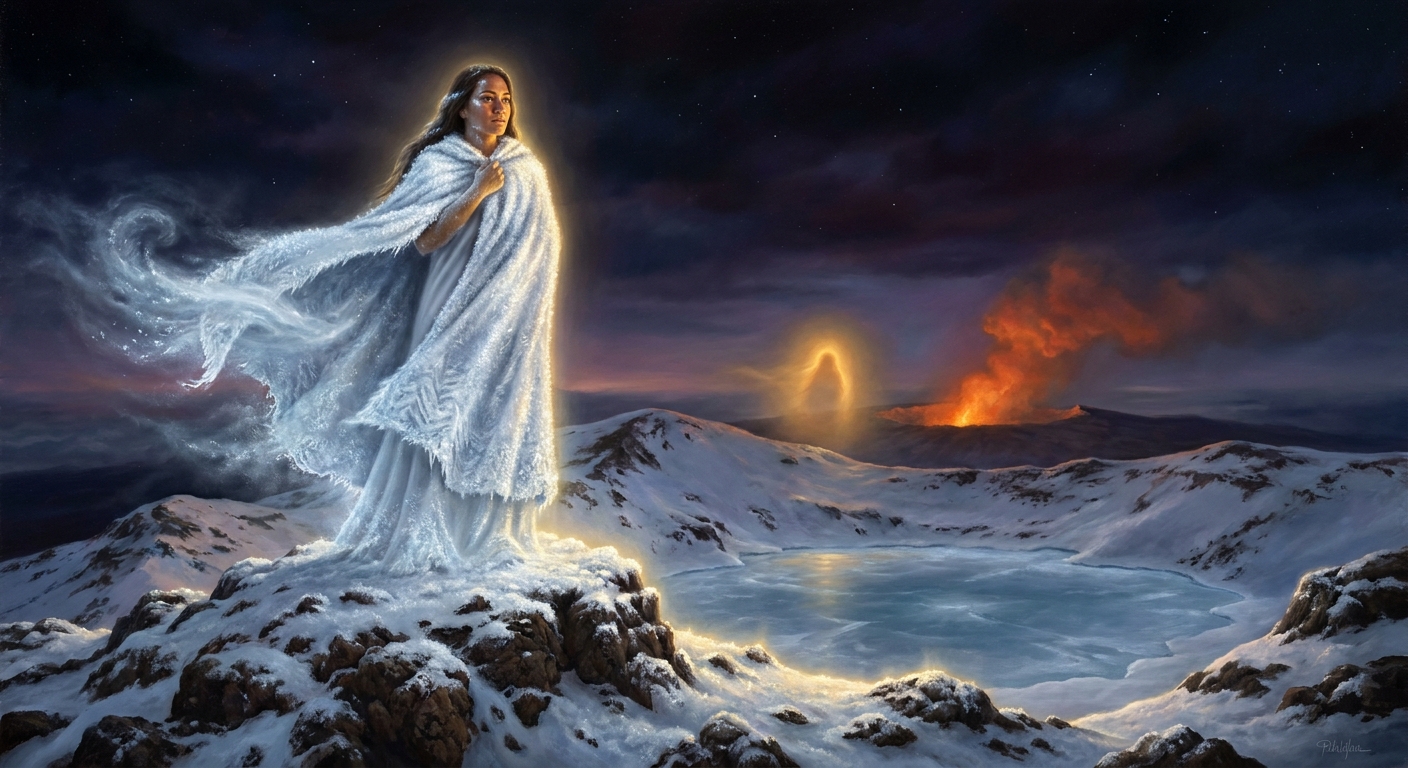
Generating art… Poliʻahu on the summit of Mauna Kea — white kapa cloak woven of snow, the killing wind in her sleeve, the alpine lake Waiau at her feet
 Generating art…
 The slope between the mountains — a wave of lava meeting a wall of freezing wind, ʻōhiʻa trees igniting and rimming with frost in the same instant
 Generating art…
 Echoes Across Traditions
Entities
- Pele
- Poliʻahu
- Lilinoe
- Waiau
- Kahawali

Sources
- Martha Beckwith, *Hawaiian Mythology* (1940), ch. 12 (Pele) and ch. 13 (Poliʻahu)
- Nathaniel B. Emerson, *Pele and Hiiaka: A Myth from Hawaii* (1915)
- William D. Westervelt, *Hawaiian Legends of Volcanoes* (1916)
- Mary Kawena Pukui & Samuel H. Elbert, *Hawaiian Dictionary* (1986) — entries on Pele, Poliʻahu, ahi, hau
- Patrick V. Kirch, *Legacy of the Landscape* (1996)