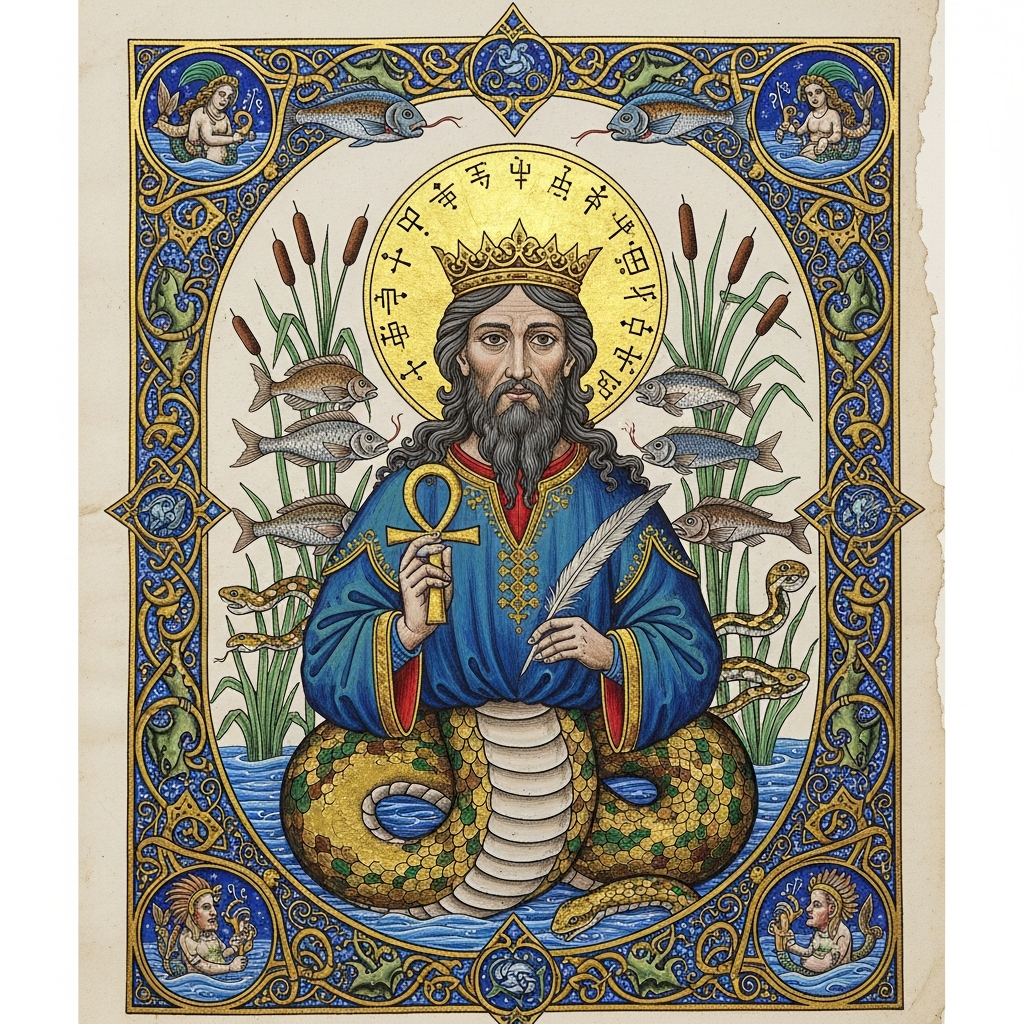
Nzambi Creates and Becomes Silent
Mythic time — Kongo oral tradition, Central Africa · The Kongo Kingdom, present-day Democratic Republic of Congo, Republic of Congo, and Angola
Contents
Nzambi, the supreme being of the Kongo people, creates everything alone from nothingness — without a partner, without a battle, without a sacrifice. Then Nzambi becomes silent. The entire Kongo religious tradition is largely about how to reach a God who has stopped speaking.
- When
- Mythic time — Kongo oral tradition, Central Africa
- Where
- The Kongo Kingdom, present-day Democratic Republic of Congo, Republic of Congo, and Angola
In the beginning, Nzambi speaks.
This is the whole of the Kongo creation: Nzambi speaks, and what is spoken comes to exist. There is no partner in this. There is no primordial chaos to be defeated, no world-egg to be cracked, no first matter to be shaped by divine hands. There is the silence before the speaking and then there is the world.
The Kongo do not narrate this in detail. They do not tell you what Nzambi looked like while creating, or the sequence of days, or the specific order in which things came to be. The creation account is brief, almost abrupt, because the Kongo theological tradition is not primarily interested in the creation. It is interested in what happened after.
After creation, Nzambi becomes silent.
Nzambi Mpungu — Nzambi of the heights, Nzambi the Supreme — is the name the Kongo use for the high aspect of the divine. Mpungu means elevated, high, the aspect that is above and beyond. Nzambi Mpungu created the universe. Nzambi Mpungu sustains the universe in some fundamental sense that is not the same as moment-to-moment involvement. And Nzambi Mpungu cannot be approached.
This is not a statement of divine hostility. It is a statement of divine nature. Nzambi Mpungu is not angry at the Kongo people. Nzambi Mpungu has not withdrawn as punishment for some primordial transgression. The silence is the silence of the absolute — the silence of something so completely itself that speech directed at it from below cannot, by the nature of the distance, reach it.
The Kongo live with this fact. They have lived with it for as long as the tradition can remember. They have built their entire religious system around the implications of a creator who is present in everything and reachable by nothing — who is, in the precise sense, everywhere and nowhere, the ground of all existence and the most inaccessible point in the cosmos.
What the Kongo do instead of approaching Nzambi directly is maintain the network.
The bakulu are the ancestors. Not the recent dead — those are still in transition, still becoming, still working through the process of dying that takes longer than the physical death. The bakulu are the established dead, the ones who have fully crossed, who are on the other side of the great water and have been there long enough to have perspective. They are the mediation layer between the living and the divine.
The bakulu accumulate goodness in death as they accumulated muntu — human dignity, force, presence — in life. A man who lived well, who kept the community together, who was honest in trade and just in dispute and generous in feast, dies and becomes a bakulu who retains and magnifies those qualities. He is now accessible to the living — through prayer, through dream, through the diviner who knows how to call him — and he can intercede. Not with Nzambi directly. But in the network of spiritual forces that ultimately derives from Nzambi, the bakulu’s accumulated goodness is a current that flows in the right direction.
The simbi are spirits of the water and the earth — nature spirits, the energy of specific places, the divine attention that has concentrated in a particular spring or a particular crossroads or a particular tree that has been old enough to hold memory. The simbi are not ancestors. They are something older, the divine force that was latent in the natural world from the moment Nzambi spoke it into existence. They can be approached through the correct rituals, through the correct offerings, through the correct posture of attention. They mediate in a different way than the bakulu — not through the authority of a life well lived but through the authority of place and time.
The Lemba — the sacred society of merchants and healers that maintained the great trade routes of the Kongo Kingdom in the eighteenth and nineteenth centuries — understood this network with the precision of people whose lives depended on it. The Lemba adept was a specialist in the network: in knowing which bakulu to call for which problem, which simbi governed which crossroads, what the correct ritual approach was for each node in the invisible web of spiritual relationships that ran underneath the visible world of trade and politics. To be a Lemba master was to know the topography of the network well enough to navigate it, to carry what the living needed to the places in the network where it could be processed into what the living needed.
None of this reaches Nzambi.
The Kongo do not pretend that it does. They are too careful a theological tradition for that. Nzambi Mpungu is the source. The source is silent. The network runs on what the source generated at the moment of creation, and the practitioners of the Kongo religious tradition are not technicians trying to reach the source — they are navigators trying to use the current the source generated, to move things and people and prayers through a system that Nzambi made and then entrusted to the ancestors and the spirits to maintain.
The silence is not empty.
This is the most important thing to understand about Nzambi’s silence, and it is the thing that outsiders — the Portuguese missionaries who arrived in the Kongo Kingdom in 1491, the Belgian colonial officials who arrived four centuries later — consistently misread. They saw a people without elaborate creation myths, without a tradition of approaching the supreme deity directly, without temples to Nzambi or festivals for Nzambi or priesthoods dedicated specifically to Nzambi, and they concluded that the Kongo did not have a high god in the serious theological sense.
What they were looking at was not the absence of theology. It was the presence of a very sophisticated theology that had concluded that the correct relationship to a transcendent creator is not direct petition but careful maintenance of the created order. The Kongo religious system is enormous and complex. The network of ancestor-relationships and spirit-relationships and healing societies and divination systems is rich and technically demanding. But none of it is pointed at Nzambi, because pointing at Nzambi is not what the tradition understands as possible or useful.
Nzambi speaks once. Everything comes from that speech. What remains — the world, the living, the dead, the spirits, the rivers, the crossroads, the medicine bundles, the nkisi containers that focus spiritual force — all of this is the speech in progress, the ongoing reverberation of the one utterance, the universe as the word Nzambi spoke and then let go.
The Kongo religious practitioner is not trying to make Nzambi speak again. They are trying to understand what the one utterance meant.
When the Kongo people were taken across the Atlantic in the slave ships — millions of them, over three centuries, from the coastal ports of the Loango Kingdom and the Kingdom of Kongo itself — they brought the network with them.
They brought the concept of nkisi — the sacred container, the material object that focuses spiritual force, that makes the invisible accessible through the visible. They brought the understanding of the crossroads as a place of spiritual concentration. They brought the role of the diviner-healer, the nganga, who knows how to navigate the network. They brought the concept of the bakulu — the ancestor dead who retain influence in the world of the living.
In Cuba these elements merged with the Spanish Catholic saint system and became Palo Monte — the religion of the sticks, of the forest spirits, of the nkisi-container called nganga in Spanish spelling. In Brazil they merged with Candomble and Umbanda. In Haiti they contributed to Vodou — the lwa who ride their devotees, the cosmogram drawn in chalk at the ceremony’s center, the fundamental understanding that the divine is present in the world but must be actively called, actively maintained, actively honored.
None of these diaspora traditions can speak to Nzambi directly either.
But they keep the network intact. They keep the ancestor relationships. They keep the crossroads. They keep the containers. In doing this, they honor the theological insight that Nzambi’s silence produced: that a supreme deity too vast to be approached is not thereby absent, and that the right response to divine silence is not despair but the careful cultivation of every relationship in the created order that brings us closer to what we cannot directly reach.
Nzambi created everything and became silent. This is the founding theological fact of the Kongo tradition. Most religions are organized around speaking to God. The Kongo tradition is organized around the implications of a God who will not speak back — around the question of what you do when the creator has finished creating and the creation is yours to maintain. The answer the Kongo gave is: you learn the network. You honor the dead. You tend the crossroads. You carry what you need through the system the creator made and then gave to you. The silence of Nzambi is not an abandonment. It is a delegation. The world is the creator’s speech and the speech is yours to interpret.
Scenes
Nzambi creates from nothingness — no partner, no adversary, no primordial matter to work with
 Generating art…
 The world complete and beautiful and Nzambi already silent — the deity turning inward, becoming inaccessible, the creation finished and the creator gone into a silence that nothing on earth can break
 Generating art…
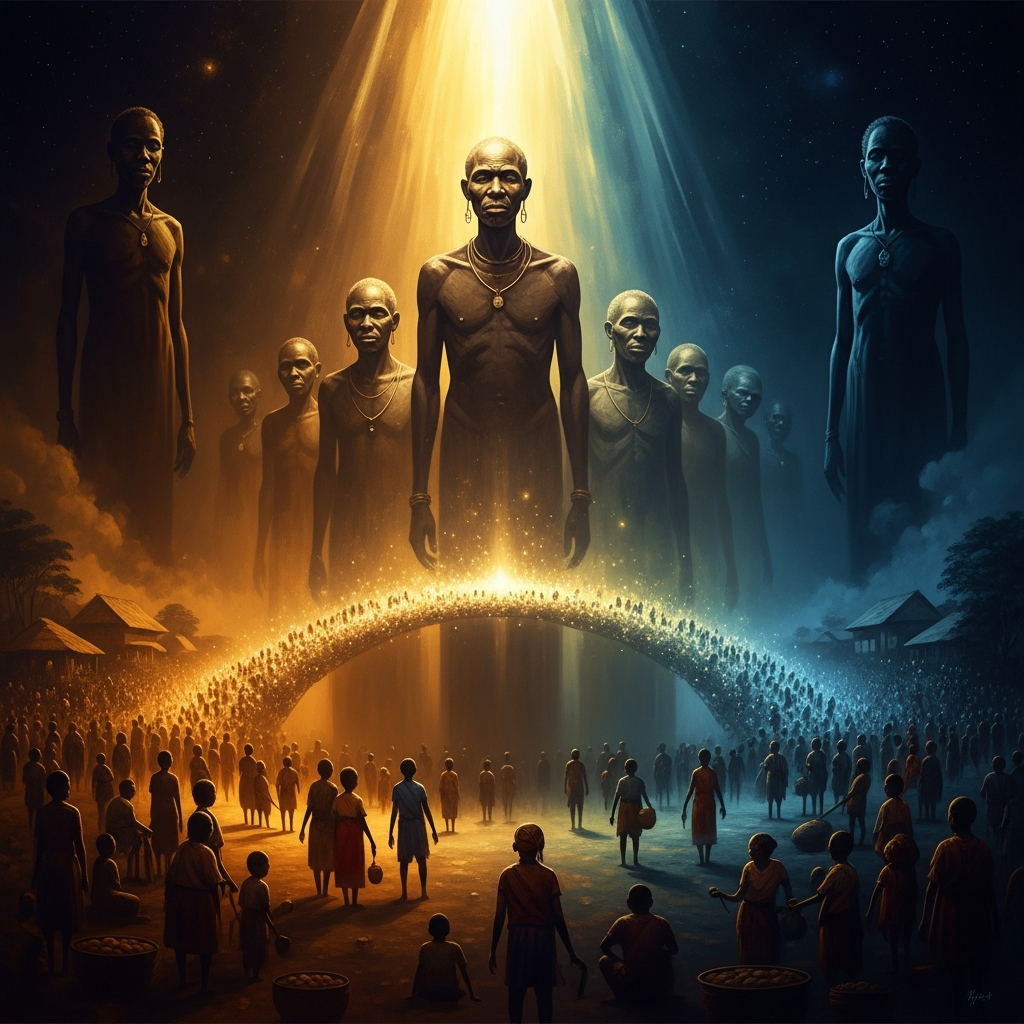
 The bakulu — ancestors who died facing the rising sun — stand in the space between the living and the silent god, their accumulated goodness a bridge across the gap that Nzambi's silence created
 Generating art…
 Echoes Across Traditions
Entities
- Nzambi
- Nzambi Mpungu
- Bakulu
- Simbi
- Lemba

Sources
- Wyatt MacGaffey, *Religion and Society in Central Africa: The BaKongo of Lower Zaire* (University of Chicago Press, 1986)
- Wyatt MacGaffey, *Kongo Political Culture: The Conceptual Challenge of the Particular* (Indiana University Press, 2000)
- John M. Janzen and Wyatt MacGaffey, *An Anthology of Kongo Religion* (University of Kansas, 1974)
- Robert Farris Thompson, *Flash of the Spirit: African and Afro-American Art and Philosophy* (Random House, 1983)
- Maureen Warner-Lewis, *Central Africa in the Caribbean: Transcending Time, Transforming Cultures* (University of the West Indies Press, 2003)