The Spirits Disassemble the Shaman
Pre-empire Mongolia, oral tradition — the shamanic illness pattern documented across Siberian and Central Asian peoples · A ger on the Mongolian steppe; and simultaneously the spirit world that occupies the same space at a different depth
Contents
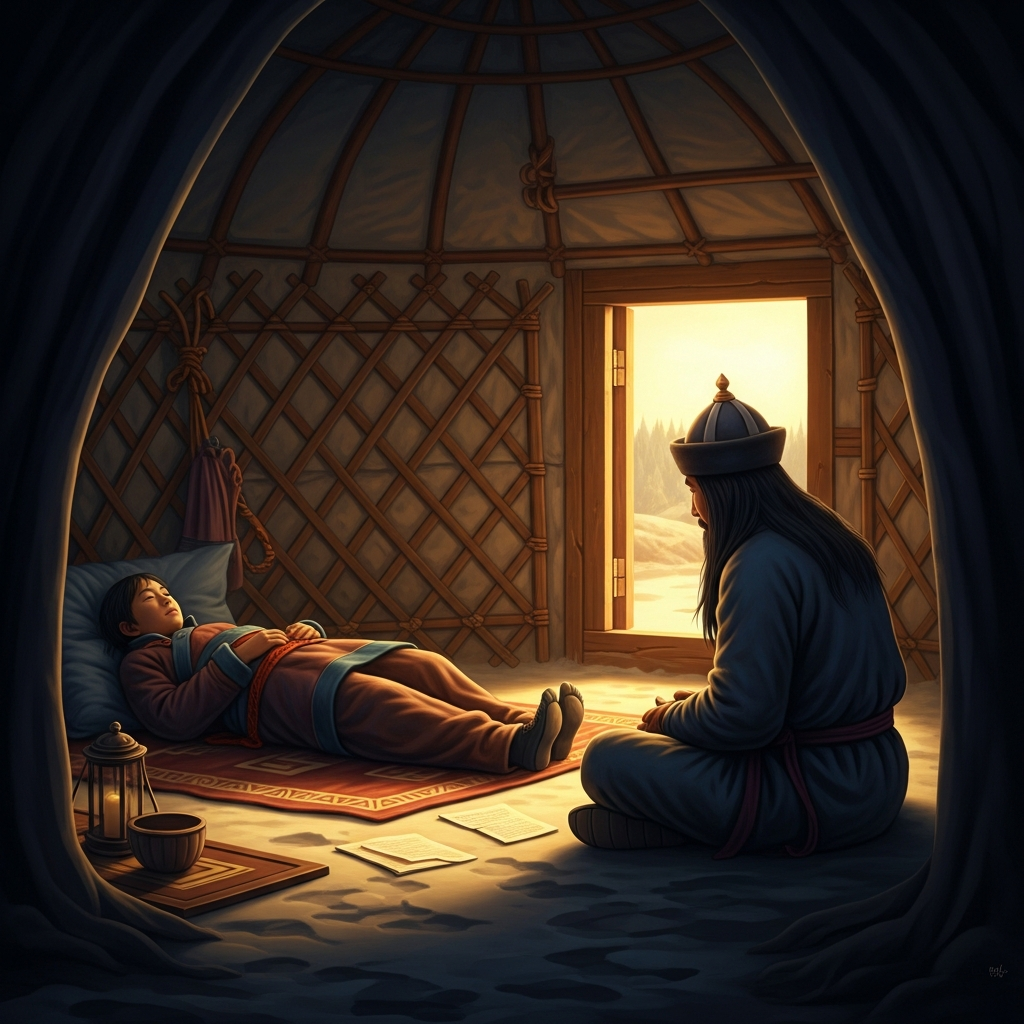
A young Mongolian böö burns with shamanic illness for weeks. His teacher watches from outside the ger. Tonight the dismemberment reaches its final stage — and whether the young man wakes whole depends on which bones the spirits decide to put back.
- When
- Pre-empire Mongolia, oral tradition — the shamanic illness pattern documented across Siberian and Central Asian peoples
- Where
- A ger on the Mongolian steppe; and simultaneously the spirit world that occupies the same space at a different depth
The illness begins with dreams.
Not terrible dreams at first — just wrong ones, dreams in which the landscape of the steppe is subtly altered, the mountains in the wrong place, the river running uphill, the stars arranged in configurations that have no name. The young man, whose name in this account we hold back because the tradition holds it back — the shaman before initiation does not yet have the name he will carry after — wakes from these dreams sweating but otherwise intact. He does not tell anyone.
Then the fever comes.
It comes on a night when the temperature outside drops below what it has any right to drop in that season, a cold that has personality, a cold that feels directed. His teacher — an old böö who has made the journey himself and carries the marks of it in the way his eyes move, always slightly tracking something that other people cannot see — is at his ger when the fever announces itself. He puts his hand on the young man’s forehead and holds it there for a moment. Then he steps outside.
He does not come back in. He sets up his own small fire outside the ger entrance and sits down to wait.
Inside the ger the world reorganizes.
The fever does not feel like illness from inside. From inside it feels like a door being opened — a door that has always been in the room but that the young man could never see because you need a certain temperature to make it visible. Now the room has that temperature and the door is there and it is already open and on the other side of it is a landscape he has no name for, though it is not entirely strange because he has been approaching it for months through the wrong dreams.
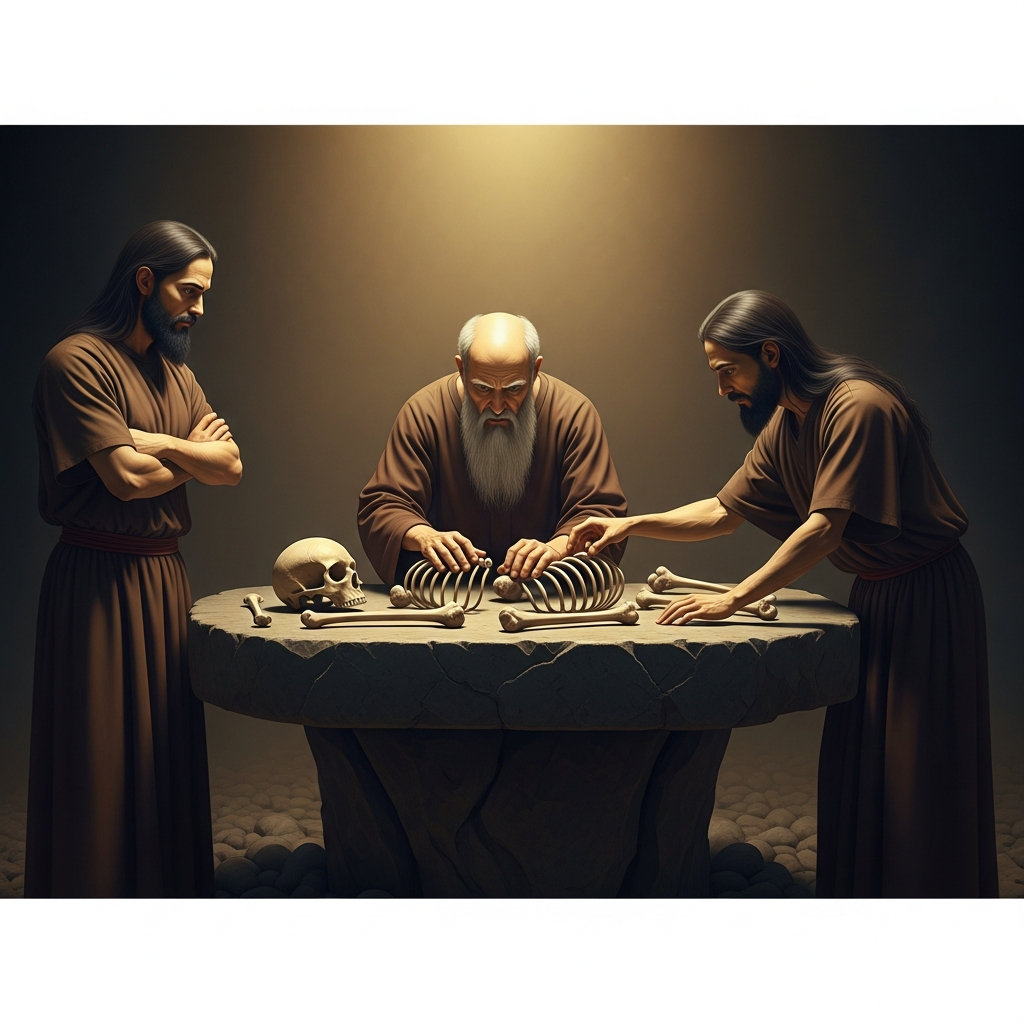
The landscape is an immense flat plain under a sky that is not blue but deep iron gray, and in the center of the plain is a table made of stone that was not cut by human hands. Around the table are shapes that are not quite animals and not quite people, though they have features of both — the bear’s weight, the eagle’s attention, the wolf’s specific quality of patience.
The young man tries to speak and finds that he cannot, because the part of him that speaks is not currently attached to the part of him that moves.
This is how it begins.
The spirits work methodically.
There is no drama in their manner — they are not cruel and they are not kind, they are simply engaged in a task that requires precision, and they approach it with the impersonal concentration of craftsmen. The first thing they remove is not a bone but a sense: the sense that the ordinary world is more real than the spirit world. This goes quickly, cleanly, like a hook coming out of cloth.
Then the bones.
They take them out one by one and lay them on the stone table, and as each bone comes free the young man feels not pain but a successive clarification — the way a sentence becomes clearer as unnecessary words are removed. First the small bones of the hands. Then the long bones of the arms. The ribs, taken out in pairs, placed parallel on the stone. The vertebrae, counted aloud in a language that is not Mongolian but that he understands completely, the way you understand a sound that your body has always known how to interpret.
They count his bones and they argue about them.
The argument is in the same not-Mongolian language and it concerns which of his bones are adequate for what he will be asked to do, which are too dense to conduct what needs to move through them, which have been weakened by the life he lived before the illness. The spirits hold bones up to the iron sky and examine them. They set some aside.
The ancestor shaman stands apart from the others.
He has been dead for three generations — the young man’s teacher’s teacher’s teacher, a name he learned as a child, a presence he sometimes felt in the periphery of the wrong dreams. Now the ancestor shaman is here in full, and he is watching the dismemberment with his arms folded and his expression unreadable.
The young man understands that this is the man who will be his primary ongon — his spirit helper, the ancestor consciousness that will travel with him and advise him and sometimes speak through him when the ceremony requires it. But first the ancestor shaman wants to see what the spirits are building. He watches the table. He watches the argument over the bones. He waits.
When the spirits have set aside the bones they do not intend to return, the ancestor shaman steps forward and opens his own coat, and hanging inside it on iron hooks — the iron discs that shamans sew into their dalia, the costume that represents the shamanic body, each disc a rib or a bone — are the extra bones. The ones that come from the spirit world rather than the human world. The ones that let a person stand at the junction between realms without being destroyed by the pressure differential.
He takes them down one by one and places them on the table among the young man’s sorted bones.
The spirits begin the reassembly.
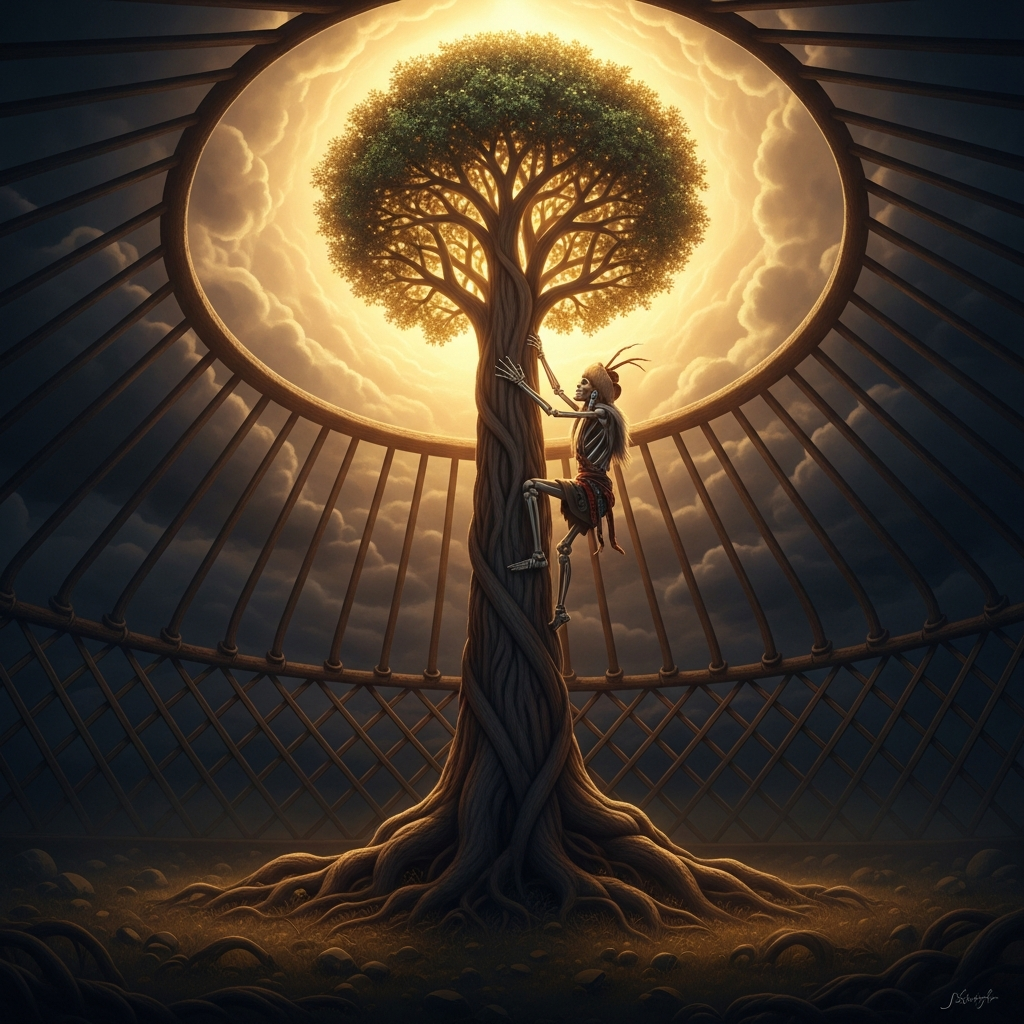
The ger’s smoke-hole is also the smoke-hole of the cosmic ger.
This is the teaching that the young man’s teacher gave him in the early months of the relationship, back when the wrong dreams were just beginning and the nature of the situation was becoming clear. The World Tree — the great axis that connects the nine upper heavens to the middle world to Erlik’s realm in the roots — is not somewhere else. It stands precisely where the ger’s smoke-hole opens to the sky. When the shaman travels between worlds, he travels up or down the trunk of that tree, and the entry point is always the smoke-hole, always the place where the domestic fire opens to the infinite.
The young man’s teacher explained this carefully. He explained the nine heavens, each with its own deity and its own quality of light. He explained Erlik’s realm below — not hell in the Christian sense, not a place of punishment, but the administrative center of the dead, the place where souls wait and where stolen soul-fragments are held by minor demons who regard them as property. He explained the tör, the drum, whose two faces are the two worlds and whose beat is the rhythm of the journey.
He explained all of this and then he said: You will have to feel your way through it. No one can do that part for you.
Now, in the fever, the young man’s reassembled body finds the base of the World Tree in the center of the ger, precisely where the fire burns, and begins to climb.
The new bones make it possible.
Without them he would go up three branches and fall — the human body is not built for the upper air, the pressure of the upper heavens against unmodified bone is too much, the soul dissolves. But the spirit-world bones distributed through his reassembled skeleton act as armor and as antenna both: they hold him together and they receive the signal of each heaven as he passes through it.
He climbs until he reaches the level where his ongon is waiting.
The ancestor shaman is there ahead of him, standing on a branch as thick as the trunk of any ordinary tree, and he turns when the young man arrives and looks at him with those unreadable eyes for a long moment. Then he nods, once, slowly, the way you acknowledge a debt being paid or a contract being accepted.
“I will be with you when you drum,” the ancestor shaman says, in Mongolian now, the language of his original life. “Not always visibly. But when you need me you will feel the extra bones.”
The young man understands. He begins the descent.
He wakes in the ger before dawn.
He is drenched in sweat and the fever has broken and his body aches in a way that is not quite pain but is the memory of pain, the echo of what was done to him in the other world registered in his flesh. He lies still for a long time, cataloguing the sensation. Something is different. He can feel it the way you feel a missing tooth with your tongue — not a subtraction but a presence, an addition, something that was not there before and that changes the architecture of the whole.
He turns his head toward the smoke-hole. He can see the sky through it. It is just beginning to go gray at the edges, the stars fading at the east.
He finds his voice. He says his teacher’s name.
The old böö comes through the door immediately — he was already at the entrance, had been there all night, had been listening to the changes in the quality of the silence inside the ger. He crouches next to the young man and looks at his face for a long time, reading it the way you read tracks in snow.
“How many heavens?” the teacher asks.
The young man tells him.
The teacher sits back on his heels. Something moves through his expression that is not quite pride and not quite relief but contains elements of both. He picks up the tör from the place where it leans against the ger wall and holds it out.
“Then let’s begin,” he says.
The Mongolian shamanic tradition holds that the böö does not choose the vocation — the vocation chooses the böö, announces itself through the illness, and the candidate can accept the call or refuse it. Refusal is possible. The spirits will accept it. But the tradition is clear on what refusal costs: without the initiation, the shamanic illness continues. The spirits are not vindictive. They simply need somewhere to go. The extra bones are waiting to be placed. If the candidate will not receive them, the spirits will go on looking for the junction in his architecture, trying to find the entry point, and the fever will return, and the wrong dreams will not stop. The illness is not the consequence of refusal. The illness is the invitation. You cannot turn it down and simply return to the life you had before. You can only turn it down and remain inside it indefinitely, or say yes, and find out what you have been remade for.
Scenes
The young böö lies in his ger in a fever that has lasted eighteen days
 Generating art…
 In the fever-world, the spirits lay out his bones one by one on a stone table that was never built by human hands
 Generating art…
 The World Tree rises through the smoke-hole of the cosmic ger, its roots in Erlik's realm and its crown in the highest heaven
 Generating art…
 Echoes Across Traditions
Entities
- the böö
- the ongon
- Erlik
- the ancestor shaman
Sources
- Mircea Eliade, *Shamanism: Archaic Techniques of Ecstasy* (1951, trans. Willard Trask, Princeton University Press, 1964)
- Caroline Humphrey, *Shamans and Elders: Experience, Knowledge, and Power among the Daur Mongols* (Oxford University Press, 1996)
- Ronald Hutton, *Shamans: Siberian Spirituality and the Western Imagination* (Hambledon and London, 2001)
- Roberte Hamayon, *La chasse à l'âme: Esquisse d'une théorie du chamanisme sibérien* (Société d'ethnologie, 1990)