Etugen Holds the Ground
Mythic time continuous with the present — the offering ritual documented across Mongolian and Turkic peoples from antiquity to the present · A summer encampment on the Mongolian steppe, elevated plateau, where the grass has turned from green to bronze in a drought that has lasted six weeks
Contents
The drought has gone on too long. A Mongolian herder family at their summer encampment begins the slow negotiation with the earth itself — not as theater but as a real conversation with the substrate of the world, conducted through offering and attention and the patience required to listen to something that speaks very slowly.
- When
- Mythic time continuous with the present — the offering ritual documented across Mongolian and Turkic peoples from antiquity to the present
- Where
- A summer encampment on the Mongolian steppe, elevated plateau, where the grass has turned from green to bronze in a drought that has lasted six weeks
The grass is wrong.
It has been wrong for six weeks now — not dead, because it takes longer than six weeks for steppe grass to die, but diminished, the green pressed out of it by the heat and the absence of rain until what remains is the brown of something that is enduring rather than thriving. The horses graze longer for less. The family’s sheep have been moved twice to find grass that has any moisture left in it. The father watches the sky every morning and every evening with the expression of a man doing arithmetic whose answer keeps coming out the same.
The grandmother does not watch the sky.
She watches the ground.
Every morning the grandmother wakes before anyone else.
She wakes when the light is still the color of bone, before the sun has cleared the ridge to the east that blocks the first light of the day. She makes the fire. She heats the remaining milk from last night and sets it on to boil for the morning’s sumal. She waits.
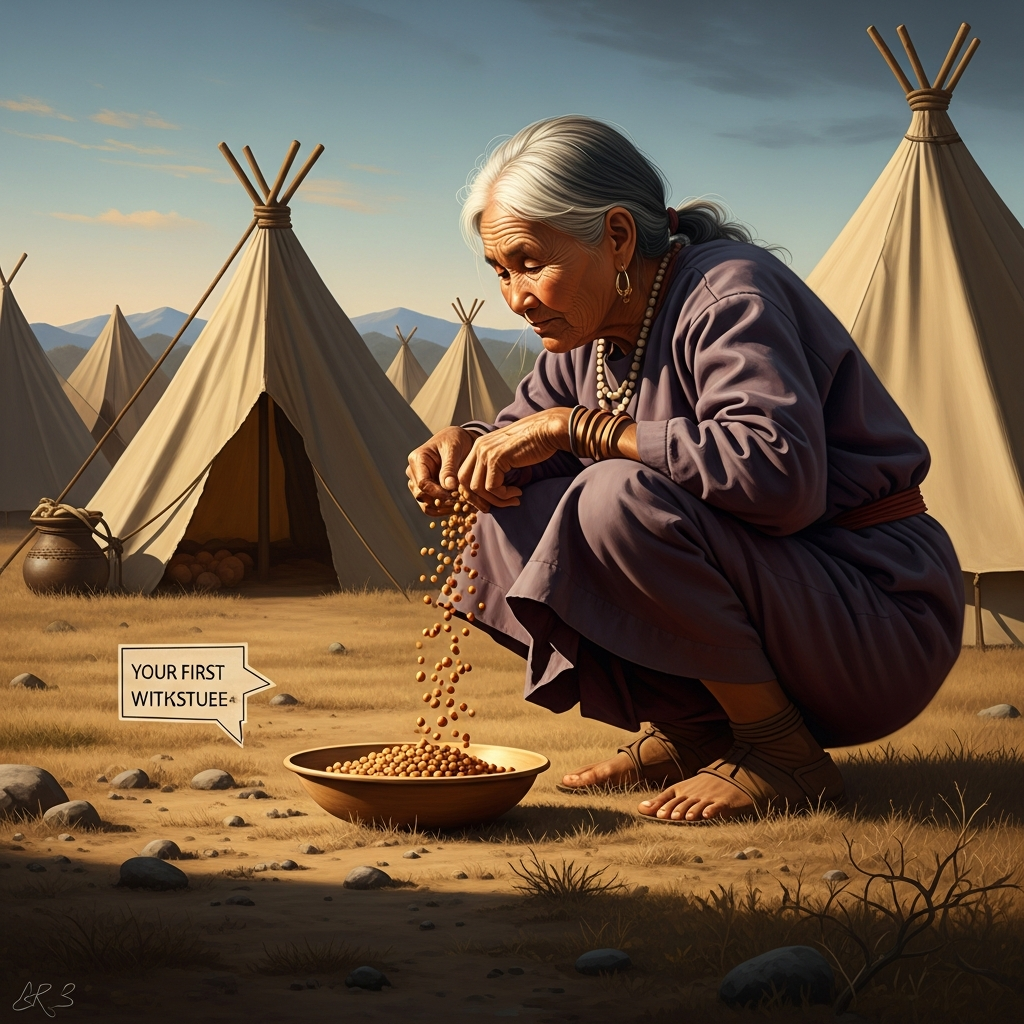
When the first portion is ready — before anyone has eaten, before she has eaten — she takes a small bowl and tips the first ladle into it. She carries it outside.
She crouches at the edge of the encampment in the direction that faces the mountain, the permanent mountain that has been there since before anyone’s memory includes a time without it, and she tips the bowl onto the ground. The liquid darkens the dry earth for a moment before it is absorbed. She watches the circle of moisture shrink as the earth takes it.
She speaks.
Not loudly. Not in the manner of a prayer delivered to a recipient who might be far away and needs the volume. Quietly, the way you speak to something that is directly beneath you and can feel the vibration of your voice through the ground as easily as hear the words through the air. She says the things that need saying: that the family is here, that they have been here through many seasons, that the relationship between this family and this particular piece of earth goes back to her grandmother’s grandmother’s time and has been maintained at every meal and every departure and every return. She says what the drought is costing them. She says this not as complaint but as information, because Etugen is vast and slow and does not track individual families’ specific situations without being reminded.
She tips the bowl and watches the earth receive it.
She goes back inside and wakes the children for breakfast.
The offering at the last meal is different.
At the end of the day, when the family has eaten and the bowls are being cleaned, the grandmother takes what remains in the pot — a small portion, left specifically for this purpose, never eaten — and carries it outside again. This time she goes to the south side of the ger, and she tips the remainder onto the ground there, and she says the closing words: gratitude for the day that was given, the acknowledgment that what the family consumed today came from the earth and will return to the earth, the recognition that the transaction is ongoing and that the obligation on the family’s side is continuous.
This is not a drought ritual. This is the daily structure of Tengrist domestic life.
The drought makes it more explicit, more urgent, but it does not change the form. The form exists because the relationship always requires maintenance, not only when it is visibly strained. The grandmother has done this twice a day since she was old enough to be the one trusted with the first and last portions. Her mother did it. Her grandmother did it. The portion tipped to the earth is not waste — it is rent paid on the ground beneath the ger, on the grass the sheep eat, on the root system that holds the soil together under the weight of the seasons.
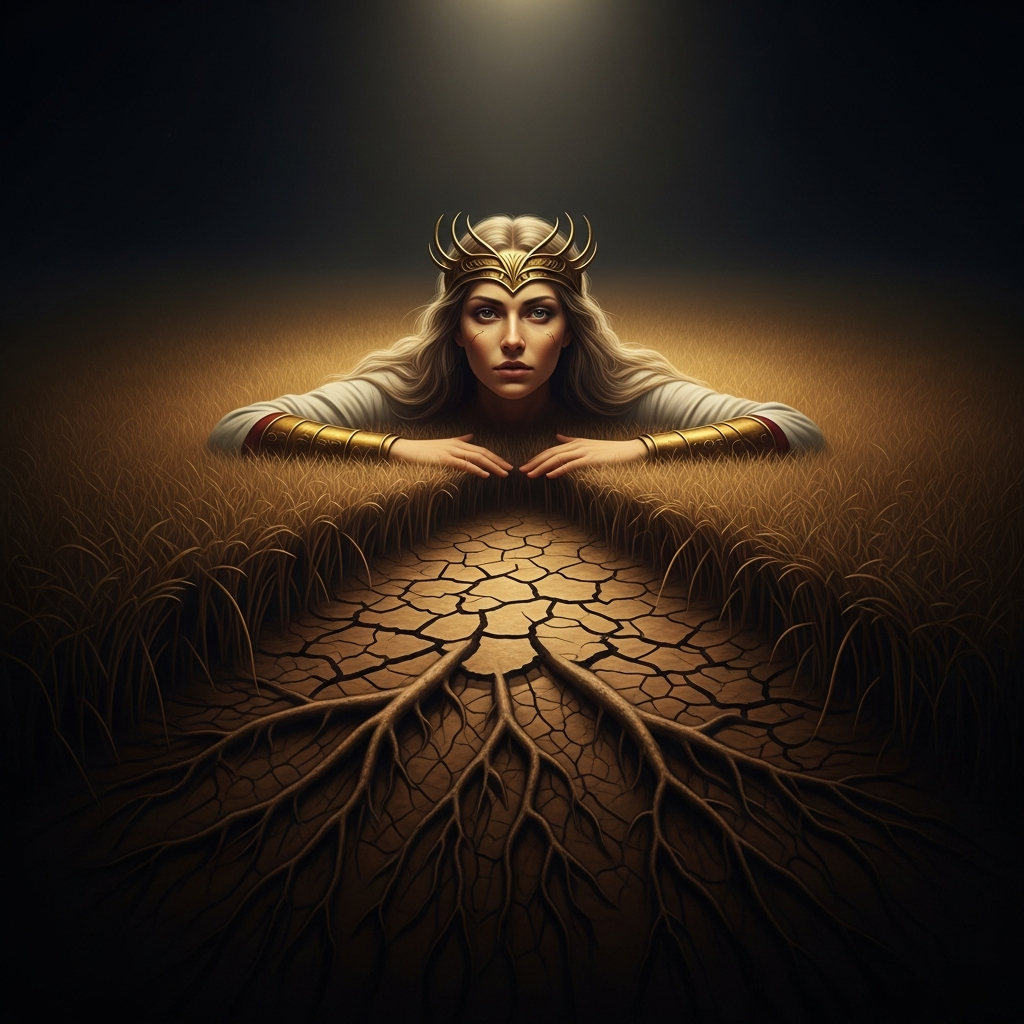
Etugen is not a person with a face and a mood. She is the ground itself.
But the ground is also a person.
On the third week of drought the family holds a longer ceremony.
The grandmother leads it, because in this family she is the one who knows the specific obligations that have accumulated — which members of the family took without acknowledging, which seasons they moved without proper ritual send-off, which springs they used without tipping a portion back. She has been keeping this accounting for forty years. She knows the balance.
They build a fire in the open ground east of the ger. They bring the airag, the fermented mare’s milk that is Tengri’s preferred libation, and the butter that is Etugen’s preferred offering — fat being the medium of her richness, the compressed energy of grass and sun and water converted through the body of the animal into something the earth can recognize as equivalent to what she gave.
The grandmother unwraps the butter from its cloth and places it directly on the ground in front of the fire. She places beside it the small bundle of the family ongon — the ancestor spirit that mediates between the living family and the larger spirit world — and speaks to the ongon first, asking it to carry the message downward, to Etugen’s attention, more clearly than an individual voice speaking to the ground can carry.
Then she speaks to the ground.
She speaks for a long time. The family sits around her and listens because listening is part of the ceremony — the human witnesses hold the intention steady, the collective attention acting as the pressure that drives the message through the surface and into the root system below.
She names the drought accurately. She names what it is costing: the specific animals, the specific pastures, the children who are old enough to understand scarcity and are watching the grass the way adults watch the sky. She does not blame. She does not demand. She lays out the situation with the same care she would take explaining it to an elder who is powerful but who does not have all the information.
She says: “We are still here. We have been here faithfully. We are asking you to remember us in the distribution.”
The theology of the request is precise.
Etugen does not control the rain — that is Tengri’s domain, the sky-function, the weather that descends from above. But Etugen controls the ground’s readiness to receive the rain when it comes: the moisture held in the root system, the soil’s capacity to absorb and retain, the specific quality of the earth’s patience in a drought. A ground that has been properly honored holds moisture longer. A ground that has been honored by this family for generations has a relationship with the family’s patterns of use, knows the weight of their gers and the pressure of their animals’ hooves, has received the first and last portions of every meal for forty years from this grandmother’s hands.
The grandmother is not asking Etugen to make it rain.
She is asking Etugen to be ready when it does. To hold whatever comes generously. To remember that this family has been faithful and deserves the full measure of what the ground can give when the drought breaks.
This is the distinction that takes years to learn: Tengri and Etugen have separate jurisdictions, and a prayer aimed at the wrong jurisdiction does not reach its recipient. You do not pray to Etugen for sky-events. You pray to Etugen for the earth’s response to sky-events, which is a different and equally important thing.
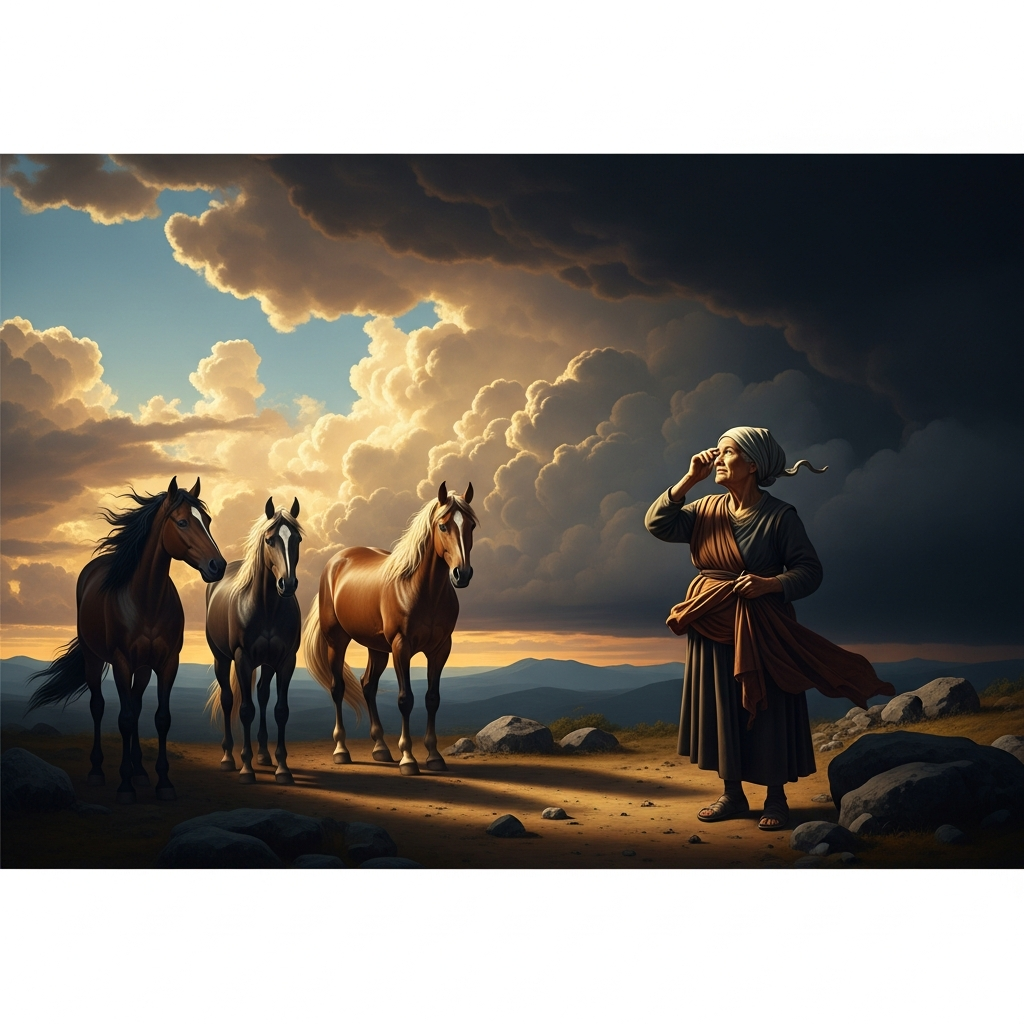
On the seventh day after the longer ceremony, the clouds come from the northwest.
The grandmother is outside when they appear on the horizon — low, gray, the specific color of clouds that intend to deliver rather than just threaten. She watches them for a long time without moving. The horses at the edge of the encampment feel them before they are visible to humans, turning as one to face the northwest with their ears forward and their nostrils working, the ancient calculation of rain in the air.
She does not run inside to tell the family. She does not pray again.
She watches the clouds come.
When the first drops hit the dry ground around her feet, she crouches and touches the earth with both hands, palms flat, the way you touch something you want to feel clearly. The ground is warm from six weeks of drought. The rain hits it and the smell rises immediately — the specific clean smell of dry earth receiving water, the petrichor that is the earth’s way of exhaling.
She keeps her hands on the ground until the rain has been falling for a few minutes and the circle of moisture under each palm has grown large enough to meet in the middle. Then she stands.
She tips the last of the butter into the wet earth. She says the closing words.
“Thank you,” she says. “We will keep our side of it.”
Etugen does not answer in words. She has never answered in words. She answers in the specific quality of the ground under your feet — in whether it holds moisture or drains it away, in whether the grass comes back dense or sparse after a drought, in whether the roots hold the soil when the rains are heavy or whether the earth gives way. These are her sentences. They are slow sentences, written over seasons rather than moments, and they require a different kind of attention to read than the sky’s sentences of weather and light. The sky speaks in events. The earth speaks in patterns. Both must be listened to, in their own time, in their own register. The family that manages this listening — that honors Tengri with the airag raised to the sky and honors Etugen with the butter pressed to the ground — is the family that survives the steppe’s long argument between heaven and earth.
Scenes
The grandmother crouches at the edge of the encampment in the early morning and tips the first portion of the day's meal onto the dry ground
 Generating art…
 Etugen is not a figure with a face
 Generating art…
 On the seventh day of the family's intensified offerings, the clouds come from the northwest
 Generating art…
 Echoes Across Traditions
Entities
- Etugen
- Tengri
- the family ongon
Sources
- Jean-Paul Roux, *La religion des Turcs et des Mongols* (Payot, 1984)
- Caroline Humphrey and Urgunge Onon, *Shamans and Elders: Experience, Knowledge, and Power among the Daur Mongols* (Oxford University Press, 1996)
- Walther Heissig, *The Religions of Mongolia* (University of California Press, 1980)
- Manduhai Buyandelger, *Tragic Spirits: Shamanism, Memory, and Gender in Contemporary Mongolia* (University of Chicago Press, 2013)