Ogotemmeli Speaks the Star
Mythic time and recorded October 1946 — Dogon oral tradition, Bandiagara Escarpment, Mali · The Bandiagara Escarpment, Mali — five hundred metres of sandstone cliff above the Sahel
Contents
In October 1946, a blind elder named Ogotemmeli speaks to the French anthropologist Marcel Griaule for thirty-three days about Dogon cosmology. What he describes — a small, heavy star circling Sirius every fifty years — matches Sirius B, confirmed by Western astronomy only in 1862. The debate about how he knew has never been settled.
- When
- Mythic time and recorded October 1946 — Dogon oral tradition, Bandiagara Escarpment, Mali
- Where
- The Bandiagara Escarpment, Mali — five hundred metres of sandstone cliff above the Sahel
The blind man is speaking about a star.
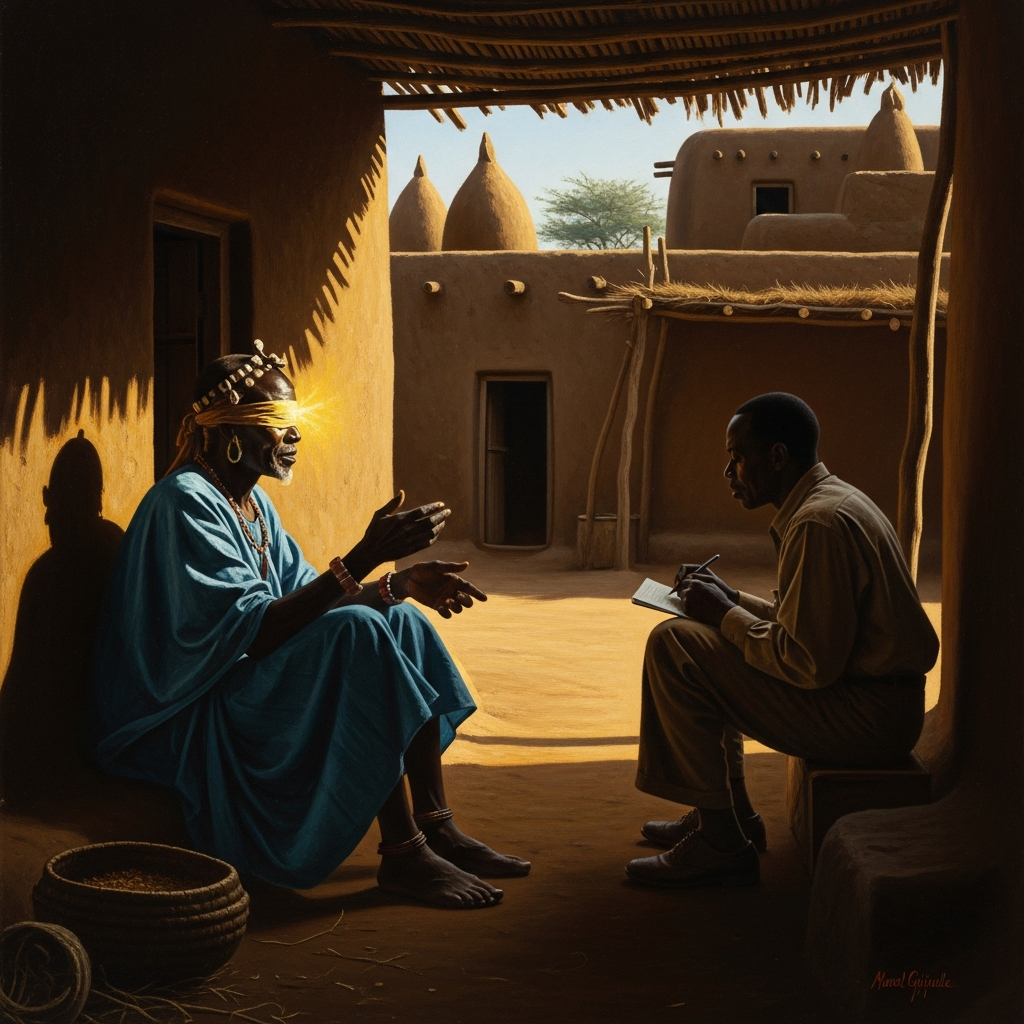
His name is Ogotemmeli. He is a priest of the Lebe cult in a village on the Bandiagara Escarpment, a sandstone cliff in Mali that rises five hundred metres above the Sahel and holds, in its crevices and terraces and the small carved windows of houses built into the rock face, one of the densest concentrations of living oral tradition in the world. He has been blind for years — he lost his sight in a hunting accident, a gun that misfired, the particular irony of a man who was a hunter and became an elder and found that blindness gave him access to a different kind of seeing.
He is sitting in the shade of the awning of his courtyard, in October 1946, speaking to Marcel Griaule.
Griaule is French. He has been coming to the Dogon for fifteen years as an anthropologist, part of the great French ethnographic enterprise of the colonial period, and the Dogon elders have been watching him for most of that time and deciding, by their own internal processes, what to do with him. Now they have decided. They have told Ogotemmeli: speak. Griaule has earned the right to hear the full cosmology. Tell him.
Ogotemmeli speaks. He speaks for thirty-three days.
Before the world is made, Amma is alone.
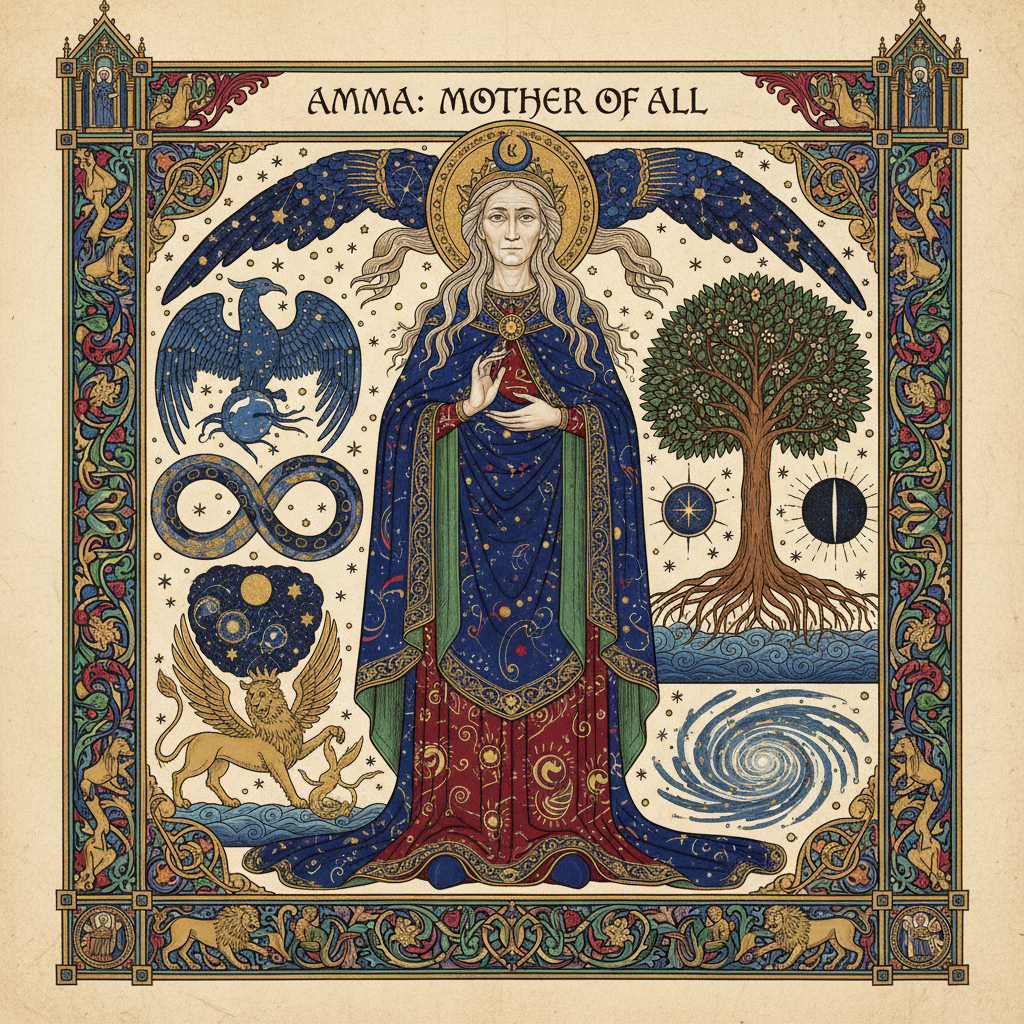
Amma is the supreme deity of the Dogon — not easily translated, not comfortably compared to any single Western concept of God, but the source, the original, the one whose opening produces everything else. He is the egg of the world. He holds inside himself, in concentric rings, the seeds of every thing that will exist.
He opens.
He casts the seeds outward in a spiral — the spiral, the specific geometry of the Dogon cosmos, the shape that correct things always make. He throws stars. He makes the earth. He looks at the earth he has made and he wants it, and the wanting is the beginning of the problem.
He reaches down to couple with the earth.
The earth resists. A termite mound rises — the anthill that is also a body, the earth’s refusal that is also, in the symbolic register of Dogon cosmology, the earth’s dignity. Amma does not hear the refusal. He cuts it away and forces himself on the earth, and from that violation the first child is born.
It is lame.
The first child of creation is Yurugu — the pale fox, the jackal, the figure of disorder that limps across the Sahel to this day on his uneven legs. He was born wrong because his conception was wrong. He is the record of Amma’s failure, the evidence of the violence that attended the first act of creation, walking the earth forever after as the living proof that something at the very beginning went badly.
Amma does not give up.
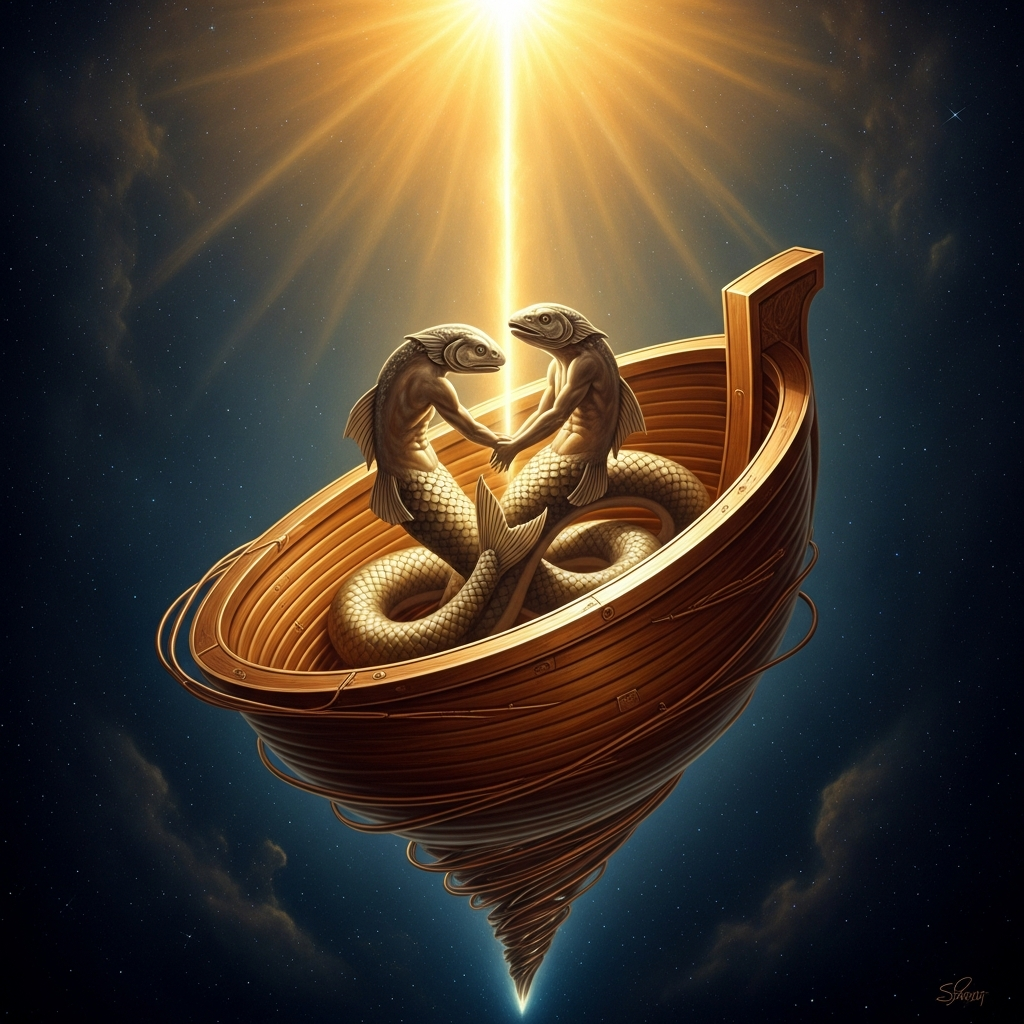
He couples with the earth again, this time gently, this time in the way that does not require force, and the second coupling produces twins. The twins are perfect. They are double, balanced, complementary — two of one, the Dogon ideal of all correctly ordered things. Their name is Nommo. Their form is half-human and half-serpent, or half-human and half-fish — the form that is equally at home in water and light, in the earth and the sky.
There are eight Nommo, in four pairs. Each pair is itself complete. Together they are the original family, the properly ordered beginning, the correction of the first failure.
And they come to earth.
The ark is not a boat.
When Ogotemmeli describes the vehicle that carries the Nommo from the sky to the earth, he uses Dogon words that Griaule’s translator struggles to render in French, and that will spend decades being rendered imperfectly in every subsequent language. The ark is round. It spins. It is made of beaten copper that flashes red as it turns. Inside it the Nommo crouch in specific postures at specific positions that correspond to the cardinal points and the cosmic geometry of the Dogon universe.
It descends from Sigi Tolo.
Sigi Tolo is the Dog Star. Sirius — the brightest star in the night sky, the one that rises with the sun during the hottest weeks of the year, the star that ancient Egyptian astronomers used to predict the flooding of the Nile. In October 1946, in the courtyard of a blind man on a sandstone cliff in Mali, Marcel Griaule is writing down the name of a specific star as the point of origin for an ark of beaten copper that contains the progenitors of humanity.
Then Ogotemmeli says something else.
Sigi Tolo is not alone, he says. There is another star that circles it. It is called Po Tolo — the star of the Digitaria seed, the smallest grain the Dogon plant. Po Tolo is small. It is the smallest, heaviest thing in the universe. It is the seed of the universe — the smallest possible unit of everything that exists, compressed into a star. It circles Sigi Tolo once every fifty years. The Sigui ceremony — the great Dogon festival that is held periodically to renew the masks and re-teach the sacred speech — is organized around the passage of time that this orbit takes.
Griaule stops writing.
He has been trained in Western astronomy. He knows that Sirius has a companion star. He knows that the companion star is a white dwarf — an incredibly small, incredibly dense object, the remnant of a star that has burned through its fuel and collapsed. He knows that this companion was confirmed by Western telescopes in 1862, that its mass was calculated in 1925, that its orbital period around Sirius A is approximately fifty years.
He is looking at a blind man in a village in Mali who has just described, in the vocabulary of Dogon sacred astronomy, the confirmed parameters of Sirius B.
He picks up his pencil and writes.
Ogotemmeli is not finished.
He tells Griaule about the word.
Speech in Dogon cosmology is not what speech is in the ordinary sense. Speech is the structure of reality. The first speech — the speech of the Nommo, the speech they bring in the ark from Sirius — is not language as the Dogon now speak it. It is the principle of differentiation, the original cut, the moment when things become distinguishable from each other. Without the word, everything is everything. The word is what makes one thing not another thing.
The Nommo give this speech to humanity in three stages.
The first speech is dry and basic — the language of cultivation, the names of the grain and the seasons, the minimal vocabulary of survival. The second speech is wet — the speech that carries weaving, because weaving and language share a structure. The warp and weft of the loom are the warp and weft of grammar: to weave a cloth is to speak a sentence with thread, to make meaning from the alternation of two elements. The third speech is the parole claire, the clear word, the speech of full initiation — the language in which a Dogon priest can describe the universe.
Ogotemmeli is speaking the third word to Griaule.
He is not supposed to. Or rather: he is supposed to, now, because the elders have decided. But the decision is not trivial. The parole claire is reserved for fully initiated members of the Awa society, given out over decades, withheld from women and from the uninitiated and from foreigners who have not gone through the process. To speak it to Griaule is an act of enormous trust and calculated risk — the elders have decided that writing it down in French, in a book that will circulate in Paris and London and New York, is preferable to letting it die. The Dogon are not unaware of what colonialism is doing to their world. They are making decisions about survival.
Ogotemmeli speaks. Griaule writes. The afternoon light on the Bandiagara cliffs turns the sandstone the color of the inside of an apricot, and the night comes on, and the lamp is lit.
Thirty-three days.
The controversy will erupt later.
In the 1970s, Robert Temple will publish The Sirius Mystery and argue that Dogon knowledge of Sirius B is so specific and so accurate that it must derive from ancient contact with an advanced civilization — possibly extraterrestrial, possibly the same culture that built the pyramids. The book will sell widely and produce a cottage industry of speculation.
In 1991, the Dutch anthropologist Walter van Beek will return to the Dogon after spending years among them and publish a rebuttal in Current Anthropology. He finds no trace among ordinary Dogon of the elaborate Sirian astronomy Griaule recorded. He suggests that Ogotemmeli was a singular genius who may have been influenced by French missionary or colonial visitors who carried Western astronomy; or that Griaule’s own questions shaped the answers he received; or that a system as complex as what Ogotemmeli described simply does not circulate at the level where van Beek was able to access it.
Both positions have defenders. Neither has won.
What is not disputed: Ogotemmeli described a small, dense star circling Sirius every fifty years, to a French anthropologist in 1946, using indigenous Dogon astronomical vocabulary that predates any plausible colonial transmission of Western astronomy. Whether this knowledge is genuinely ancient or is something else — reconstruction, synthesis, creative response to an interested outsider, something the tradition cannot yet account for — is a question the evidence cannot definitively answer.
The Dogon do not consider the controversy their problem.
Their cosmology does not depend on what French or Dutch anthropologists think of it. The ark descended from Sigi Tolo. The Nommo brought the word. The fox still walks the divination grid at the village edge. The Sigui ceremony still renews the masks. These things are true in the way that the Dogon understand truth — not empirically verifiable in the Western sense, but cosmologically operative, structure-giving, the framework inside which Dogon life is intelligible.
In the morning, after the fox has walked the grid, the diviner comes to read the tracks.
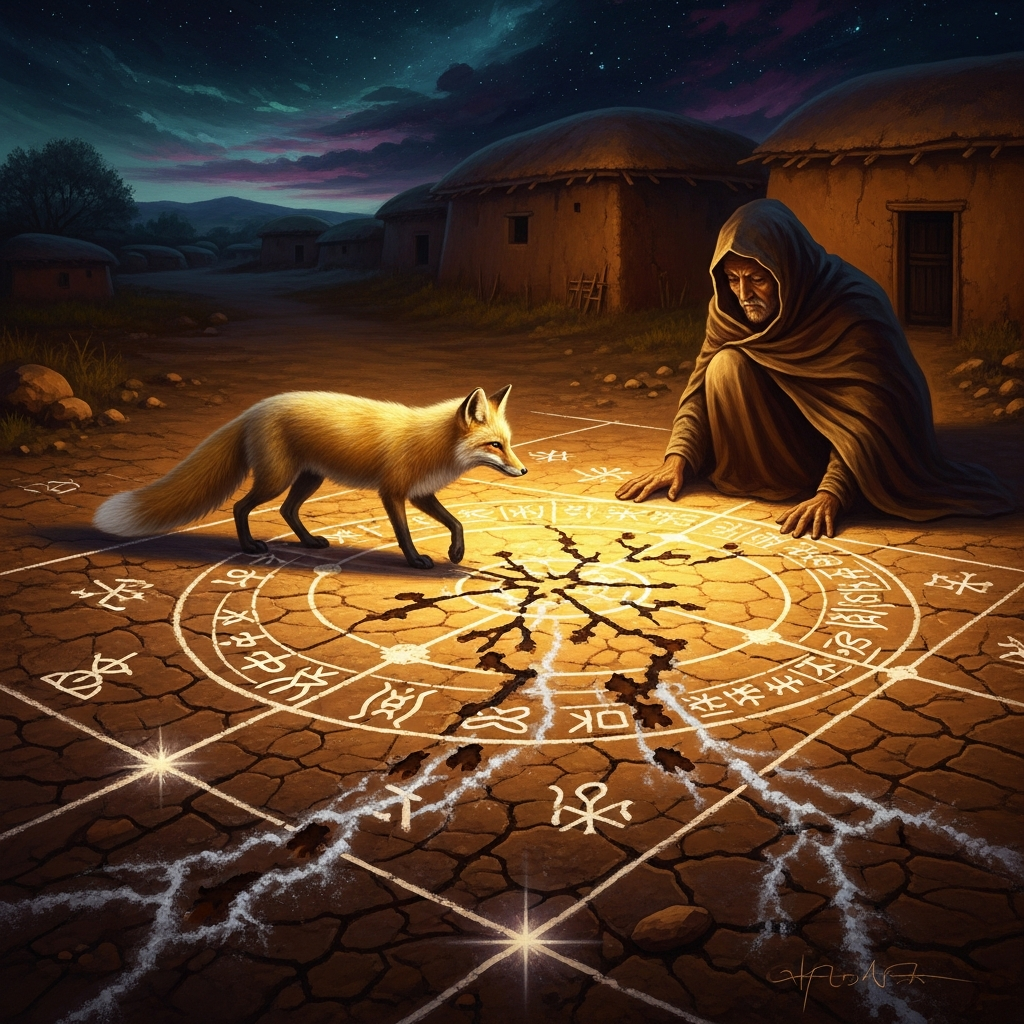
The grid is drawn in fine sand at the village’s edge — a rectangle divided into squares, with kola nuts placed at specific intersections according to the question being asked. Yurugu, the pale fox, the lame jackal, the first-born of Amma’s failed coupling, walks the grid at night. He moves in his unpredictable way, the way of disorder, and where he puts his paws the sand shifts. In the morning the diviner reads the paw-prints the way a doctor reads symptoms — not to find out what Yurugu wanted to say, because Yurugu does not want to say anything, but to find out what disorder has done in the night and what it means for the day ahead.
Yurugu is the first and permanent mistake of creation. He was born lame from a violent act. He cannot be healed. He cannot be improved. He is not evil — the Dogon do not think in terms of evil the way Western theology tends to — he is what happens when the very beginning goes wrong, and wrong beginnings leave traces in everything that follows.
He is also, paradoxically, the most useful tool the Dogon have for divination, because disorder is the only force that tells the truth spontaneously. The Nommo brought the word, the structured speech, the correct language. But the correct language can be used correctly or incorrectly. It can be used to deceive, to manipulate, to construct beautiful falsehoods. Yurugu’s disorder cannot lie. He does not know how. He walks through the night and puts his paws where disorder put them, and the diviner reads the map of chaos in the morning and tells the village what is true.
Amma is still in his egg. The Nommo are still in the ark, somewhere, still descending. The fox is walking the grid at the edge of the village. The sandstone cliffs of the Bandiagara glow red in the late afternoon.
Ogotemmeli sits blind in his courtyard.
He is telling someone about a star.
The Dogon tradition is about the gap between the first attempt and the correction — between Yurugu, the lame disorder of the first failed coupling, and the Nommo, the perfect twins who came after. Human life lives in that gap. The divination grid is drawn at the village edge because disorder walks there, and disorder must be read, and reading disorder is how the Dogon know what the Nommo came to teach: that the world was made twice, the first time badly, and that the second making is still descending from a star.
Scenes
October 1946, Bandiagara Escarpment
 Generating art…
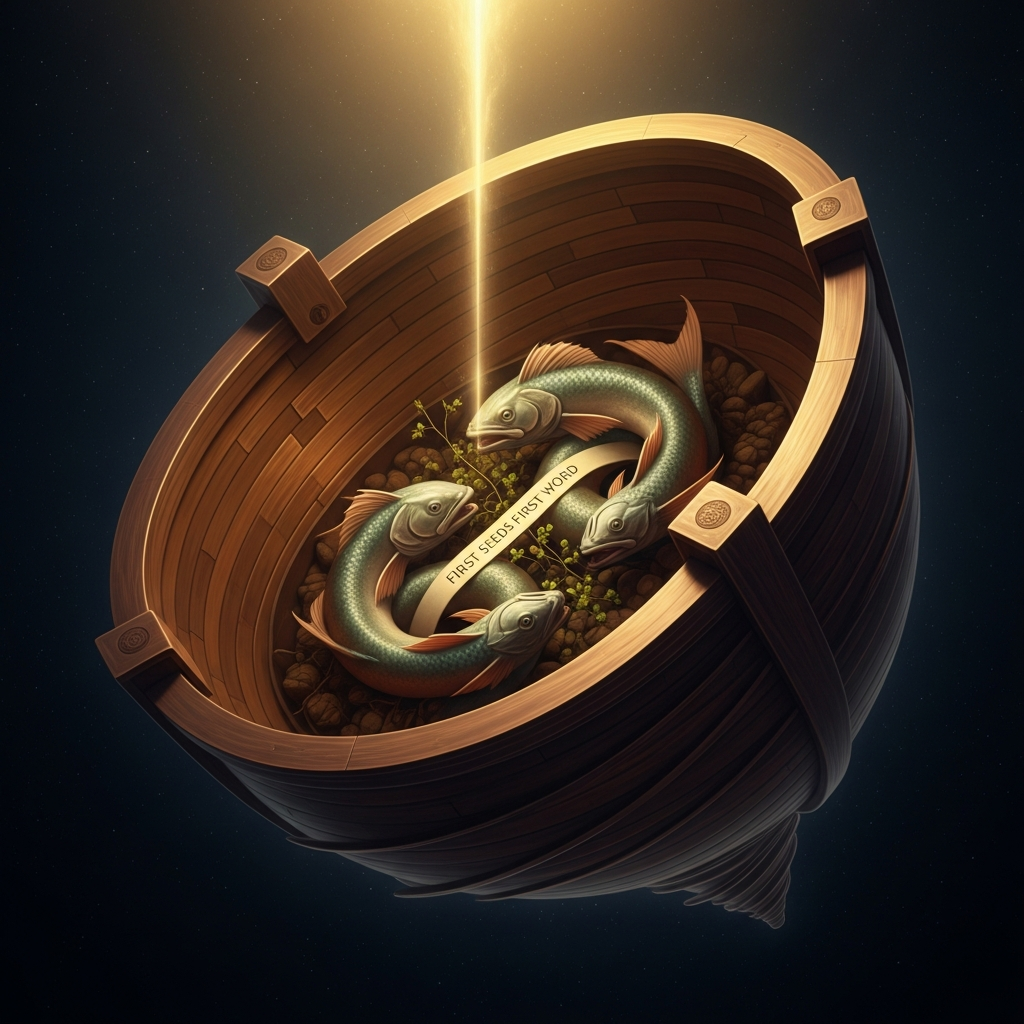
 From Sirius, the ark of the Nommo descends — a vortex of beaten copper turning as it falls through the void, the twin fish-beings curled inside, half human and half serpent, carrying the first seeds and the first word
 Generating art…
 The pale fox walks the divination grid at the village edge, its tracks recording disorder overnight, the diviner reading in the morning what disorder has decided to say
 Generating art…
 Echoes Across Traditions
Entities


Sources
- Marcel Griaule, *Conversations with Ogotemmeli: An Introduction to Dogon Religious Ideas* (Oxford University Press, 1948; English trans. 1965)
- Marcel Griaule and Germaine Dieterlen, *Le Renard Pale / The Pale Fox* (Institut d'Ethnologie, 1965)
- Walter E.A. van Beek, 'Dogon Restudied: A Field Evaluation of the Work of Marcel Griaule,' *Current Anthropology* 32.2 (1991)
- Robert K.G. Temple, *The Sirius Mystery* (Sidgwick and Jackson, 1976)
- Philip M. Peek and Kwesi Yankah, eds., *African Folklore: An Encyclopedia* (Routledge, 2004)