The Nommo Descend in an Ark of Fire
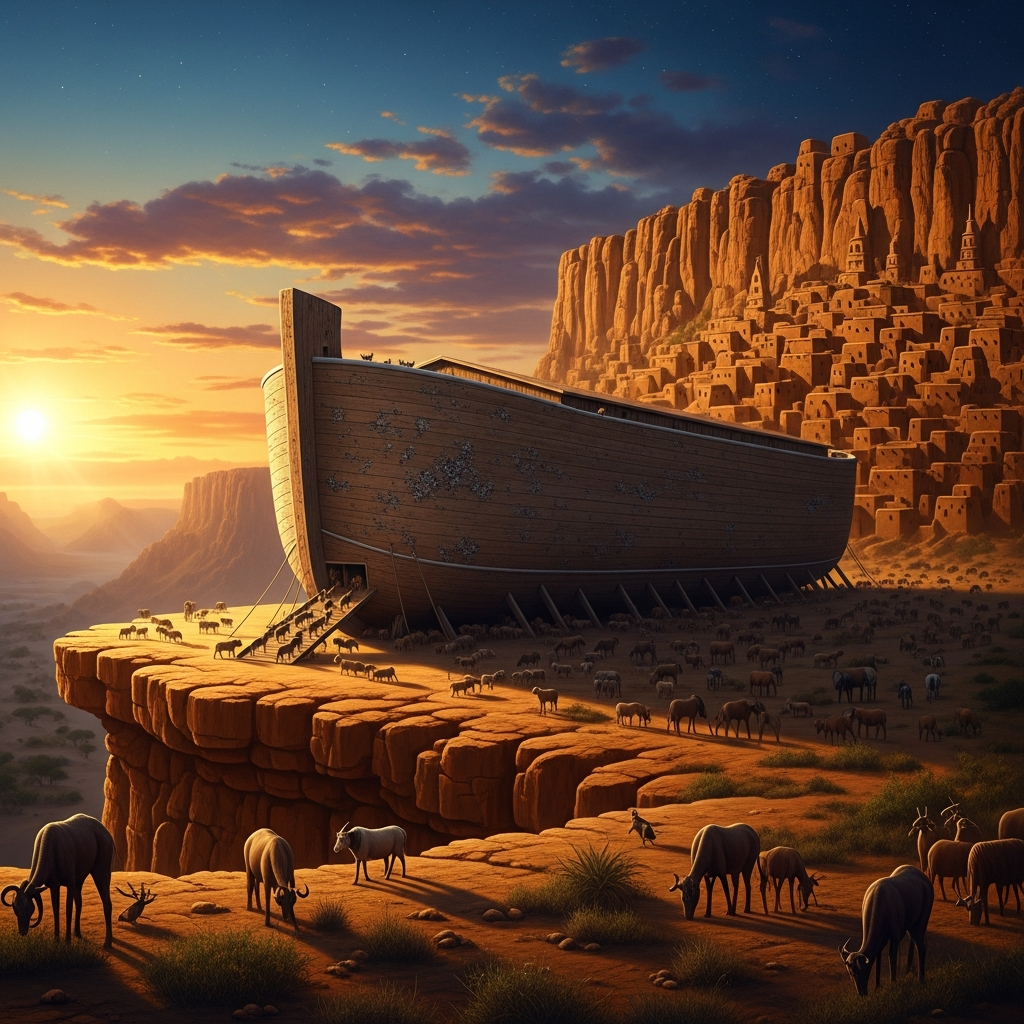
Mythic time · Recorded by Marcel Griaule from Ogotemmêli, October 1946 · Bandiagara · The Bandiagara Escarpment, Mali — five hundred metres of sandstone cliff above the Sahel, where the Dogon villages cling to the rock
Contents
Amma fails his first creation and the jackal is born lame. He tries again, and twin fish-beings spiral down from Sirius in a turning ark of copper, bringing the first humans, the first crops, the sacred word.
- When
- Mythic time · Recorded by Marcel Griaule from Ogotemmêli, October 1946 · Bandiagara
- Where
- The Bandiagara Escarpment, Mali — five hundred metres of sandstone cliff above the Sahel, where the Dogon villages cling to the rock
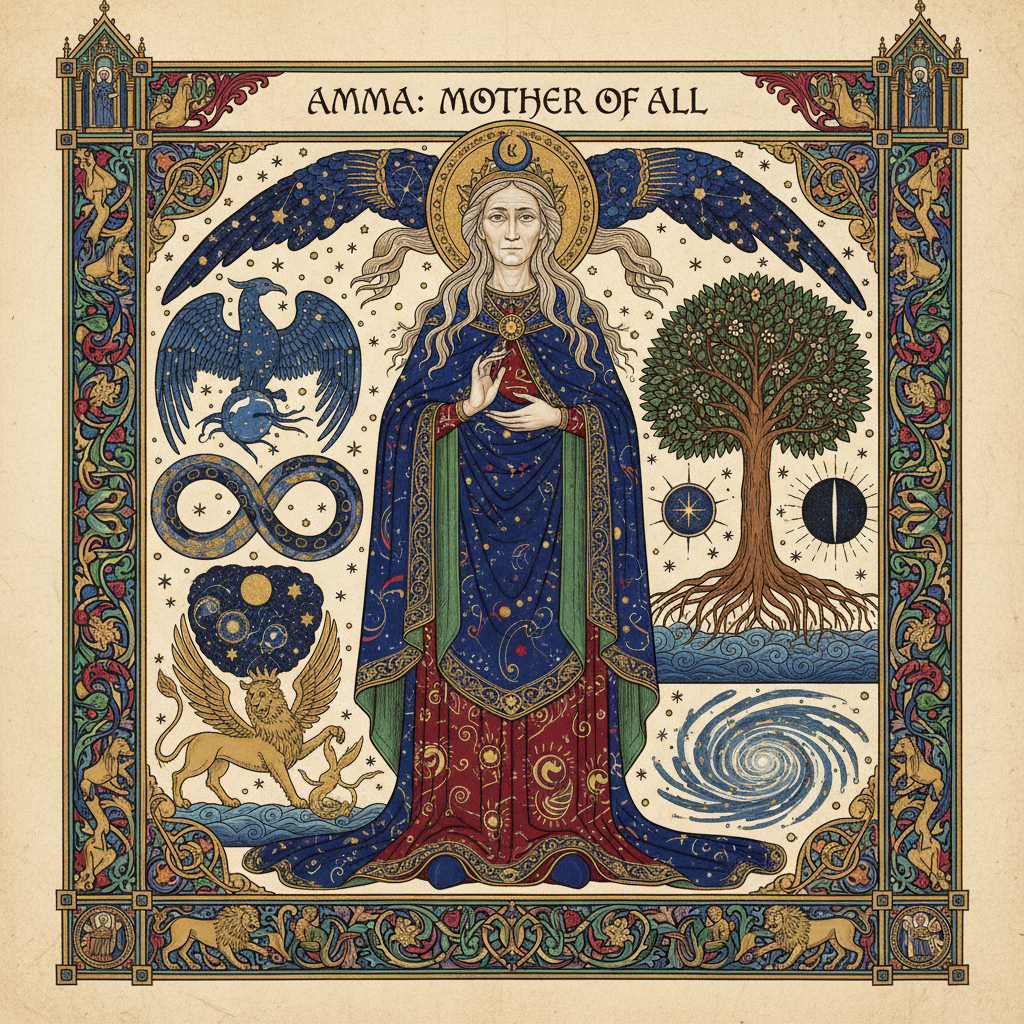
Before the world is made, Amma is alone.
He is the egg of the world. Inside him, in concentric rings, he carries the seeds of every thing that will exist — every star, every grain of millet, every child who will ever be born. He is the potential. He has not yet decided to become the actual. He sits in his own darkness, turning, and the seeds inside him sing in their thousands.
Then he opens.
He casts the seeds outward in a spiral. He throws stars. He throws planets. He shapes the earth as a flat disk, a body laid down before him, and he looks at the body and he wants it. He reaches down to couple with the earth — to fill her with the second wave of creation, the living wave, the wave that will become beings — and the earth resists.
A termite mound rises out of her. The Dogon priest who tells the story does not soften this. The termite mound, says Ogotemmêli, is the earth’s clitoris. It refuses to be entered. It says no.
Amma does what gods who refuse to hear no have always done. He cuts it away. He excises the termite mound and forces himself upon the earth, and from this violation the first child is born — and the first child is broken.
It is a jackal. It is lame. It is not the being Amma intended. It is the figure of disorder loose in the world, walking on its uneven legs across the Sahel forever after, doing what disorder does. The Dogon call it Yurugu, the pale fox. To this day Dogon diviners draw a grid in the sand at the edge of the village before nightfall, lay out kola nuts and questions inside the squares, and let the fox come at night and walk the grid. In the morning the diviner reads the tracks. The fox tells the truth because the fox is the original wound, and an original wound knows everything that has gone wrong since.
Amma does not give up.
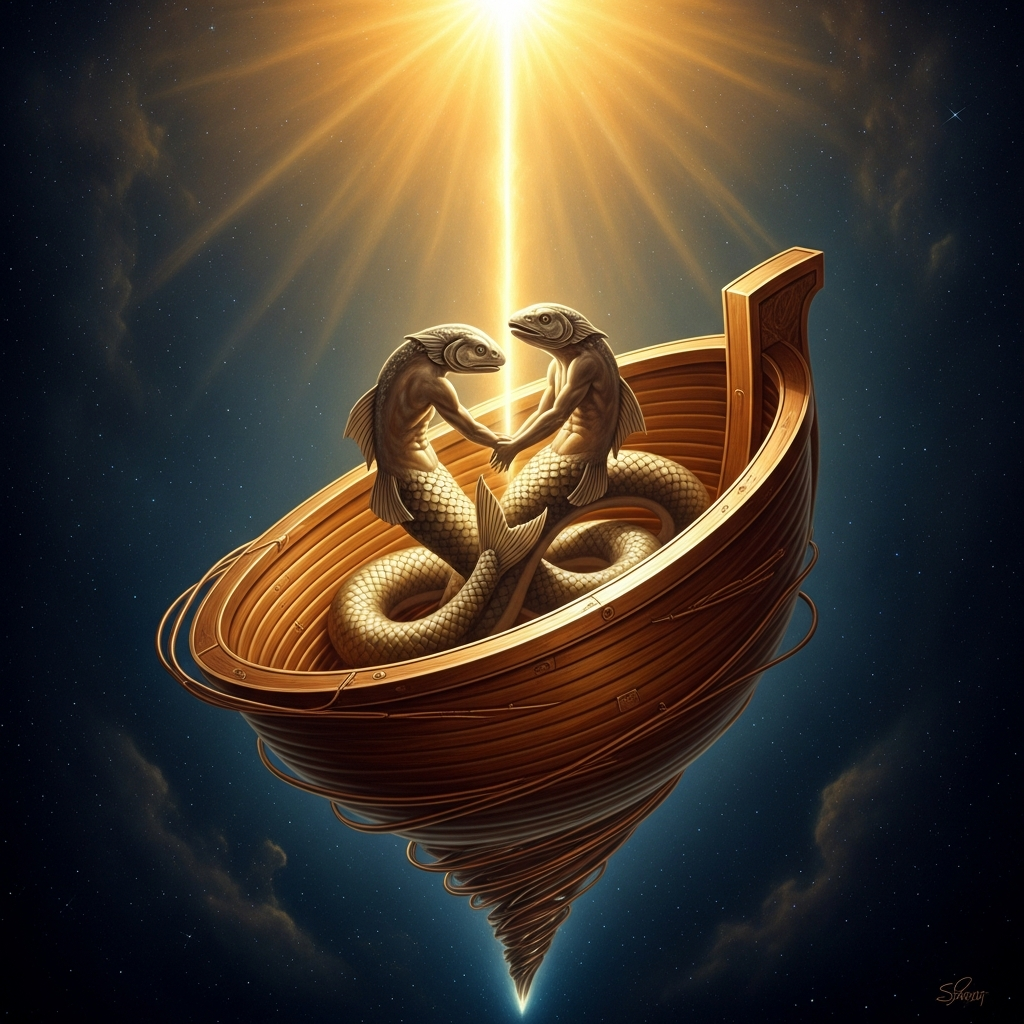
He couples with the earth a second time, gently this time, and the second coupling produces twins. The twins are perfect. They are perfect because Amma has learned. They are not single beings with a single nature; they are double, balanced, complementary, two of one. The Dogon word is Nommo.
The Nommo are half-human and half-serpent. Or half-human and half-fish. The teller decides; the truth is the same. Their upper bodies are smooth and humanlike; below the waist they are scaled and curling. They live in water. They live in light. They live where water and light meet — in the rivers, in the rain, in the descent of the dawn.
There are not two Nommo. There are eight, in four pairs. Each pair complete in itself. Together they are the original family of beings, and from them every thing that lives in the proper way will descend.
But before the descent, there is the question. How do the Nommo come from the sky to the earth?
They come, says Ogotemmêli, in an ark.
The ark is not a boat. It is a thing the Dogon describe in language that has no Western equivalent. It is round; it spins; it is made of beaten copper that flashes red as it turns. Inside it the Nommo crouch in their proper postures. The ark descends from a particular point in the sky — and here is where the world will start arguing in 1946, here is where the modern controversy begins — the ark descends from Sirius. From Sigi Tolo, the Dog Star. The brightest star in the night sky.
Sirius, says Ogotemmêli, is not one star. It is three. Sigi Tolo is the visible one. Po Tolo is small and very heavy and circles Sigi Tolo every fifty years, and it is the smallest, densest thing in the universe — the seed of every thing that exists. Emme Ya Tolo is the third, larger than Po Tolo but harder to see. The orbit period of Po Tolo is fifty Sigui years; the Sigui ceremony, the great Dogon ritual that rebuilds the masks and re-teaches the sacred speech, is held every sixty years roughly to track the orbit Ogotemmêli has just described to a French anthropologist who has, until this conversation, never heard of any of this.
Sirius B — the white dwarf companion of Sirius A — is confirmed by Western telescopes in 1862. Its mass and density are calculated by 1925. Marcel Griaule arrives at Bandiagara as an outsider already trained in this Western astronomy. He sits with Ogotemmêli in 1946. He listens to a man who has never owned a telescope and who has never read an astronomy textbook describe a star that is small and dense and circles the Dog Star every fifty years.
The world will spend the rest of the century arguing about what just happened.
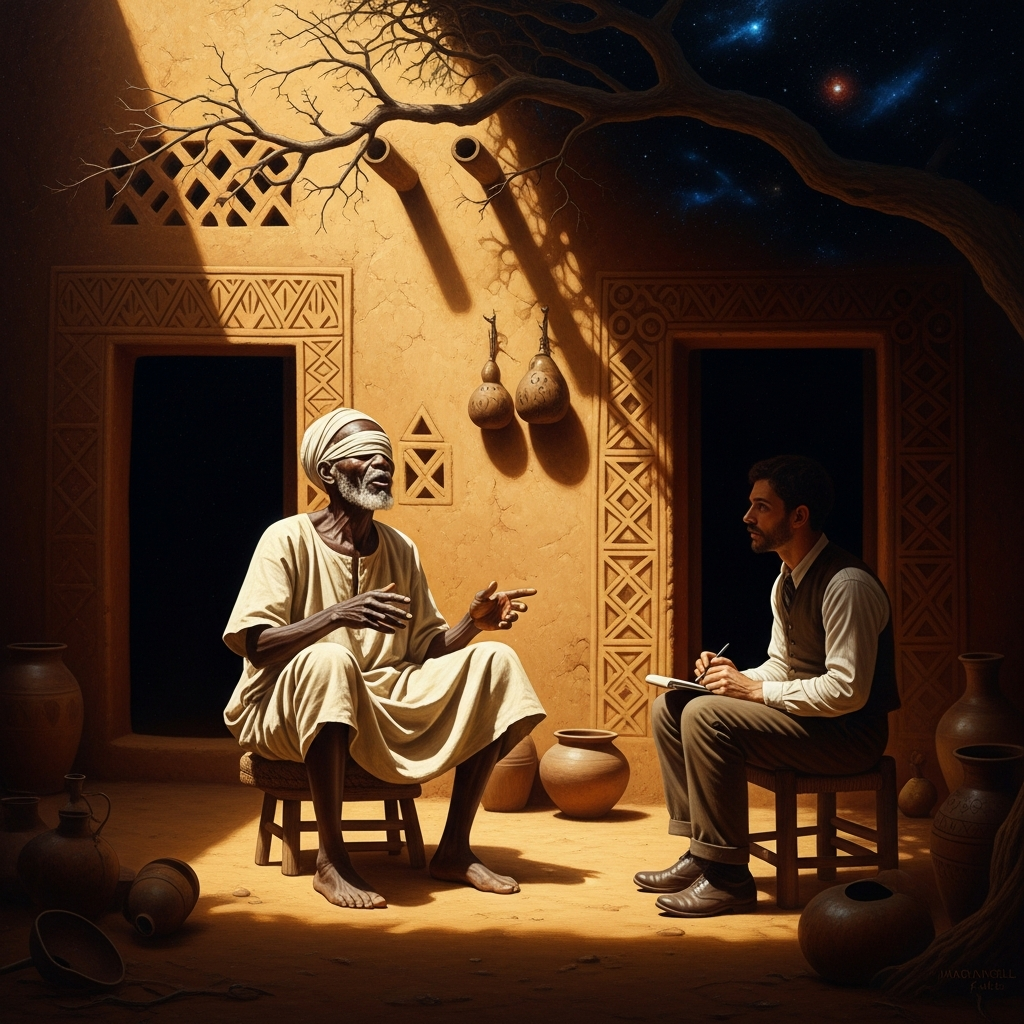
But that is the future. In the courtyard at Bandiagara, in October 1946, only the present is happening. Ogotemmêli is blind. He lost his sight in a hunting accident years ago, and his blindness has done what blindness sometimes does — it has turned him inward, deeper into the inheritance of his lineage, into the chain of priests of the Lebe cult who have carried this story orally for fifteen generations. He sits in the shade of his thatch awning and he speaks slowly, in Dogon, to a translator who carries the words across to Griaule. Griaule writes. He writes for thirty-three days. He writes everything Ogotemmêli says.
Ogotemmêli is telling Griaule things he is not supposed to tell.
This is part of why Griaule is electrified. The full creation myth — the cosmology, the sacred speech, the grid of correspondences linking each plant and each grain and each part of the human body to a moment in the descent of the Nommo — is normally reserved for fully initiated members of the Awa society, the men’s masking association of the Dogon. It is given out in stages, over decades. To tell it to a foreigner, to a man who has not gone through any of the initiations — Ogotemmêli’s elders have decided, after long conferences Griaule will only hear about later, that the Frenchman has shown enough patience and enough respect to be granted the higher knowledge. They tell their priest: speak.
He speaks.
He tells Griaule about the descent. The ark of the Nommo turns as it falls. It traces a spiral path through the air, the way water traces a spiral as it drains, the way the Sigui dance traces a spiral around the village. The path of the descent is the path of all proper movement; everything in the Dogon cosmos either spirals correctly, in the way of the Nommo, or moves in straight lines and sharp angles, in the way of the lame jackal. To dance correctly is to dance the descent. To weave correctly is to weave the descent. To plant correctly is to plant the descent. The whole life of the village is a re-enactment of the way the Nommo came down.
The ark touches earth.
It touches earth, says Ogotemmêli, at the place that will become the Bandiagara Escarpment. The Nommo step out. They bring the eight first ancestors of humanity in their hands — four pairs of twins, the parents of the four lineages of the Dogon. They bring the seeds of every cultivated grain. They bring the techniques of pottery, the techniques of weaving, the techniques of speech. They bring the word.
The word is the key.
Speech in Dogon thought is not what speech is in modern European thought. Speech is the structure of the world. The first speech, the speech of the Nommo, is not yet differentiated into language; it is the principle of differentiation itself, the moment of pattern, the cut that separates one thing from another. The Nommo give this speech to humanity in three stages. The first speech is dry — basic, naming, agricultural; the language of the first cultivators. The second speech is wet — the speech that allows weaving, because weaving and language share a structure: the warp and weft of the loom is the warp and weft of grammar, and to weave a cloth is to speak a sentence with thread. The third speech is the highest. It is the speech of the parole claire, the clear word, the language of full initiation, in which a Dogon priest can describe the universe.
This is the speech Ogotemmêli is using.
He is, in his blind courtyard at Bandiagara, speaking the third word. He has never been outside Mali. He has never met an astronomer. He has never met a Greek or a Babylonian or a Mesoamerican. But what he is describing — fish-beings who descend in a turning vehicle from a star, bringing speech and agriculture, while a primal disorder limps across the world below — is what dozens of other traditions have also described. Oannes rises from the Persian Gulf to teach the Sumerians. Quetzalcoatl descends from the sky and walks on the earth of Mesoamerica. Enki rises from the Abzu. The Watchers descend onto Mount Hermon. The Holy Spirit descends in tongues of fire at Pentecost. The pattern is so consistent across so many separated traditions that it begins to look less like coincidence and more like a memory — or like a structure built into the way human beings tell the truth about where civilization came from.
Ogotemmêli does not know any of these other traditions.
He is just telling Griaule what his lineage has always told.
Griaule writes. The translator translates. The afternoon goes on. The light of the Sahel falls slowly down the cliff face above the village and turns the sandstone the colour of the inside of an apricot, and a man who cannot see it is describing a fish-being descending from a star, and a Frenchman is writing the words down by lamplight as the night comes on.
Years later, the controversy will erupt.
Walter van Beek will return to the Dogon in the 1980s, will spend years among them, and will say that he can find no trace among ordinary Dogon of the elaborate cosmological knowledge Griaule recorded. He will suggest that Ogotemmêli was a singular genius, perhaps influenced by passing Jesuit visitors, perhaps weaving Griaule’s own questions into a system he was inventing on the spot. Others will defend Griaule, will note that priestly knowledge is reserved precisely for people like Ogotemmêli and not for everyone, will argue that the Sigui ceremony’s sixty-year cycle is suspiciously close to the orbit of Sirius B for chance.
The argument will go on. The argument is not the point.
The point is the descent.
Whether it happened, whether Ogotemmêli was right about Sirius B, whether the ark of beaten copper ever turned through any sky — the people of Bandiagara live, every day, as if it did. Their villages are built into the cliffs because the Nommo came to the cliffs. Their granaries are shaped like the ark because the ark held the first seeds. Their dances spiral because the descent spiralled. Their masks, unfinished and renewed at every Sigui, hold the geometry of the original moment.
The fox still walks at night. The grid is still drawn in the sand at the village edge. In the morning the diviner reads the tracks of disorder and knows what is coming. The original wound is still walking. So is the original gift.
Amma is still in his egg. The seeds are still singing.
The ark, somewhere, is still turning.
Scenes
Amma forms the earth as a flat disk and reaches down to couple with it
 Generating art…
 From a point of light at Sirius, the ark of the Nommo descends — a vortex of beaten copper turning as it falls, the twin fish-beings curled inside it, half human and half serpent
Generating art… The ark touches earth at the Bandiagara Escarpment
 Generating art…
 October 1946
 Generating art…
 Echoes Across Traditions
Entities
- Amma (the supreme god)
- The Nommo (twin fish-beings)
- Ogotemmêli (the blind elder)
- Marcel Griaule
- Yurugu (the pale fox / jackal of disorder)
Sources
- Marcel Griaule, *Conversations with Ogotemmêli: An Introduction to Dogon Religious Ideas* (1948; English trans. 1965)
- Marcel Griaule and Germaine Dieterlen, *Le Renard Pâle / The Pale Fox* (1965)
- Walter E.A. van Beek, 'Dogon Restudied: A Field Evaluation of the Work of Marcel Griaule,' *Current Anthropology* 32.2 (1991)
- Philip M. Peek and Kwesi Yankah, eds., *African Folklore: An Encyclopedia* (2004)
- Robert K.G. Temple, *The Sirius Mystery* (1976) — for the Sirius B controversy and a sceptical assessment thereof