The Jar at Nag Hammadi
December 1945 · Jabal al-Tarif cliffs, near Nag Hammadi, Upper Egypt
Contents
An Egyptian peasant digging for fertilizer in a cliff at the foot of the Jabal al-Tarif unearths a sealed clay jar — and rewrites the first three centuries of Christianity.
- When
- December 1945
- Where
- Jabal al-Tarif cliffs, near Nag Hammadi, Upper Egypt
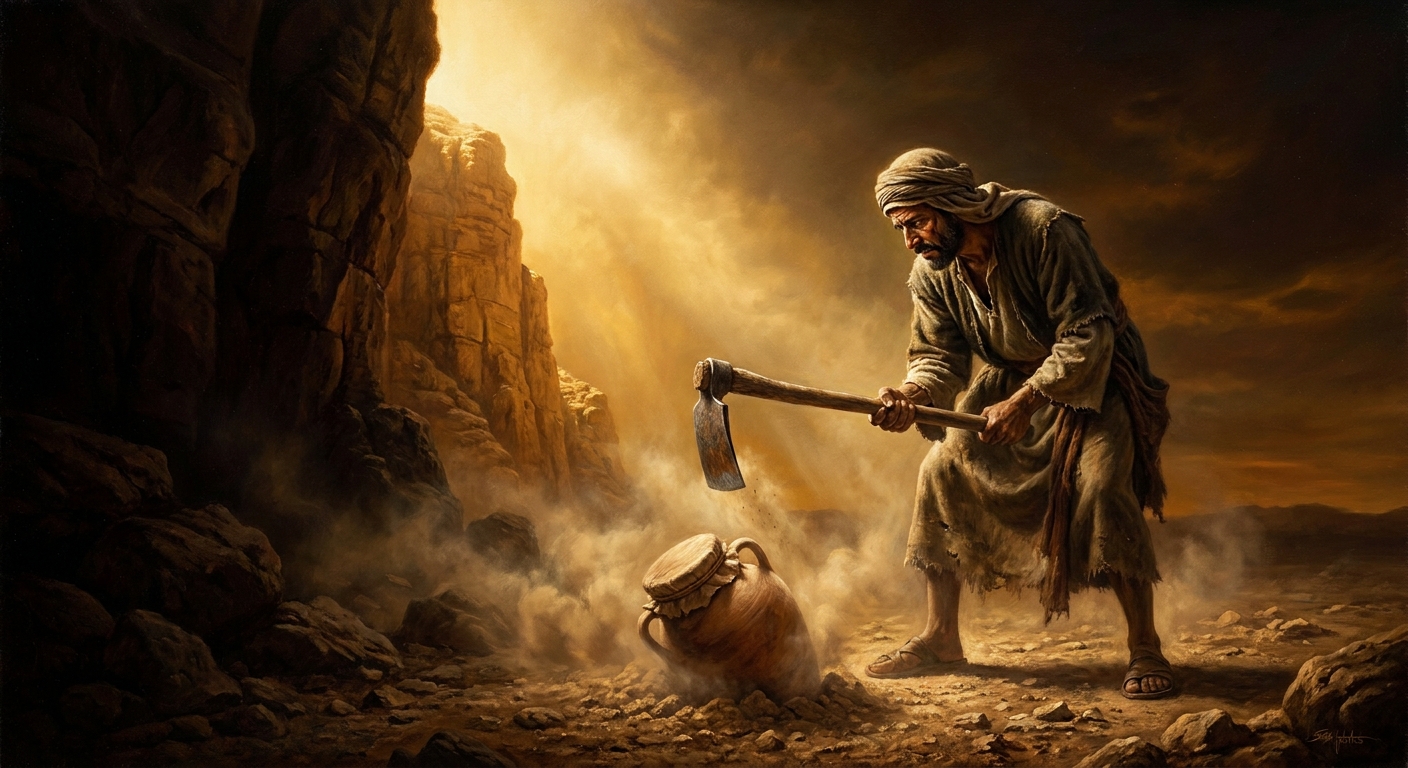
The mattock strikes something hollow.
Muhammad Ali al-Samman is digging sabakh — the soft, nitrogen-rich silt that drifts against the cliffs of the Jabal al-Tarif and that fellahin have hauled home as fertilizer for as long as anyone in al-Qasr can remember. His brother Khalifah is with him. Their camels wait in the shade. It is a December morning, the sun already hard, and the cliff face is honeycombed with the empty tombs of men who died when Egypt still spoke Coptic.
The mattock comes back wrong. Not stone. Not bone. A flat, dry thunk — the sound of a clay lid that has been waiting sixteen hundred years for somebody to be hungry enough to find it.
He kneels. He brushes back the silt.
A jar. Sealed. Almost a meter tall.
He hesitates. The fellahin tell stories about jars in cliffs — jinn sealed inside, smoke that comes out and chooses a man. But greed beats fear by a small margin in any village, and Muhammad Ali raises the mattock and brings it down on the lid.
No smoke. No gold. Just paper.
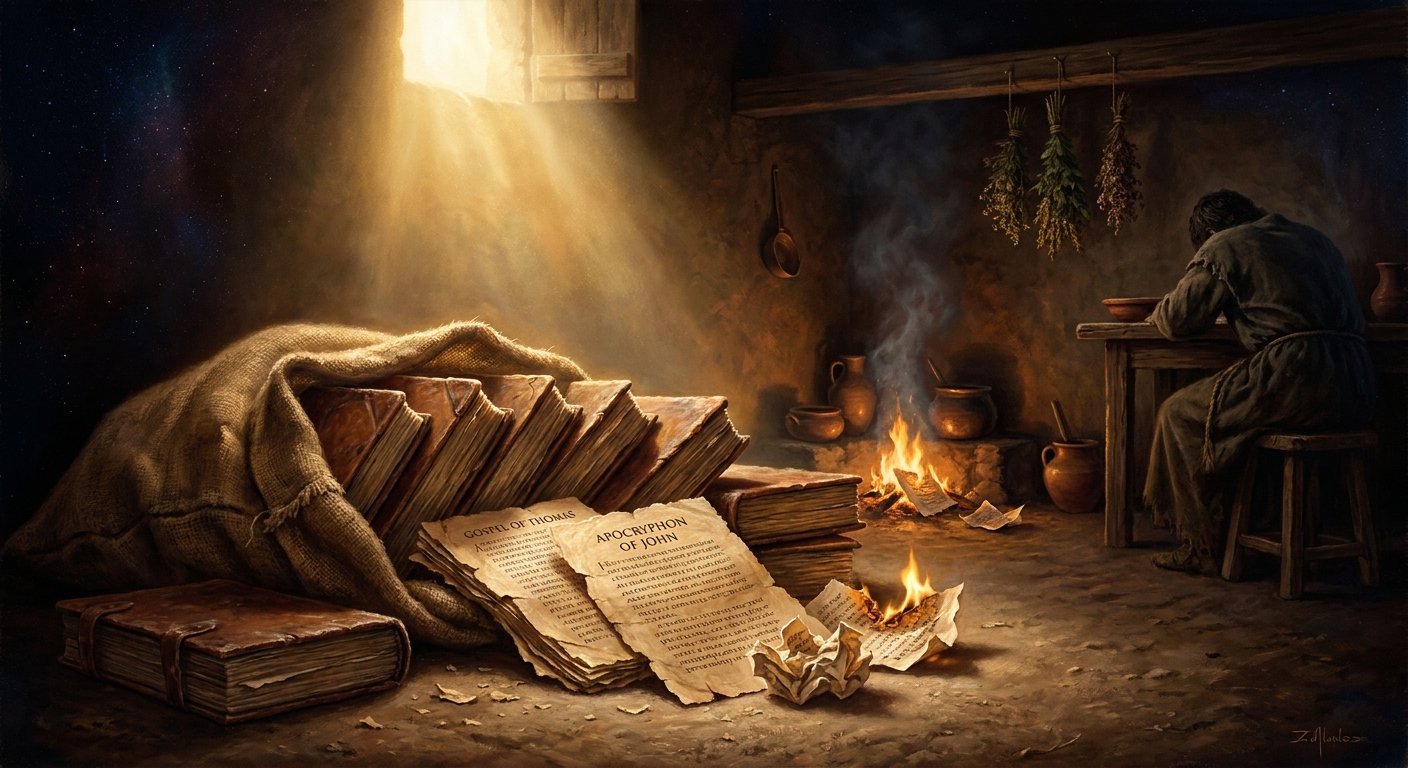
Thirteen leather-bound codices, stacked like loaves, the bindings cracked but holding. Coptic script in a hand none of the brothers can read. They carry the books home wrapped in a turban, dump them on the floor of the family hut beside the bread oven, and his mother, Umm Ahmad, uses some of the loose leaves over the next weeks to start the fire.
Pages of the Gospel of Thomas. Pages of the Apocryphon of John. The first sayings of Jesus that Christianity ever wrote down, going up the chimney as kindling.
Then the blood feud begins.
Muhammad Ali’s father has been murdered six months earlier; the family takes its vengeance on the suspected killer that same winter — hacks him down in the road, eats his heart raw between them, the way Upper Egyptian feuds were still settled in the 1940s. The police come for the al-Samman brothers. Muhammad Ali, fearing the codices will be found and confiscated as another crime, gives them to a Coptic priest in the village for safekeeping. The priest, who can read enough of the script to know what they are, lets his brother-in-law take one to Cairo.
The codices begin to scatter.
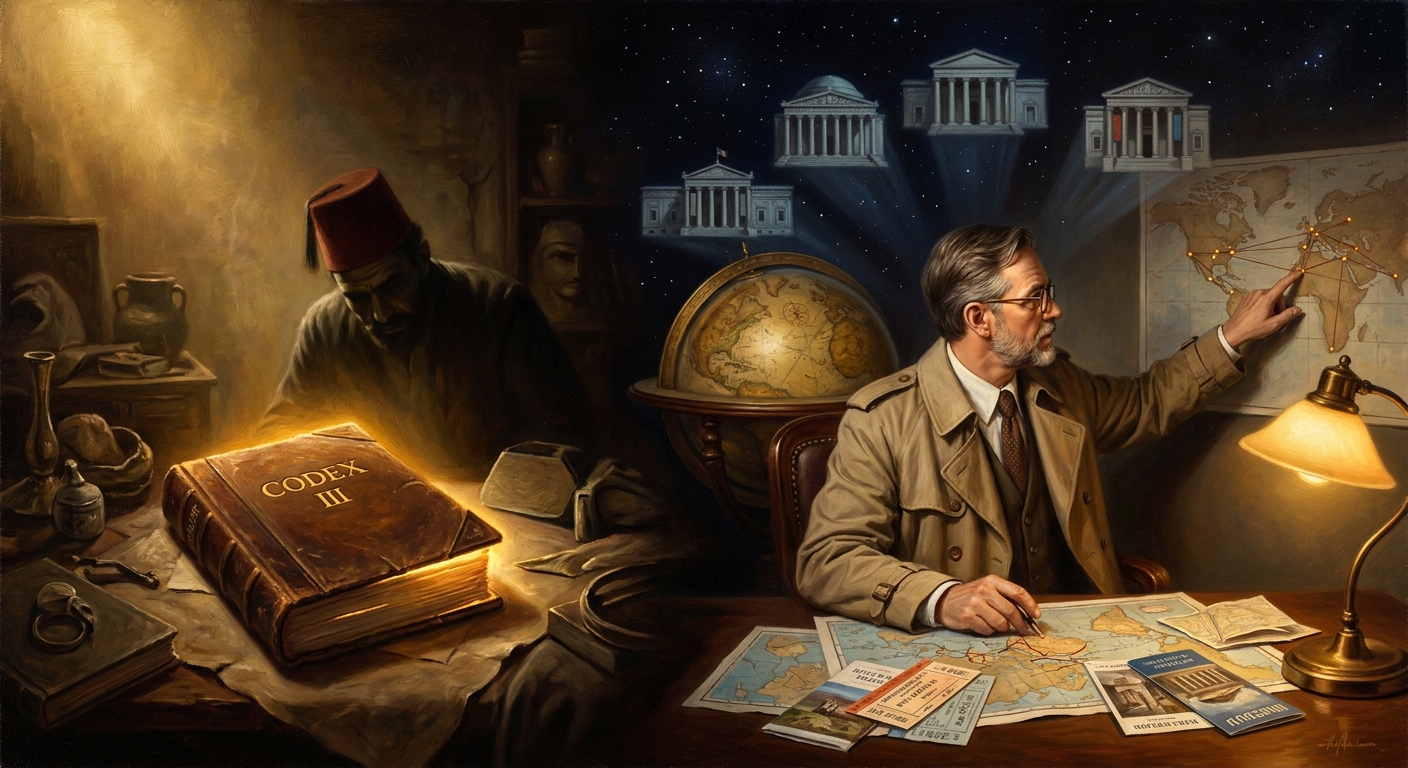
One ends up with a one-eyed antiquities dealer named Phokion Tano. Another is smuggled out of Egypt and offered for sale in Belgium, then America. Carl Jung’s institute in Zurich quietly buys Codex I — it will be called the Jung Codex for years. The Egyptian government chases the rest. By 1952, eleven codices and parts of a twelfth are locked in the Coptic Museum in Cairo. The thirteenth is in pieces on three continents.
Nobody publishes them.
The 1950s pass. A French scholar gets exclusive rights and sits on the texts. A German team translates fragments. A Dutch scholar’s working papers are stolen. Cold War politics, academic feuds, Suez — for fifteen years, the most important Christian discovery of the twentieth century is locked in a glass case in Cairo while a small priesthood of scholars argues over whose name will be on the spine.
Then James M. Robinson arrives.
A Claremont professor with the patience of a customs inspector and the stubbornness of a man who has personally photographed every page in every codex, Robinson spends the late 1960s and early 1970s flying between Cairo, Zurich, Paris, and Coptic monasteries, threatening, charming, and outlasting the men sitting on the manuscripts. In 1977 he publishes The Nag Hammadi Library in English — every text, every fragment, in one volume.
The dam breaks.
What pours out is not a heresy. It is a world.
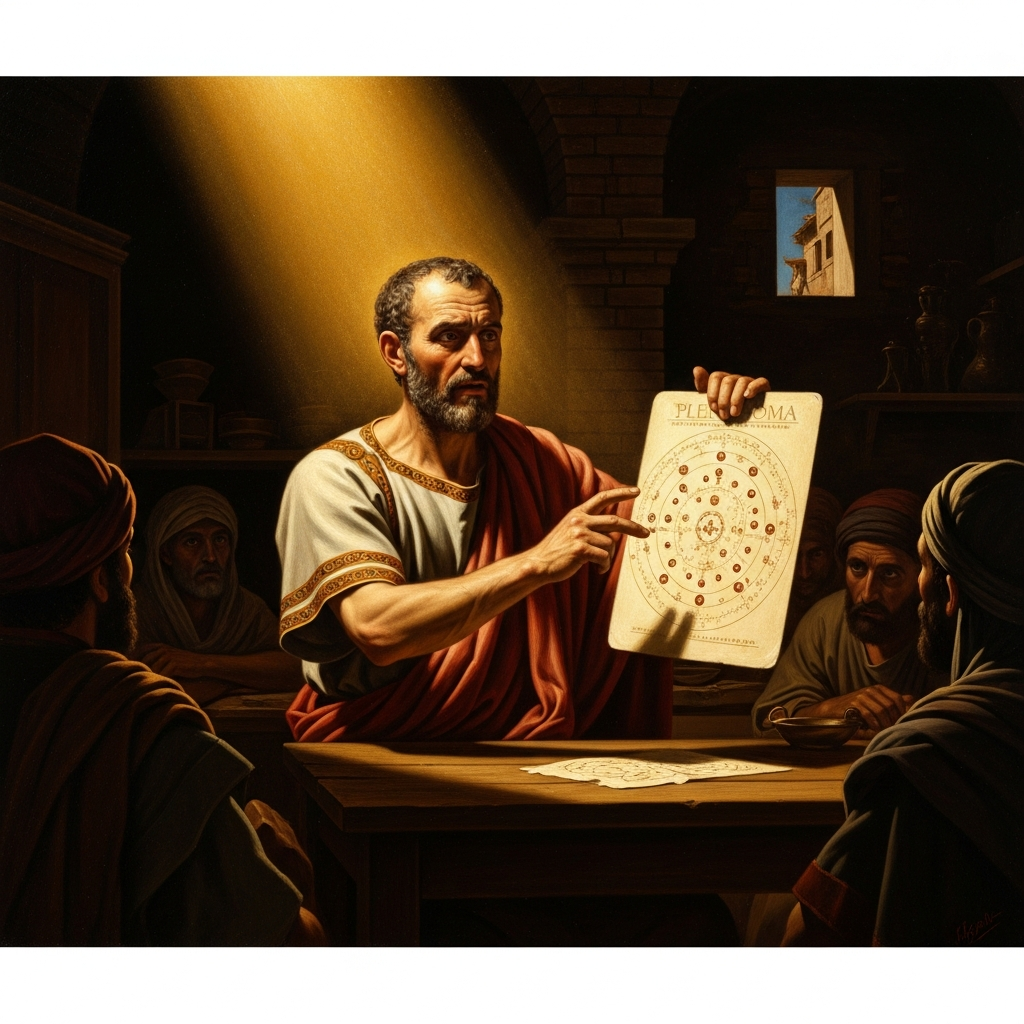
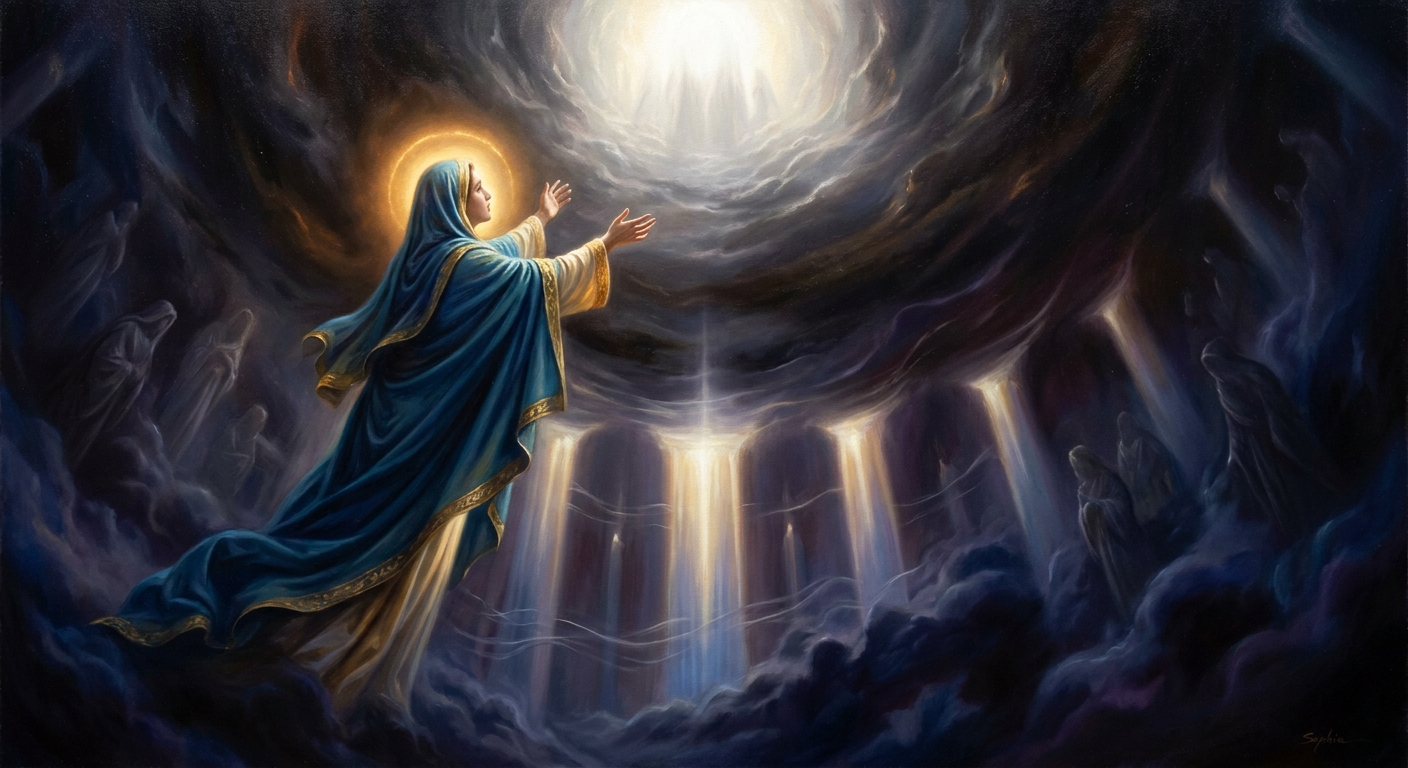
The Gospel of Thomas: a hundred and fourteen sayings of Jesus, no narrative, no crucifixion, no resurrection — “If you bring forth what is within you, what you bring forth will save you. If you do not bring forth what is within you, what you do not bring forth will destroy you.” The Gospel of Philip, with its kiss between Jesus and Mary Magdalene the orthodox tradition spent fifteen centuries trying to forget. The Apocryphon of John, with Sophia falling from the Pleroma and birthing the Demiurge — the false god of Genesis, the jealous Yahweh, the cosmic mistake. The Gospel of Truth. The Thunder, Perfect Mind, with its terrifying first-person voice: “I am the whore and the holy one.”
Elaine Pagels reads the codices in the Coptic Museum in 1969. Ten years later she publishes The Gnostic Gospels. The book wins the National Book Award. Suddenly American Christianity has a shadow it cannot shake.
Somebody buried the jar around 367 CE.
That year, Athanasius of Alexandria sent out his Thirty-Ninth Festal Letter — the first list of the twenty-seven New Testament books that would become the canon, and the order to burn everything not on the list. The Pachomian monastery of Saint Pachomius stood three miles from the Jabal al-Tarif. The codices’ scribal hand matches Pachomian Coptic. Some monk — or some abbot, or some quiet, frightened community — refused to burn the books.
He sealed them in a jar instead. He carried the jar to the cliff. He buried it in the sabakh where, sixteen hundred years later, a peasant looking for fertilizer would swing a mattock and bring an entire alternate Christianity back into the daylight.
The orthodox won the war. The jar won the long game.
The jar is the parable.
Athanasius, with the empire behind him, could burn libraries — and did. But you cannot kill a text by burning every copy you can find, because someone, somewhere, in fear or stubbornness or simple love, will always wrap one in leather, seal it in clay, and hide it in a cliff.
Muhammad Ali al-Samman never read the books he found. He died in al-Qasr, illiterate, in a feud that outlived him. The codices he carried home in a turban are now the foundation stones of an entire field. The Gospel of Thomas, lost for sixteen centuries, is now read in a hundred languages.
The desert keeps what the empire orders destroyed. The desert keeps it for as long as it takes.
Scenes
December 1945 — the sealed jar at the foot of the Jabal al-Tarif, moments before the mattock breaks it open
Generating art… Thirteen leather-bound codices, fifty-two texts — the Gospel of Thomas, the Gospel of Philip, the Apocryphon of John — spill onto the kitchen floor in al-Qasr
 Generating art…
 Cairo, 1948 — Codex III on the antiquities black market; James Robinson, twenty years later, chasing each codex to a different museum on three continents
 Generating art…
 Echoes Across Traditions
Entities
- Muhammad Ali al-Samman
- Gospel of Thomas
- Gospel of Philip
- Apocryphon of John
- James M. Robinson
Sources
- James M. Robinson (ed.), *The Nag Hammadi Library in English* (1977; rev. 1988)
- Elaine Pagels, *The Gnostic Gospels* (1979)
- Marvin Meyer (ed.), *The Nag Hammadi Scriptures* (2007)
- Karen L. King, *What Is Gnosticism?* (2003)
- James M. Robinson, *The Story of the Bodmer Papyri* and his 1979 *Biblical Archaeologist* account of the find