This Is the End — For Me the Beginning
April 9, 1945 · two weeks before liberation · Flossenbürg concentration camp, Bavaria — the SS execution yard at first light
Contents
On a clear April dawn at Flossenbürg, two weeks before the camp's liberation, Dietrich Bonhoeffer is stripped naked, walked to a meathook gallows, and hanged for a plot he helped plan against Adolf Hitler.
- When
- April 9, 1945 · two weeks before liberation
- Where
- Flossenbürg concentration camp, Bavaria — the SS execution yard at first light
The order arrives at Flossenbürg in the night.
A direct command from Hitler’s bunker, signed in the last weeks of a regime collapsing on every front: the prisoners connected to Admiral Canaris’s Abwehr conspiracy are to be executed before the Americans arrive. Patton’s Third Army is sixty miles away. The order is hand-carried through fields where Wehrmacht units are already burning their own paperwork.
Bonhoeffer is moved from Buchenwald to Schönberg to Flossenbürg in a wood-gas truck. He preaches a final service to fellow prisoners in a Schönberg schoolhouse on Low Sunday. The text is Isaiah 53. With his stripes we are healed. He has just finished the closing prayer when the SS men come through the door and call his name.
He goes quietly.
He has a habit, his fellow prisoners will report later, of being the calmest man in any room he is escorted out of. Payne Best, the British intelligence officer who shared the journey with him, watches him gather his small bundle of books and his pipe and turn at the doorway.
This is the end, he says, in the German of the Berlin upper class, for me the beginning of life.
He hands Best a scrap of paper with the address of George Bell, the Bishop of Chichester, and a message: tell him that for me this is the end but also the beginning. Best memorizes it. The paper is destroyed. The message is delivered, after the war, in person.
It is a four-mile drive to Flossenbürg.
The camp doctor on duty, H. Fischer-Hüllstrung, will write a deposition years later. He will describe seeing the prisoner kneel in his cell at dawn, in fervent prayer, before being led to the yard. In almost fifty years as a doctor, he writes, I have hardly ever seen a man die so entirely submissive to the will of God.
The submission is not passivity. Bonhoeffer has spent two years in prison conspiring. He has helped Jews escape to Switzerland on Abwehr cover identities. He has known about — and approved of — the bomb in Stauffenberg’s briefcase. The peace he carries to the gallows is not the peace of a man who did nothing. It is the peace of a man who did the thing his theology required and accepted the bill.
The yard at dawn is small.
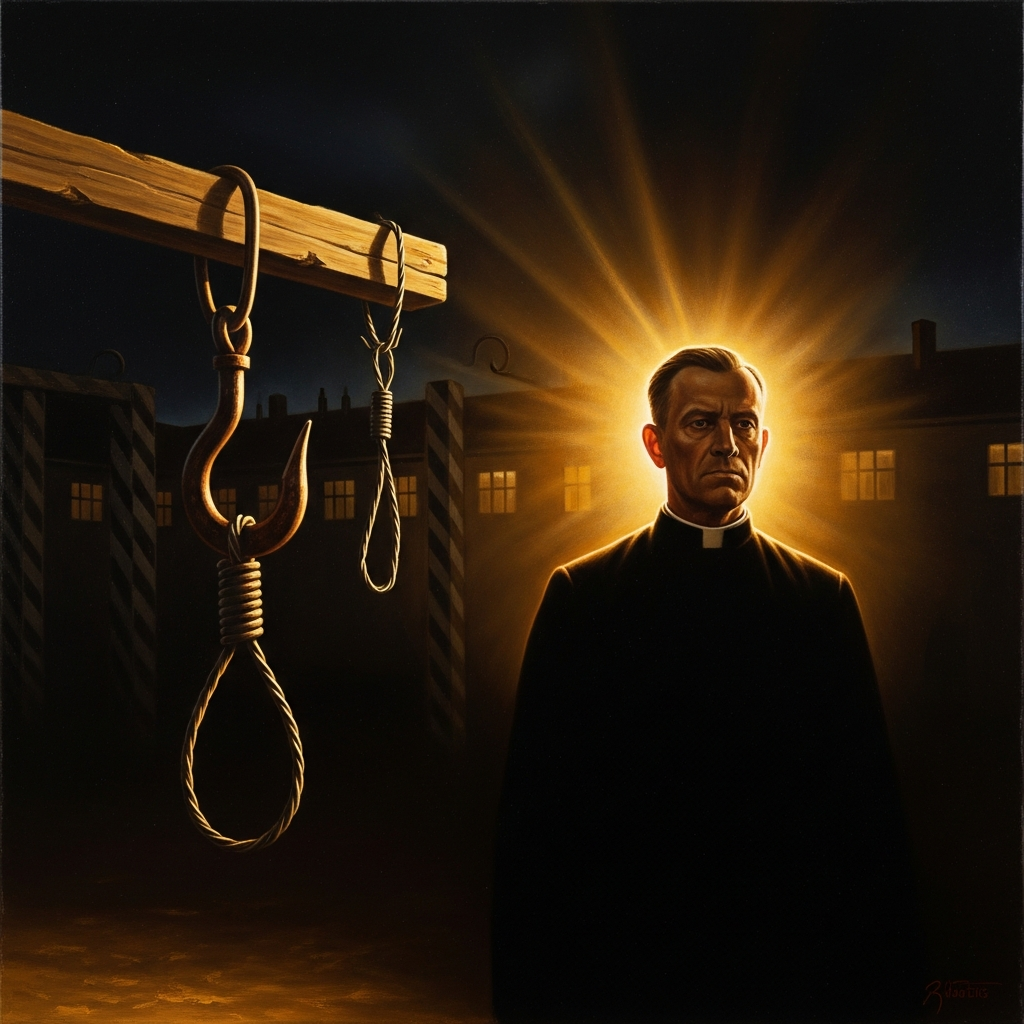
There is no proper gallows. There is a meathook in a beam, the kind butchers use, and a length of piano wire. The SS strip the condemned naked — Canaris, Oster, Sack, Strünck, Gehre, Bonhoeffer — to humiliate them, to deny them even the dignity of a shirt. Bonhoeffer has done calisthenics every morning of his imprisonment. His body, at thirty-nine, is leaner than it was when he taught at Union Seminary.
He climbs the small wooden step.
The wire is looped over the hook. He is given a moment for a final prayer. He prays it silently. The step is kicked.
It takes a long time. Piano wire is slow.
Two weeks later the U.S. 90th Infantry Division enters Flossenbürg.
They find the camp records partially burned, the surviving prisoners walking skeletons, the meathook still in the beam. Bonhoeffer’s family in Berlin will not learn his fate until July, when a memorial service is held for him in London, broadcast by the BBC, and his father — Karl Bonhoeffer, the great psychiatrist — hears in his Berlin study that his son is dead.
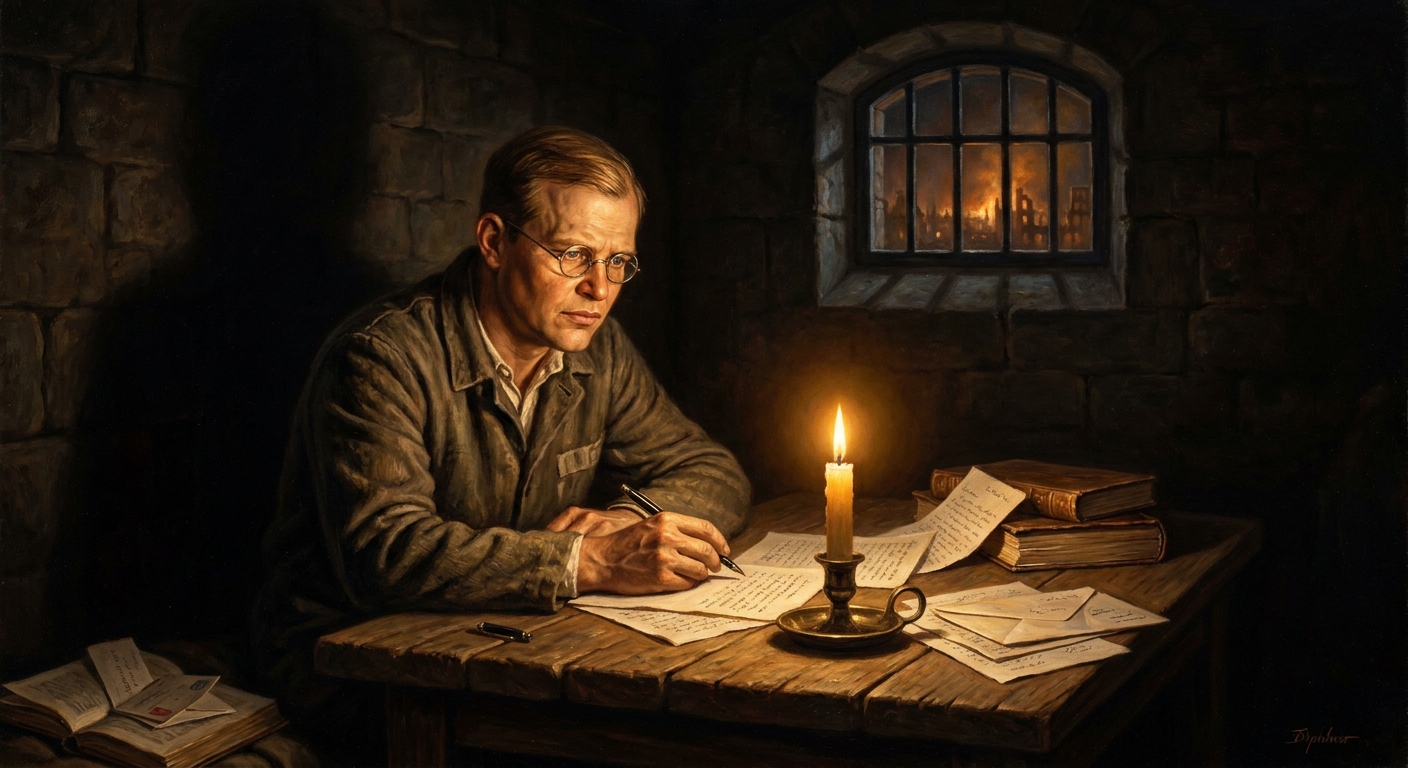
The manuscript of Ethics is incomplete in a desk drawer. The letters from Tegel prison have been smuggled out by a sympathetic guard, hidden in laundry, addressed to Eberhard Bethge. They will become the most widely read theological work of the twentieth century.
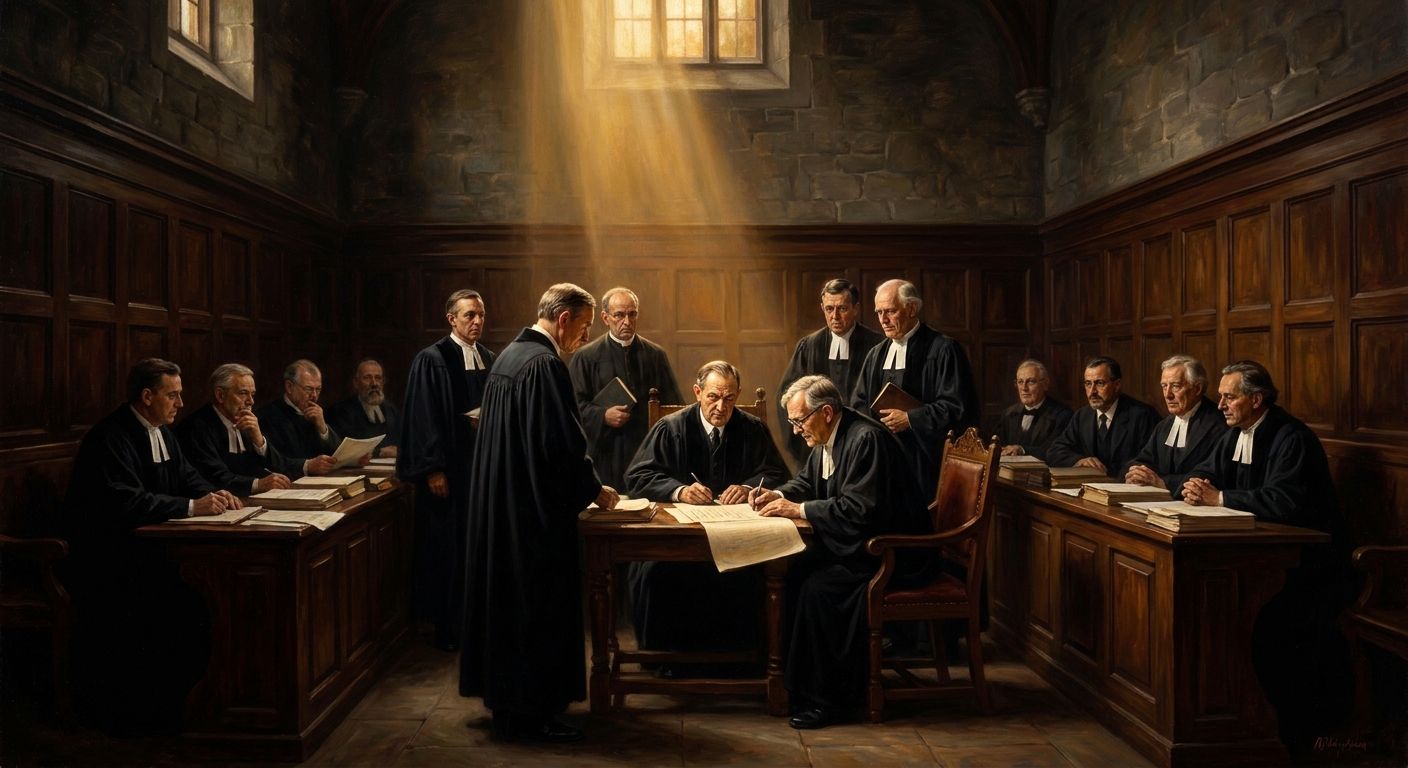
The Confessing Church’s witness was a minority report. Most of German Protestantism — the Deutsche Christen — had bent the knee to the regime by 1934. Bonhoeffer was the rare voice who saw, early and clearly, that a church that signs concordats with mass murderers is no longer a church but a chaplaincy.
The phrase he is remembered for, costly grace, was published when he was thirty-one. He could not have known, writing it, that he would be the textbook example. Cheap grace is grace without discipleship, grace without the cross, grace without Jesus Christ. Costly grace is the gospel which must be sought again and again, the gift which must be asked for, the door at which a man must knock. Such grace is costly because it calls us to follow, and it is grace because it calls us to follow Jesus Christ. It is costly because it costs a man his life.
He paid retail.
Scenes
The execution yard at Flossenbürg, dawn of April 9, 1945 — a meathook, a noose of piano wire, and a pastor
Generating art… Cell 92, Tegel military prison — where the *Letters and Papers from Prison* were smuggled out in laundry
 Generating art…
 Barmen, May 1934 — the Confessing Church declaring that Christ alone, not the Führer, is the Word of God
 Generating art…
 Echoes Across Traditions
Entities
- Dietrich Bonhoeffer
- the Confessing Church
- Adolf Hitler
- Karl Bonhoeffer
- Eberhard Bethge
Sources
- Eric Metaxas, *Bonhoeffer: Pastor, Martyr, Prophet, Spy* (2010)
- Eberhard Bethge, *Dietrich Bonhoeffer: A Biography* (rev. ed. 2000)
- Dietrich Bonhoeffer, *The Cost of Discipleship* (Nachfolge, 1937)
- Dietrich Bonhoeffer, *Letters and Papers from Prison* (Widerstand und Ergebung, 1953, ed. Bethge)
- Charles Marsh, *Strange Glory: A Life of Dietrich Bonhoeffer* (2014)