Transfiguration on the Mountain
~28–30 CE · six days after Peter's confession at Caesarea Philippi · A high mountain — traditionally Mount Tabor in Galilee, or Mount Hermon
Contents
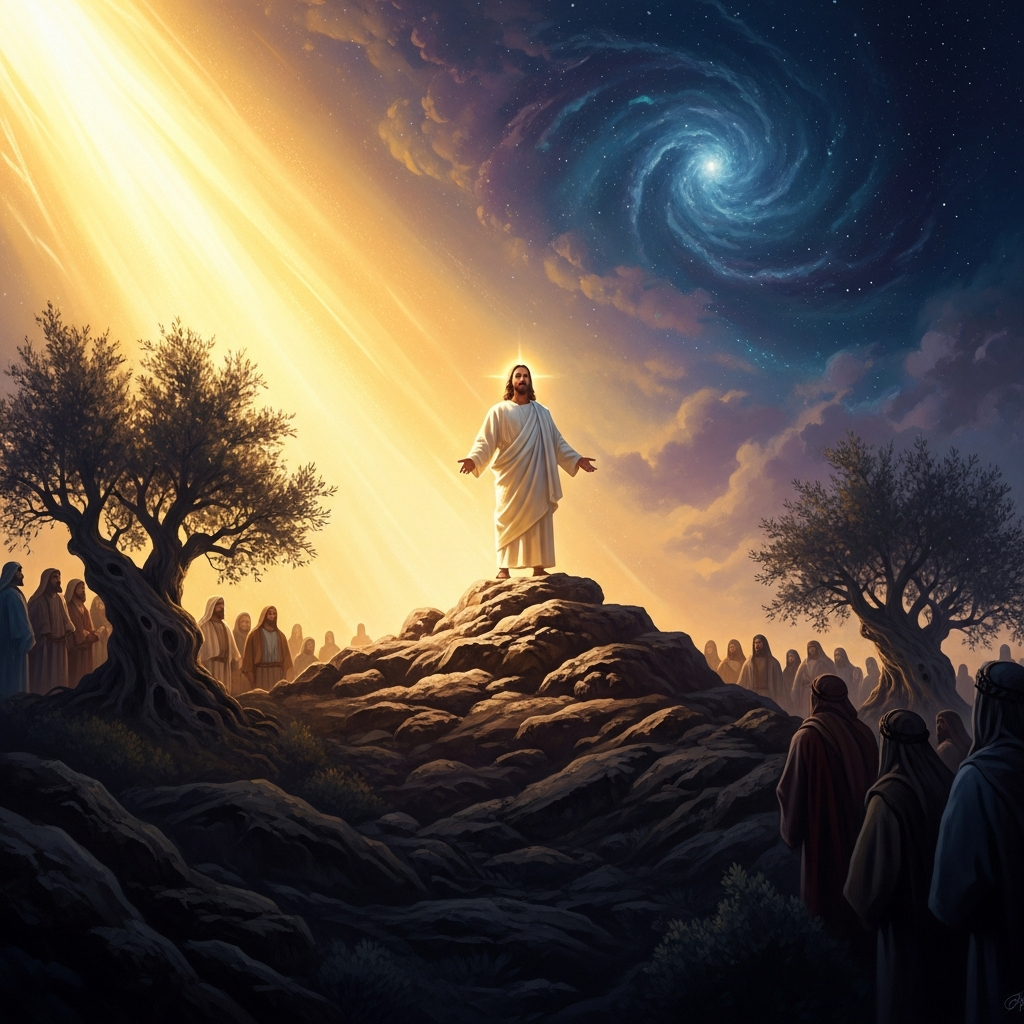
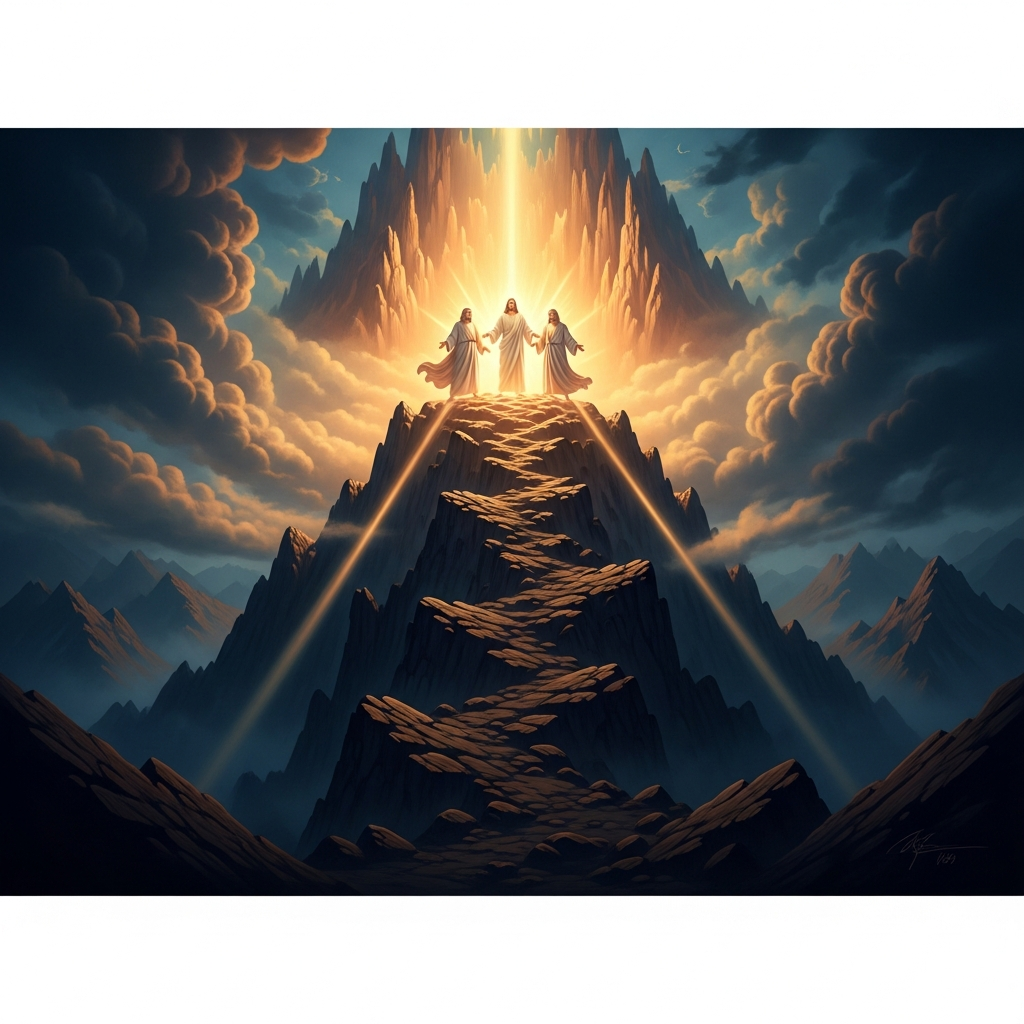
Peter, James, and John follow Jesus up a high mountain. His face blazes like the sun. Moses and Elijah stand beside him. A cloud descends and God speaks. When the disciples dare to look again, only Jesus remains — and the world they understood is gone.
- When
- ~28–30 CE · six days after Peter's confession at Caesarea Philippi
- Where
- A high mountain — traditionally Mount Tabor in Galilee, or Mount Hermon
Six days earlier, Peter said the right thing in the wrong key.
At Caesarea Philippi, Jesus asked who people were saying he was, and Peter answered without hesitation: You are the Christ, the Son of the living God. Jesus told him the answer came from God, not from blood and flesh — and then, almost immediately, told all three of them something that broke the frame of the answer. The Son of Man, he said, must go to Jerusalem. He must suffer many things at the hands of the elders and chief priests. He must be killed. And on the third day he must be raised. Peter grabbed him by the arm and said God forbid it, Lord — and received the sharpest rebuke in the gospels: Get behind me, Satan.
Six days of silence after that, walking south through Galilee. Six days to absorb what it means to have named your teacher the Messiah and to have him respond by describing his own execution. Then Jesus takes Peter, James, and John aside and tells them they are going up a mountain.
He does not explain why.
This is the pattern. He takes the three of them — the inner circle within the twelve — without a stated reason, and they follow because following is what they do now. The mountain is high enough that the climb takes effort, high enough that the villages below become small, high enough that the sky feels present in a way it doesn’t in the valleys. Matthew 17:1 says simply that he led them up a high mountain apart — the Greek word is kat idian, privately, separately, away from the crowd.
They are alone on the mountain when it happens.
His face changes first. Not a shift of expression — a shift of substance, as if something behind the skin has decided the skin is insufficient. The Greek is metemorphōthē: he was transformed, transfigured, the word from which the English metamorphosis descends. His face blazes like the sun. His garments turn white as light — Mark’s gospel will say whiter than any bleach on earth could make them, which is Mark’s way of saying: this whiteness has no natural source. It is not reflected. It radiates.
The three disciples are watching a man they have traveled with for months shed the ordinary like a garment.
Moses and Elijah appear.
Luke says they are speaking with Jesus about his exodon — his departure, his exodus — which he is about to accomplish in Jerusalem. The word is carefully chosen. What is coming is not merely a death. It is the same shape of event as the night the Israelites walked out of Egypt — a passage through mortal danger into freedom, a liberation accomplished through blood. Moses, who led the first exodus, stands here on a mountain as he stood on Sinai, speaking of the second.
Elijah stands beside him. The prophet who did not die — who was swept into heaven on a chariot of fire — stands beside the prophet who did, whose grave on Pisgah nobody could ever find. The whole weight of Jewish scripture about death and deliverance and divine appointment is compressed into these two men on either side of the blazing figure of Jesus.
Peter opens his mouth. Peter almost always opens his mouth.
Lord, it is good that we are here. If you wish, I will make three tents — one for you, one for Moses, one for Elijah.
Luke, with characteristic gentleness, adds: not knowing what he was saying. The impulse is correct — something is happening that deserves to be marked, honored, made permanent. The instinct is the one that has built temples and cathedrals and shrines on every sacred hill in human history: the attempt to hold the moment, to roof over the numinous before it moves on. But the numinous does not want a tent.
The cloud comes while Peter is still speaking.
Bright and dense simultaneously, the way light that comes from inside a thing looks different from light that falls on it from outside. It covers them — covers all five of them, the three disciples and the two from the other side of death — and out of the cloud comes a voice that the disciples have not heard before but know immediately is the same voice that spoke over the Jordan when Jesus was baptized.
This is my beloved Son, with whom I am well pleased. Listen to him.
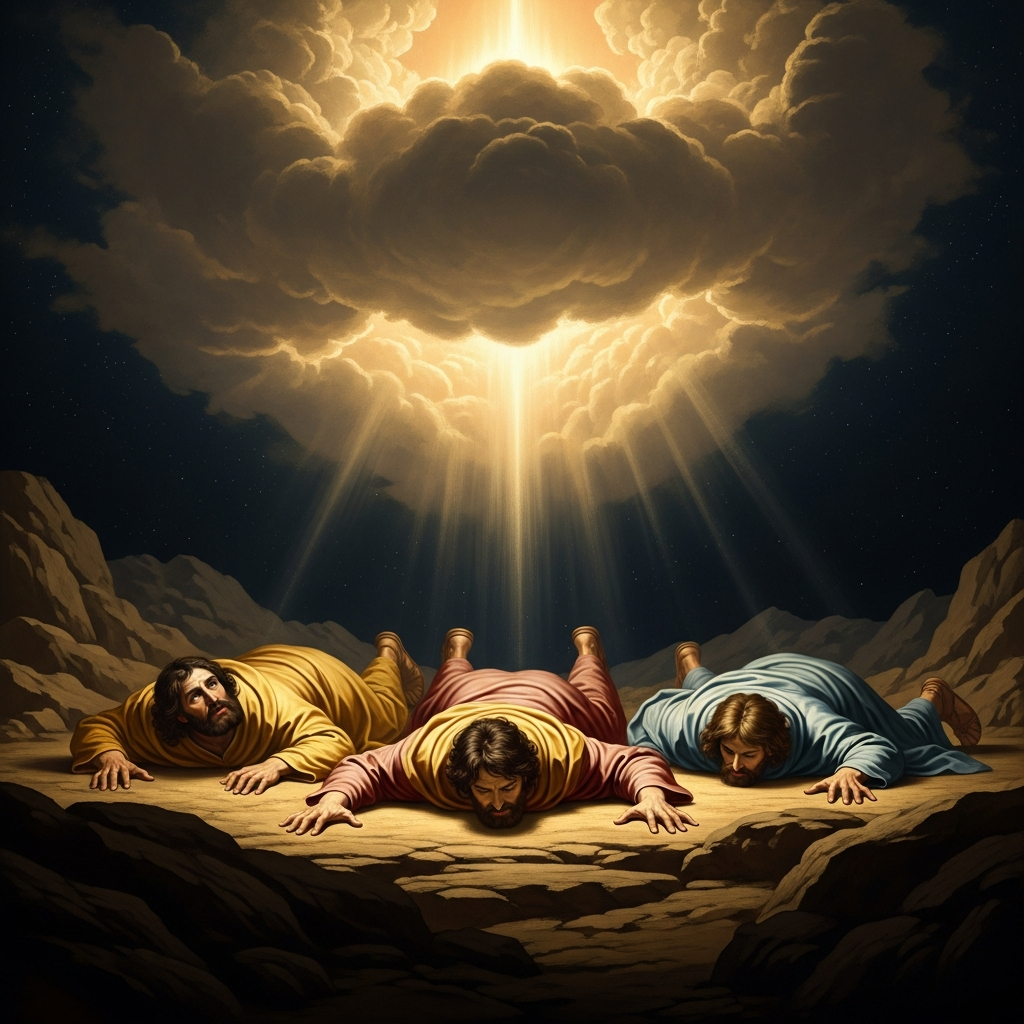
The disciples fall on their faces. Matthew 17:6 says they were greatly afraid, which is the standard Semitic formula for the experience of direct divine encounter — the same trembling that seized the Israelites at Sinai, that dropped Ezekiel on his face before the chariot-throne, that made Isaiah cry out I am ruined when he saw the Lord in the Temple. The body responds to the sacred before the mind can rationalize. The body hits the ground.
Then a touch on their shoulders. Rise and have no fear.
They lift their faces.
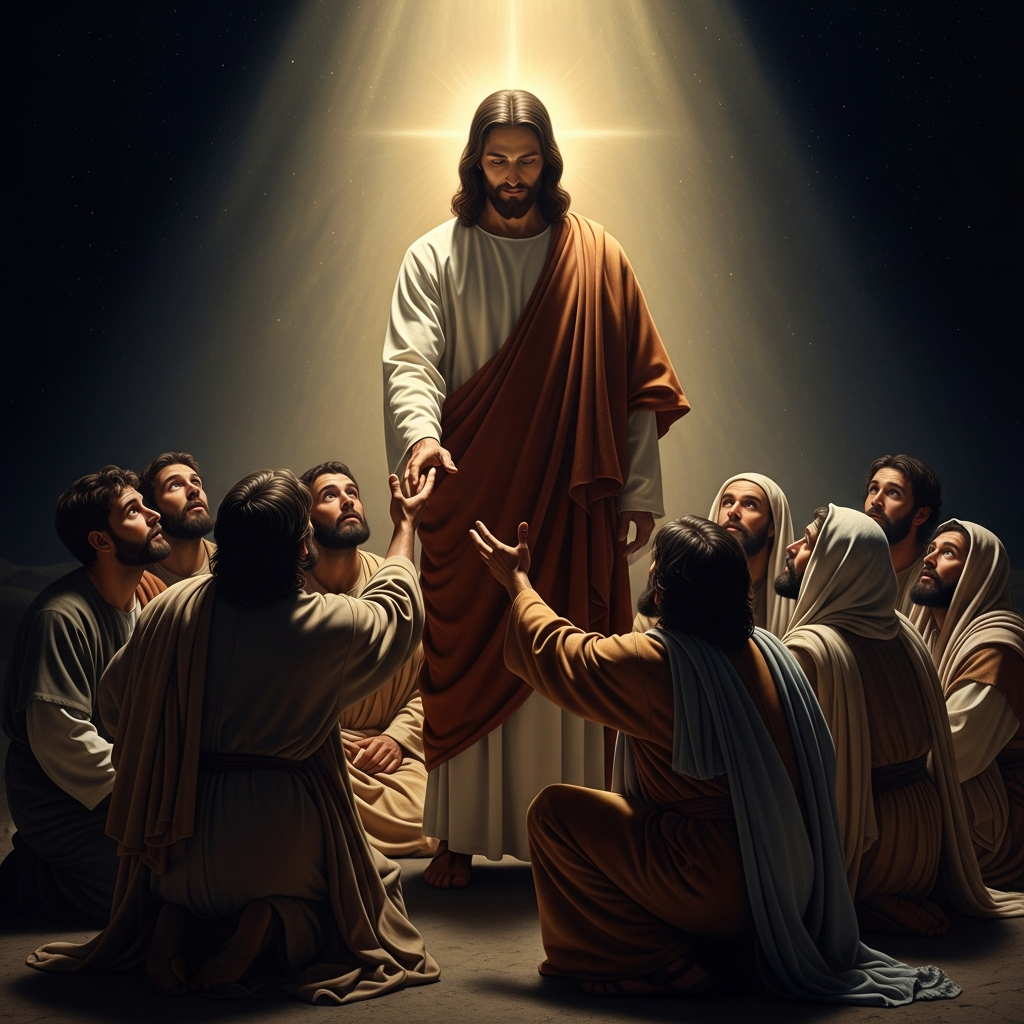
Moses is gone. Elijah is gone. The cloud is gone. The blazing face and the garments white as lightning are gone. Jesus stands above them in the morning light, a man in ordinary clothes, the same face they ate breakfast with yesterday, his hand on the shoulder of the one he just touched. They saw no one but Jesus only.
Only. The Greek is monon, alone, singular. The cloud of witnesses has parted and left one figure. Not Moses who gave the law from Sinai. Not Elijah who called fire from heaven. The voice in the cloud did not say listen to the three of them or listen to the tradition they represent. It said: listen to him.
The descent is silent. Jesus orders them to tell no one the vision until the Son of Man is raised from the dead, and the three of them walk down the mountain wondering privately what raised from the dead means, because the category doesn’t fit anything they know. Dead men stay dead. Lazarus was an exception. But he is talking about himself, and the resurrection of the Messiah is not a concept they were given. So they carry the vision down the mountain in their hands like a vessel they don’t yet have a shelf for.
They ask, on the descent, about Elijah — because the scribes teach that Elijah must come before the Messiah arrives, and if Jesus is the Messiah, the sequence seems wrong. Jesus tells them: Elijah has already come. They did not recognize him and did to him whatever they wished. He means John the Baptist, who is already dead in Herod’s prison, executed for naming Herod’s sin aloud. The forerunner went first. The pattern is set.
The descent from the mountain rejoins the ordinary: a crowd below, an arguing group of scribes, a father with an epileptic boy who the other disciples could not heal. Jesus heals him. The mountain vision becomes background, unmentioned, held by three men who keep the secret for the rest of Jesus’ life and begin to understand it only after Easter.
Peter will write about it decades later, in what becomes 2 Peter 1:16–18: We did not follow cleverly devised myths when we made known to you the power and coming of our Lord Jesus Christ, but we were eyewitnesses of his majesty. For when he received honor and glory from God the Father, and the voice was borne to him by the Majestic Glory: “This is my beloved Son, with whom I am well pleased,” we ourselves heard this very voice borne from heaven, for we were with him on the holy mountain.
He will not say more than that. The mountain is not the kind of thing you explain.
The Transfiguration sits at the exact center of Matthew’s gospel — the midpoint between Galilee and Jerusalem, between the Beatitudes and the cross. What it does at the center is hold open, for one moment, the question that will drive everything that follows: who is this, exactly?
Peter said it at Caesarea Philippi. The voice in the cloud confirms it. Moses and Elijah — the Law and the Prophets — stand beside it. The tradition calls this fulfillment: everything that came before was pointing here, and the blazing face on the mountain is the moment the pointing is allowed to show its object.
The disciples fall on their faces. They are told to rise. They come down the mountain and rejoin the road to Jerusalem, which is also the road to the cross. The vision they carry is not comfort, exactly. It is a question they will spend the rest of their lives answering.
Scenes
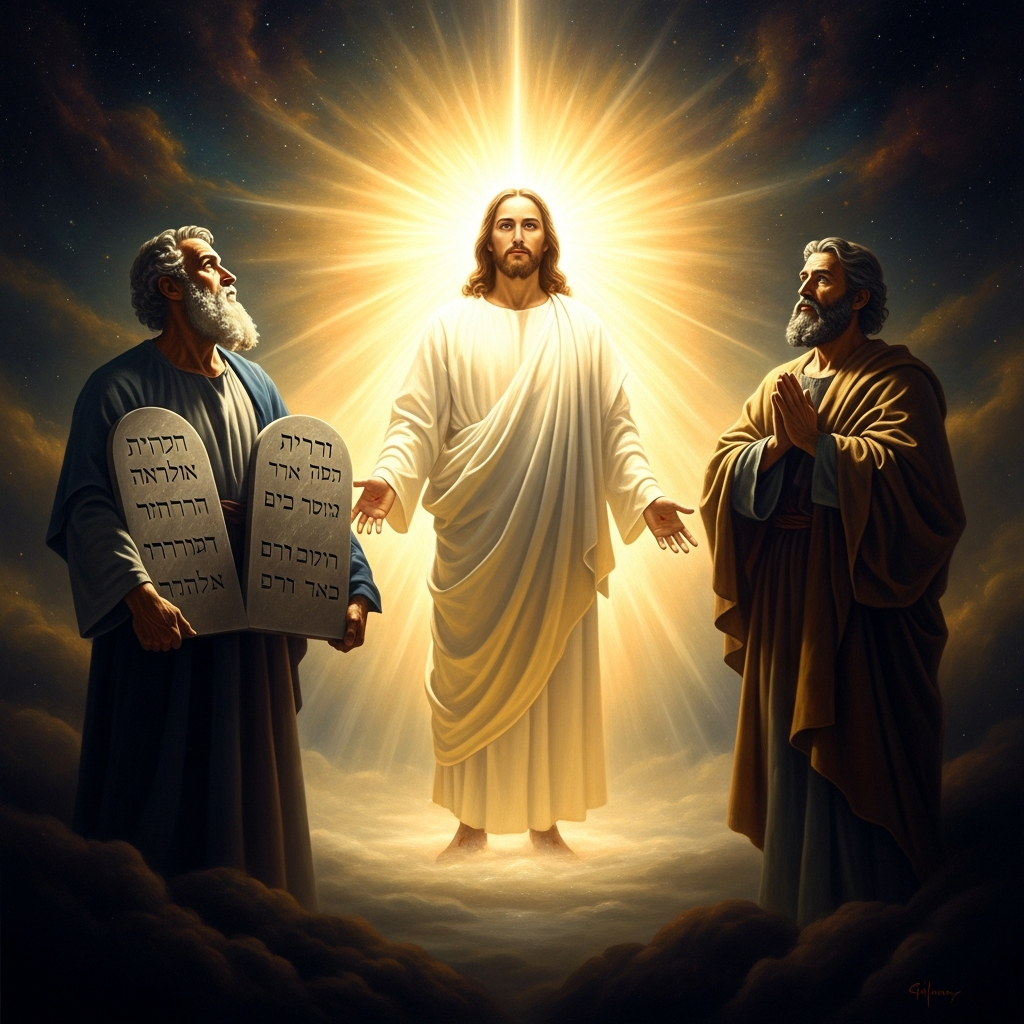
Moses and Elijah stand on either side of the blazing Christ — the Law and the Prophets flanking the one they both pointed toward
 Generating art…
 Peter, James, and John collapse face-down on the mountainside as the cloud descends and the voice of God fills the air
 Generating art…
 When the disciples lift their faces, the vision is gone — only Jesus stands above them, his hand reaching down, the ordinary morning returned
 Generating art…
 Echoes Across Traditions
Entities
- Christ
- Peter
- James
- John
- Moses
- Elijah
Sources
- Matthew 17:1–13
- Mark 9:2–13
- Luke 9:28–36
- 2 Peter 1:16–18
- Exodus 34:29–35 (Moses' shining face)
- 1 Kings 19:8–13 (Elijah at Horeb)
- Dale Allison, *The New Moses: A Matthean Typology* (1993)
- Origen, *Commentary on Matthew* (~248 CE)