The Woman at the Well: Living Water
~28–30 CE · During a journey from Judea to Galilee through Samaria · Jacob's well near Sychar in Samaria — a specific, real location still identifiable today, near modern Nablus
Contents
At noon, alone at Jacob's ancient well near Sychar, a Samaritan woman comes to draw water and finds a Jewish man sitting there who asks her for a drink. He breaks two rules at once — men do not speak alone with women, Jews do not share vessels with Samaritans. He offers her water that will never run out. She wants it. He tells her everything about her life. She goes back to her village and becomes the first evangelist in John's gospel.
- When
- ~28–30 CE · During a journey from Judea to Galilee through Samaria
- Where
- Jacob's well near Sychar in Samaria — a specific, real location still identifiable today, near modern Nablus
It is noon, and she comes alone.
The women of Sychar draw water in the morning, in the cool, in groups — the well is a social event and the morning hour is the convention. A woman who comes at noon comes when no one else is there. She comes alone because the company of other women has become painful, or because she has been made unwelcome, or because the questions and the looks have gotten heavy enough that solitude at midday is preferable to community in the morning. We are not told which. John gives us only the hour and the fact that she is alone.
She is a Samaritan. He is a Jew — which means they are descended from two branches of the same Israelite tradition that split eight centuries earlier over a question of which temple was the correct one and which bloodline the correct priesthood. The split produced seven hundred years of mutual contempt. Samaritans and Jews do not speak to each other if they can help it. They do not share vessels. The purity codes on both sides have made even a cup of water a political act.
Jesus is sitting on the well’s edge, tired from the journey, alone. The disciples have gone into the village to buy food.
He asks her: give me a drink.
She says: how is it that you, a Jew, ask a drink of me, a woman of Samaria?
The question holds two violations at once and she names them both. The ethnic boundary — Jews and Samaritans — and the gender boundary, which in the ancient Mediterranean world was more nearly absolute than modernity usually grasps. A man of any reputable standing did not address a woman in public who was not his wife or close kin. This was the convention across Greek, Roman, and Jewish culture alike. The disciples, when they return, will be astonished to find him talking with a woman. They will not ask why; the why is obvious. The surprise is that he is doing it.
Jesus ignores the political objection and goes past it: if you knew the gift of God, and who it is that is saying to you, “give me a drink,” you would have asked him, and he would have given you living water.
Living water — hydōr zōn — is a phrase with two referents in her world. Practically, it means running water, spring water, water with a source rather than collected rainwater, which is technically superior for ritual washing. Theologically, in the Hebrew prophets, it is a metaphor for God: Jeremiah calls God the fountain of living water; Zechariah prophesies living water flowing from Jerusalem. She may be hearing both meanings simultaneously when she asks the practical question: Sir, you have nothing to draw water with, and the well is deep. Where do you get that living water?
Then: Are you greater than our father Jacob, who gave us the well and drank from it himself, and his sons, and his livestock?
The question is genuine Samaritan theology. Jacob is as much the Samaritans’ ancestor as the Jews’. This well is the inheritance of a shared patriarch. The question is: who are you to offer better water than the man who dug this hole in the ground?
Jesus does not answer the historical question. He answers the need underneath it.
Everyone who drinks of this water will be thirsty again, but whoever drinks of the water that I will give him will never be thirsty again. The water that I will give him will become in him a spring of water welling up to eternal life.
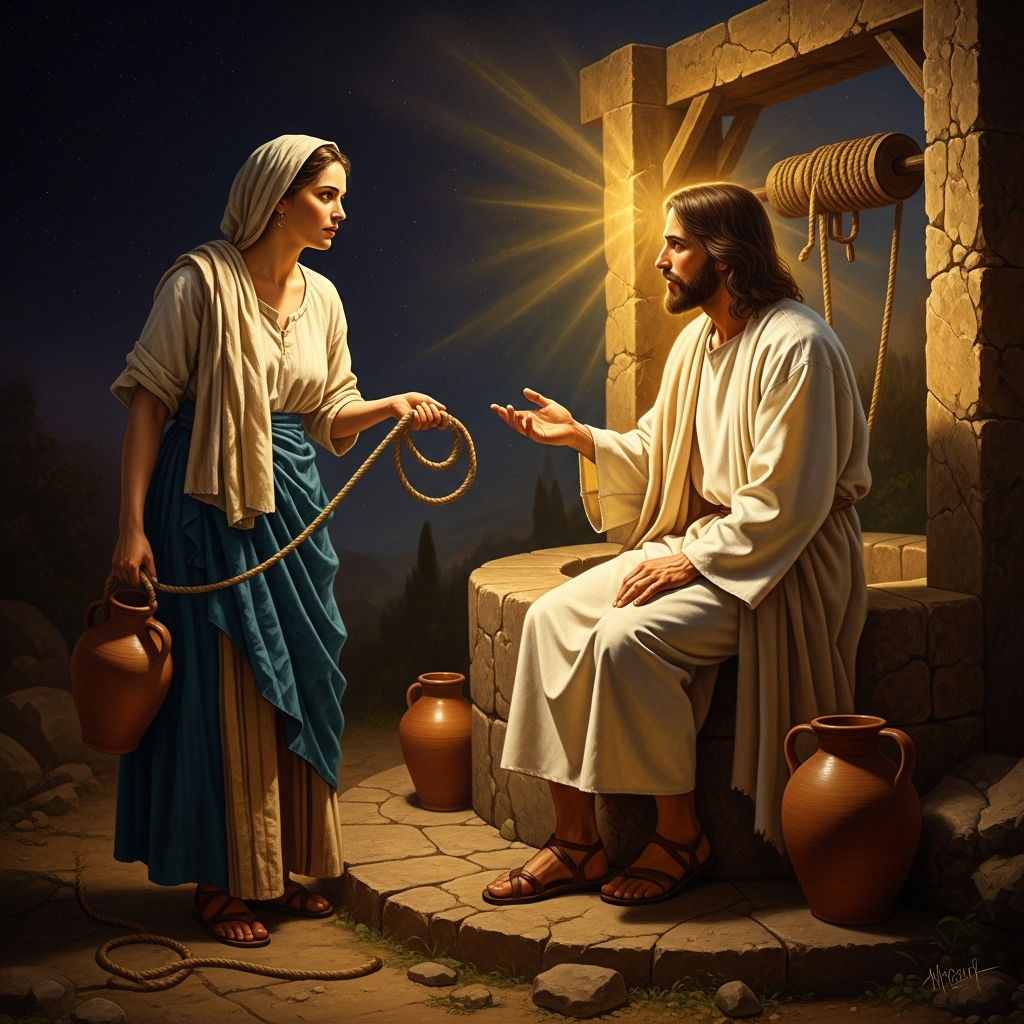
She says: Sir, give me this water, so that I will not be thirsty or have to come here to draw water. She is still reasoning practically — this would solve the logistical problem of the noon journey, the loneliness of it, the labor of it. She wants the water. She is not pretending to understand what he means. She wants what he is offering.
He says: go, call your husband, and come here.
She says: I have no husband.
He says: you are right. You have had five husbands, and the one you have now is not your husband. What you have said is true.
The pastoral tradition has spent centuries arguing about those five husbands — whether this is moral condemnation, whether the woman is an adulteress or a widow or a victim of a culture in which women could be divorced and remarried without consent. What John records is not condemnation. Jesus does not scold her. He states the fact. Then he says: what you have said is true. The precision of the observation is what moves her, not a judgment.
She says: Sir, I perceive that you are a prophet.
She raises the ancient theological argument between their peoples — the one about which mountain is correct, Gerizim or Jerusalem — and Jesus does not take the bait in the direction she expects. He does not argue for Jerusalem. He says the hour is coming when neither mountain matters, when true worshipers will worship in spirit and truth, when the location of the temple is beside the point because the Father is seeking worshipers and worship is an interior act that no geography can contain or exclude.
She says: I know that Messiah is coming — he who is called Christ. When he comes, he will tell us all things.
Jesus says: I who speak to you am he.
This is the only place in the synoptic tradition where Jesus states plainly and without qualification who he is, and he states it to this woman, alone, at a well, at noon, in a foreign country, in the middle of a conversation about water. It is not at the Temple. It is not to the Twelve. It is not in Jerusalem. It is here.
The disciples return from the village and find him talking with a woman. They say nothing. They stand with their food and their surprise and say nothing.
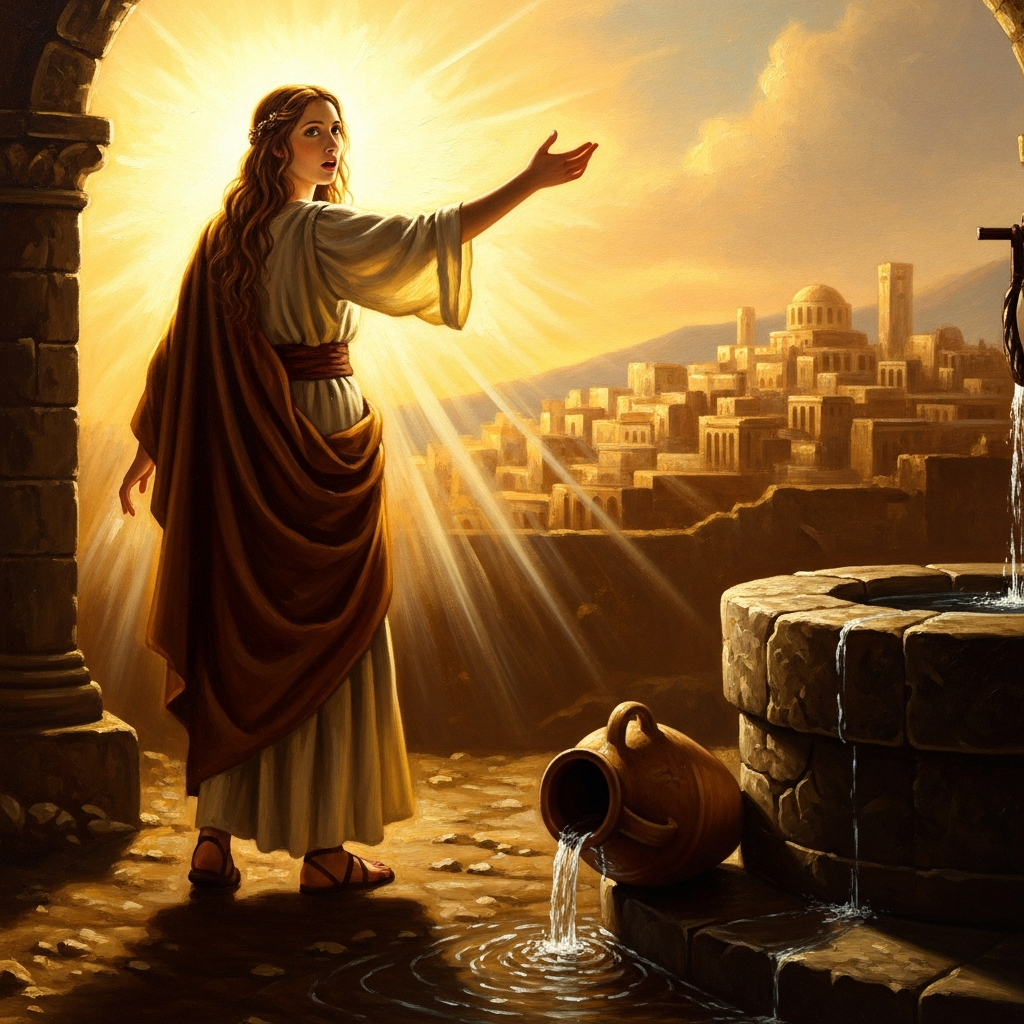
The woman leaves her water jar.
This is the detail John inserts quietly and it carries everything: she came to the well for water, she has had the conversation, she has been told everything about her life, she has received the offer of living water — and she walks away without the water jar she came for. She goes back into the city. She finds the people there and says: Come, see a man who told me all that I ever did. Can this be the Christ?
The testimony is precisely calibrated to what she knows. She does not claim to understand the full theological weight of what happened. She does not claim he is definitely the Messiah. She says: he told me everything I ever did. Come and see. These are the exact words Philip used to Nathanael two chapters earlier. Philip, who had been explicitly called by Jesus, uses the same three words that this unnamed woman at the edge of a village uses after one conversation at noon.
Many Samaritans from that city believe because of her word. They come out of the city toward him. They ask him to stay with them. He stays two days. More believe. They say to the woman: it is no longer because of what you said that we believe, for we have heard for ourselves, and we know that this is indeed the Savior of the world.
She came to the well at noon to be alone. She left without the jar she came for. Her name is never given — in two thousand years of naming and cataloguing, the tradition has called her Photini, Philomena, Svetlana, Susanna, and a dozen others, as if the anonymity of the text itself is an invitation. She is whatever the unnamed person at the edge of a village is, in every village, in every century: the one who carries the news because she happened to be at the well at the wrong hour and found someone waiting.
The jar is still there, presumably, sitting at the curb of the ancient well. She walked back into the city empty-handed and full.
Scenes
Noon at Jacob's well — the wrong hour to draw water, the hour when no one else comes — and a Jewish man sitting on the well's edge asks a Samaritan woman for a drink
 Generating art…
 She asks him for this living water, still thinking of logistics, still holding the rope and the jar — and he asks her to go get her husband, and everything shifts
 Generating art…
 She leaves her water jar at the well and goes back into the city: Come and see a man who told me everything I ever did
 Generating art…
 Echoes Across Traditions
Entities
- Christ
Sources
- John 4:1–42
- Genesis 24, 29; Exodus 2 (well betrothal scenes)
- Sandra Schneiders, *The Revelatory Text* (1991)
- Raymond Brown, *The Gospel According to John* I–XII, Anchor Bible (1966)
- Hosea 2:14–20 (God as husband of Israel in the wilderness)