Feeding the Five Thousand: Twelve Baskets Left Over
~29 CE · Shortly before Passover (John 6:4) · A deserted place near Bethsaida, northeast shore of the Sea of Galilee — a hillside, grass still green, near the water
Contents
A crowd of five thousand has followed Jesus to a deserted place and it is growing late. The disciples say: send them away. Jesus says: you feed them. They have five loaves and two fish. Jesus takes the bread, looks up, blesses it, breaks it, and gives it to the disciples to distribute. Everyone eats and is satisfied. Twelve baskets of fragments are collected. This is the only miracle recorded in all four Gospels.
- When
- ~29 CE · Shortly before Passover (John 6:4)
- Where
- A deserted place near Bethsaida, northeast shore of the Sea of Galilee — a hillside, grass still green, near the water
John tells us it is nearly Passover.
The crowd that follows Jesus to the northeast shore of the Sea of Galilee is large enough that Philip, when Jesus asks him where to buy bread for them, does his arithmetic and says: two hundred denarii worth of bread would not be enough for each of them to get a little. Two hundred denarii is eight months’ wages. Philip is not being unhelpful. He is demonstrating that the scale of the problem exceeds the available solution. This is the disciples’ correct analysis of the situation. This is the starting point.
The crowd has followed him because of the signs he has been performing on the sick. Jesus has crossed the sea in a boat trying to find a quiet place — Mark says he wanted to rest, the disciples wanted rest, they had not had time to eat. The crowd outrans the boat on foot around the shoreline and is waiting when he lands. He sees them and has compassion on them — splanchnizomai, that gut-level response — and he begins to teach and heal. By the time the afternoon is advanced and the shadows are lengthening, five thousand people, at minimum, are sitting on the hillside in the spring grass.
The disciples come to him with a reasonable plan. Send them away. Let them go to the surrounding villages and farms and buy food and find lodging before it gets dark.
Jesus says: you give them something to eat.
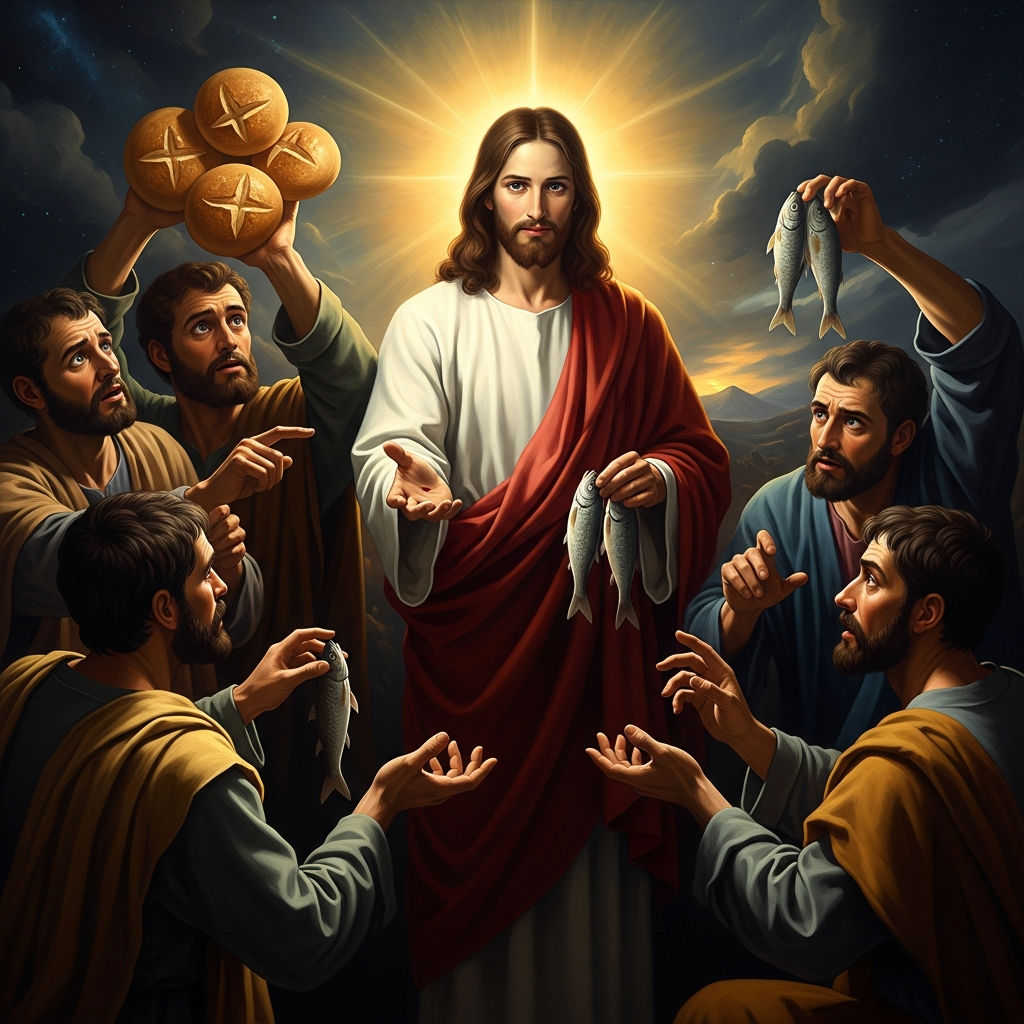
The disciples bring the inventory.
In Mark’s account, he asks what they have. In John’s, it is Andrew who surfaces the specific count — five barley loaves and two fish — and Andrew already knows this is insufficient: but what are they for so many? Five and two. Seven items. Enough for one small meal for perhaps one family.
Jesus says: bring them here to me.
In Mark’s account, he tells the disciples to seat the crowd in groups on the green grass — symposia symposia, company by company, the Greek repeating the word for emphasis, as if he is seating them for a formal banquet. They sit in groups of hundreds and fifties. The hillside becomes an ordered arrangement of companies, each visible to the ones around them, none invisible in the back of a formless mob. Mark’s word for the colors of their clothing against the grass is remarkable: prasiai prasiai, garden-bed by garden-bed, like a planted field. Five thousand people arranged on a hillside like a human garden.
He takes the five loaves and the two fish.
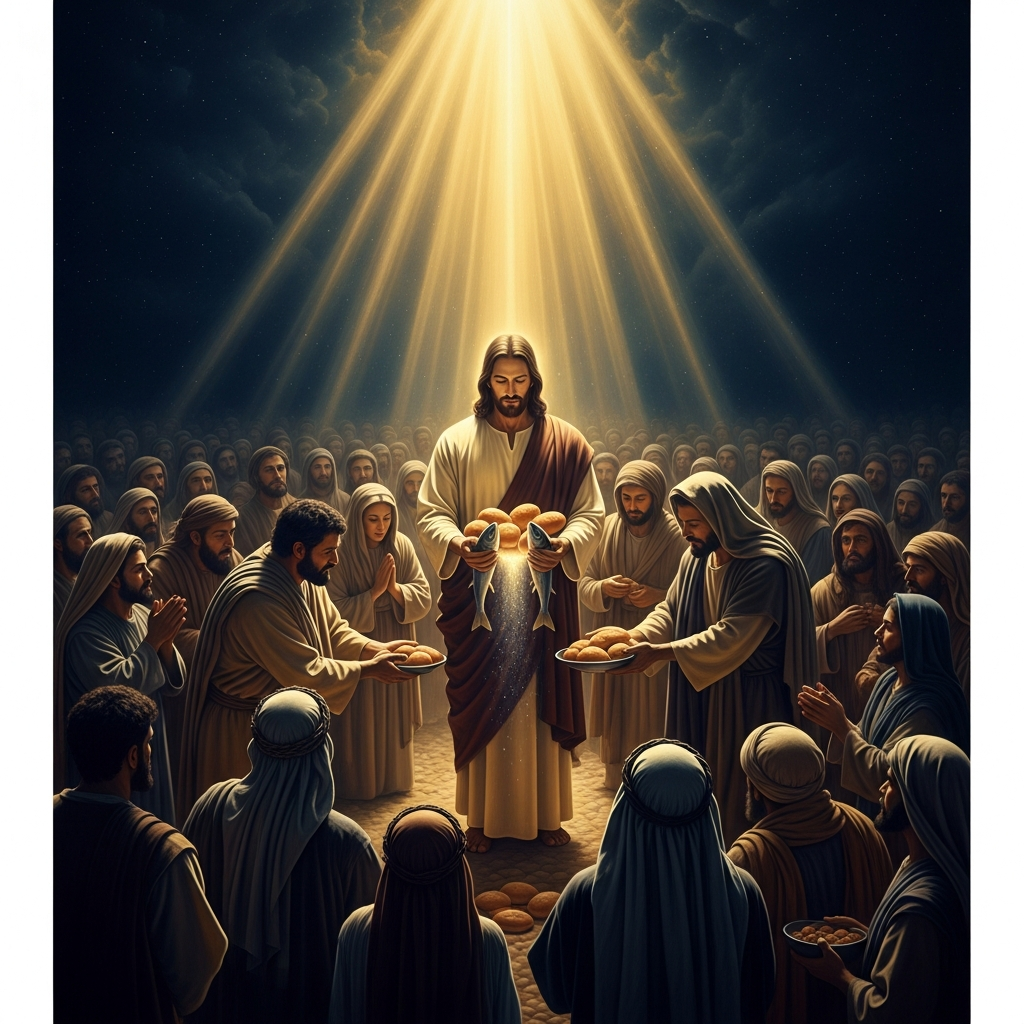
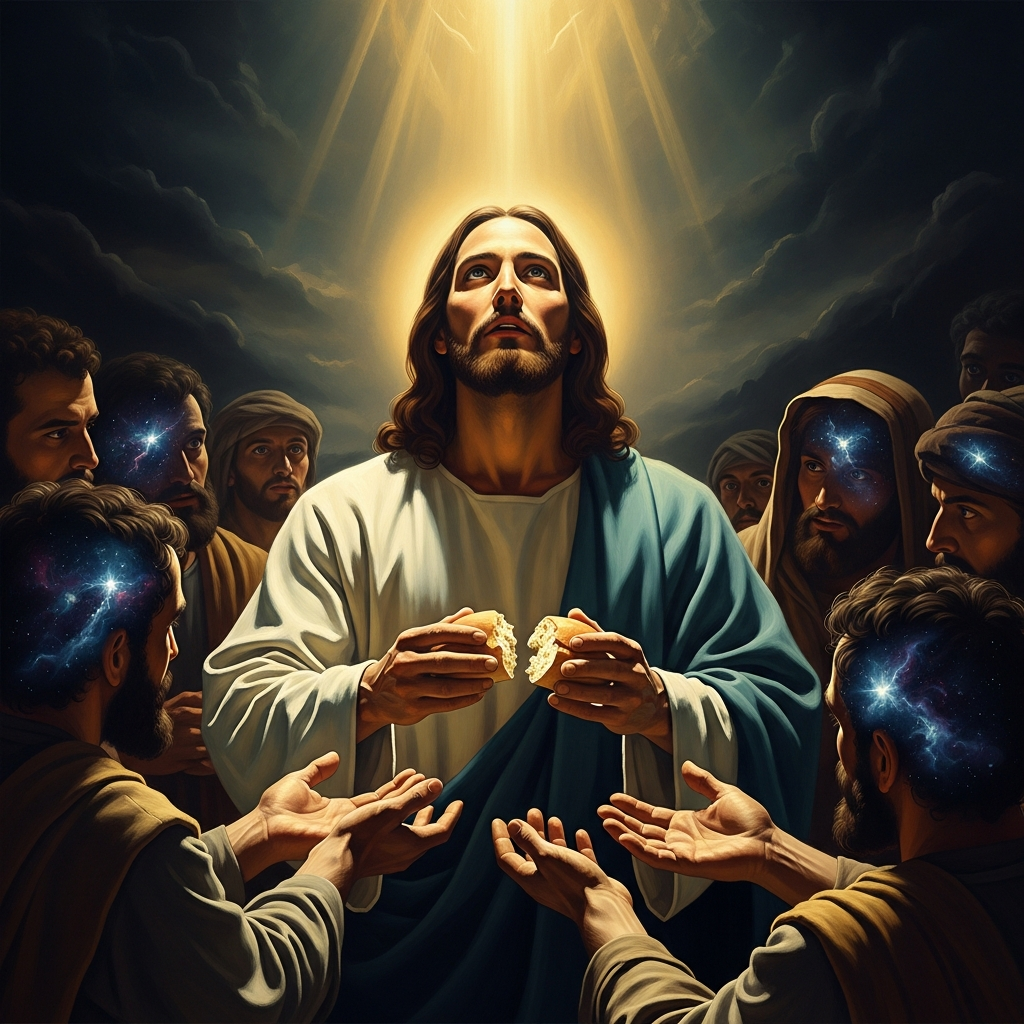
He looks up to heaven. He blesses — eulogēsen, from which the word Eucharist will develop. He breaks the loaves. He gives them to the disciples to distribute to the people. The fish he divides as well.
Four verbs: took, blessed, broke, gave. These four verbs will be repeated at the Last Supper, and they will be repeated in every Eucharist in every tradition that uses one since. The pattern is set here on a hillside by a lake in the spring of the year, with five thousand people sitting in the grass and a problem that cannot be solved by arithmetic.
The distribution begins. Each disciple takes from what Jesus has blessed and broken and carries it out to the groups. They carry bread to the first group. They return for more. They carry bread to the second group. They return. The text does not explain the mechanism of the multiplication — whether the loaves keep multiplying in the hands of Jesus, whether they multiply in the baskets of the disciples, whether something happens at the moment of distribution that the text declines to name. John’s account, the most theologically developed, does not address the mechanics at all. The miracle is simply reported as what happened: they distributed, and everyone ate.
Everyone eats and is satisfied.
Chortazō — satisfied, filled, not merely given enough to survive but fully fed. Matthew, Mark, Luke, and John all use the same word. Five thousand people, on a hillside, late in the afternoon, in a deserted place with no market and no bakery, eat until they are full.
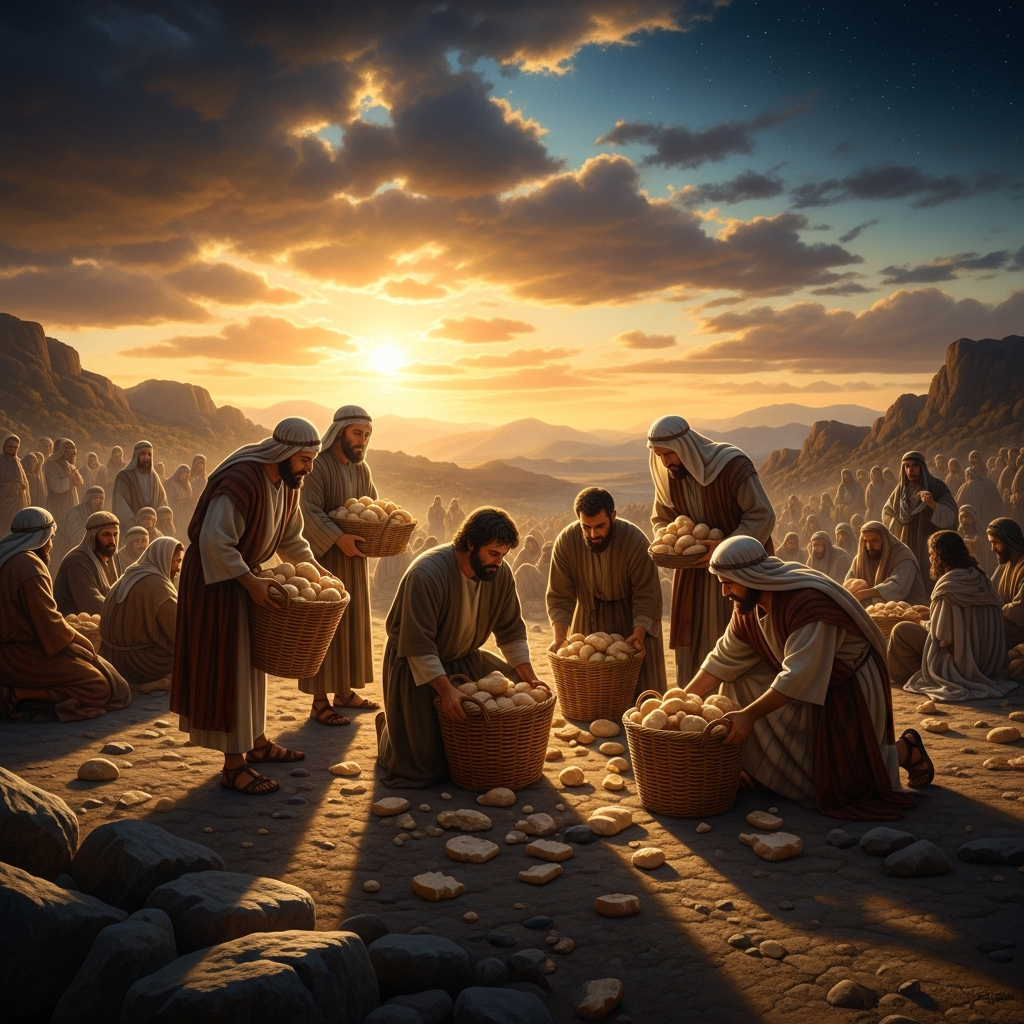
Then Jesus tells the disciples to collect the fragments, so that nothing is wasted. They collect twelve baskets full of broken pieces from the five barley loaves — twelve baskets, after five thousand people have eaten. More left over than what they started with.
The number twelve is not an accident. Matthew, Mark, and Luke all note it. Twelve baskets: twelve tribes of Israel, twelve disciples, twelve as the number of the restored people of God. The surplus is a sign, not a footnote. The feeding that began with five items does not end with zero. It ends with twelve full baskets. Abundance is not merely sufficiency — it is remainder.
John’s number for the crowd — five thousand men, women and children additional and unnumbered — is also legible: five as the number of the books of Torah, the Pentateuch that fed Israel’s spiritual life, now exceeded by the bread that the teacher provides. The symbolism is not allegory: the bread is real, the fish is real, the people are real and hungry. But the numbers are chosen to make the moment legible as the fulfillment of a very long story.
John records what happens after the meal.
When the crowd perceives what has happened — that this man has fed five thousand in a deserted place with almost nothing — they say: This is indeed the Prophet who is to come into the world! The Prophet is a specific figure in Jewish expectation: the one Moses promised in Deuteronomy 18, the prophet like Moses who would arise and speak God’s words. Moses fed Israel in the wilderness. This man has fed Israel in the wilderness. The crowd perceives the typology immediately.
Then: Perceiving then that they were about to come and take him by force to make him king, Jesus withdrew again to the mountain by himself.
He withdraws. He refuses the crown. The feeding is not a political program. The king they want is not the kind of king he is. He goes up the mountain alone, into the dark, and the disciples take the boat back across the lake without him.
The next day John records the Bread of Life discourse — the longest unbroken teaching in any gospel. The crowd follows him across the lake and he spends the discourse correcting their understanding of what happened on the hillside. They want the bread. He tells them they want the bread because they were filled, not because they understood the sign. The bread they should seek is not bread that perishes. The true bread from heaven gives life to the world.
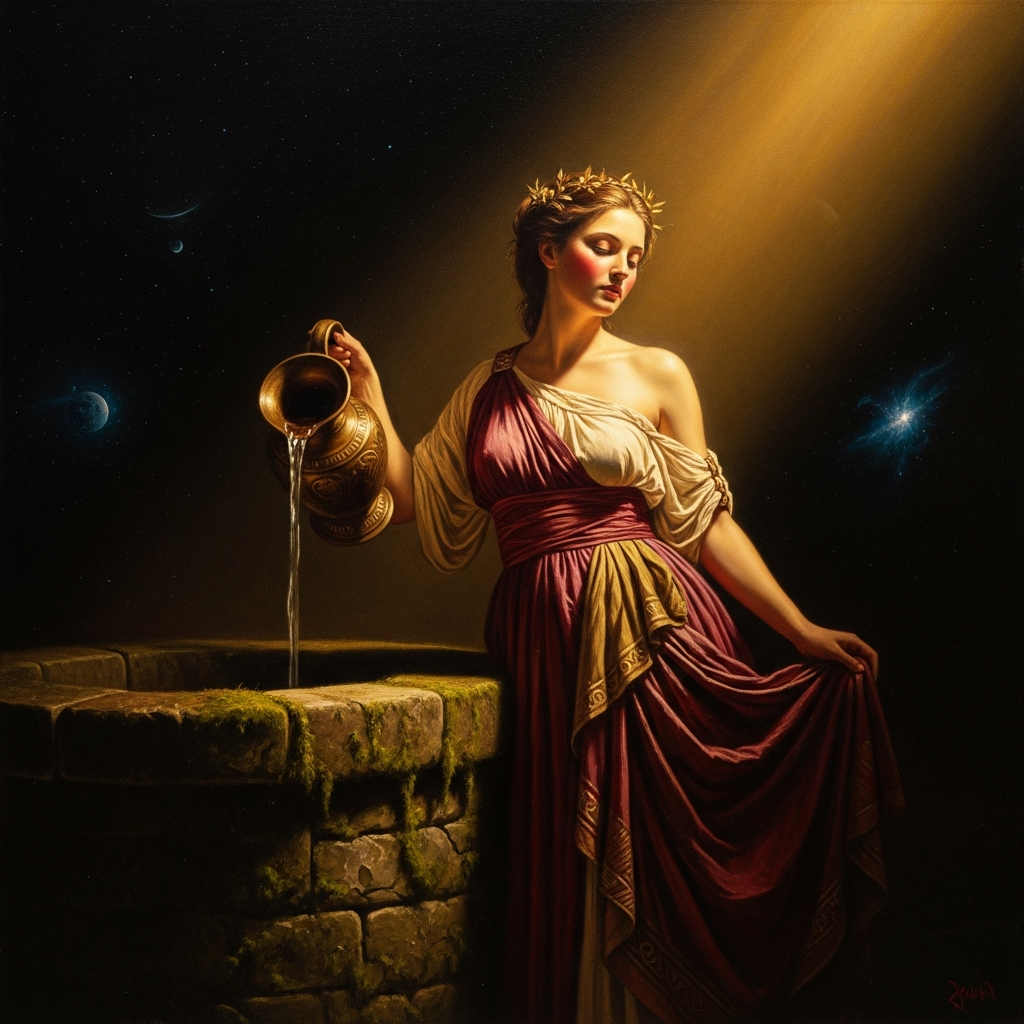
He says: I am the bread of life; whoever comes to me shall not hunger, and whoever believes in me shall never thirst. The two promises — hunger and thirst — echo the woman at the well, echo the manna in the wilderness, echo the entire tradition of divine provision for a hungry people in a desert place.
The crowd grumbles. They know his family. They know where he comes from. How can he say he came down from heaven? He doubles down: unless you eat the flesh of the Son of Man and drink his blood, you have no life in you. Many of his disciples walk away after this. He lets them go. He asks the Twelve: do you want to leave too? Peter answers for them: Lord, to whom shall we go? You have the words of eternal life.
The feeding is the only miracle in all four Gospels. Every other sign appears in one, two, or three accounts; this one no one left out. The church read it for twenty centuries as the prototype of the Eucharist, the moment on the hillside before the Last Supper where the pattern was established — take, bless, break, give — that would be repeated every time bread was put on an altar.
The twelve baskets remain unexplained by physics. They remain the number of the tribes and the number of the disciples and the number of what is left when a desert crowd eats its fill from a boy’s lunch. The feeding began with not enough. It ended with more than it started. The arithmetic of the kingdom runs in the wrong direction, and always has.
Scenes
The disciples count what they have — five loaves, two fish — and report it back to Jesus as evidence of impossibility
 Generating art…
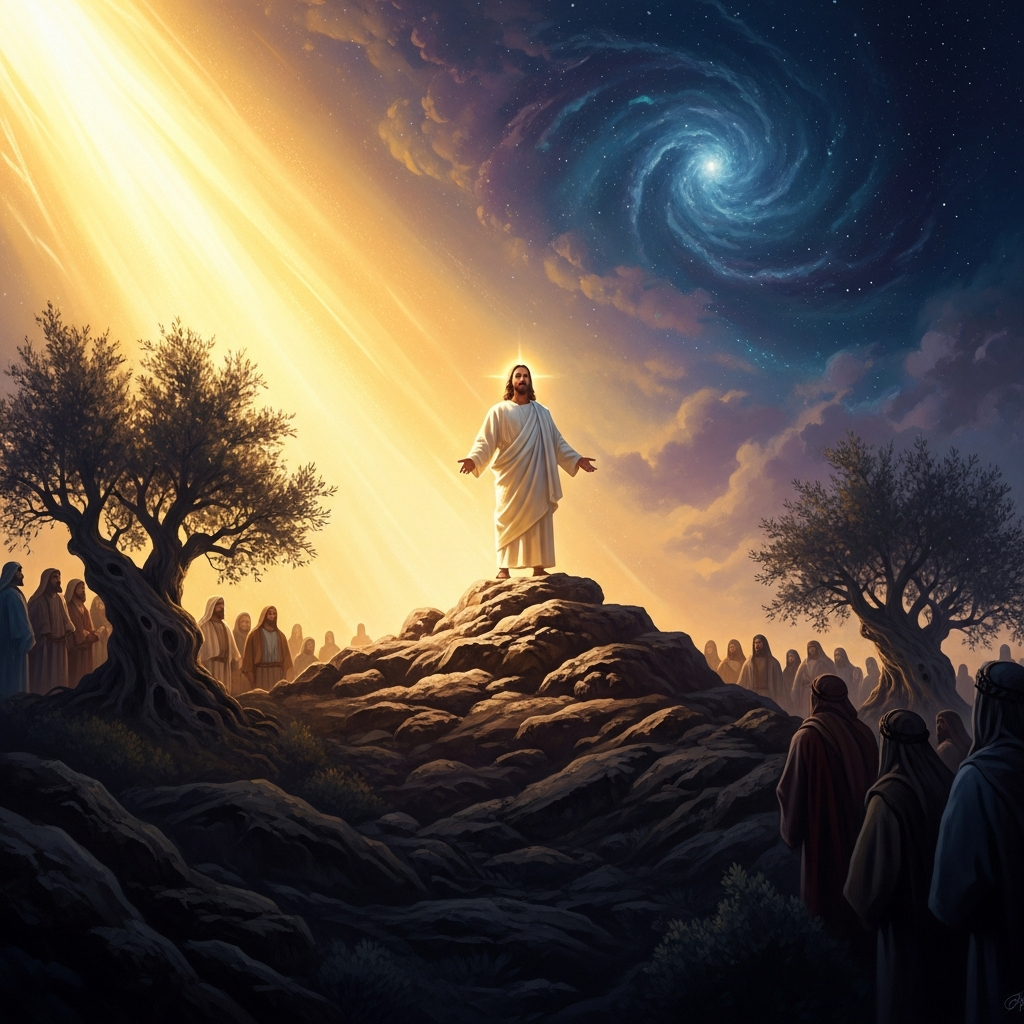
 He looks up to heaven, blesses and breaks the loaves, and gives them to the disciples to set before the people — the same four gestures that will define the Eucharist: take, bless, break, give
 Generating art…
 After five thousand people have eaten and are satisfied, the disciples gather the fragments — twelve baskets full of broken pieces, more left over than what they started with
 Generating art…
 Echoes Across Traditions
Entities
- Christ
Sources
- Matthew 14:13–21
- Mark 6:30–44
- Luke 9:10–17
- John 6:1–15; 6:22–71
- 2 Kings 4:42–44 (Elisha and twenty loaves)
- Exodus 16 (manna in the wilderness)
- N.T. Wright, *Jesus and the Victory of God* (1996)
- Raymond Brown, *The Gospel According to John* I–XII, Anchor Bible (1966)