Sermon on the Mount
~28–30 CE · early Galilean ministry · A hillside above the Sea of Galilee, near Capernaum
Contents
On a hillside above the Sea of Galilee, Jesus sits down and speaks. Peasants, fishermen, and tax collectors hear a teaching that dismantles every assumption they carry about virtue, wealth, piety, and the kind of God they live under.
- When
- ~28–30 CE · early Galilean ministry
- Where
- A hillside above the Sea of Galilee, near Capernaum
He does not stand.
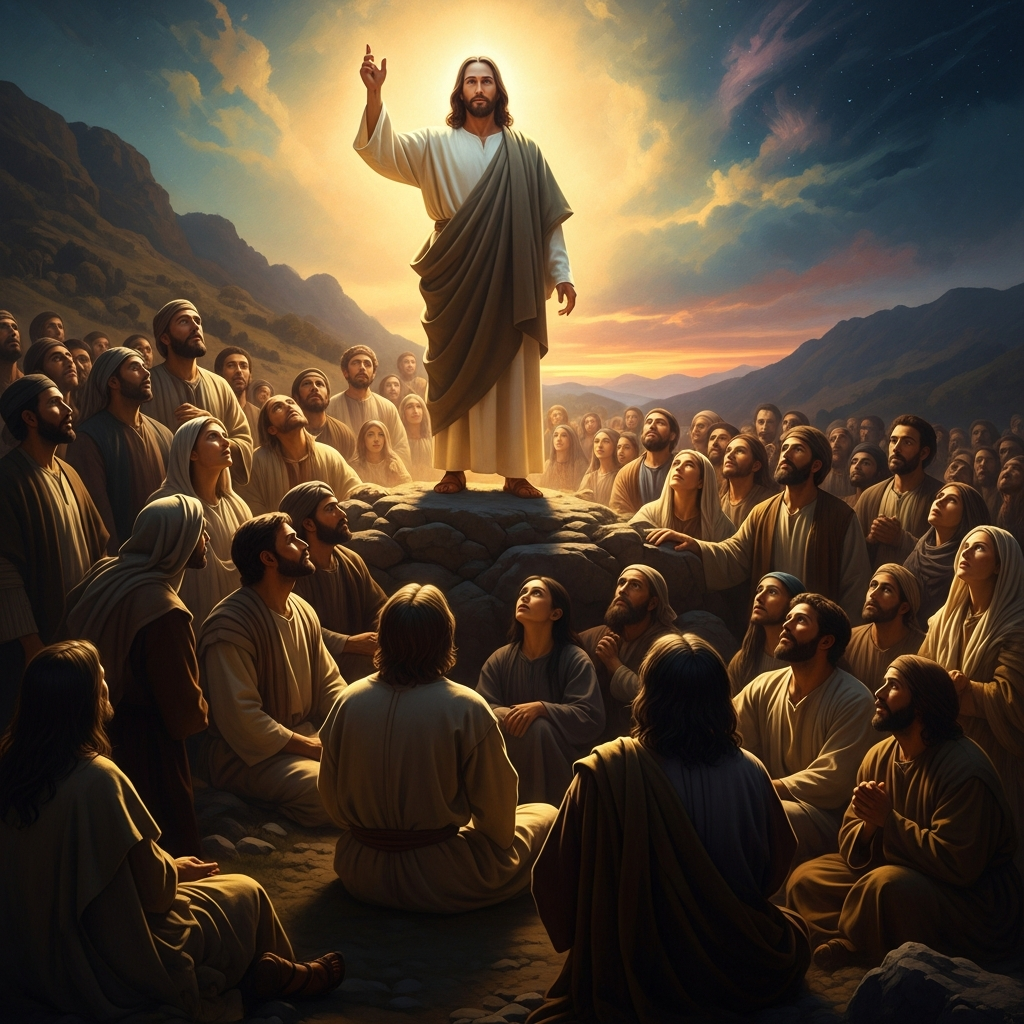
That is the first thing. Every teacher they know stands to speak — the scribes in the synagogues, the Pharisees in the public squares, the men with the loudest arguments for the highest seats. Jesus sits down. He sits on the hillside above the Sea of Galilee, Matthew 5:1 will later say, and when he sat down, his disciples came to him. The crowd arranges itself around him on the slope: fishermen from Capernaum still smelling of nets, women carrying water jars, a tax collector who was probably Matthew, Pharisees who have come to evaluate. The lake shimmers five hundred feet below. He opens his mouth.
Blessed are the poor in spirit, for theirs is the kingdom of heaven.
The sentence lands wrong for everyone who hears it. The poor in spirit are not the pious. They are not the learned. In Aramaic, the word is aniyye, the destitute, the ones who have nothing left to prop up their dignity with — and he tells them, first, before anything else, that the kingdom belongs to them.
He works through the Beatitudes the way a carpenter works through a joint: with precision, without haste.
Blessed are those who mourn. Blessed are the meek. Blessed are those who hunger and thirst for righteousness. Each line inverts the logic of the world they inhabit — a world that blesses the powerful, the well-connected, the ritually clean, the men who know which door to knock on in Jerusalem. Every institution these people interact with tells them that God rewards the successful. Jesus tells them that God has already given the kingdom to the broken, and that everything they understood about merit is backwards.
He gets to the peacemakers — they shall be called sons of God — and then he gets to the persecuted, and the crowd understands that this list is also a prophecy. He is describing the people in front of him. He is describing what is about to happen to them.
Blessed are you when people revile you and persecute you and utter all kinds of evil against you falsely on my account. Rejoice and be glad, for your reward is great in heaven.
Rejoice. He says it in present tense. Not later. Now.
Then he says something about salt.
You are the salt of the earth. Not you will become, not you should aspire to be — you are. Present tense. Declarative. The fishermen and the tax collector and the women with the water jars: salt. The thing that preserves meat in a world with no other refrigeration, the thing that makes food worth eating, the thing traded across the known world for its irreplaceable necessity. Then: But if the salt has lost its taste, how shall its saltiness be restored? It is thrown out and trampled under the feet of men.
The crowd understands the threat inside the promise. They are something valuable. They are also something that can fail at the one thing it is for.
He says they are light, too. A city on a hill that cannot be hidden. A lamp that no one puts under a basket. And then he turns toward the law, the thing everyone in this crowd knows he is supposed to uphold, and he recalibrates it from the inside. You have heard that it was said to those of old, “You shall not murder.” He pauses. But I say to you that everyone who is angry with his brother will be liable to judgment. The crowd hears the grammar of authority — not “the scriptures say” or “the rabbis teach” but I say — and they feel what it means. This man speaks as if the law is his to reinterpret. Not to abolish. To complete.
Six times he says it: you have heard it was said… but I say to you.
Murder goes deeper than the act — it begins in contempt. Adultery goes deeper than the body — it begins in the eye that covets. Oaths are unnecessary if your yes means yes. Retaliation is replaced by something harder: turn the other cheek, give the cloak when they take the coat, go two miles when compelled for one. He is not listing rules. He is describing an orientation of the self so complete that the rules become redundant — a character from which the actions flow without calculation.
Then he reaches the sentence that has stopped philosophers and generals and politicians for twenty centuries: Love your enemies and pray for those who persecute you.
Not tolerate. Not strategically neutralize. Love. Pray for. Because your Father in heaven makes the sun rise on the evil and the good, and the rain fall on the just and the unjust, and if you only love those who love you, you are doing nothing that any tax collector cannot do. The standard is not your enemy’s behavior. The standard is God’s.
The crowd sits with this. Some of them are thinking of Roman soldiers. Some are thinking of neighbors. Some are thinking of the men who hold their debt.
He turns to prayer, and the teaching gets quieter and more interior.
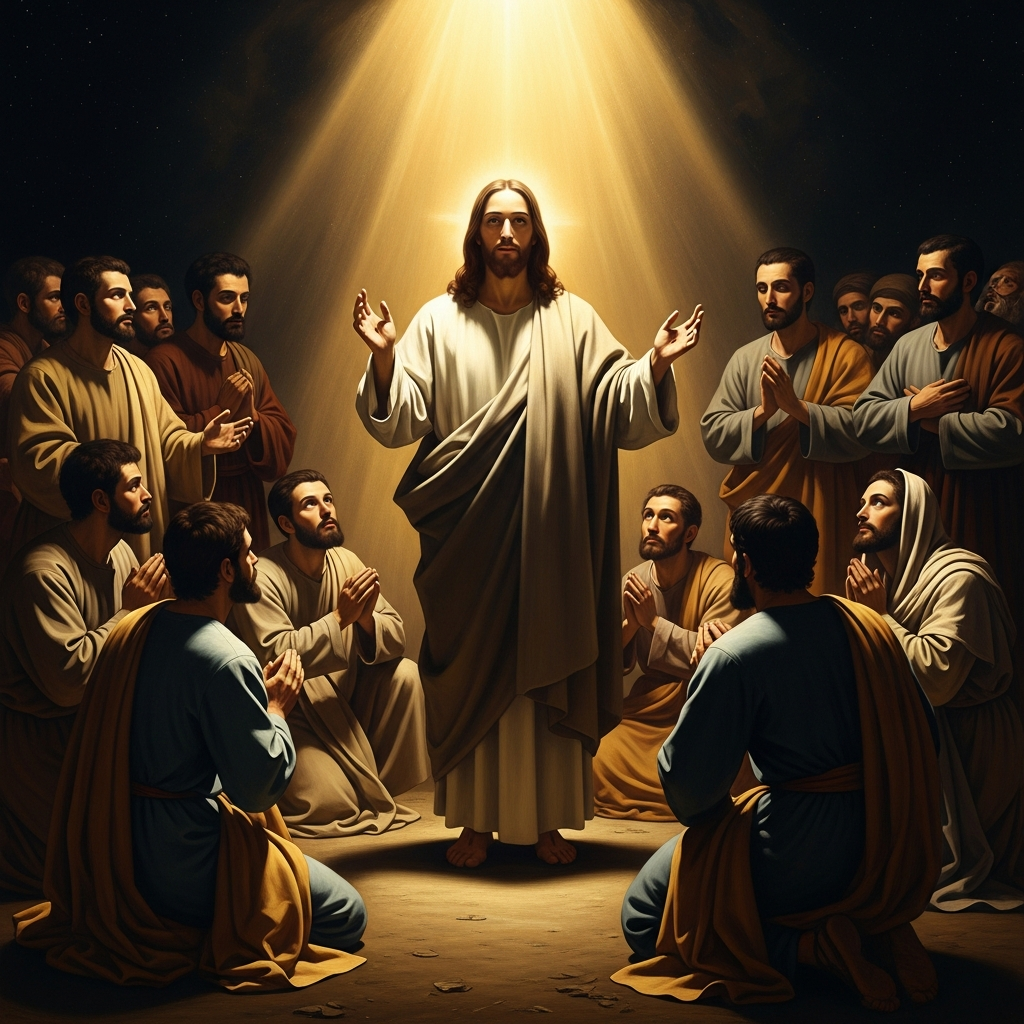
Do not pray in the streets to be seen, he says. Do not heap up empty phrases. Go into your room, close the door, speak to your Father in secret — and your Father who sees in secret will reward you. Then he gives them the words, the ones they will repeat two billion times across two thousand years: Our Father in heaven, hallowed be your name. Your kingdom come, your will be done, on earth as it is in heaven. The prayer has no performance in it. No formula. Seven petitions in Greek, fourteen words in Aramaic, short enough to be held in a single breath. Daily bread. Forgiveness as a practice the pray-er also extends. Deliverance from the evil one. The prayer assumes dependence. It assumes debt. It assumes a world that is not yet what it will be, and asks that the distance close.
He talks about fasting — do not disfigure your face so others can see you fast; wash your face, anoint your head, let the sacrifice be between you and God. He talks about money — you cannot serve God and wealth, and the word is mammon, a power, a lord, the thing that requires the same total allegiance that God requires, and which therefore cannot coexist with God in the chamber where ultimate loyalty lives. He talks about worry, and here the voice drops into something approaching tenderness.
Consider the lilies of the field, how they grow: they neither toil nor spin, yet I tell you, even Solomon in all his glory was not arrayed like one of these.
He gestures down the hillside toward the anemones scattered across the slope — red and white against the dry spring grass — and the crowd looks where he points. The flowers do not know they are beautiful. They are simply, extravagantly alive.
He ends with a question about foundations.
Everyone who hears these words of mine and does them, he says, is like a man who built his house on rock. Rain came. Floods rose. Winds blew. The house stood. Everyone who hears and does not do them is like a man who built on sand — same storm, same wind, same flood. The collapse is great.
He says it and stops. The crowd does not applaud. They are not the applauding kind, and he is not the kind who waits for it. Matthew 7:28 records the moment: when Jesus finished these sayings, the crowds were astonished at his teaching, for he was teaching them as one who had authority, and not as their scribes.
Not as their scribes. The scribes quote precedent. They argue from tradition to tradition, scholar to scholar, century to century. They are very learned men and their learning is a fortress inside which they stand. Jesus does not quote precedent. He says I say to you, and the crowd cannot name exactly what it is he has, only that it is the thing they were waiting for without knowing they were waiting.
He stands. He comes down the mountain. A man with leprosy meets him at the bottom. He reaches out and touches him.
The Sermon on the Mount is not an ethical system. It is a description of what a person looks like when they have been seized by the kingdom of heaven — the interiority, the orientation, the logic of the self so reformed that righteousness exceeds that of the scribes and Pharisees not by more effort but by a different kind of person doing the acting.
The Beatitudes are not instructions. They are diagnoses. Jesus looks at the crowd on the hillside and tells them what they already are. The kingdom belongs to the poor in spirit — not because poverty is virtuous, but because the kingdom belongs to those with nothing left to trade for it.
Two thousand years of moral argument downstream from this hillside, and the hardest sentence is still the plainest one: love your enemies. The storm tests the foundation. The foundation holds or it does not.
Scenes
Jesus speaks the Beatitudes — blessing the poor in spirit, the mourning, the meek — while the crowd presses close on the hillside
 Generating art…
 Hands raised, voice steady: Jesus teaches his disciples the prayer that will become the most repeated sentence in human history
 Generating art…
 He gestures toward the wildflowers on the slope — 'Consider the lilies of the field' — and the crowd follows his hand toward the blooms
 Generating art…
 Echoes Across Traditions
Entities
- Christ
- Peter
- John
- Matthew
Sources
- Matthew 5:1–7:29
- Luke 6:20–49 (Sermon on the Plain)
- Didache 8:2–3 (Lord's Prayer variant)
- N.T. Wright, *The Sermon on the Mount: The Kingdom of Heaven and What It Means for the Church* (2022)
- Dale Allison, *The Sermon on the Mount: Inspiring the Moral Imagination* (1999)
- Dietrich Bonhoeffer, *The Cost of Discipleship* (1937)