Contents
A young woman in Nazareth, alone at her loom or her water jar, hears a greeting that will split history in two. Gabriel speaks. Mary answers. Two billion lives hinge on a single word.
- When
- ~6 BCE · Luke composed ~80-90 CE
- Where
- Nazareth
She is working when the world changes.
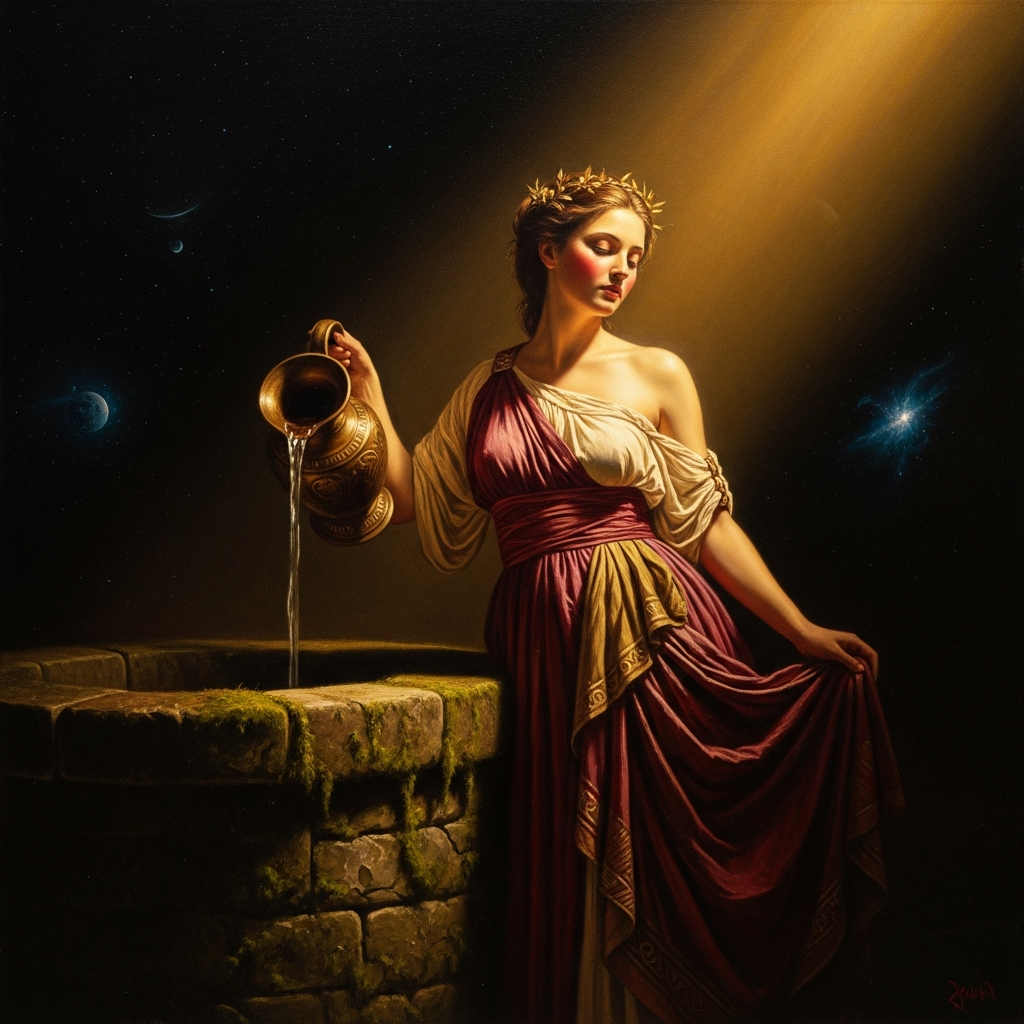
Luke does not tell us what she is doing exactly — whether her hands are wrapped around the handle of a water jar, or whether they are moving across the warp of her loom, threading the wool in the pattern her mother taught her. He is not interested in those details. He is interested in what happens next. But we can imagine: a young woman in an ordinary room in an ordinary hill town in Galilee, doing what young women do in the hour before a life is interrupted. The jar. The loom. The sound of wind through the door. The smell of dust and bread.
Then Gabriel.
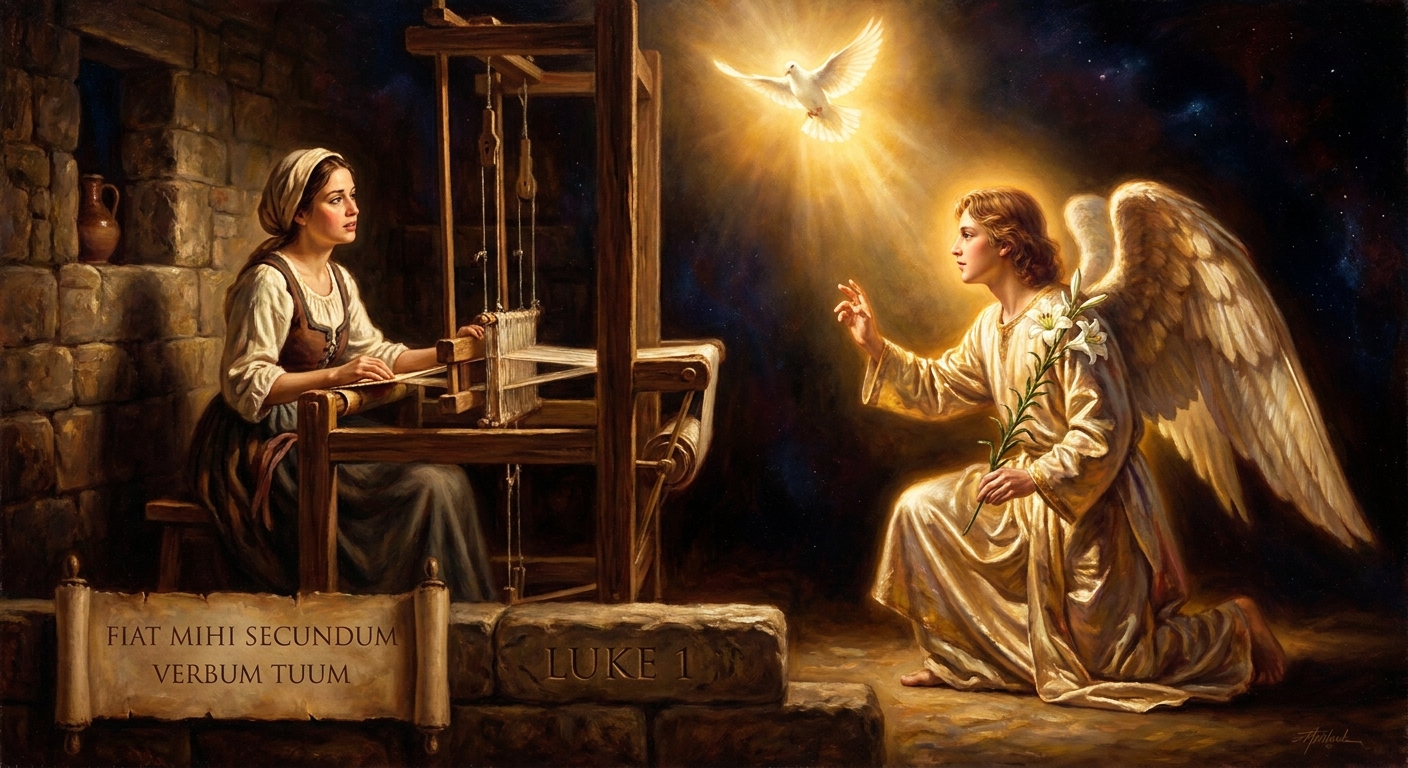
The angel does not announce himself gradually. He does not settle on the sill and wait to be noticed. The Greek word Luke uses — eiselthon — is blunt: he came in. He entered. And the first word out of his mouth is not a question. It is a title she has not yet been given.
Chaire, kecharitomene.
Hail, full of grace.
The phrase is unusual enough that translators have argued over it for twenty centuries. Kecharitomene is a perfect passive participle — it describes a state already completed, a grace already poured out and settled, not something being offered now. Gabriel is not saying: here is grace, take it. He is saying: you are already full of it. This is who you already are. The gift was given before I arrived.
She is troubled. Not by the figure — she will deal with the figure. She is troubled by the greeting. What sort of greeting is this? She turns the words over, the way you turn a strange coin in your hand, looking for the mint mark.
He sees her thinking and continues.
Do not be afraid, Mary. You have found favor with God. You will conceive and bear a son, and you shall call his name Jesus. He will be great. He will be called the Son of the Most High. The Lord God will give him the throne of his father David. He will reign over the house of Jacob forever. Of his kingdom there will be no end.
The speech is enormous. It reaches from the Davidic promise eight centuries old all the way to eternity. A Jewish girl in Nazareth would hear every word of it against the backdrop of scripture — the throne of David, the house of Jacob, the reign without end. Every prophetic hope the people had carried through exile and oppression and Roman occupation. All of it, apparently, about to take up residence in her body.
She does not say yes yet.
She asks a question.
How will this be, since I do not know a man?
This is not doubt. It is precision. She is not Sarah laughing behind the tent flap, incredulous that God would bother with her. She is not Zechariah, who asked the same kind of question two chapters earlier and was struck mute for his trouble. The difference the interpreters have noted for centuries is tone: Zechariah demanded a sign to believe. Mary simply needs to understand the mechanism. She has accepted that this is happening. She wants to know how.
Gabriel explains: The Holy Spirit will come upon you. The power of the Most High will overshadow you.
Episkiasei — overshadow. The same word used for the cloud that covered the Tabernacle in the wilderness, the visible presence of God settling over the tent of meeting. The divine dwelling in a mobile home in the desert, traveling with a people who had nowhere permanent to go. And now the same presence, settling over a woman who is herself a kind of tent — a body in which God will take up residence and walk among the people again.
Gabriel adds one more thing before he is finished. He gives her a proof she did not ask for: your cousin Elizabeth, the one who has been barren all her long life, is already six months pregnant. Because nothing is impossible with God.
He does not say: and therefore you must.
He stops talking.
The room is quiet.
The decision is hers.
Here is what she is not:
She is not a queen. She is not a prophet with a track record. She is not wealthy, or educated, or connected. She is betrothed to a carpenter named Joseph in a village so forgettable that when a skeptic hears where Jesus is from, his first instinct is: Can anything good come out of Nazareth? She is young — the traditions say anywhere from twelve to sixteen, the age of betrothal in Second Temple Galilee. She has not yet moved into Joseph’s house. She has not begun the life everyone around her expects her to live.
She is asked to abandon that life in advance of ever having it.
She is asked to carry a child she cannot explain to anyone — not to Joseph, not to her parents, not to the village — without any guarantee that she will be believed. Pregnancy outside of marriage in that world is not a scandal the way it is a scandal now. It is a legal matter. Joseph has the right to divorce her publicly. The law of Deuteronomy 22 still sits in the air over every such conversation. Gabriel does not address any of this. He announces. He explains the mechanics. He offers Elizabeth as a sign. And then he is quiet.
And she speaks.
Idou he doule Kyriou.
Behold the handmaid of the Lord.
Genoito moi kata to rhema sou.
Let it be unto me according to thy word.
That is all. Five words in Greek. The fiat of Catholic tradition — fiat mihi secundum verbum tuum in the Vulgate. Let it be done. The verb genoito is in the optative mood — the grammatical form for a wish or a willing. She is not resigning herself. She is not being overrun. She is choosing.
The angel departs.
She is alone again in the room. The jar. The loom. The dust and bread. But the world is different now, and she is different, and she already knows it.
She will carry this through a suspicious pregnancy and a long road to Bethlehem and a birth in the worst possible circumstances. She will carry it through Egypt and back, through thirty years of ordinary life, through one spectacular week in Jerusalem that ends with her son dying in front of her on a Roman cross — Simeon’s prophecy exact, the sword through her soul. She will carry it to the upper room where the disciples are hiding after the Resurrection, still steady, still present, still the one who said yes when everyone else was still asleep.
The whole architecture of Christianity fits inside that one word.
A young Galilean girl, alone in a room, says yes to history.
The angel is gone. The word remains.
Luke wrote his account somewhere between 80 and 90 CE, likely for a Gentile audience who would not have known the Hebrew prophetic background. He spends more time on the Annunciation than on any other event in the birth narrative. The speech Gabriel gives is the densest concentration of Old Testament promise in the New Testament. Raymond Brown counts at least six direct allusions to the Hebrew prophets in nine verses. Luke is saying: the whole library of the past arrives in this moment, in this room, in this greeting.
Mary speaks three times in Luke’s Gospel. Here. At the Visitation, where she sings the Magnificat. And at the wedding at Cana, where she says to the servants: “Do whatever he tells you.” She is not a character who is explained. She is a character who acts.
Scenes
Gabriel appears to Mary in Nazareth — the greeting that will unmake her ordinary life and remake the world
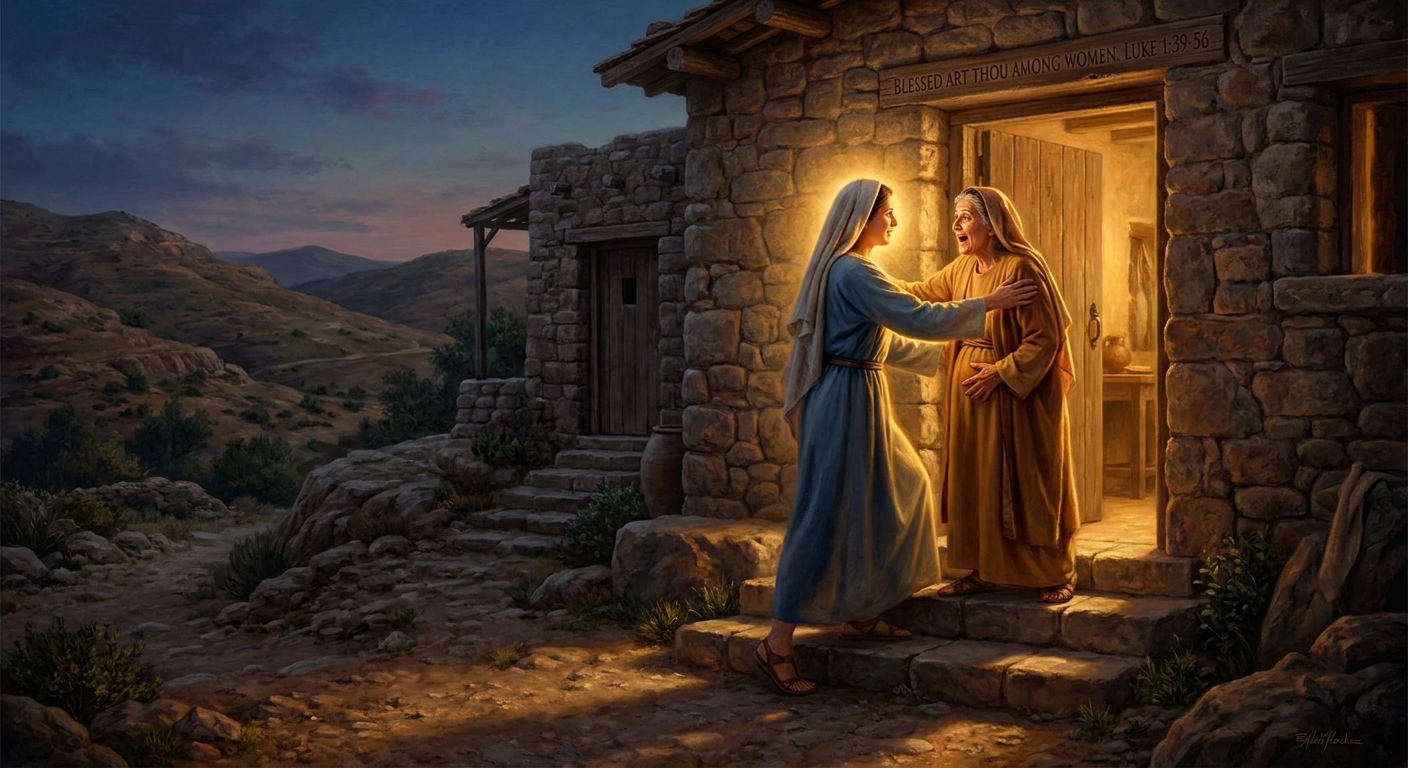
Generating art… The Visitation: Mary travels to the hill country and greets her cousin Elizabeth, whose unborn son leaps at the sound of her voice (Luke 1:39-56)
 Generating art…
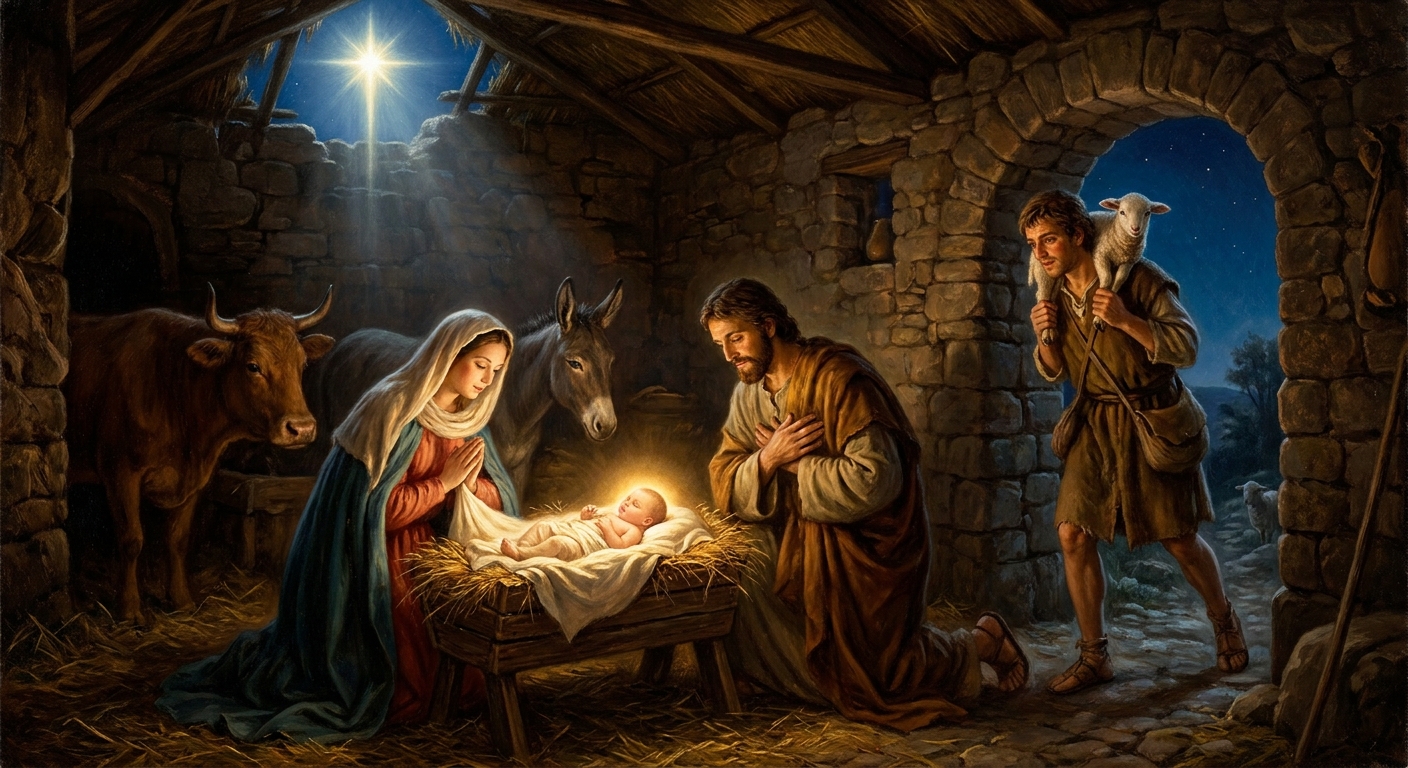
 The birth in Bethlehem — the consequence of the *fiat*, nine months on
 Generating art…
 Echoes Across Traditions
Entities
- Mary
- Gabriel

Sources
- Luke 1:26-38
- Robert Alter, *The Hebrew Bible: A Translation with Commentary* (2019)
- Raymond Brown, *The Birth of the Messiah* (1977)
- Mary Donovan Turner & Mary Lin Hudson, *Saved from Silence* (1999)