The Head That Would Not Stop Singing
Mythic Time · Ovid, *Metamorphoses* XI (8 CE) · Thrace, the river Hebrus, the island of Lesbos
Contents
Orpheus returns from the underworld without Eurydice and renounces women. The Maenads, drunk and enraged by his refusal, tear him apart on a hillside during a Bacchic rite. His head floats down the river Hebrus to Lesbos, still singing. The island becomes the birthplace of lyric poetry.
- When
- Mythic Time · Ovid, *Metamorphoses* XI (8 CE)
- Where
- Thrace, the river Hebrus, the island of Lesbos
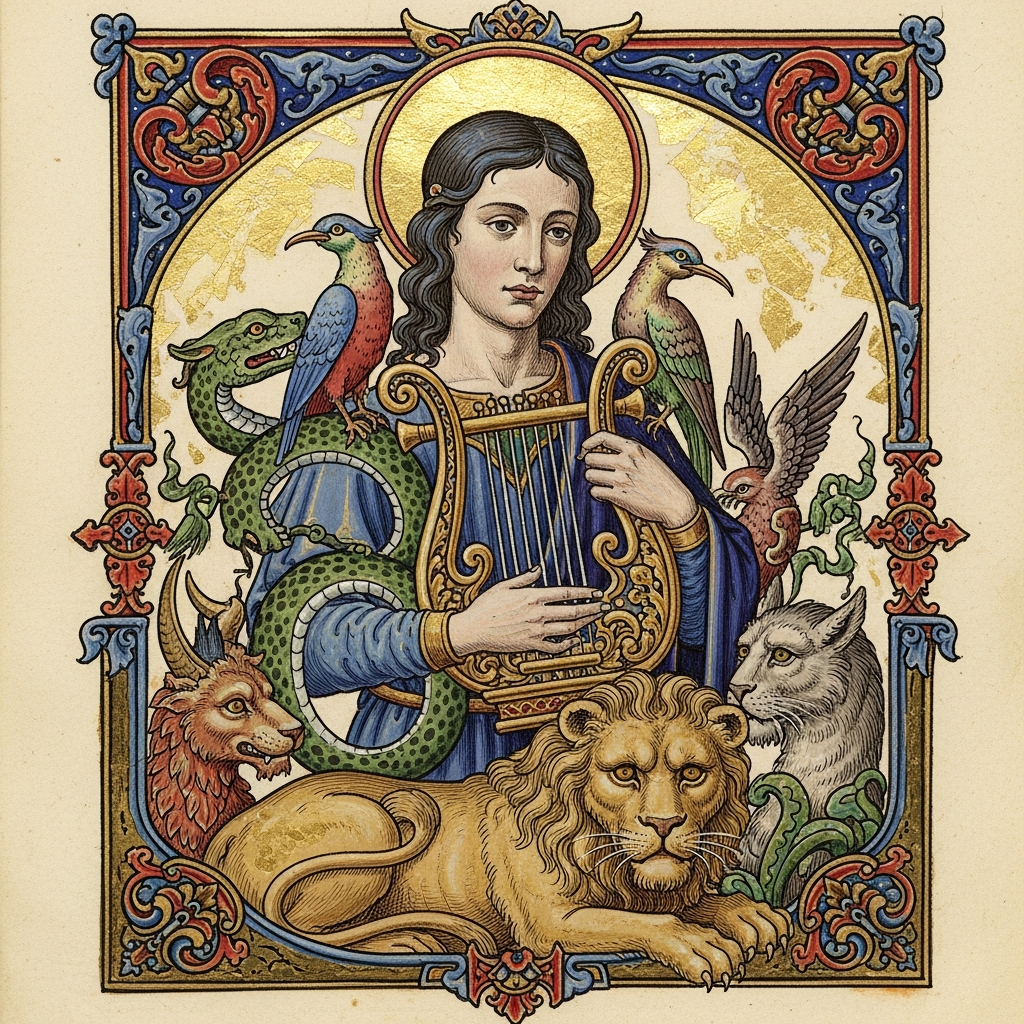
He comes back to Thrace alone, and the trees come to him.
Not one kind of tree but all of them — the oak and the ash and the slim birch and the heavy pine, bending toward him the way trees bend in storms, except that there is no storm, there is only his lyre and the music he has been making since he crossed back out of the underworld without her. Ovid counts them: the beech, the holm oak, the chestnut, the ash, the laurel, the hazel, the silver fir, the ilex, the plane tree, the maple, the willow weeping already as if it knows. The stones lean. The rivers pause. The wild animals crouch down.
He plays for them because he will not play for people.
He has renounced women. The sources say various things about why: grief, primarily, the absence of Eurydice made worse by the presence of every other woman who is not her. Some say he redirected his desire toward young men, which enraged the women of Thrace. Some say he simply would not touch them, would not look at them, and this was the insult. The Maenads — the possessed women of Dionysus’s retinue, who run in the mountains during the festivals and tear animals with their bare hands and eat the raw flesh — regarded his refusal as an offense against the god, against the principle of union and wildness that is the whole meaning of Dionysiac worship.
Orpheus serves Apollo. He has always served Apollo: the lyre, the order, the beautiful articulation of grief. Apollo and Dionysus are the two poles of Greek culture, and the tension between them is structural, and Orpheus has chosen the wrong pole.
The Maenads are coming up the hill.
He does not hear them at first.
He is playing to the trees, which have been listening all afternoon, the grove thickened around him with the oaks and the ash trees tilted at their attentive angles, the birds gone quiet in the branches. The Thracian women appear at the edge of the grove one by one and then in groups, the garlands on their heads, the ivy-wound thyrsus — the staff of fennel topped with a pine cone that is the Dionysiac weapon — in their hands.
They stop at the edge of the music.
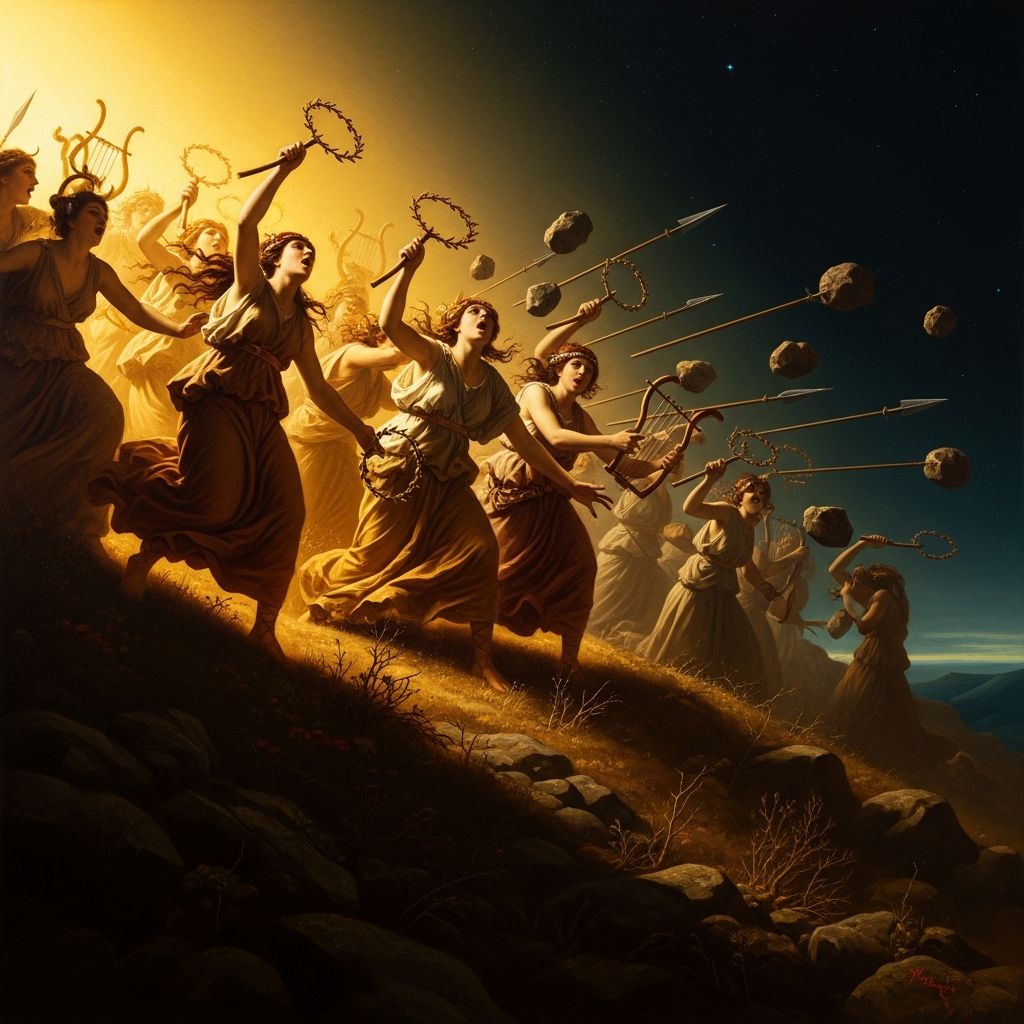
Ovid describes what happens next with clinical precision, because the miracle is structural to the story: they throw things at him. Stones first. A stone aimed at Orpheus leaves the woman’s hand and falls at his feet, as if apologized into submission by the music before it arrives. A spear. The spear slows in mid-flight, loses its direction, clatters to the ground six feet short of him. The weapons turn back. The trees lean in closer around him.
Then one of the women begins to scream.
Not a word — a sound below words, the ololugmos, the ritual cry of the Bacchic rite, the sound that means the god has entered and the ordinary rules of the body are suspended. The other women take it up. The scream builds until it is louder than the music, louder than the lyre’s strings can reach against it, and the stones that were turning back in the music now do not turn back because the music cannot be heard, because the music is drowned, because the medium it travels through — the quiet that lets beauty move through air and change what it passes — has been replaced with Dionysiac noise.
He looks up from his playing.
They are on him before he can change keys.
The dismemberment is described in every account — Ovid, Virgil, Apollodorus — with the same features and the same economy: it is quick, it is total, and it is accompanied by a sound the poets do not try to transcribe. His arms are pulled from their sockets. His head is taken from his shoulders. His body is scattered across the hillside.
What Ovid finds worth recording — what every account pauses on — is what happens to the head.
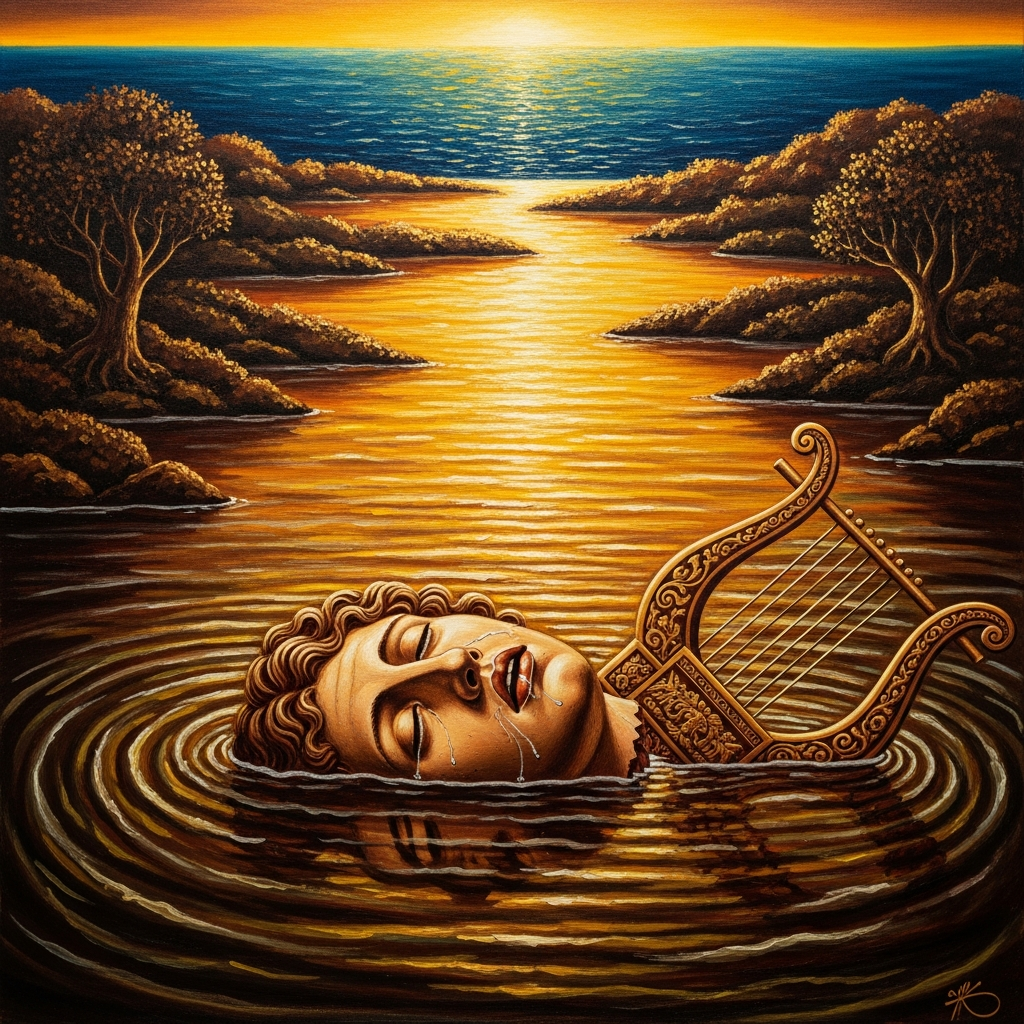
The Maenads throw it into the Hebrus, the river that runs out of the Thracian hills toward the Aegean. The lyre, which has been lying in the grass, is thrown in with it or falls in of its own accord — the ancient sources are not precise about the lyre’s agency here, but they are clear that it goes where the head goes. The head and the lyre enter the water together.
The head sings.
The lyre plays.
Ovid says the cold tongue says something mournful. Virgil says only that the voice cries Eurydice from the middle of the river, the banks echoing the name, the river itself carrying the name down to the sea. The head floats toward the Aegean and the river will not drown it and the cold of the water will not silence it and the song continues down the length of the Hebrus, twenty, forty, sixty miles to the coast, the voice already past the question of whether it is alive.
The head and the lyre arrive on Lesbos.
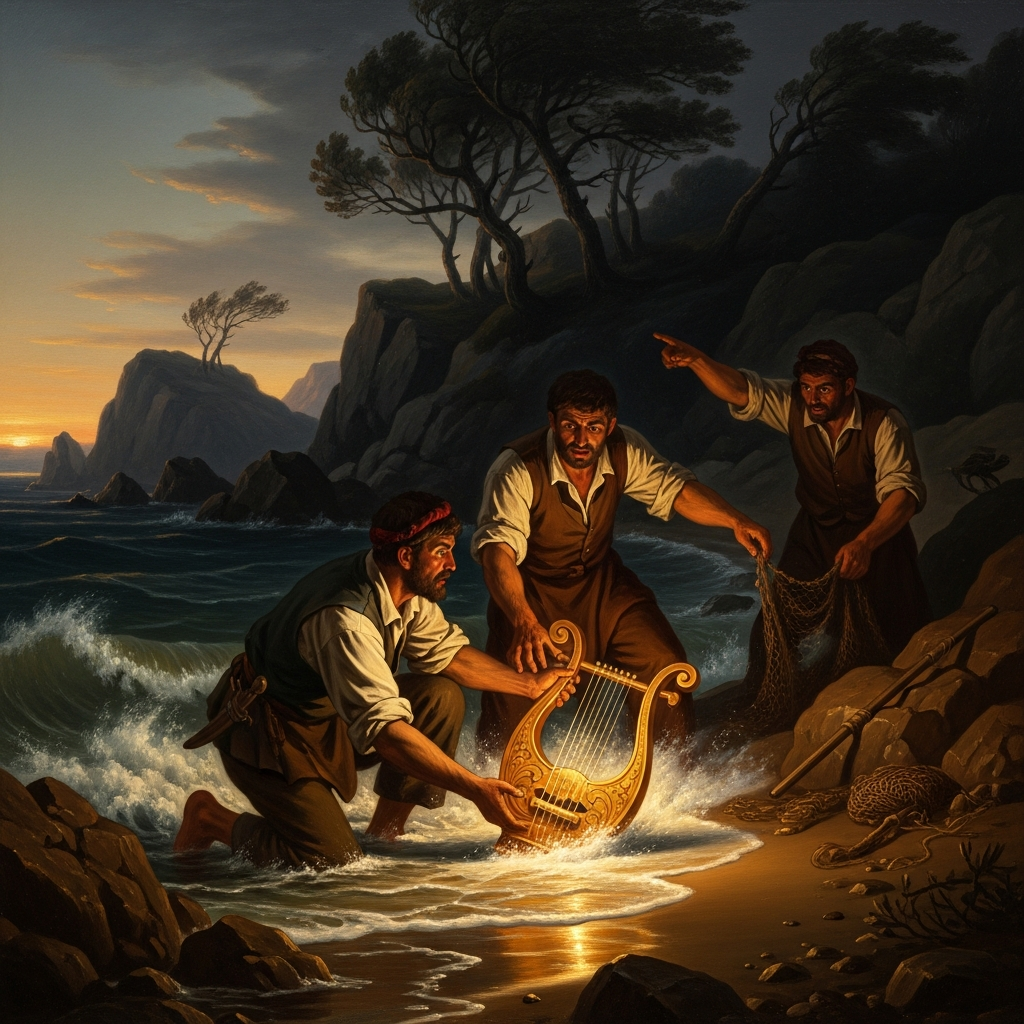
They wash up together on the western shore of the island, found — different accounts say — by fishermen, or by the Muses themselves, or by the nymph who tends the spring at Antissa. They are found together in the grey morning, the lyre still making a sound against the rocks as the water moves it. The head, by the time it arrives, has gone quiet.
The Lesbian women bury the head. The Muses take the lyre and hang it in Apollo’s temple. A nightingale builds its nest on the grave and sings there — an unusual nightingale, better than any other on the island, the poets say, as if the head’s last exhalations have been absorbed by the small bird that lives above it.
Lesbos becomes the birthplace of lyric poetry.
Within a century of the head’s arrival, the island produces Sappho and Alcaeus — two poets whose voices are so original and so formally precise and so emotionally exact that they define, still, what lyric poetry can do. Sappho writes in the first-person singular about desire and loss and the body’s response to the beloved. Alcaeus writes in the first-person singular about exile and political rage and wine and the sea. Both of them are making, in Greek, the thing that a voice makes when it has been separated from its body and floats downstream, still vibrating, still finding the precise pitch of its grief.
This is what the myth proposes: lyric poetry is downstream of the wound. The poem is what the dismembered singer makes when the body is gone and only the voice remains.
The Muses mourn.
Ovid says they mourn his scattered members across the Thracian hills. They find his limbs and bury them at Leibethra, at the foot of Mount Olympus, and the nightingales that sing there are, by report, more beautiful than the nightingales anywhere else in Greece. The lyre becomes the constellation Lyra, hung in the sky by Zeus or Apollo or the Muses, depending on which account you trust — the instrument that played the dead woman out of Hades placed among the stars where it cannot be lost and cannot be silenced and plays, in the astronomical imagination, the music of the spheres.
The Maenads are punished. Dionysus turns them into oak trees — one account has them pursued by their own roots into the ground, their feet thickening into bark, their arms becoming branches, still screaming silently in the direction of the hill where the singer was. The god of ecstasy punishing the ecstasy that went too far, the god of dismemberment angry at the dismemberers — a consistency that is, in the Dionysiac logic, not a contradiction. Dionysus is not an alibi for every destruction. He is a god of transformation, and transformation is not always welcome.
Orpheus finds Eurydice in Hades.
This is Ovid’s ending, and it is the ending that keeps being returned to. He arrives in the underworld a second time, not as a singer but as a shade, and she is there, and they walk together in the Elysian fields — sometimes ahead of her, sometimes behind, sometimes walking side by side, and sometimes he turns and looks at her, and now he may. The backward glance that destroyed them both has become, in the underworld, the ordinary gesture of two people walking together who look at each other as they go.
Death, the myth says, is the place where the condition that was placed on them — the impossible condition of trust that the living cannot maintain — no longer applies.
The head on the river is the image the tradition kept.
Painted on hundreds of Attic vases: the head floating in the Hebrus, eyes half-open, the river current moving the hair. Red-figure pottery, black-figure pottery, late-Hellenistic goldwork — the head of Orpheus in the water is one of the most frequently depicted images in ancient Greek art. Not the music that moved Hades. Not the backward glance. The floating head, still singing.
The reason it keeps being painted is the reason it keeps being told: it is the only version of artistic survival available when everything else has been taken. The instrument is gone. The body is gone. The woman is gone, again, a second time. The hands that played the lyre have been scattered across a Thracian hillside. What remains is the voice, detached from everything that housed it, singing in the water on its way to the sea.
This is the myth that art makes about itself when it is honest. The song does not save the singer. The song survives the singer. The Maenads win — they always win, the forces that are larger than the individual, the noise that is louder than any lyre — and the head goes on regardless, down the Hebrus, and what lands on Lesbos is not a god or a ghost but a tradition, and the tradition is Sappho, and Sappho is the first lyric — from lyra — and the lyric is the formal consequence of the head that would not stop.
The oracle at Lesbos operated for centuries at the site where the head was buried. Petitioners came from across the Aegean — the oracle was known for its accuracy, particularly in matters of poetry and love, which the ancient world understood as related. The head was consulted. The head answered. Apollo eventually closed the oracle, because the head of Orpheus was giving better advice than the oracle at Delphi, and there is only room for one singing prophet in a Hellenistic religious economy.
The lyre in the constellation Lyra is still visible on clear nights in the northern hemisphere. It culminates in August, near the Perseid meteor shower, when the shooting stars look to some observers like sparks from the strings. Vega, the brightest star in Lyra, is the fifth brightest star in the night sky.
Sappho and Alcaeus were contemporaries on Lesbos in the late seventh century BCE. They may have known each other. Alcaeus wrote to Sappho directly, and she answered. What both of them understood — what the island seems to have taught its poets with unusual consistency — is that the lyric works by isolation: one voice, one moment, one body’s specific response to desire or grief or the sea, stated in the most formally precise language available. The dismembered head as the theory of the form.
Rilke understood this. His Sonnets to Orpheus begin: here was a tree, ascending. Pure transcendence. The voice of Orpheus, received by the tree that leans toward him, as the founding act of poetry. Rilke knew the head was downstream. He started before the dismemberment, at the music, because the music and the dismemberment are not opposites. The music is what made the dismemberment possible. You have to play well enough to enrage the Maenads. The song has to matter enough to be destroyed.
Scenes
The Maenads of Thrace, thyrsus in hand, descending from the hillside in full Bacchic frenzy — their weapons turning back at first, the music deflecting spear and stone, until the women's screaming drowns the lyre
 Generating art…
 The severed head of Orpheus floating down the river Hebrus toward the Aegean, the lips still moving, the lyre drifting beside it — classical red-figure pottery, Thracian banks, the sea opening ahead
 Generating art…
 The lyre of Orpheus washing ashore on the island of Lesbos, found by fishermen in the grey dawn — the instrument that became the patron object of lyric poetry, from Sappho to Alcaeus to Pindar
 Generating art…
 Echoes Across Traditions
Entities
- Orpheus
- Maenads
- Dionysus
- Apollo
- the Muses

Sources
- Ovid, *Metamorphoses* X-XI (8 CE)
- Virgil, *Georgics* IV.453-527 (29 BCE)
- Apollodorus, *Library* 1.3.2
- Charles Segal, *Orpheus: The Myth of the Poet* (Johns Hopkins, 1989)
- W.K.C. Guthrie, *Orpheus and Greek Religion* (Princeton, 1935)
- M.L. West, *The Orphic Poems* (Oxford, 1983)