Sisyphus and the Stone
Mythic Time · sung in *Odyssey* 11 (~750 BCE), reframed by Camus 1942 · Ephyra (Corinth) and Tartarus, the deepest pit beneath the underworld
Contents
The founder-king of Corinth twice cheated death — chaining Thanatos in his own house, then tricking Persephone into releasing him from the underworld. The gods invent a punishment from which no cunning can escape: a boulder, a slope, and the certainty that the stone always rolls back down.
- When
- Mythic Time · sung in *Odyssey* 11 (~750 BCE), reframed by Camus 1942
- Where
- Ephyra (Corinth) and Tartarus, the deepest pit beneath the underworld
He was the cleverest king Greece had produced.
Ephyra — later called Corinth — sat on its isthmus between two seas, and Sisyphus had founded it the way a merchant founds a trading floor: with calculation, with foresight, with an eye for which gods to flatter and which to overhear. He hosted travelers and watched them leave with less than they came with. He told Asopus where Zeus had taken his daughter, in exchange for a spring on his acropolis. Zeus took note. Zeus is patient about these things. Zeus sent Death.
Thanatos came up the road to Ephyra with chains in his hands. He had collected kings before. He expected this one to be no different.
Sisyphus invites him in.
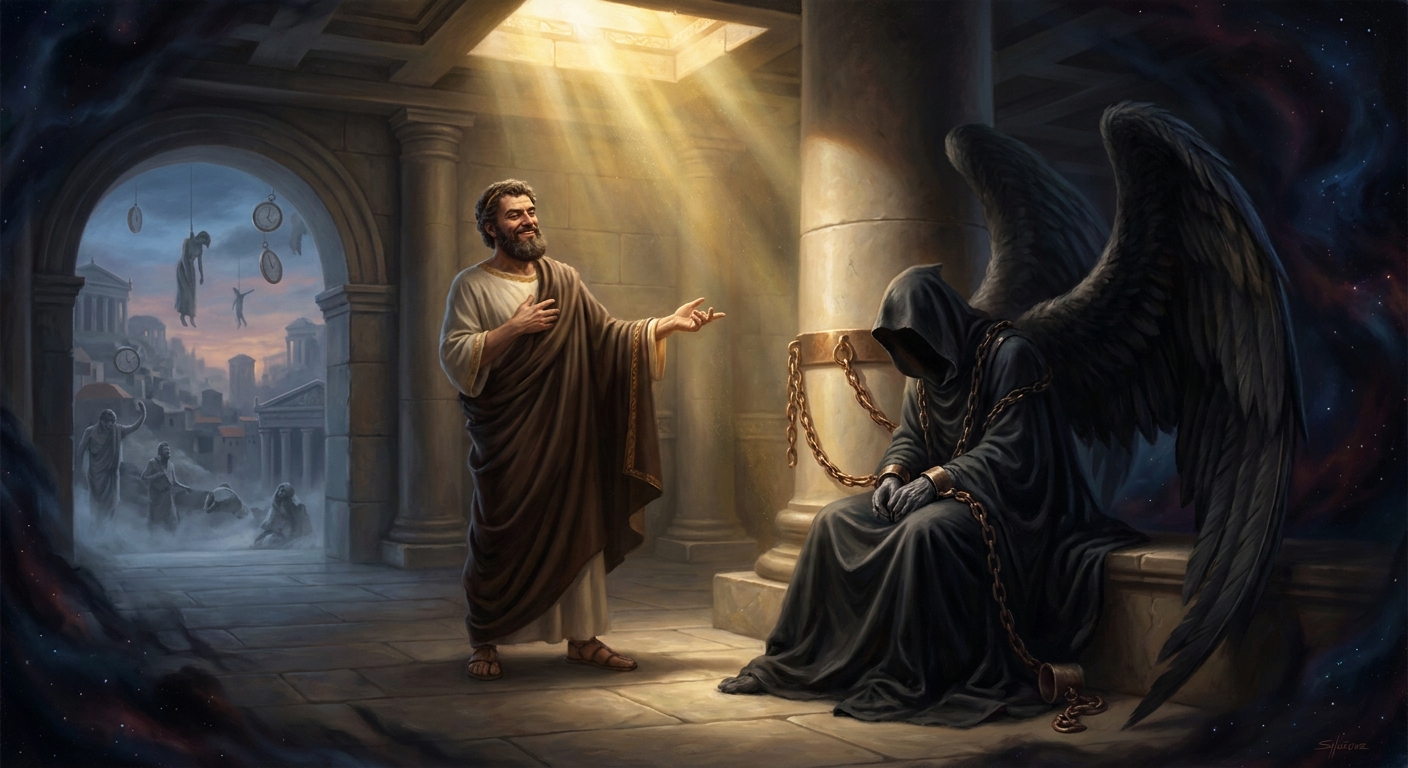
He offers wine. He admires the chains — exquisite craftsmanship, may I see how they fasten — and Thanatos, who has not been complimented in any extant century, demonstrates. The chains close. They close around Death himself. Sisyphus locks him in a cupboard.
For days, no one dies. Old men who should have crossed the river continue arguing in the agora. Soldiers run through with spears stand up and walk home. Ares, who needs corpses for his wars to mean anything, complains to Olympus. Hermes is dispatched. The cupboard is opened. Thanatos comes out furious.
Sisyphus, by then, has instructed his wife Merope: when I die, do not bury me. Leave my body in the public square. Make no offerings.
Then he lets Thanatos take him.
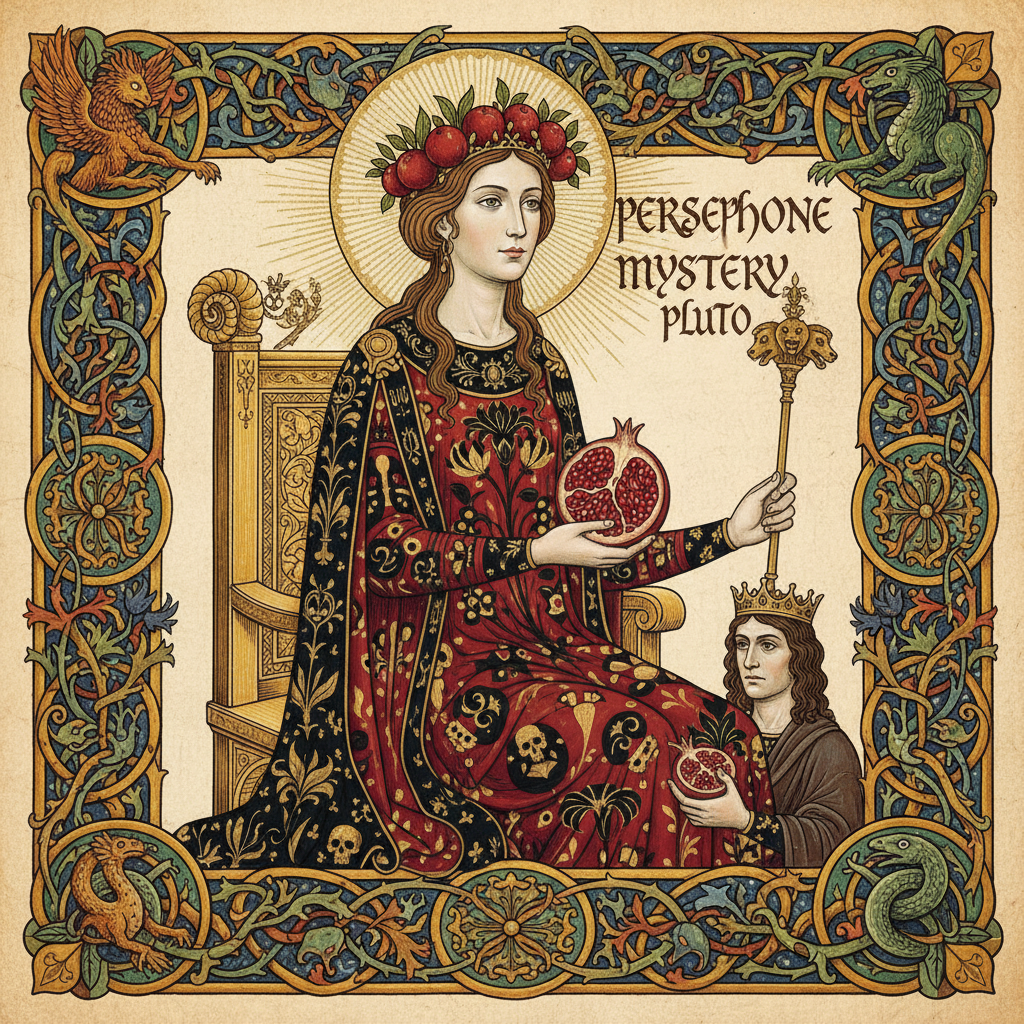
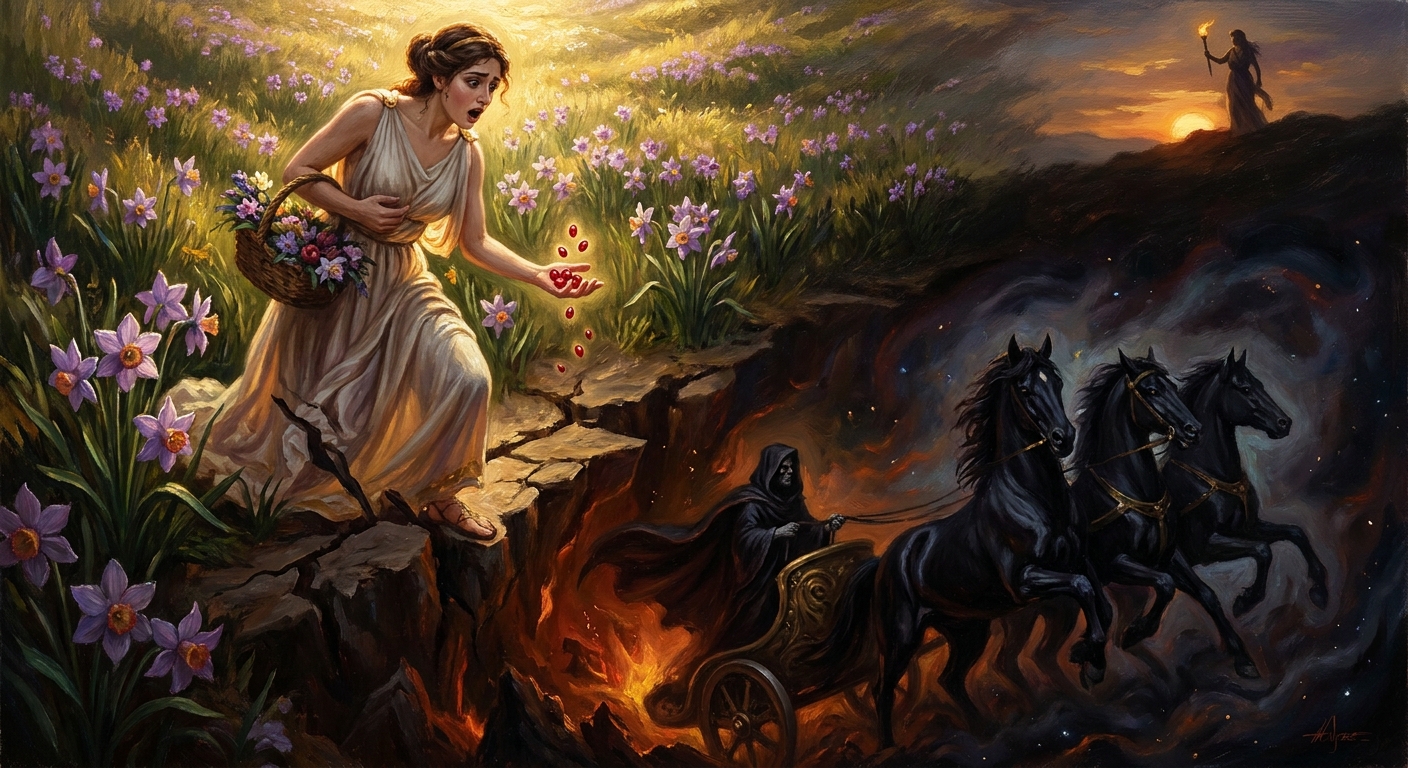
In the underworld, he goes straight to Persephone.
He is weeping. He is the king of Ephyra and his wife — his wife — has dishonored his corpse. No coin under the tongue. No rites. No procession. He is a shade without standing in the very court where she queens. Surely the queen of the dead, who knows what it is to be torn from one world into another, can spare him three days to return and shame his widow into proper conduct.
Persephone, who is six months in and six months out and has a soft place for the recently arrived, agrees. Three days. Then back.
He climbs out of Tartarus. He returns to Ephyra. He does not punish his wife — she did exactly what he told her to do — and he does not go back. He lives. He drinks his wine. He runs his isthmus. He grows old in his palace while Hermes stands at the gate of the upper world wondering when the king will keep his appointment.
Hermes finally comes for him in person. The escort is no longer optional.
The gods convene.
This man has chained Death. This man has tricked the Queen of the Dead. This man has died twice and refused to stay dead. What punishment has not yet been tried on him? Tantalus’s fruit will not work — Sisyphus would find the angle. The vulture of Tityos would not work — Sisyphus would befriend the vulture. The wheel of Ixion turns, but turns; there is rhythm in it, and rhythm can be borne.
Zeus thinks. Zeus has had time to think.
He decides on a stone.
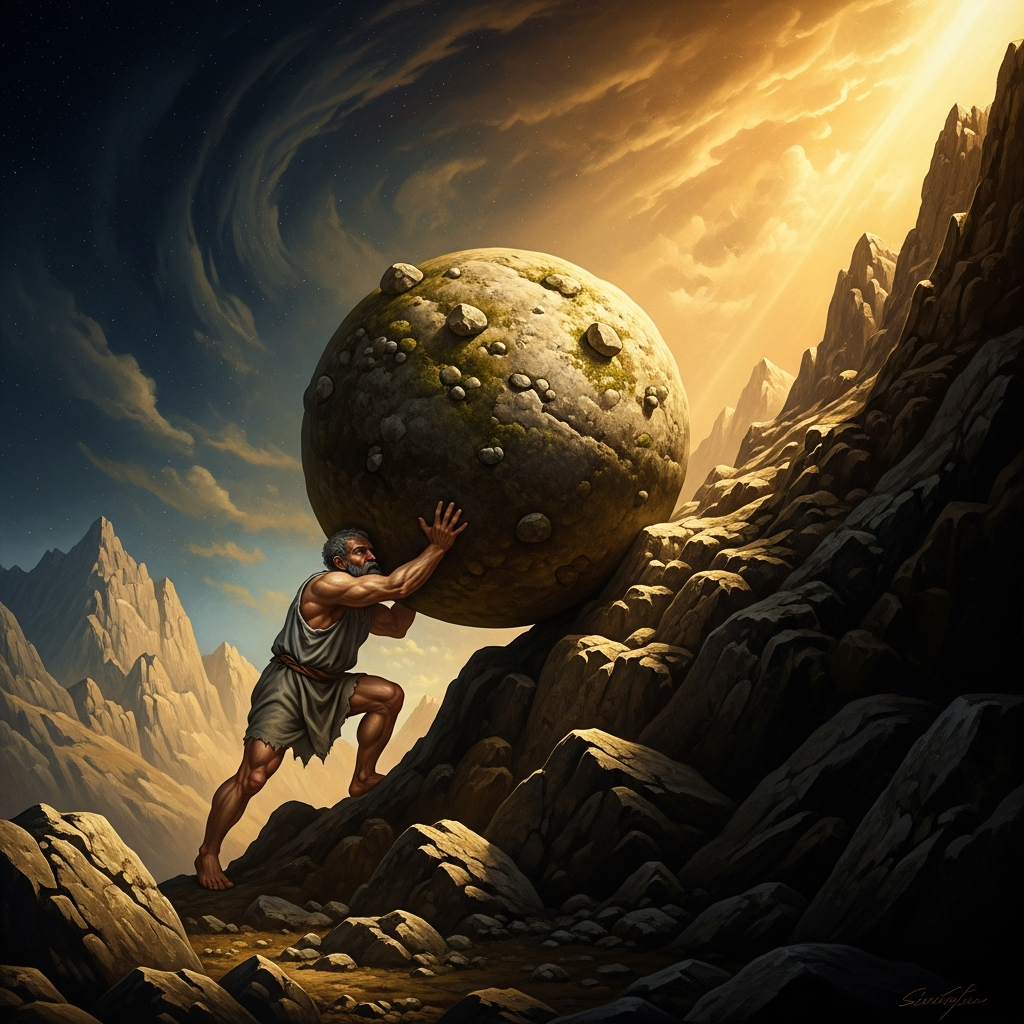
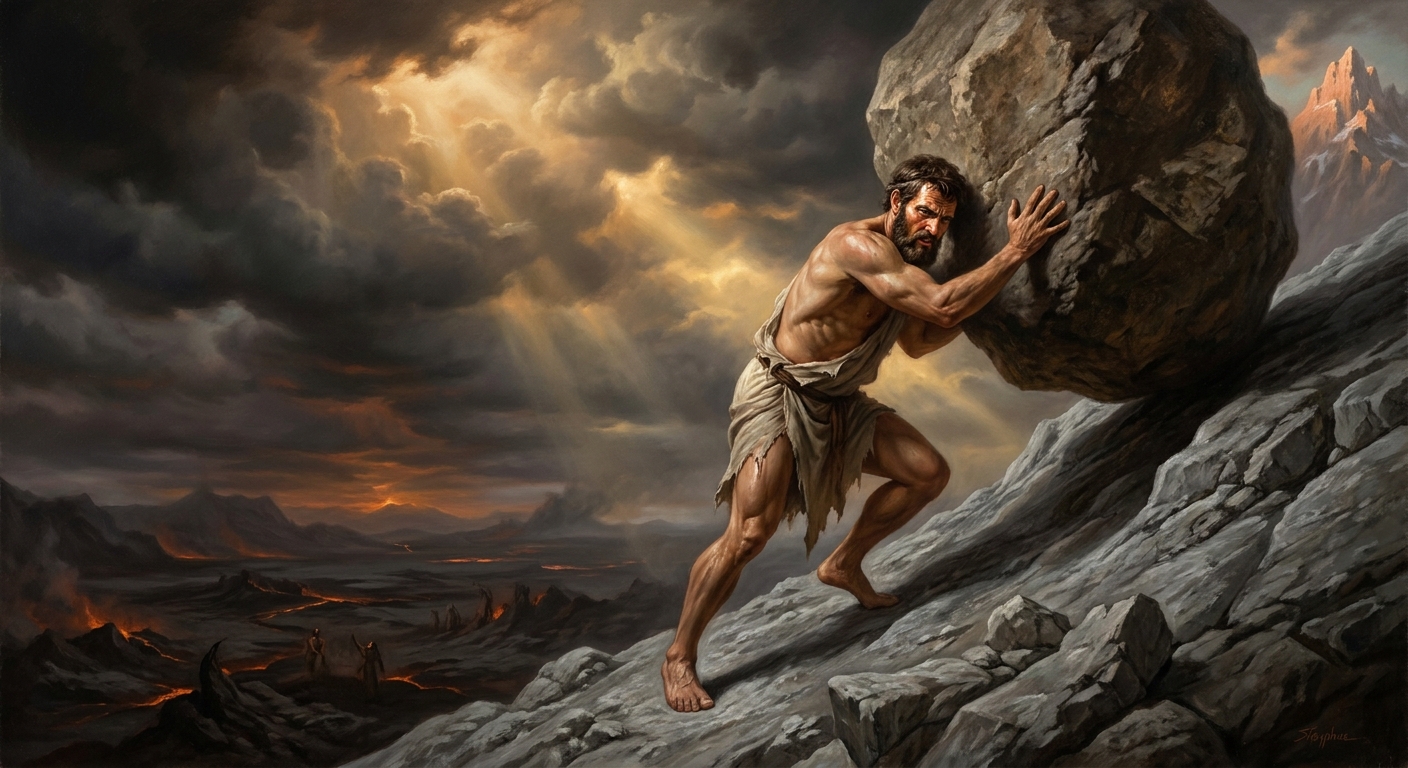
A boulder, large enough that a man’s whole body must press against it to move it at all. A hill, steep enough that the boulder will not stay where it is put. The instruction: roll the stone to the summit. The mechanism: when it nears the top, the stone slips, rolls back, and gathers speed past him to the bottom of the slope. He must walk down. He must begin again.
There is no audience. There is no end. There is no clever angle. The boulder is just a boulder. The hill is just a hill.
This is the punishment Sisyphus cannot outwit.
He pushes.
The first time, he tries to think his way through it. He looks for a flatter line, a smoother face, a place to wedge his shoulder. He finds none. The slope is featureless in the way only divine geometry is featureless: it admits no improvement. He gets the stone within reach of the summit. The stone slips. The stone rolls back. He walks down after it.
The second time, he tries to find meaning in the rhythm. He counts his breaths. He counts the beats of his heart against the rock. He gets the stone within reach of the summit. The stone slips. He walks down.
The thousandth time, he stops counting.
The boulder warms under his hands. His palms wear smooth. His shoulders develop the exact musculature the stone requires. He becomes the perfect instrument for a task whose fruit is guaranteed to be taken from him. Homer sees him from the river of the dead — Odysseus catches a glimpse, Book Eleven, sweat pouring down a king’s body, dust rising around his head — and looks away.
Three thousand years later, a Frenchman writes a book about him.
Camus does not deny the punishment. The boulder is the boulder. The slope is the slope. What Camus claims is that the gods got the geometry right and the psychology wrong. They imagined Sisyphus shattered. They imagined him pleading. They did not imagine him walking back down.
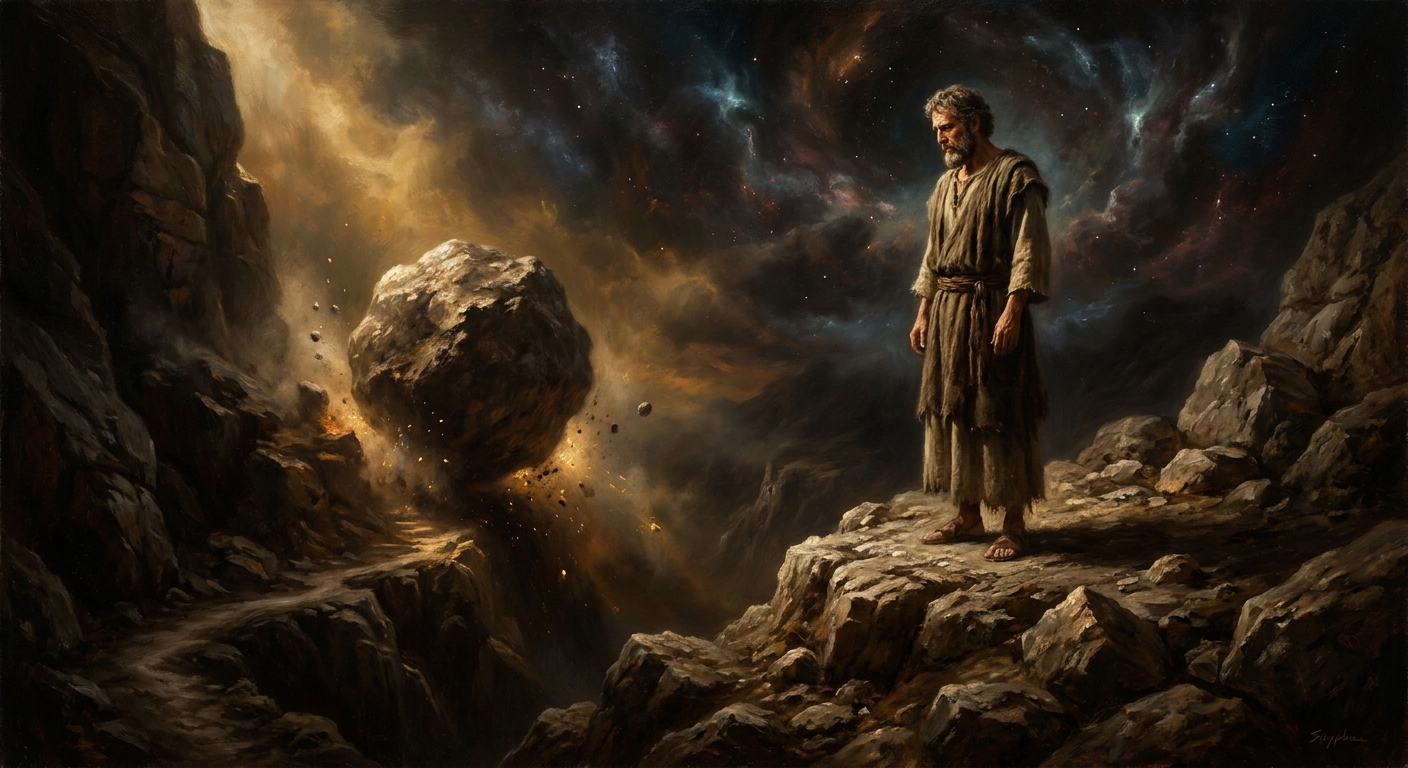
The walk down, Camus says, is the moment that matters. The stone has rolled. The labor is over. For the duration of the descent, Sisyphus is a man unburdened on a hillside, with the whole world below him, knowing exactly what he is and exactly what is coming. He is not deceived. He is not consoled. He is alive in the only way the gods have left available to him.
One must imagine Sisyphus happy, Camus writes. The sentence has irritated readers for eighty years. It is meant to.
The Greeks invented the figure. Camus inverted it. In between, three thousand years of human beings have looked at their work — the field that must be plowed again next spring, the meal that must be cooked again tomorrow, the child who must be raised through the same fevers as last year’s child — and seen Sisyphus on the slope.
Job’s God answers him out of a whirlwind. The Buddha tells his samsara to wake up. Krishna tells Arjuna to act without attachment to the fruit. The Greek gods tell Sisyphus nothing at all. They have a slope and a stone and a sentence with no end, and they wait to see what the human animal does with eternity when meaning has been removed from it as cleanly as a surgeon removes a tumor.
What the human animal does, it turns out, is keep pushing. Whether that is cowardice, defiance, or grace is the question every wisdom tradition since has tried to answer.
The stone is still rolling. The hill is still there. Sisyphus is still walking back down.
Scenes
Sisyphus seizes Thanatos — Death himself — and clamps him in chains in the house of the king
 Generating art…
 Tartarus: Sisyphus heaves the boulder toward a summit that recedes with every step
 Generating art…
 The stone finds the bottom again
 Generating art…
 Echoes Across Traditions
Entities
- Sisyphus
- Thanatos
- Hades
- Persephone
- Zeus

Sources
- Homer, *Odyssey* XI.593-600 (Robert Fagles trans., 1996)
- Hesiod, *Theogony*
- Pseudo-Apollodorus, *Library* 1.9.3, 3.12.6
- Pausanias, *Description of Greece* 2.5.1
- Albert Camus, *The Myth of Sisyphus* (1942)