Theseus in the Labyrinth
Mythic Time · likely Bronze Age, written down ~5th century BCE · Crete — the labyrinth at Knossos
Contents
Athens pays its blood tribute to Crete. A prince volunteers. A princess hands him a thread. At the center of the darkness, he finds the monster — and kills it. But a father watches from a cliff for white sails that never come.
- When
- Mythic Time · likely Bronze Age, written down ~5th century BCE
- Where
- Crete — the labyrinth at Knossos
Every nine years, Athens counts its children.
Seven youths. Seven maidens. The city selects them by lot, or perhaps by cruelty — the accounts differ, and both are probably true. They board a ship with black sails. The ship crosses the Aegean to Crete. At Knossos, the tribute is received by King Minos, who received it from Poseidon, who demanded it because Minos broke a promise about a white bull. The grievance is theological, the mathematics human: fourteen Athenian children every nine years, fed to the Minotaur in the labyrinth beneath the palace. The Minotaur is the child Minos will not name — the thing Pasiphaë bore after the god arranged her desire for the bull, the thing Daedalus built an enclosure for because there is no honest word in any language for what the creature is. Half man. Half bull. Entirely hungry.
No one has come back from the labyrinth. It is not designed for return.
Theseus volunteers.
He is the son of Aegeus, king of Athens — or of Poseidon, depending on who you ask, and his mother was apparently not certain herself. He is young. He is built like a promise the gods made to violence. When he steps forward, the Athenian elders do not argue, because the Athenians are the kind of people who will let a king’s son die before admitting they have been bleeding for a generation and do not know how to stop.
He asks his father for one concession: if he succeeds, he will change the ship’s sails from black to white on the voyage home. Aegeus agrees. The king stands on the cliff at Sunium to watch. He will stand there until he sees what color the sails are.
The black-sailed ship crosses the Aegean.
Ariadne sees Theseus the moment he disembarks.
She is the daughter of Minos, which means she is also the half-sister of the thing in the labyrinth — a fact she lives with the way you live with a house that has a room you cannot enter. She watches the tribute being processed and she makes a decision that will cost her everything and she makes it anyway, which is the most Greek thing that happens in this story.
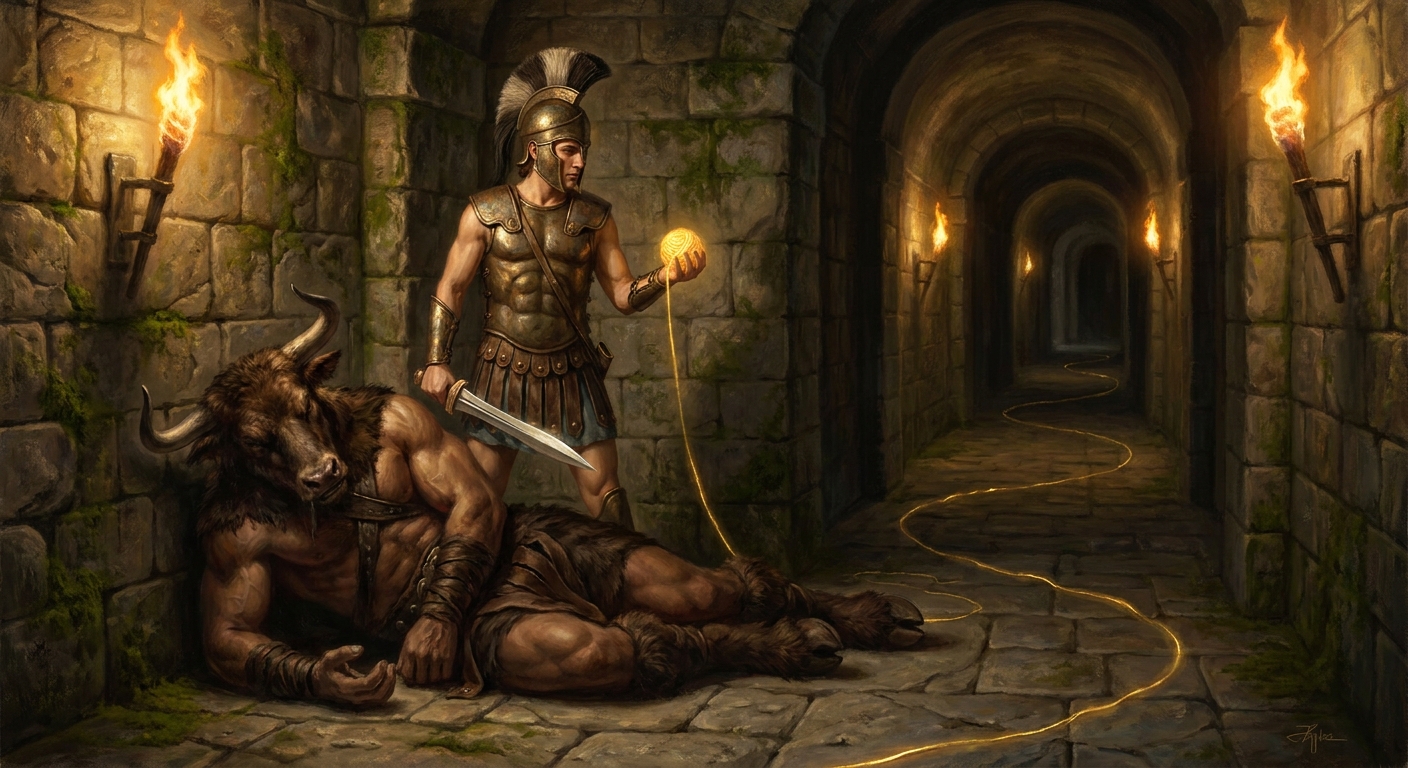
She goes to Daedalus. The architect who built the labyrinth is also the only man who knows its solution. He tells her: give the hero a ball of thread. Fasten one end to the entrance. Let him unwind it as he walks. The labyrinth cannot be memorized — its genius is that it defeats memory, doubles back on itself, makes every direction feel like progress — but a thread can be followed regardless of what the mind has lost. The thread is not a map. It is a tether. It is the difference between a man who goes in and a man who comes back out.
Ariadne goes to Theseus in the night. She gives him the thread. She extracts a promise: take me with you. Marry me. Do not leave me in a place where I am the half-sister of the monster my father feeds.
He takes the thread. He makes the promise.
In the morning he enters the labyrinth.
Daedalus built it for a god’s embarrassment, which means he built it to last and built it to confuse. The walls are stone. The passages turn without warning. Sound bounces in ways that make distance meaningless. He has been in the dark for what feels like an hour when the smell hits him — not death exactly, but the thing before death, the animal musk of something that eats and is never satisfied.
He pays out the thread behind him. He does not look back.
The Minotaur is at the center, as things of that kind always are. It is larger than the stories prepared him for. It has a man’s torso and a bull’s head, which means it has a bull’s eyes — wide-set, dark, catching no light — and he cannot tell from those eyes whether it is afraid of him or has simply never considered being afraid of anything. It charges the way bulls charge: without strategy, without hesitation, with the full weight of a body that has never needed to be subtle.
He steps aside. He takes it by the horn. He drives the other hand into its throat until something important gives way.
The Minotaur falls. The floor is already stained. One more stain changes nothing.
He stands in the dark at the center of the labyrinth and he breathes. He is the first man to reach this place and leave it. Then he follows the thread back — through every turn that confused him going in, past every wall that looked like a wall and every opening that looked like an exit, back toward the light, hand over hand along the line Ariadne held at the other end.
The thread does not fail. He comes out.
They sail north in the night, Theseus and Ariadne and the fourteen who did not die, and they stop at Naxos because the sea is rough or because a god intervenes — Dionysus has a claim on Ariadne that predates any promise Theseus made — and in the morning Ariadne is on the island and the ship is gone.
The accounts disagree about whether Theseus intended this. Some say he was told in a dream to leave her. Some say Dionysus took her while Theseus slept. Some say Theseus was simply the kind of man who is capable of great courage and ordinary betrayal and the two things do not cancel each other. She weeps on the shore. The god comes to her. She becomes his. She lives well, eventually. The story is not kind to her on the way there.
Theseus sails on toward Athens.
He forgets the sails.
It is the kind of forgetting that does not feel like forgetting at the time — he is victorious, his crew is alive, the sea is behind him and home is ahead, and the sails are black but he will change them when he remembers and he does not remember. Aegeus is on the cliff at Sunium. He has been on the cliff a long time. He sees the ship appear on the horizon. He watches it grow larger. The sails stay black.
Black means dead. Black means the tribute was taken and the tribute was not enough. Black means he has lost his son as Athens has lost its children, every nine years, generation by generation, and the thing in the labyrinth is still eating.
Aegeus steps off the cliff.
The sea takes his name. The Aegean has been the Aegean ever since — named not for the hero, not for the monster, not for the architect or the princess or the god, but for the old man who could not bear to wait for white sails that were already coming.
Theseus arrives in Athens to find himself king.
He buries his father. He unifies Attica into a single city-state, the synoikismos — the gathering of the villages into one. He establishes the Panathenaic festival. He becomes, in the tradition’s own accounting, the founder of Athens, the hero who made the city possible by killing what had been eating it.
The city names everything after him. The ship that carried the tribute becomes a sacred vessel maintained for centuries, its planks replaced one by one as they rot, until philosophers argue whether it is still the same ship — the oldest question in identity posed by a piece of timber, which is another thing Theseus left behind.
The thread was Ariadne’s. The courage was his. The black sails were his fault. The sea is his father’s name.
That is the whole of it: a hero who liberates his people, loses his promise, causes the death he set out to prevent, and becomes a founder anyway. The myth does not clean him up at the end. Athens was built by a man who forgot to change his sails. That is the founding story, and Athens kept telling it.
The Minotaur dies in every generation under a different name. Humbaba in the cedar forest, Goliath on the plain of Elah, Grendel in the mead-hall, Vritra at the source of the waters, Kamsa in the arena. The pattern is the same: something monstrous has been eating the people, and one person descends into the place where it lives. The descent is the story. The killing is almost incidental.
What changes is the thread. Gilgamesh had Enkidu. David had a sling and an unreasonable confidence. Beowulf had thirty men’s strength in his grip. Theseus had Ariadne — which is to say, he had someone who loved him enough to find the solution the hero could not find alone. The thread is always someone else’s gift.
Forget the thread and you are still brave. But you do not come back.
Echoes Across Traditions
Entities
- Theseus
- the Minotaur
- Ariadne
- Daedalus
- Aegeus
Sources
- Plutarch, *Theseus*
- Apollodorus, *Library* 3.15, *Epitome* 1.7-9
- Ovid, *Metamorphoses* 7-8
- Robert Graves, *The Greek Myths* (1955)
- Walter Burkert, *Greek Religion* (1985)
- Edith Hall, *Introducing the Ancient Greeks* (2014)