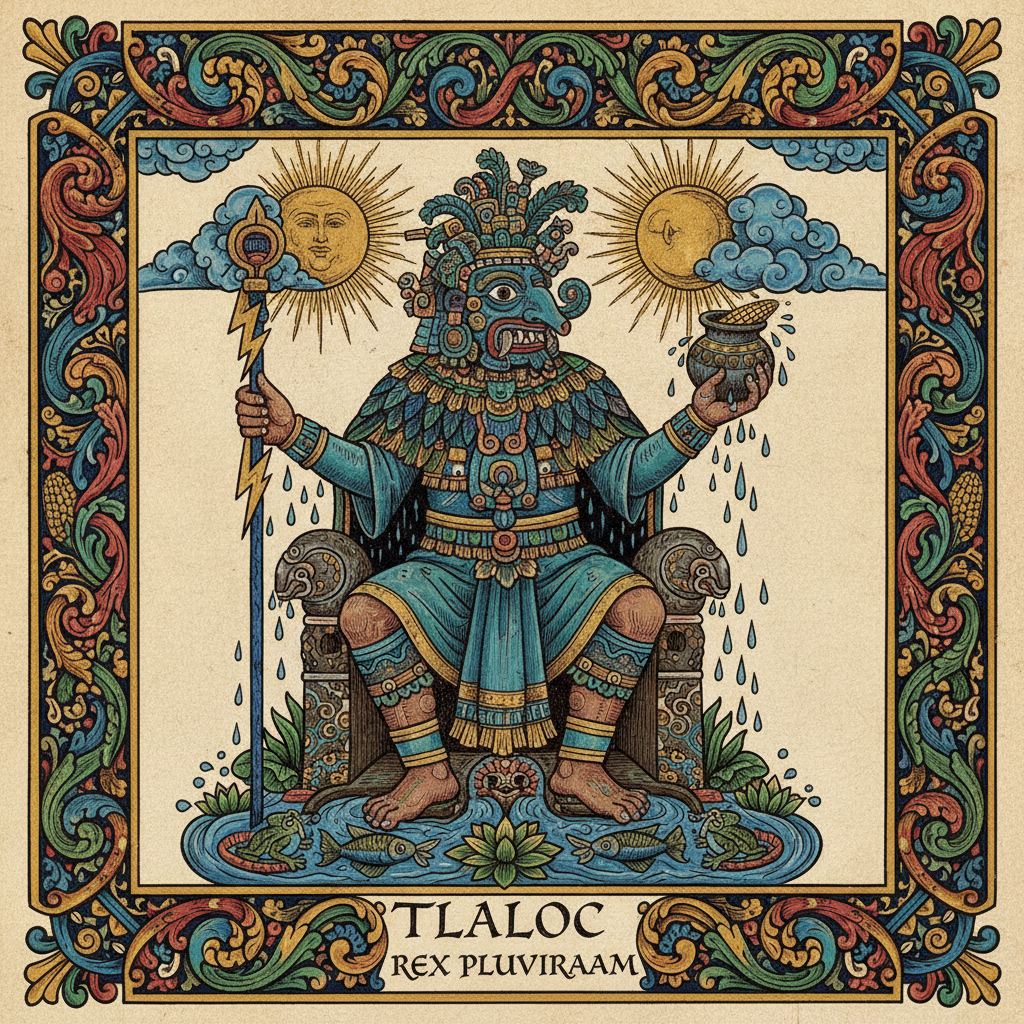
Tlaloc's Children of Rain
Ritual cycle: annually in Atlcahualo and Tozoztontli (approximately February–March) · Tlaloc temple, Templo Mayor, Tenochtitlan; summit of Mount Tlaloc, Valley of Mexico
Contents
The rain god Tlaloc requires the tears of children as sacrifice — children who cried abundantly were considered especially efficacious offerings. A tlalocan priest prepares the rain ceremony on the mountain. What the theology says about necessity, suffering, and agricultural survival.
- When
- Ritual cycle: annually in Atlcahualo and Tozoztontli (approximately February–March)
- Where
- Tlaloc temple, Templo Mayor, Tenochtitlan; summit of Mount Tlaloc, Valley of Mexico
The priest has been awake since the third hour of the night.
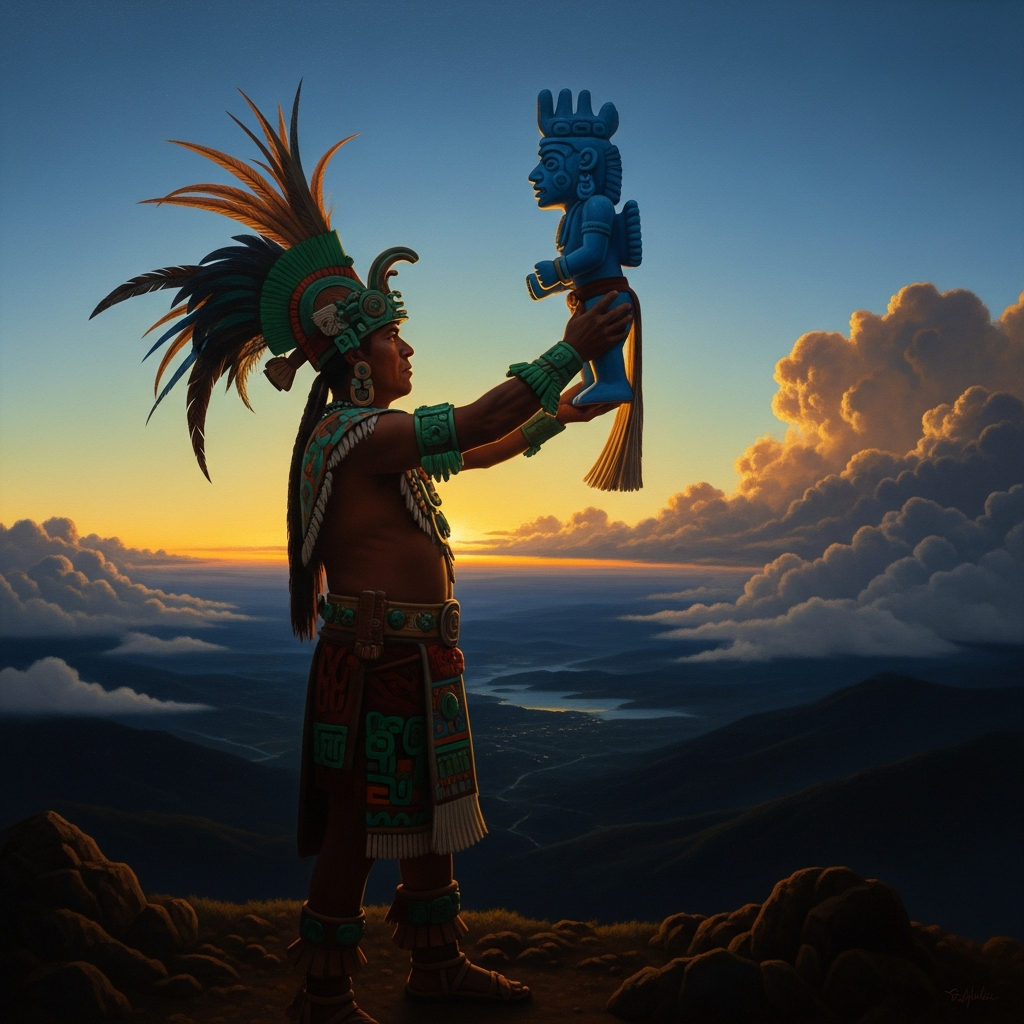
He climbed the mountain in darkness, before the children arrived, before the families, before the long procession would begin its ascent from the valley floor. He is called a tlamacazqui — a priest of the order that tends the rain deity — and he has made this climb many times, and each time the mountain feels different in the dark, the stone under his sandals less like ground than like something that breathes. Mount Tlaloc rises to more than four thousand meters above the valley of Mexico. At this altitude in February, the cold comes in through cloth as though cloth were not there.
He has fasted for twenty days.
The effigy he carries is painted blue — the color of water, of jade, of the sky in the dry season when it is most absent. It is small enough to carry in two hands. Its eyes are goggled, ringed in a way that suggests both vision and blindness, the looking that sees everything and the blank stare of falling rain. The Mexica have many names for rain: water that falls, water that stands, water that moves through channels, water that descends from mountains as mist. Tlaloc governs all of them. His assistants, the Tlaloque, are small storm gods who live in the mountains and tip the great water vessels that produce rain; when the vessels tip, lightning strikes. When the lightning strikes, it marks the exact point where water will enter the earth.
The priest sets the effigy at the summit shrine and waits.
Below, in the city, the preparation began at sunrise.
The children selected for the rain ceremony are very young — the sources say between one and seven years, the sources do not agree precisely — and they are selected for a specific quality that the theology requires: they must cry. Not merely cry as children cry from fear or hunger, but weep abundantly, copiously, in the specific way that mirrors what the ceremony is asking Tlaloc to provide. The Florentine Codex, compiled by Bernardino de Sahagun from indigenous accounts within a generation of the conquest, is explicit: children who had two cowlicks, which was considered an auspicious marking, were especially sought; children who were described as crying continuously were considered most effective. The tears are the grammar. The rain god, whose own iconography includes water running from his mouth and eyes, requires tears as the syntactic unit through which petition becomes intelligible.
The parents of these children — and the sources confirm that some were purchased, some were given voluntarily, some were the children of enslaved persons — participated in the procession. They were not, by the accounts that survive, simply bereaved. The theology provided a framework in which what was being done was not murder but appointment: the children would go to Tlalocan, the paradise of Tlaloc, a place of perpetual water and flowers and abundance. Children who died by drowning, by water-related illness, by lightning, all went to Tlalocan. They did not go to the general afterlife of the dead, which was a journey of four years through nine underground levels. They went directly to the rain paradise. They became part of the water cycle, part of what would return.
The priest on the mountain understood this. The parents were asked to understand it too.
Whether they did is a different question.
Inga Clendinnen, in her close reading of Aztec sources, argues that Mexica religious life was not experienced as coercive indoctrination but as genuine cosmological participation — that the people who watched these ceremonies were not merely performing compliance but inhabiting a worldview in which the sacrifice made sense because the alternative, drought, was well within living memory and catastrophic beyond what modern urban populations can readily imagine. The Valley of Mexico is not naturally well-watered. The lake system that surrounded Tenochtitlan was a human engineering achievement maintained by continuous labor. The milpa fields that fed a city of two hundred thousand people depended on rainfall that arrived in a narrow seasonal window and could fail entirely. When it failed, people died in numbers that dwarfed the numbers killed in any single rain ceremony.
The theology of necessity is not comfort. But it is theology in the proper sense: a systematic account of why the world is the way it is and what must be done to sustain it.
The tlamacazqui on the mountain was not a sadist. He was a hydraulic engineer who worked in the language his civilization had developed for hydraulic engineering, and that language was ritual, and ritual required the grammar of tears.
The procession reaches the summit.
The children are dressed in paper regalia — small crowns, paper vestments, painted with the colors of water and maize. Their faces carry the telltale marks of Tlaloc’s iconography: the liquid-rubber paint around the eyes, the goggle-ring that identifies the wearer as belonging, for the duration of the ceremony, to the rain deity’s household. They are carried in litters decorated with green branches, and the branches are the color of the growing corn that will need the rain. Everything in the ceremony is typological: the color of water predicts water; the sound of weeping predicts rain; the tears on a child’s face are the rain that has not fallen yet, already falling.
The ceremony at the summit involves the effigy, the offerings of food and copal incense, the paper regalia burned, and then, in the accounts Sahagun assembled, the death of the child in the water. The summit of Mount Tlaloc has a large enclosed compound — archaeologists have confirmed its remains — and at its center, a pit that collected water. What exactly happened at that pit the sources describe with varying specificity. What is consistent across accounts is the framing: this is not punishment. This is appointment. The child is being sent to the water god’s house.
The priest performs what the ceremony requires him to perform.
By afternoon, the priests watching the eastern horizon report what they report most years: cloud banks building over the mountains, the particular purple-gray of rain clouds over the Valley of Mexico in early spring. Whether the correlation is causal is a question the Mexica cosmology does not ask in those terms. Causality in the Mexica system is not the causality of Aristotelian physics or modern science; it is better described as resonance. Like produces like. Water produces water. The tears of the innocent, offered at the mountain of the rain god, resonate with the water that the Tlaloque hold in their great jars and tip toward the earth. The resonance is the mechanism. The mechanism is also the meaning.
The rain falls.
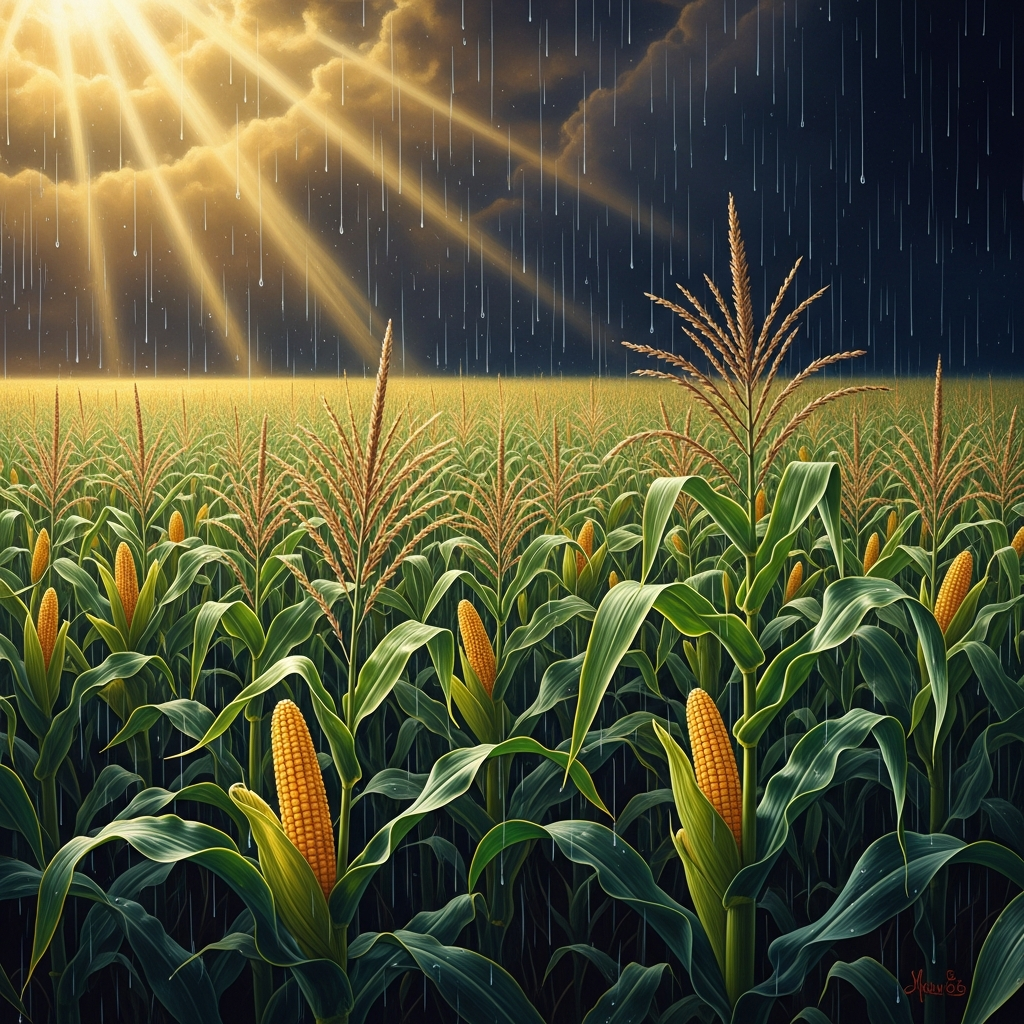
The milpa will drink.
The city of two hundred thousand will eat again.
The priest descends the mountain in the rain, and his sandals are soaked, and this is the point.
What the theology of Tlaloc asks of its practitioner is not the suspension of feeling but the subordination of feeling to a collective calculus that no individual is positioned to override. The priest who wept climbing the mountain — and the sources suggest that some did — was not betraying the ceremony. He was completing it. He was the rain, already falling.
Scenes
A tlalocan priest at the summit of Mount Tlaloc before dawn, the valley below still dark
 Generating art…
 A procession of children dressed in paper regalia, their faces painted with liquid rubber and rubber-banded crowns of maize-green
 Generating art…
 Rain falling on a mature milpa — the intercropped field of maize, squash, and beans that is the agricultural foundation of Mexica civilization
 Generating art…
 Echoes Across Traditions
Entities
- Tlaloc
- Tlalocan
- Chalchiuhtlicue
- Tlaloque

Sources
- Inga Clendinnen, *Aztecs: An Interpretation* (Cambridge University Press, 1991)
- Bernardino de Sahagún, *Florentine Codex: General History of the Things of New Spain*, Book II (trans. Anderson and Dibble, 1951)
- David Carrasco, *City of Sacrifice: The Aztec Empire and the Role of Violence* (Beacon Press, 1999)
- Cecelia Klein, 'The Ideology of Autosacrifice at the Templo Mayor,' in *The Aztec Templo Mayor* (ed. Boone, 1987)
- Kay Read, *Time and Sacrifice in the Aztec Cosmos* (Indiana University Press, 1998)