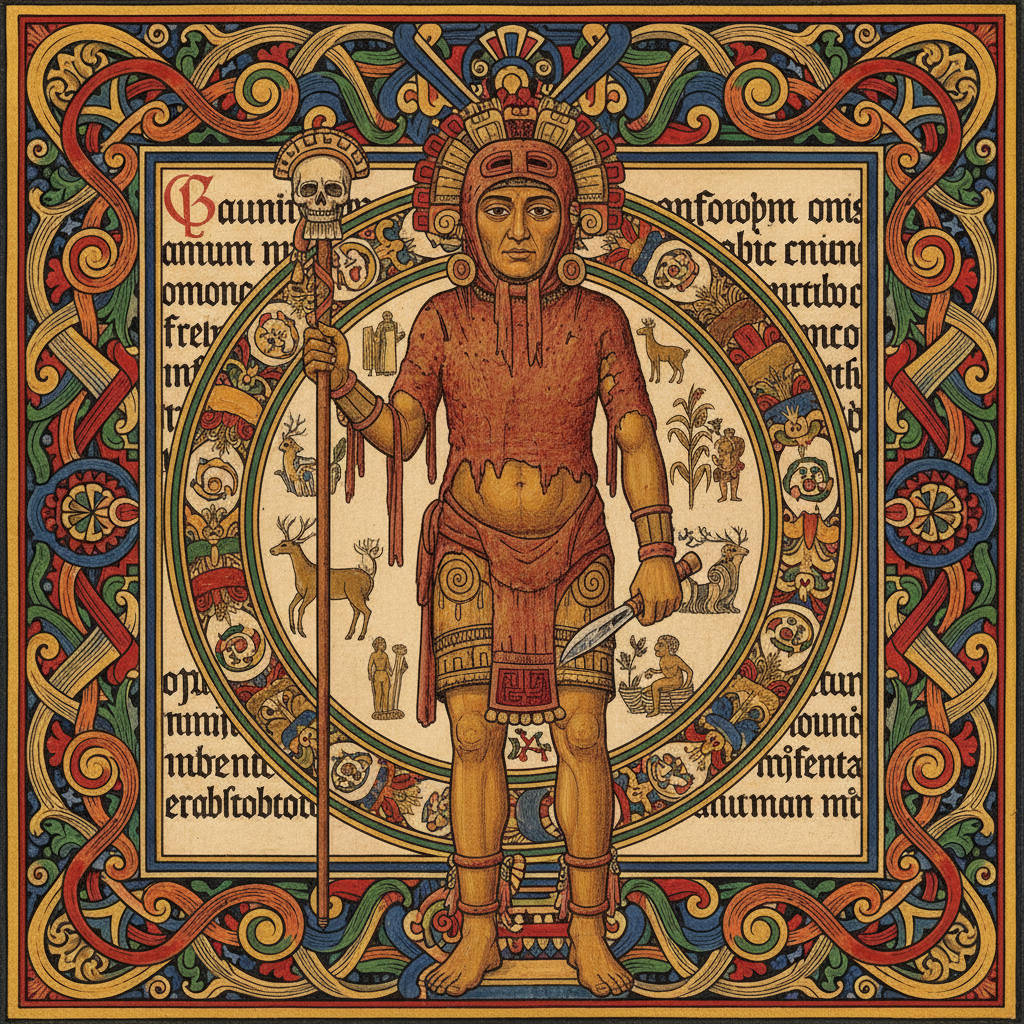
Xipe Totec: The Flayed One
Annual ceremony: Tlacaxipehualiztli (approximately February–March) · Templo Mayor, Tenochtitlan; agricultural fields of the Valley of Mexico
Contents
The god of agricultural renewal whose priests wore the flayed skins of sacrificial victims for twenty days, representing the earth's dry husk that must be shed before new growth. A tlacaxipehualiztli ceremony at the temple. The theology of death-as-skin.
- When
- Annual ceremony: Tlacaxipehualiztli (approximately February–March)
- Where
- Templo Mayor, Tenochtitlan; agricultural fields of the Valley of Mexico
The skin must come off before the new growth can begin.
This is not a metaphor that Xipe Totec requires his priests to translate. It is literal, ceremonially literal, performed on actual bodies in actual time in the actual city of Tenochtitlan every year in the month the Mexica called Tlacaxipehualiztli — which means, straightforwardly, the Flaying of Men. The god is Our Lord the Flayed One, and his festival is the enactment of what the agricultural year requires: the dead outer layer, the dry corn husk, the winter-killed surface of the earth, pulled away from the living tissue underneath so that the wet new growth can emerge.
The priests of Xipe Totec wear the skins of sacrificial victims for twenty days.
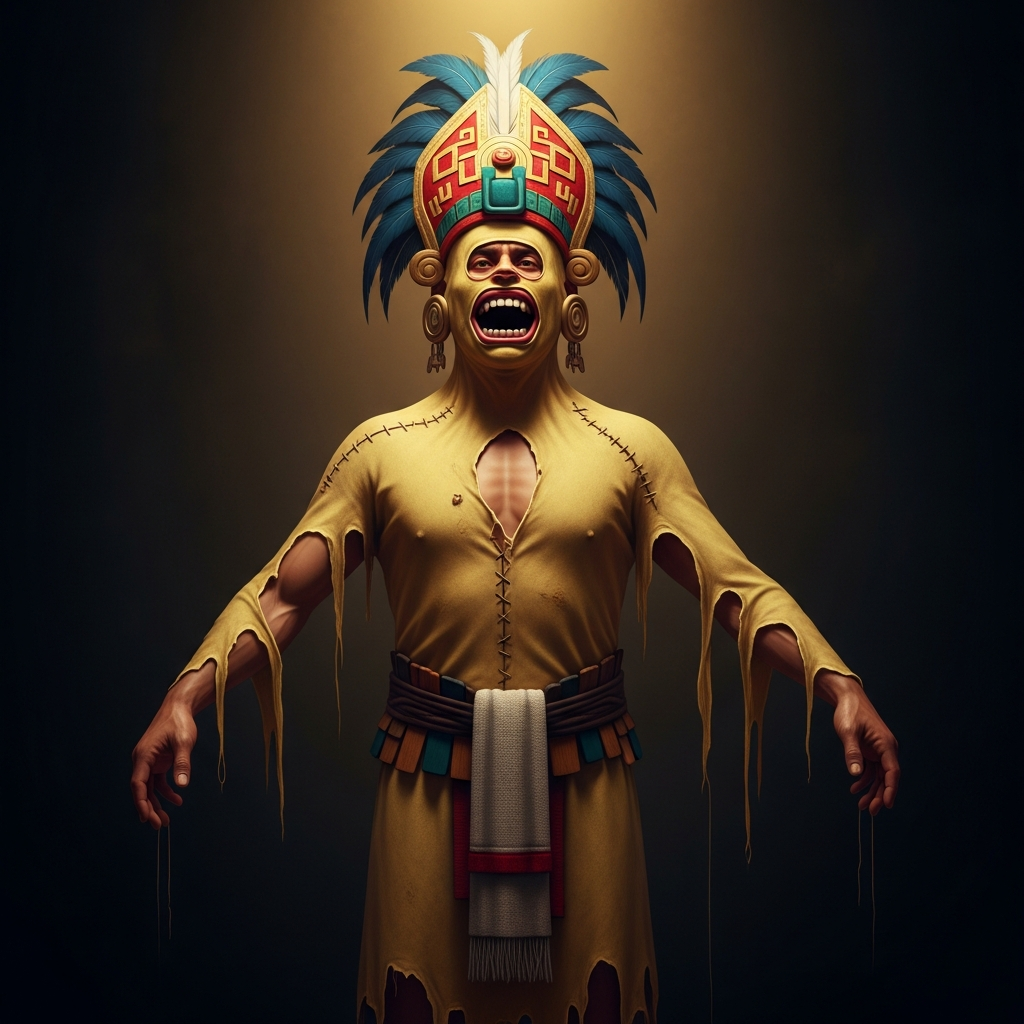
Not as symbolic gesture. They pull them on over their own bodies like garments — the back stitched closed, the face’s empty eyeholes above the priest’s own eyes, the hands of the skin falling over the priest’s hands, the whole assemblage smelling, after the first few days, of what a human skin that has been worn continuously for twenty days smells like. They eat and sleep and perform ceremonies in these skins. They are the god. The god is defined as the one who wears the dead skin.
The theology here is precise.
Look at what a corn plant does in the late dry season. The outer husk is dead: brown, papery, without moisture, clinging to the ear that is also dead and dry. Everything is dead-seeming. And then the rain comes, and the next generation of plants pushes through the dead ground, and what was dead falls away from what is living. The dead husk does not rot away on its own in the weeks before planting. It stays. It covers the ground. It is, from the outside, indistinguishable from the final condition of the plant.
Xipe Totec is the god in that interval. He is the god between the death of the old growth and the emergence of the new. His body is the dead corn plant that still has living seed inside it. His skin is the husk. The ceremony of Tlacaxipehualiztli is performed in the month that corresponds, in the Valley of Mexico’s agricultural calendar, to the dry-season lull before spring planting — the moment when the fields look most dead and the seed is most ready.
The priest who wears the skin is not celebrating death. He is inhabiting the exact theological moment between death and life, wearing the death on his body the way the earth wears it every year — unavoidably, for the duration — until it falls away.
The ceremony begins with gladiatorial sacrifice.
Warriors captured in the Flower Wars — the ritualized military campaigns whose explicit purpose was the taking of live prisoners for sacrifice — are given mock weapons and tied to a large stone, then required to fight fully armed jaguar and eagle warriors. The sources describe this in detail: the prisoner fights with a sword edged with feathers rather than obsidian. If he fights well enough to wound four jaguar and eagle warriors, he may be given a real weapon for the final bout. If he does not, he is taken from the stone and the flaying begins.
The Florentine Codex describes the flaying process with the dispassionate specificity of a professional account: a skilled flayer removes the skin in a single piece, working quickly. The skin is then given to the priest who will wear it. The priest dresses in it. There is a ceremony. The priest who is now Xipe Totec moves through the city, interacts with other priests and nobles, accepts offerings, performs ritual actions that the sources describe in the same neutral documentary tone as the flaying. The twenty days pass.
At the end of twenty days the skins are removed and buried.
The sources record that the removal of the skins reveals new skin under them — the priest’s own skin, which has been pressed against the inner surface of the human garment for twenty days. Inga Clendinnen notes this reversal: the outer skin, the dead skin, has been shed, and what is revealed beneath it is living. The ceremony has reproduced, in the priest’s body, the agricultural transformation it was designed to celebrate.
Xipe Totec’s face in the codices is one of the strangest in Mexica iconography.
He is painted red and yellow — the colors of fire and late-season corn — and his face has the peculiar look of a face within a face: the eyes of the deity visible through the eyeholes of the skin he wears, the stitched-shut mouth of the outer skin separate from the mouth inside it. He is the god who is always double, always a living thing inside a dead thing’s form, always the seed inside the husk. His statues and stone carvings show this doubling explicitly: the outer skin stitched at the back, the hands of the skin hanging loose over the hands beneath, the face of the dead over the face of the living.
His colors are the colors of what the maize field looks like in the weeks before planting: dry gold, red-brown of spent stalks, the specific exhausted palette of a field that has given everything it had and is waiting to be asked for more.
He is not, in the theology, a god of death. He is a god of the interval between death and life — the god who keeps the form of the dead thing intact long enough for what is inside it to be ready. The flayed skin is not a trophy or a demonstration of power. It is a garment the earth wears every year, and the priest who wears it is performing the earth’s own patience.
The tlacaxipehualiztli ceremony is also a ceremony of spring warfare.
The two are not separable in the Mexica system. The Flower Wars that produce the sacrificial victims for the ceremony are themselves an agricultural technology: the maintenance of divine favor through blood is the same system that maintains rainfall through the tears of children, the same system that moves the sun through the sky by feeding it continuously with hearts. War, in the Mexica framework, is not separate from agriculture. It is the mechanism that keeps the agricultural preconditions in place.
The prisoner who dies on the sacrifice stone and whose skin is given to the priest of Xipe Totec has not simply lost a war. He has been appointed to a function. His skin, worn for twenty days and then buried in the earth, is an offering to the same ground that will produce the spring corn. His death, in the theology of the Flayed One, is the precondition of the next growing season in the most literal sense available: his body enters the ground, and the corn comes up.
The ceremony ends. The skins are buried. The rains come, or they are asked to come, or the theology that has performed correctly awaits the agricultural response that correct theology produces.
Xipe Totec’s theology is the earth’s own theology: nothing new grows without the death of the old thing, and the death of the old thing does not disappear — it becomes the ground from which the new thing rises. The priest who wears the dead skin for twenty days is not celebrating cruelty. He is keeping faith with the interval. He is the moment between death and life, which is the moment everything depends on, and which has to be inhabited by someone.
Scenes
A priest of Xipe Totec in full regalia — the flayed human skin worn over his own body like a second skin, already yellowing after days of wear, stitched at the back and hands
 Generating art…
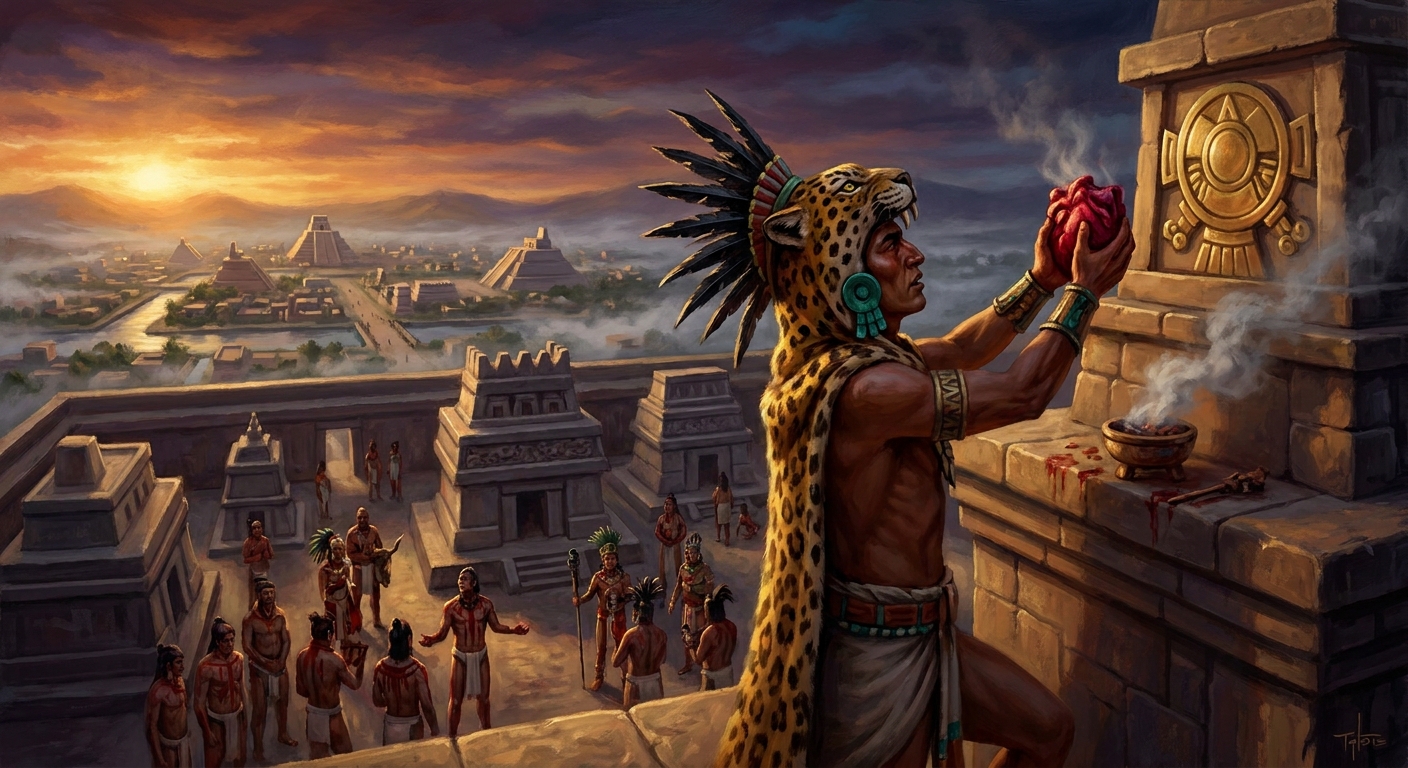
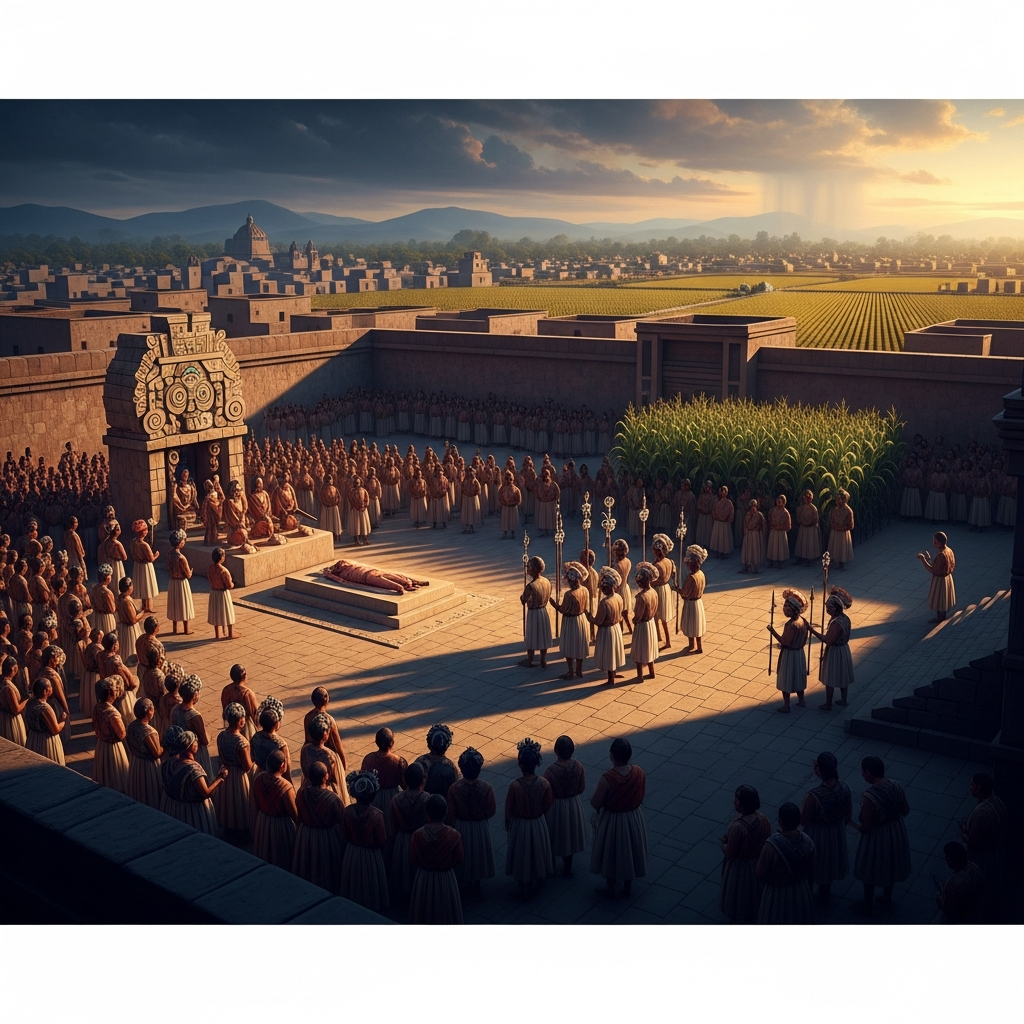
 The tlacaxipehualiztli ceremony in the courtyard of the Templo Mayor at dawn
 Generating art…
 Twenty days after the ceremony, the dry corn stalks of late winter beginning to show the first green growth of the new season
 Generating art…
 Echoes Across Traditions
Entities
- Xipe Totec
- Tlacaxipehualiztli
- Tlatlauhqui Tezcatlipoca

Sources
- Bernardino de Sahagún, *Florentine Codex: General History of the Things of New Spain*, Book II (trans. Anderson and Dibble, 1951)
- Inga Clendinnen, *Aztecs: An Interpretation* (Cambridge University Press, 1991)
- David Carrasco, *City of Sacrifice: The Aztec Empire and the Role of Violence* (Beacon Press, 1999)
- Cecelia Klein, 'The Ideology of Autosacrifice at the Templo Mayor,' in *The Aztec Templo Mayor* (ed. Elizabeth Hill Boone, Dumbarton Oaks, 1987)
- Richard F. Townsend, *The Aztecs* (Thames and Hudson, 1992)