Akhenaten and the Sun
~1353-1336 BCE · the 18th Dynasty · Amarna, the new capital from sand
Contents
Pharaoh Amenhotep IV renames himself Akhenaten, erases a thousand gods, builds a city from sand, and composes history's first hymn to a single divine light — then dies, is erased, and leaves behind an idea that refuses to stay buried.
- When
- ~1353-1336 BCE · the 18th Dynasty
- Where
- Amarna, the new capital from sand
In the thirty-eighth year of his father’s reign, a prince looks at the sky and decides it is not complicated enough to contain ten thousand gods.
His name is Amenhotep. He is perhaps seventeen. The sun is rising over Karnak and the smell of blood from a hundred morning sacrifices is rising with it — to Amun, to Ra, to Osiris, to Ptah, to Thoth, to Sekhmet, to the forty gods of the forty nomes of Egypt. This is how it has always been. This is how it will always be.
Except that it will not.
Within five years of his ascension, the new pharaoh has changed his name. He is no longer Amenhotep — Amun is Satisfied. He is Akhenaten: Effective for the Aten. The name is a declaration of war. The Aten is the sun-disc itself, not a deity who rides the sun, not a god who wears the sun as a crown. The disc. The light. The thing that is simply there, every morning, without explanation.
He builds a new city.
He picks a stretch of desert on the eastern bank of the Nile where no god has ever been worshipped, where no temple stands, where there is nothing — and he calls it Akhetaten, Horizon of the Aten. Today we call it Amarna. The limestone was cut and the walls rose and within a few years forty thousand people are living in a city that did not exist. Palaces, temples, workshops, a royal road wide enough for a chariot to turn. In the center, the Great Temple of the Aten — open to the sky, no roof, because the god does not live inside anything. The god lives in the light itself.
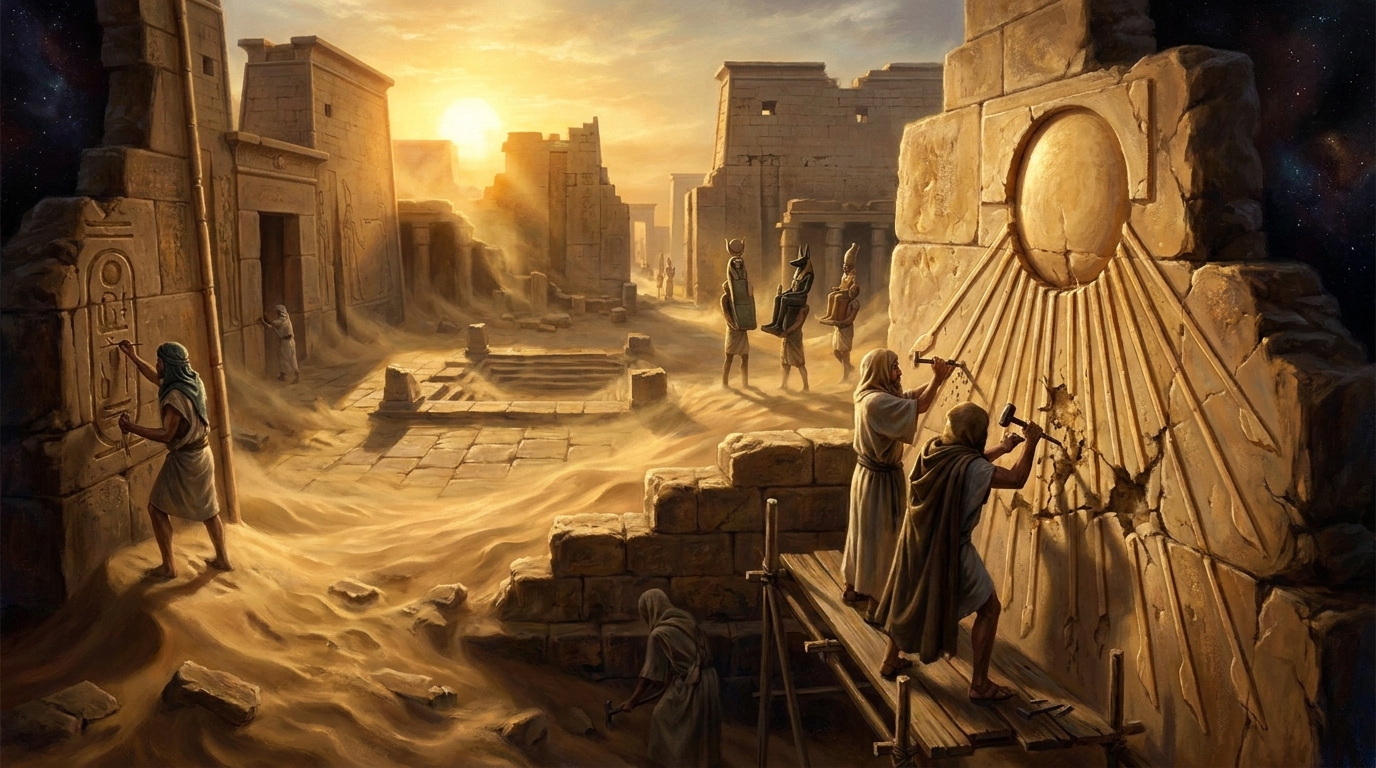
He closes Karnak. He closes the Amun priesthood. He has the name Amun chiseled from every monument in Egypt, every cartouche, every wall. The workers go up on ladders in the dark and hammer the name of the old god into dust. Not just Amun — all of them. Every name that is not Aten.
This is not reform. This is annihilation.
Then he writes the poem.
The Great Hymn to the Aten is inscribed in the tomb of the courtier Ay, and it is the most extraordinary religious document to survive from ancient Egypt. Not because of what it says about the sun — many traditions praise the sun — but because of what it refuses to say. There are no other gods in it. There is no mythology, no cosmological drama, no divine family. There is only light, and what light does.
How manifold are thy works. They are hidden from man’s sight. O sole god, like whom there is no other.
Seven hundred years later, the author of Psalm 104 will write: O Lord my God, thou art very great. Thou art clothed with honour and majesty. Who coverest thyself with light as with a garment.
The parallel is so close that scholars have been arguing about it since the 19th century. Direct borrowing? Independent convergence? A shared idea floating through the ancient Near East like pollen? The honest answer is: we do not know. What we know is that two writers, centuries apart, looked at the same light and arrived at the same silence — the silence that falls when you realize the thing you are looking at is not one of many things but the condition of all things.
Akhenaten calls that silence a god. He calls it Aten. He stakes his entire kingdom on it.
He fails.
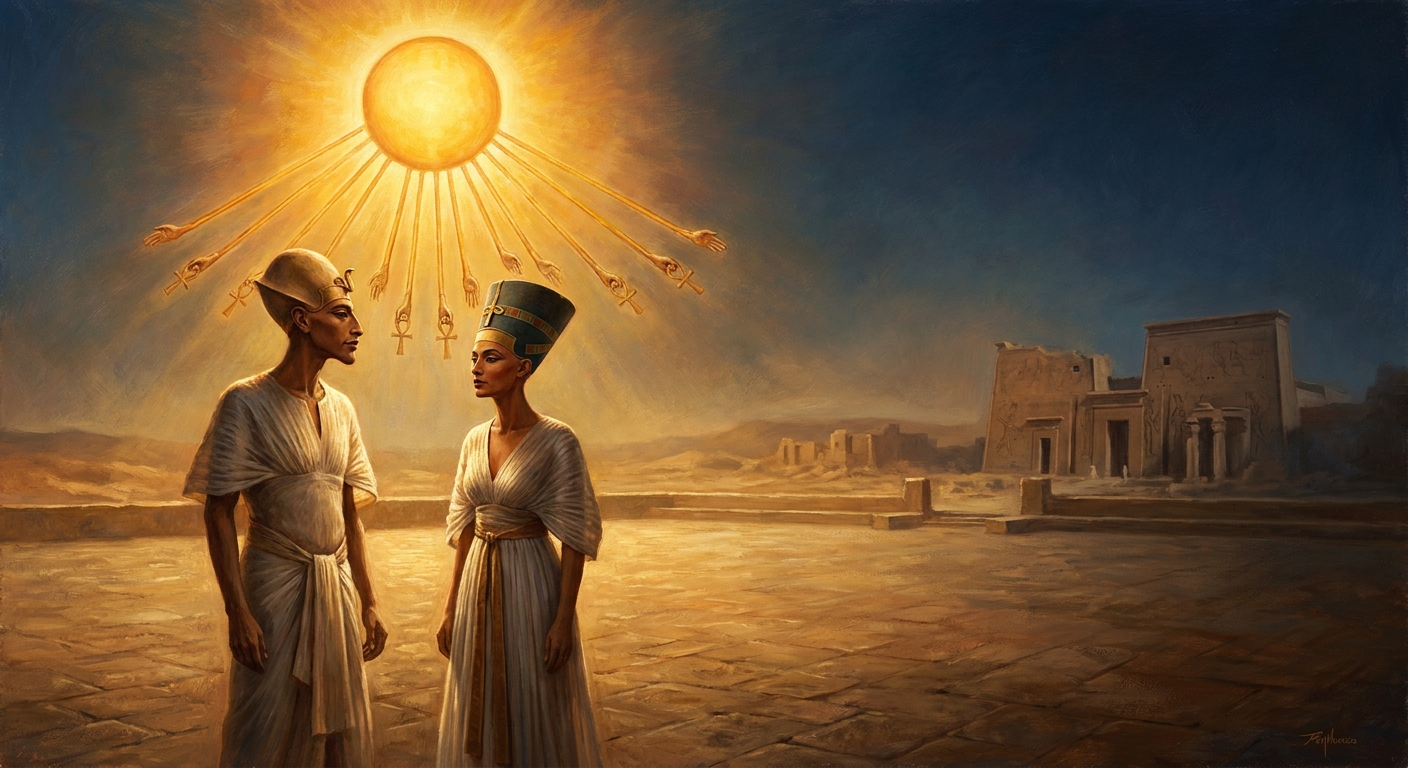
The failure is not immediate. For seventeen years Amarna stands. Akhenaten rules. Nefertiti stands beside him in the reliefs, nearly his equal in size — which is itself a theological statement, since size in Egyptian art means importance, and no queen before her is depicted at pharaonic scale. Together they stand under the disc with their daughters, the Aten’s rays ending in small open hands that reach toward them and toward no one else. The theology is simple and radical: the god loves the light; the light loves the pharaoh; the pharaoh, and only the pharaoh, mediates between the disc and the people. There is no priest class. The priests of Amun have been disbanded. There is only the royal family, standing in the open air, under the thing itself.
Somewhere around year twelve, something changes. The historical record thins. Nefertiti disappears from the monuments — dead, or elevated, or exiled, depending on which scholar you ask. The plague may have visited. The army is restless. The Amarna letters, clay tablets of diplomatic correspondence found in the archive, show vassal kings in Canaan writing desperately for troops that never come. The empire is fraying at the edges while the pharaoh watches the sun.
In year seventeen, Akhenaten dies.
We do not know how.
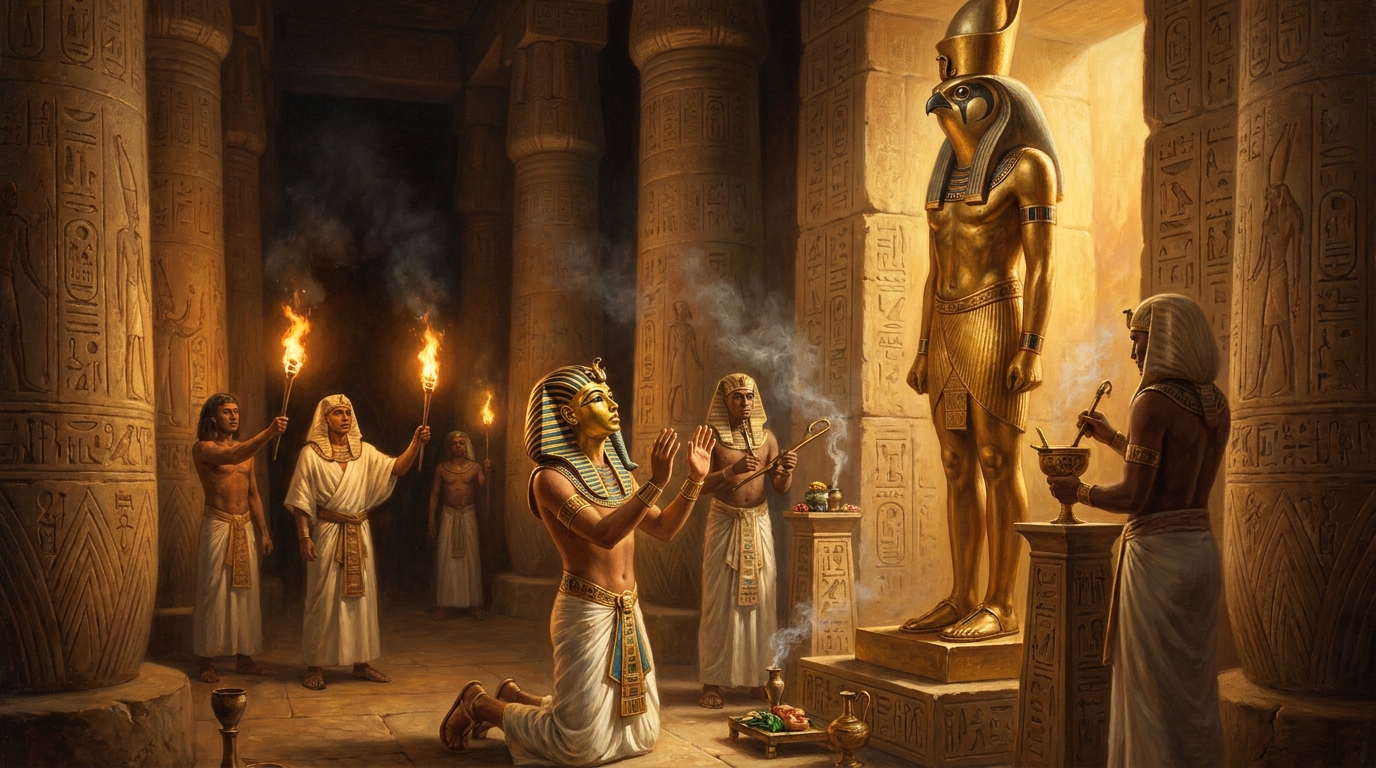
His son ascends. The boy is nine years old. His name, at the moment of his father’s death, is Tutankhaten — Living Image of the Aten. Within two years the name is changed to Tutankhamun — Living Image of Amun. The old high priest Ay stands behind the throne. The army general Horemheb stands somewhere behind Ay. The boy signs the decrees that have already been written.
Amarna is abandoned. Not destroyed — not yet — but emptied. The royal court returns to Thebes and Memphis. The temples of Amun reopen. The priesthood returns to its offices, its revenues, its three thousand years of institutional continuity. The Aten temples are systematically dismantled. The limestone is carted away to build other things.
Then the erasure begins in earnest.
Akhenaten’s name is chiseled from the king-lists. He becomes, in the official record, the criminal of Akhetaten — referenced obliquely, never named. His successors are listed as if they follow directly from his father Amenhotep III, as if the seventeen years at Amarna were a fever that the kingdom sweated out, a bad dream that did not happen.
The city that did not exist before 1346 BCE does not exist again by 1320 BCE.
Here is what the erasure could not reach.
Seventy years later — the dating is approximate, debated, contested — a man called Moses is in the Sinai. He has left Egypt. He is keeping the flocks of his father-in-law Jethro. He comes to a mountain and something speaks to him from a fire that does not consume the bush it burns in.
The voice says its name is a verb: I am what I am. I will be what I will be. Not a name in the Egyptian sense — not Ra, not Amun, not Aten. A name that is a claim about being itself. A name that means: I am the condition of all things, and unlike conditions, I do not have a name you can chisel away.
Freud, in 1939, wrote Moses and Monotheism and argued — scandalously, productively, with evidence he admitted was not conclusive — that Moses was an Egyptian, an Atenist, a survivor of the Amarna experiment who carried the monotheist idea into the desert when the restoration made it uninhabitable at home. Assmann, building on Freud sixty years later in Moses the Egyptian, was more careful: he distinguished between historical memory and mnemohistory, what actually happened and what a culture remembers happening. His point was not that Moses was literally Akhenaten’s priest. His point was that the idea migrated, the way ideas migrate — through trade, through refugees, through the slow drift of theological conversation across the ancient Near East.
The idea: that the real god has only one name.
The idea: that the others are not gods.
The idea: that you can look at the thing that makes all things visible and recognize it as the only thing worth worshipping.
Akhenaten composed the first monotheist document in human history and ruled for seventeen years and died and was erased and failed. This is the story as the Egyptian record tells it.
But the Egyptian record is the record of the priests of Amun, who had every reason to make sure the story ended there.
The Sinai is not on their monument walls. The wandering tribe is not in their king-lists. The name spoken from the burning bush is not in their cartouches.
Seventy years is a long time for an idea to travel.
It is also not very long at all.
Scenes
Akhenaten and Nefertiti raise offerings beneath the sun-disc
Generating art… Amarna, abandoned
 Generating art…
 Tutankhamun before the restored altar of Amun
 Generating art…
 Echoes Across Traditions
Entities
- Akhenaten
- Nefertiti
- Aten
- Tutankhamun
- Ay
Sources
- *Great Hymn to the Aten* (~1345 BCE) — compare Psalm 104 verse-by-verse
- Donald Redford, *Akhenaten: The Heretic King* (1984)
- Jan Assmann, *Moses the Egyptian* (1997)
- Sigmund Freud, *Moses and Monotheism* (1939)