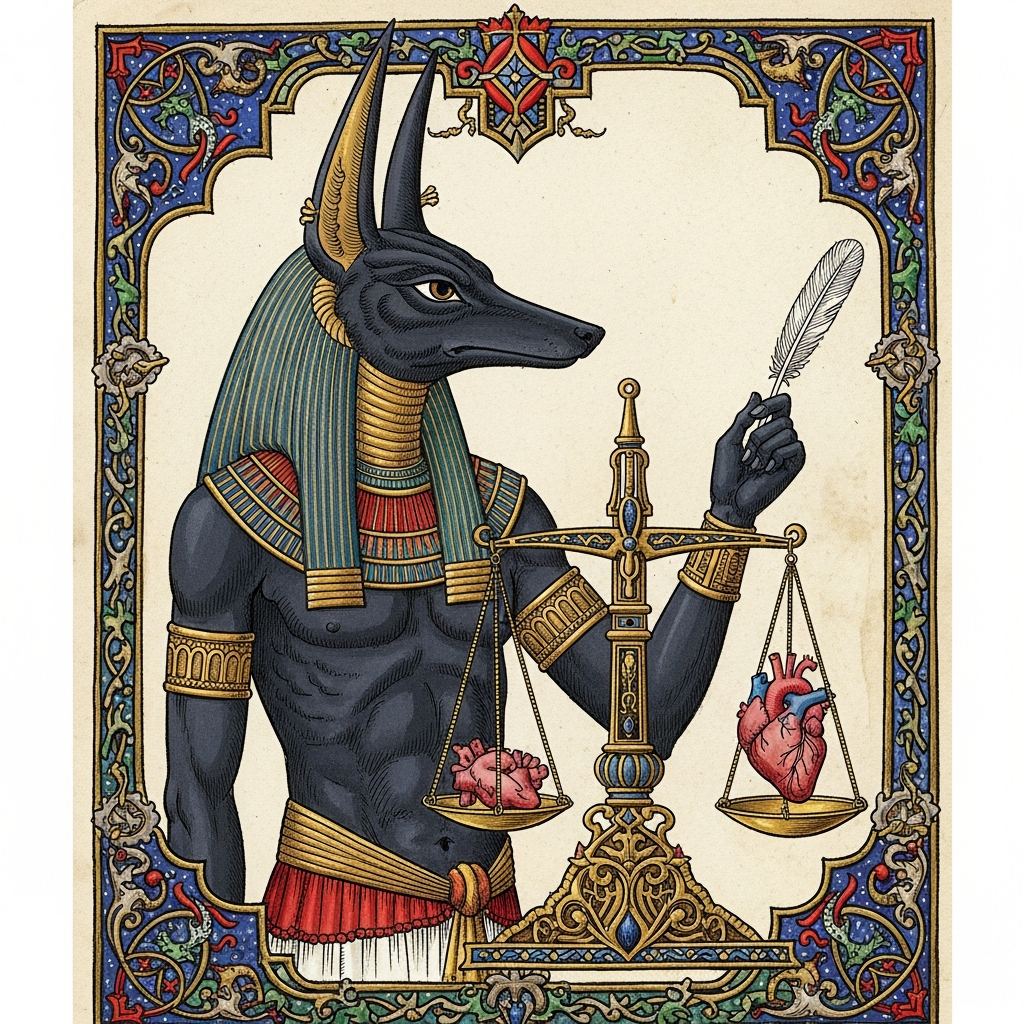
The Weighing of the Heart Against the Feather
New Kingdom period — c. 1550–1069 BCE; the theology is older, formalized in the Book of the Dead · The Duat — the Egyptian underworld; the Hall of Two Truths (the Hall of Maat)
Contents
In the Hall of Two Truths, the deceased stands before forty-two divine assessors and recites the Negative Confessions — forty-two sins they have not committed, each addressed to a specific deity in a specific city. Anubis then places the heart on the scale against Maat's feather of truth. Thoth records. The monster Ammit waits. A heart heavier than a feather is devoured, and the soul ceases to exist. The theology that emerges is one of the strangest in history: salvation depends not on what you believe, but on the lightness of what you have done.
- When
- New Kingdom period — c. 1550–1069 BCE; the theology is older, formalized in the Book of the Dead
- Where
- The Duat — the Egyptian underworld; the Hall of Two Truths (the Hall of Maat)
The heart knows everything.
This is the foundational claim that makes the Hall of Two Truths possible: the heart — ib in Egyptian, the organ at the center of the chest — is not merely the pump that moves blood. It is the seat of consciousness, of memory, of moral intelligence. Everything you have ever done is recorded in your heart. Every word spoken, every action taken, every thought held and translated into behavior is in there, written in the organic language of accumulated experience. You cannot lie about your heart. You cannot prepare a substitute. You can recite the correct formulas and wear the correct amulets and be buried with the correct papyri, but when the scales are level and the pointer rests at center, what is being weighed is not your preparation. It is you.
This is what makes the Egyptian afterlife judgment distinctive. It is not about what you believed. It is not about whether you performed the rituals, though the rituals matter. It is about the moral weight of a life, measured with the most precise instrument available: the scale of the goddess Maat, with her single ostrich feather on one side and your heart on the other.
You enter the Hall of Two Truths after a journey through the Duat — the underworld, the twelve hours of darkness that the sun’s barque navigates each night between the western horizon and the eastern dawn. You have said the words in the Book of the Dead; you have passed the gates; you have named the doorkeepers correctly; you have brought yourself, if the preparation was adequate, to this place.
The hall is long. The assessors line both sides — forty-two of them, each associated with a specific city in Egypt, each the divine overseer of a specific category of transgression. They are not judges in the way a modern judge adjudicates; they are witnesses, each responsible for verifying that you have not committed the sin that falls within their domain.
And you speak. You address each one in turn.
The Negative Confessions are the strangest liturgy in Egyptian literature. They are not confessions in the penitential sense — not admissions of guilt. They are declarations of innocence, forty-two statements of what you have not done, each addressed to a named deity in a named city: I have not done wrong. I have not robbed. I have not been greedy. I have not stolen. I have not killed men. I have not diminished the grain measure. I have not carried away the food-offerings of the temples. I have not set my mouth in motion against any man. I have not made anyone weep.
The list continues: I have not had sex with a boy. I have not polluted the river. I have not been hot-tempered. I have not been deaf to just speech. I have not blocked the water in its season. I have not waded in water. I have not raised my voice. I have not been violent.
They are specific in ways that reveal a society: the concern with accurate grain measurement speaks to a civilization built on agricultural surplus and the possibility of cheating the grain-counter. The concern with blocking the water speaks to irrigation systems and the catastrophic consequences of disrupting them. The concern with speaking ill of others, with making people weep — these are the sins of daily life, the small violences of ordinary social existence, given the same weight in the judgment as murder.
The forty-two assessors listen. If you speak truly — if your heart matches your declaration — you may proceed.
Then Anubis brings the scales.
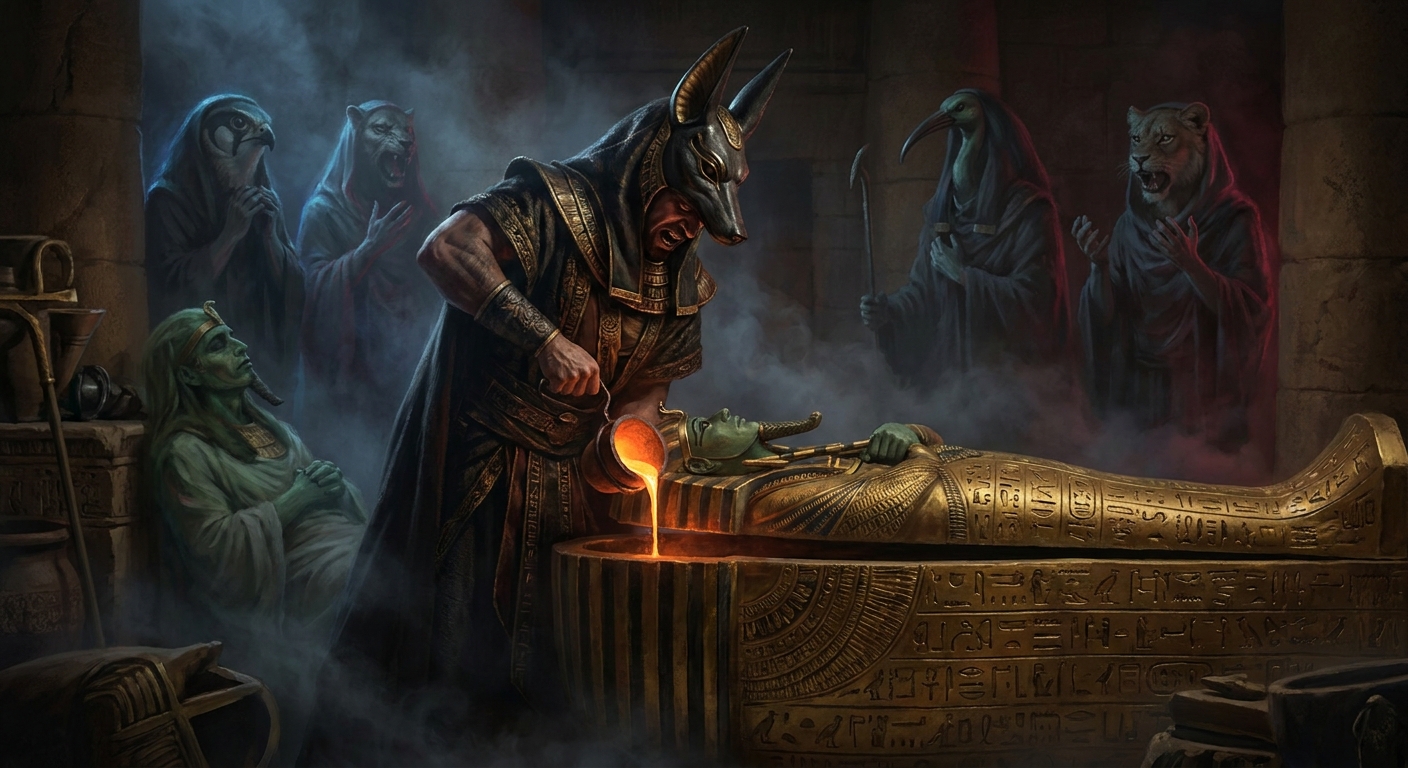
Anubis is the jackal-headed god of embalming, the god who meets the dead at the threshold, the god whose long black form appears at the moment of mummification and at the moment of judgment. He has been present through the entire preparation of the body for burial; he is present now at the assessment of the soul. He takes your heart — removed during mummification and kept in a canopic jar, returned now for this specific purpose — and places it on the left pan of the scale.
On the right pan: the feather of Maat.
Maat is not exactly a goddess in the ordinary sense. She is a principle given divine form — the concept of truth, justice, cosmic order, the right relationship between things. Her symbol is the ostrich feather: light, exact in its symmetry, requiring nothing to be other than what it is. She is what the heart is weighed against. A heart that carries no excess weight — no unacknowledged crimes, no dishonored obligations, no habitual cruelties — will balance exactly with the feather. A heart that carries more will tip the scale.
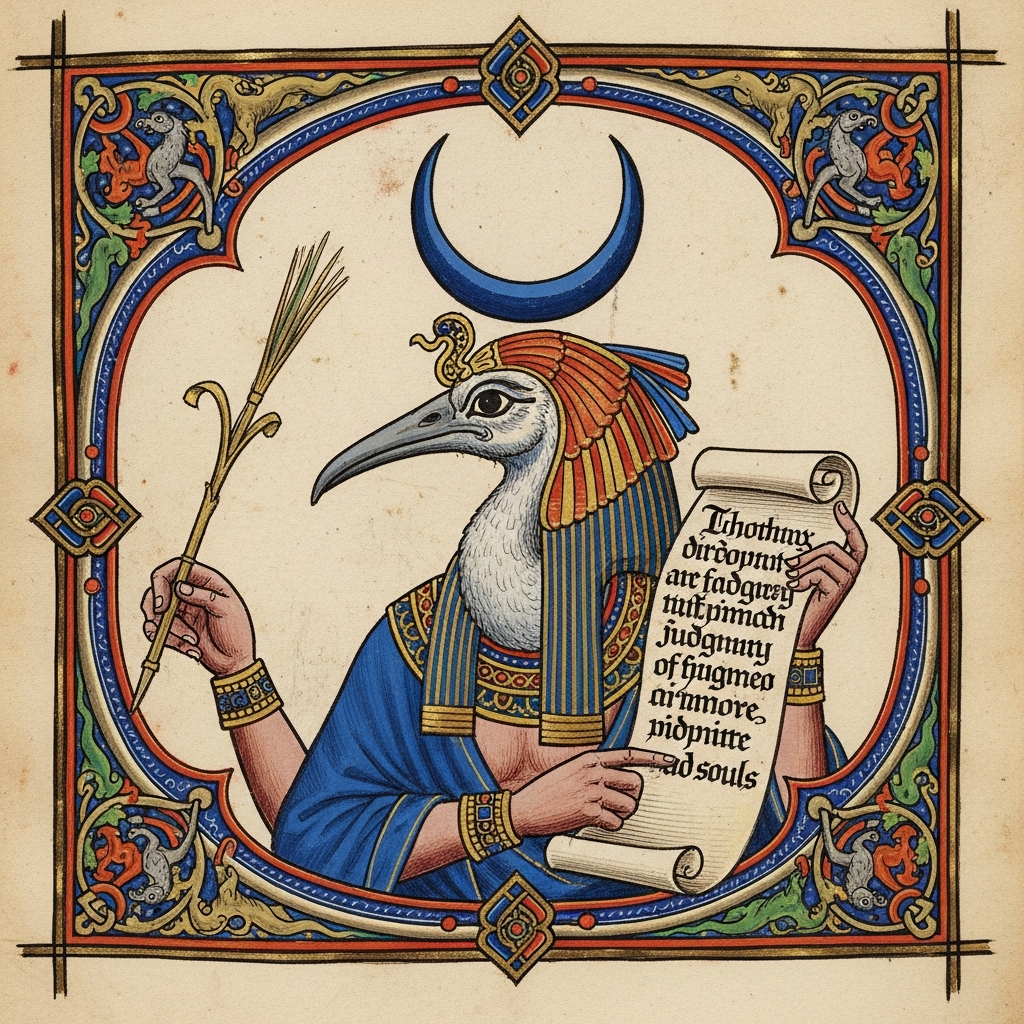
Thoth stands with his palette and his reed pen, recording. He is always recording.
Ammit waits below the scales.
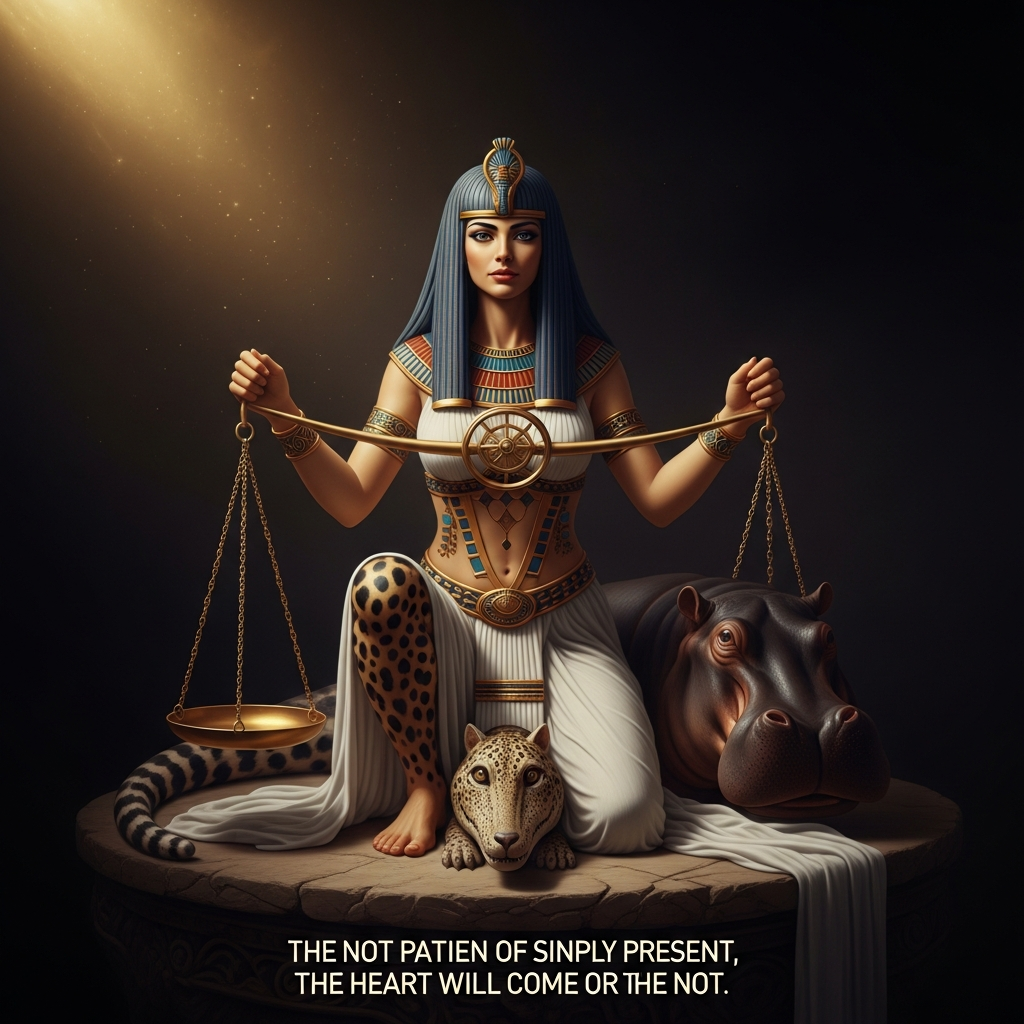
She is called the Devourer, the Bone-Eater, the Greatness of Death. She is a compound animal: the head of a crocodile, the forequarters of a leopard or lion, the hindquarters of a hippopotamus. These are the three largest predators of Egypt — crocodile for the river, lion for the desert, hippopotamus for the margins between — combined into a single form that represents total predation, the consuming of everything that the ecosystem can consume. She has no name in the sense that other gods have names; she is a function, a mechanism, the destination of the failed heart.
If the heart is heavier than the feather, Anubis removes it from the scale and gives it to Ammit. She eats it. The soul — which the Egyptians called the ba, the individual personality, the specific person who lived and breathed and accumulated memories — ceases to exist. Not punishment. Not hell. Not eternal suffering. Simple cessation. The second death.
This is the thing the Egyptians called the death that they truly die — the permanent annihilation that distinguishes the failed soul from the merely dead. Everyone dies once: the body stops, the ba separates, the journey through the Duat begins. But only the heavy-hearted die twice. The second death is the one that cannot be undone, the one from which no resurrection is possible because there is nothing left to resurrect.
If the heart and the feather balance, Thoth records the result: maa-kheru, true of voice, justified. The deceased is brought before Osiris, enthroned at the end of the hall, the dead king who became the king of the dead, and declared righteous. They pass through into the Field of Reeds — the Egyptian paradise, an idealized version of the Nile valley, with grain that grows tall and the company of the gods and the continuation of ordinary life without the weight of ordinary death.
What the theology encodes, underneath its specific imagery, is a claim about the moral physics of the universe. The heart is not a blank slate that can be washed clean by final confession or deathbed conversion. It is the accumulated record of a life. You bring what you have done. The feather does not lie. Ammit does not negotiate.
The implication for the living is not subtle: the preparation for the judgment begins the first morning you are old enough to understand that you will die. Every grain cheated from the measure, every person made to weep without cause, every word spoken against someone who has not earned it — all of it goes into the heart. All of it will be weighed.
The heart scarab — a large carved scarab placed over the heart during mummification — was inscribed with a specific spell: do not testify against me. The heart was asked, formally and with legal language, not to reveal what it knew.
This is a remarkable thing to have to ask of your own heart. It suggests that the Egyptians understood the theology completely and were also, as people are, not entirely confident that they could live up to it. They prepared the correct paperwork. They said the correct words. They asked their hearts to cooperate.
The heart was asked. Whether it complied depended on what was inside it, which was, which has always been, the point.
Scenes
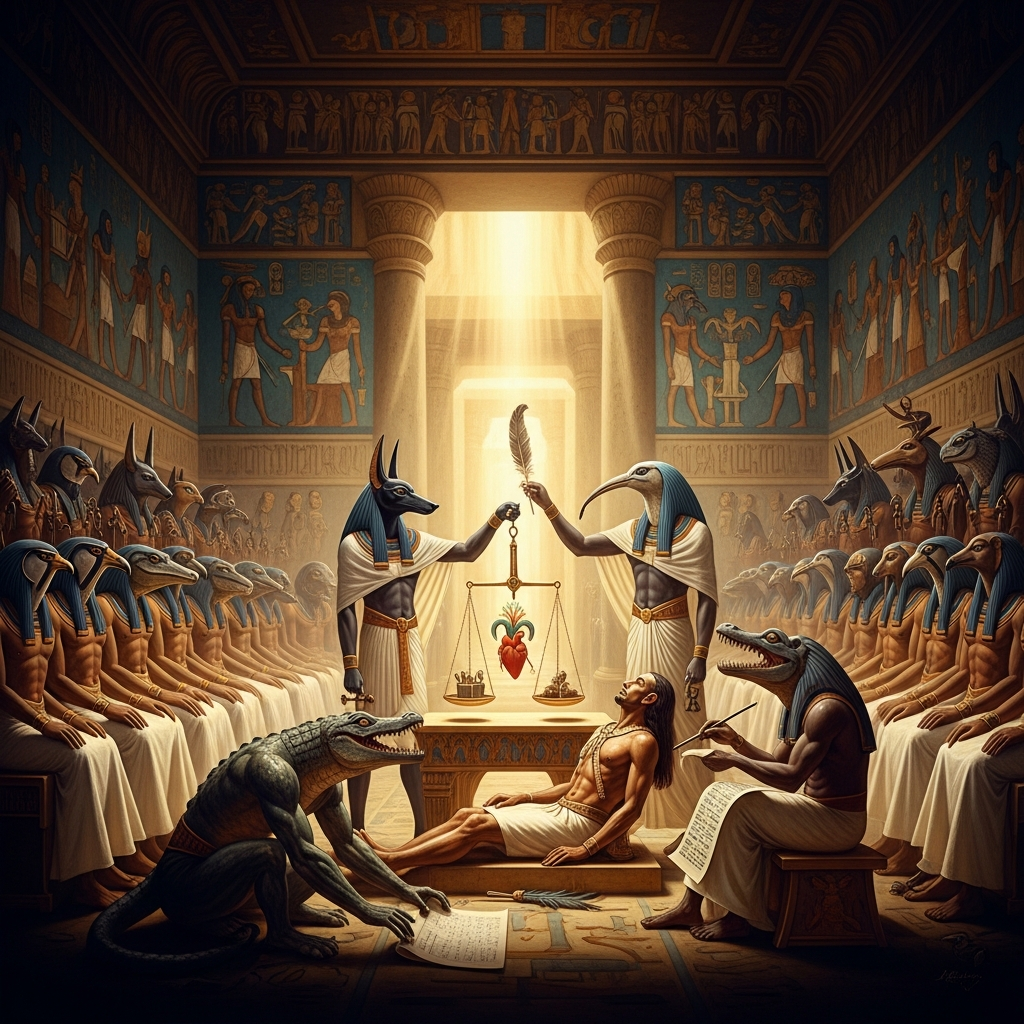
The Hall of Two Truths at full assembly: the forty-two assessors ranged along the walls, Anubis at the scales with the dead man's heart on one pan and Maat's ostrich feather on the other, Thoth standing with his scribal palette ready to record, Osiris enthroned at the far end of the hall
 Generating art…
 Ammit crouched below the scales — the head of a crocodile, the forebody of a leopard, the hindquarters of a hippopotamus, the three largest predators of Egypt combined into a single form
 Generating art…
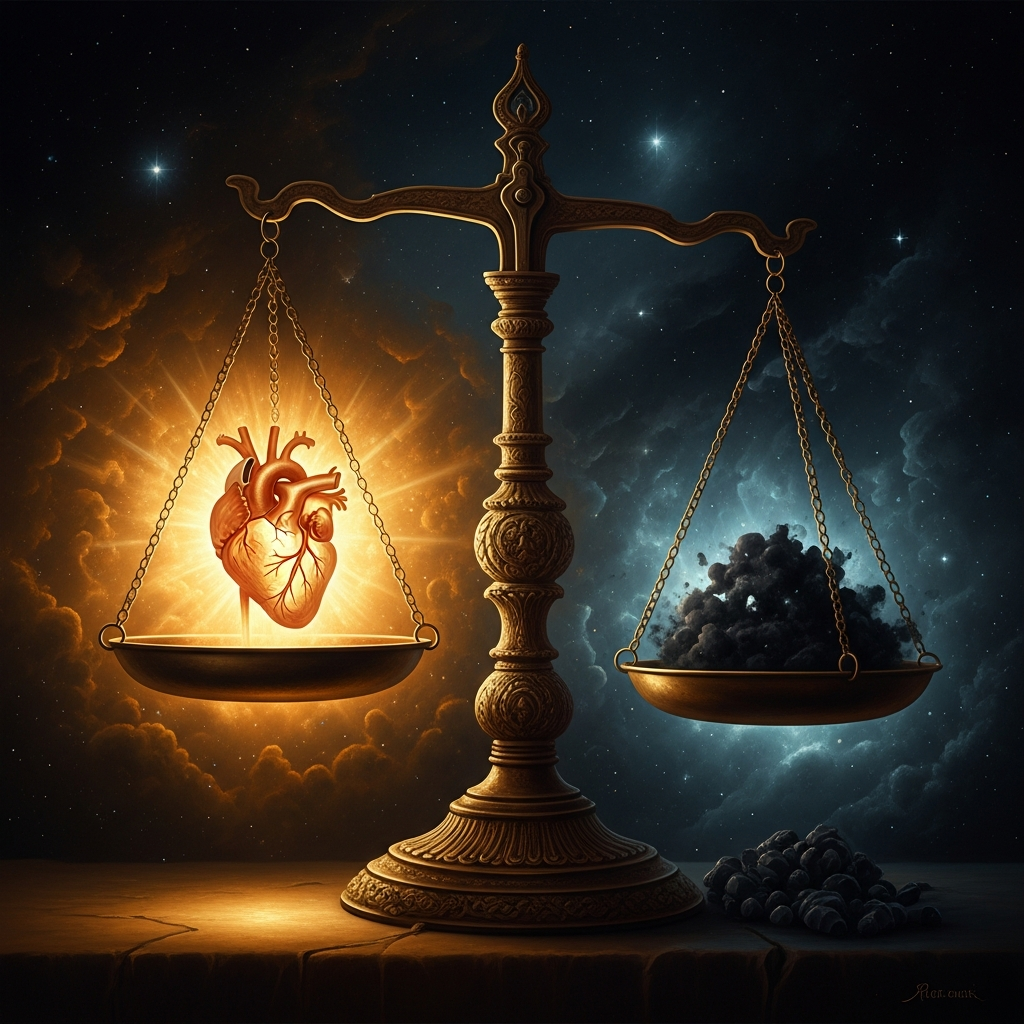
 The moment of balance: the scale's two pans at equal height, the heart and the feather exactly equivalent, the pointer of the scale at the midpoint
 Generating art…
 Echoes Across Traditions
Entities


Sources
- Jan Assmann, *Death and Salvation in Ancient Egypt* (Cornell University Press, 2005)
- Erik Hornung, *The Ancient Egyptian Books of the Afterlife* (Cornell University Press, 1999)
- Miriam Lichtheim, *Ancient Egyptian Literature, Volume II: The New Kingdom* (University of California Press, 1976)
- Richard H. Wilkinson, *The Complete Gods and Goddesses of Ancient Egypt* (Thames and Hudson, 2003)
- E.A. Wallis Budge, *The Egyptian Book of the Dead* (1895, standard edition — with caveat that later scholarship has substantially revised his translations)