Sekhmet and the Eye of Ra: The Slaughter That Almost Ended Humanity
Primordial time — the reign of Ra on earth; New Kingdom sources, c. 1550–1069 BCE · The fields of Egypt — Heliopolis, the desert, the land of men
Contents
Ra sends his Eye — the lioness goddess Sekhmet — to punish humanity for mocking him in his old age. She begins killing and cannot stop. Ra relents and tries to recall her, but she has entered the divine frenzy and is beyond hearing. Ra floods the fields with red-dyed beer; she drinks it thinking it is blood; she falls asleep drunk; humanity survives by seventy-three thousand deaths and the width of a beer vat.
- When
- Primordial time — the reign of Ra on earth; New Kingdom sources, c. 1550–1069 BCE
- Where
- The fields of Egypt — Heliopolis, the desert, the land of men
Ra is old.
This is the first fact, the one the myth requires you to hold. Ra — the sun, the supreme deity, the one whose eye is the light that makes the world visible — has grown old in the way that even gods grow old when they spend too long in the company of mortals. His bones are silver. His flesh is gold, as it always was, but the gold has gone dim. His hair, which was lapis lazuli in the beginning, has gone white. He sits in his solar barque each day and crosses the sky, and the humans below — the creatures he made from his own tears — have begun to notice. They whisper. They make calculations. They say to each other: he is weakening; we might no longer have to obey him.
Ra hears this. Gods hear everything, but the old ones hear differently — they hear everything and cannot always sort the present from the past, and the inability to distinguish what is happening from what happened long ago has a way of sharpening resentment into action. The humans were made from his tears. They have responded by mocking his age. He decides this cannot stand.
He summons his Eye.
The Eye of Ra is not a comfortable thing to contemplate.
Ra possesses two eyes — the sun and the moon — but his divine Eye, the one that acts as his agent in the world, is something different: a force that separates from his body and operates independently, the burning attention of the sun given flesh. In this moment the Eye is Sekhmet: the Powerful One, the lioness-headed goddess of war and plague and the destructive heat of the noon sun. She is not evil — this distinction matters enormously. She is what happens when divine power focuses itself on a single object without remainder. She is undivided intention given a body, and the intention Ra has given her is punishment.
She goes out into the world and she begins to kill.
The first day the killing is targeted: the humans who spoke against Ra, the ringleaders of the mockery, the ones whose calculations were most precise about the diminishment of divine power. The second day the targeting blurs. Sekhmet is in the frenzy now — the state the Egyptians called nesyt, the divine rage that operates below conscious will — and the humans who die on the second day are mostly the humans who are nearby. The fields of Egypt run with blood. The Nile’s tributaries run red not from the annual flood but from slaughter. Sekhmet wades through the shallows and laps at what she finds and is satisfied.
Ra, watching from his solar barque, realizes he has made a miscalculation.
He did not want this. The myth insists on this with some urgency: Ra relents. Having dispatched his Eye to punish humanity, he watches the punishment unfold and decides he does not want humanity destroyed — only chastened. But Sekhmet is no longer receiving instructions. She is in the frenzy. The Eye of Ra, unleashed, is no longer listening to Ra.
He convenes an emergency council. The gods gather and reach a consensus: she must be tricked. She cannot be reasoned with. She cannot be restrained by force. There is no power in the pantheon capable of holding the Eye of Ra when the Eye is set to killing. But she can be deceived.
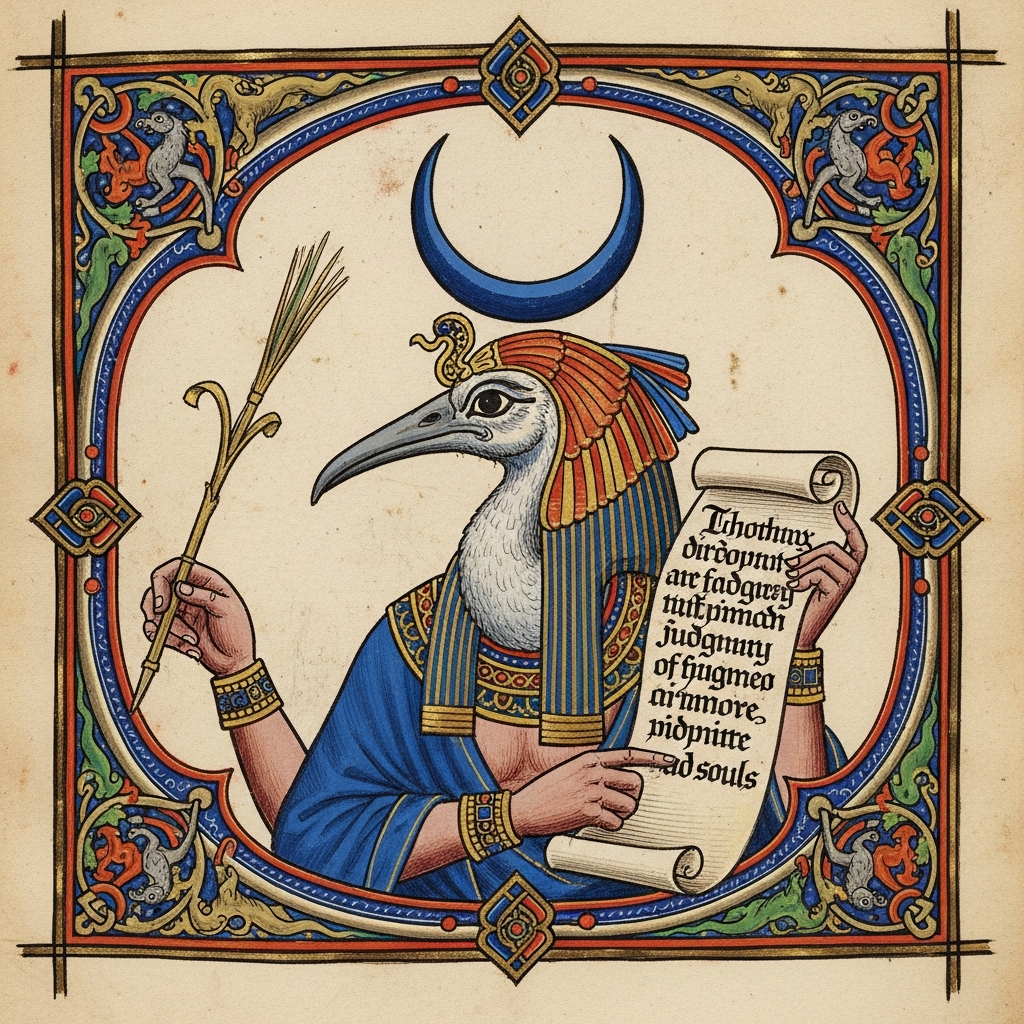
Thoth speaks — Thoth always speaks when Ra is at a loss, because Thoth is the god of the solution nobody else has thought of, the lateral answer that works by changing the frame rather than confronting the problem directly. He has a suggestion: pomegranate juice, red ochre, and beer. Seven thousand jars.
The priests work through the night. They are not told everything; they are told to carry and pour, and they carry and pour. Seven thousand jars of beer stained deep red — the exact color of blood in lamplight, the exact color of what Sekhmet has been drinking from the fields of Egypt — poured across the killing plain before she arrives for the next dawn’s work.
The ground cannot absorb it all. It stands in pools and rivers, shin-deep in the lower areas, a red sea across the sand that catches the first horizontal light of morning and turns copper.
Sekhmet arrives in the hour before full sunrise when everything has the color of the world at its most intense. She sees the field. She sees the red. She smells fermented grain and pomegranate’s sweetness and the mineral sharpness of ochre, and the distinction between what she has been drinking and what this is does not register — she is past making distinctions, and it looks exactly right.
She wades in. She lowers her head. She drinks.
The beer takes her the way the river takes everything that enters it: gradually, then completely.
She drinks until her face is in the red pool and the pool is taking her weight. She drinks until the sun is fully up. She drinks until the divine fury that has been running her for a day and a night loses its edge, its momentum, its forward pressure. The Eye of Ra closes. The lioness, drunk on beer the color of victory, lies down in the killing field.
She sleeps.
When she wakes, the sun is high. The field is quiet. She rises, and the cow horns are on her head, and the sistrum is in her hand, and the name she answers to now is Hathor: the Lady of the West, the goddess of love and music, the one who welcomes the dead at the threshold with bread and beer. The same divine force, at a different amplitude.
The texts do not record what she sees when she looks at her hands.
The festival that commemorated this story — the Feast of Drunkenness, celebrated at Dendera each year — involved the deliberate consumption of large quantities of beer by the worshippers, the deliberate re-enactment of Sekhmet’s stupor and Hathor’s emergence. The participants had to pass through the lioness to reach the cow goddess. They had to go through rage to reach love. This was not metaphor. This was liturgy.
Sekhmet’s priests were physicians. Her temples were hospitals. You came to Sekhmet when you were sick because Sekhmet was what made you sick, and the entity that makes you sick is the only entity that fully understands what sick is. Hathor’s priests were musicians. They played the sistrum — a rattle, a jangling sound, cheerful distraction — because Hathor’s job was to keep Sekhmet sleeping.
The music was not entertainment. It was maintenance. The ongoing work of keeping the lioness in the field of beer, of keeping the Eye from opening again before humanity was done needing the sun.
Scenes
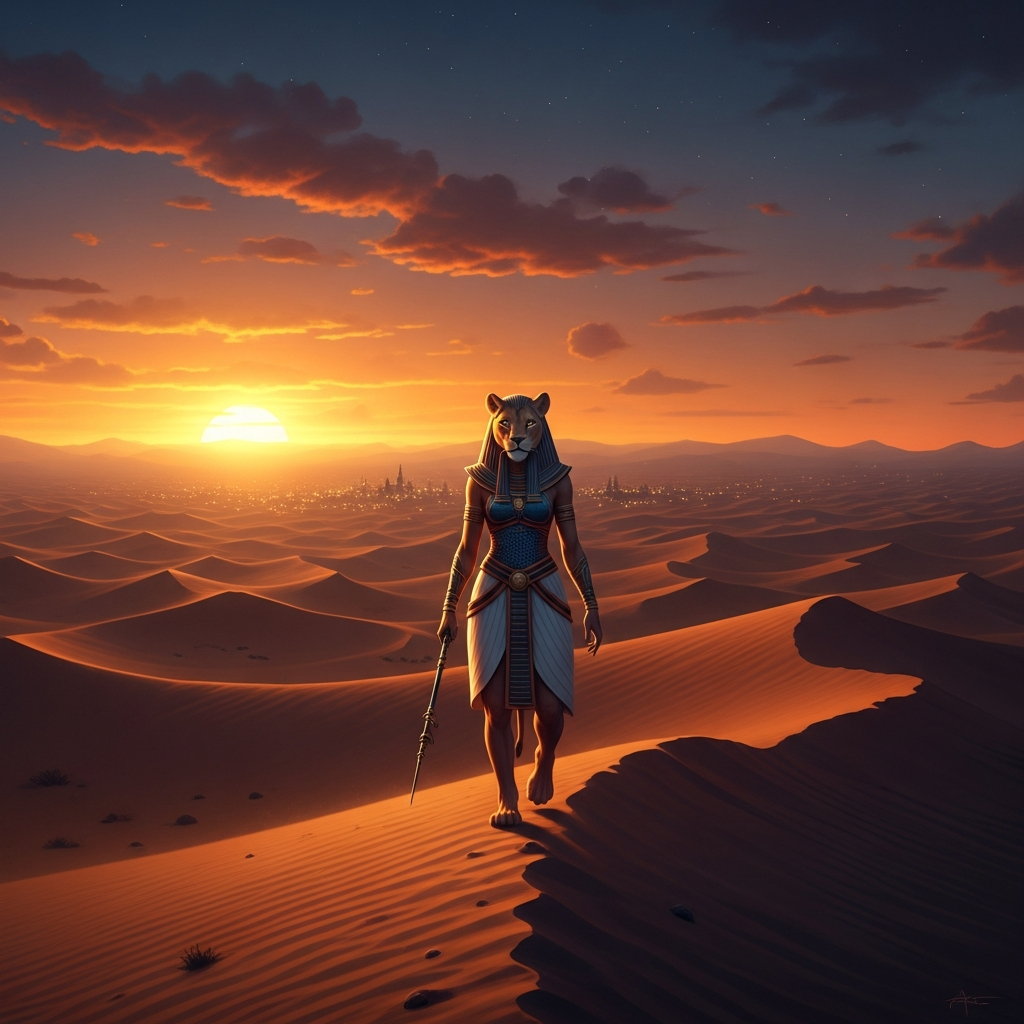
Sekhmet crosses the desert at sundown, a lioness walking upright, her body the color of the sun at its hottest, the sand behind her already red
 Generating art…
 Flooded fields at night, the water dyed the deep red of ochre and pomegranate
 Generating art…
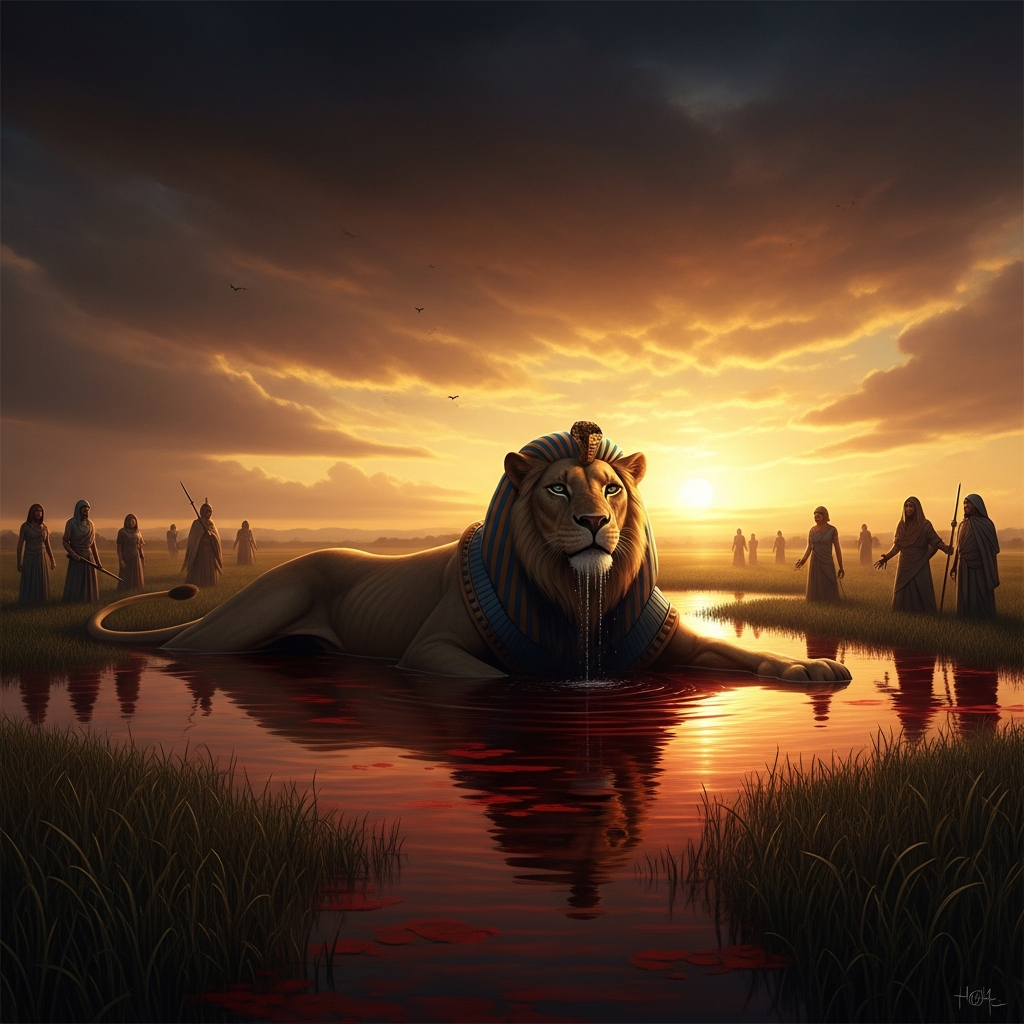
 Sekhmet collapsed in the flooded field at dawn, the lioness form half-submerged in shallow red water, her great chest rising and falling slowly
 Generating art…
 Echoes Across Traditions
Entities


Sources
- Erik Hornung, *Conceptions of God in Ancient Egypt: The One and the Many* (Cornell University Press, 1982)
- Richard H. Wilkinson, *The Complete Gods and Goddesses of Ancient Egypt* (Thames and Hudson, 2003)
- Miriam Lichtheim, *Ancient Egyptian Literature, Volume II: The New Kingdom* (University of California Press, 1976)
- Geraldine Pinch, *Egyptian Mythology: A Guide to the Gods, Goddesses, and Traditions of Ancient Egypt* (Oxford University Press, 2004)
- Jan Assmann, *Death and Salvation in Ancient Egypt* (Cornell University Press, 2005)