Sun Wukong Storms Heaven
Mythic Time · *Journey to the West* compiled by Wu Cheng'en ~1592 CE · Flower-Fruit Mountain · then heaven
Contents
Born from a stone on Flower-Fruit Mountain, the Monkey King masters immortality, steals a divine weapon, erases his name from Death's ledger, revolts against heaven, and eats the Peaches of Immortality — before the Buddha traps him under a mountain for five hundred years with a single open palm.
- When
- Mythic Time · *Journey to the West* compiled by Wu Cheng'en ~1592 CE
- Where
- Flower-Fruit Mountain · then heaven
The stone cracks open.
It has been cracking for ten thousand years — one egg of veined granite sitting on the summit of Flower-Fruit Mountain, drinking sun and moon and starlight until something inside it decides it is finished waiting. The shell splits. The monkey inside does not crawl out. He stands up, blinks at the waterfall, and announces himself to the mountain with a howl that scatters every bird from every tree in three counties.
He is nobody. He has no name yet, no lineage, no rank in the great celestial bureaucracy that governs all things between heaven and earth. He is a stone that decided to be alive.
This will become a problem for everyone.
The monkeys of Flower-Fruit Mountain name him king the same afternoon — he found the cave behind the waterfall, he led them through, so he is theirs. He rules well enough. But a king who was born yesterday from a rock is a king who has questions, and the question that nags him most is the one no monkey wants to answer: What happens when we die?
He goes looking for an immortal.
He finds one — a Taoist master named Subodhi, living in a mountain that smells of pine resin and old ink. Subodhi teaches him for years. The monkey learns 36 minor transformations, then 72 major ones — every shape a living thing has ever worn, from gnat to thundercloud, the lot of them his to wear as easily as changing a coat. He learns the somersault-cloud, a single leap that covers 108,000 li between one breath and the next. He learns how to not die.
Then he asks one question too many in front of the other students, and Subodhi sends him home.
He returns to Flower-Fruit Mountain carrying no weapon, which is an oversight he decides to correct.
The Dragon King of the Eastern Sea receives him with the nervous hospitality of someone who knows a guest can break things. Sun Wukong — he has a name now; he gave it to himself — tries every weapon in the dragon’s armory and breaks them all. Too light. Too light. Still too light. The Dragon King, growing desperate, mentions a pillar of iron in the deepest part of the treasury that nobody has been able to move for twenty thousand years. The pillar emits a golden light. It is, the king explains, the measuring rod used to calibrate the depths of the primal ocean.
Sun Wukong picks it up.
It resizes to fit his hand. It is 13,500 jin of black iron with a gold band at each end. He calls it Ruyi Jingu Bang — the As-You-Will Golden-Banded Staff — and he tucks it behind his ear as a needle when he does not need it.
He also takes armor from three more dragon kings before leaving, because the staff deserved the outfit.
The King of Hell sends demons to collect his soul on schedule. This is, from the demons’ perspective, a professional obligation. From Sun Wukong’s perspective, it is an invitation to the Registry of Death. He kills the demons, walks into the underworld himself, finds the Book of Life and Death, and erases every monkey name he can find — his own first.
He cannot be collected because he is no longer in the ledger.
He returns to Flower-Fruit Mountain and throws a party.
Heaven, which is run on the model of the imperial court and notices everything through its ministers and reports and memoranda, takes note. The Jade Emperor — Yu Huang Da Di, Supreme Ruler of Heaven, governor of every god and spirit and natural force in the cosmos — reads the report on this monkey and makes a decision that will haunt him for the rest of the novel. He offers the monkey a job.
Keeper of the Heavenly Horses.
A stable hand. A glorified groom. The Jade Emperor’s court understands the hierarchy: the monkey is a disruption; give him an official rank and he is pacified; give him a low rank and he stays low. This is how the celestial bureaucracy has worked for ten thousand years.
Sun Wukong serves for two weeks. He learns what the job is. He quits in fury, returns to Flower-Fruit Mountain, and raises a flag that reads: GREAT SAGE EQUAL TO HEAVEN.
He made the title up. He intends to keep it.
Heaven sends an army. The army loses.
The Jade Emperor, who is more administrator than warrior and knows it, consults his ministers and tries again — this time with a title rather than a sword. Sun Wukong is invited back to heaven. He is given the title Qitian Dasheng, Great Sage Equal to Heaven, and assigned a pavilion of his own with no actual responsibilities. He is being managed.
He manages, for a while, to be managed.
Then Xi Wang Mu, the Queen Mother of the West, holds her Peach Banquet — the great celestial feast where the Peaches of Immortality ripen every ten thousand years and every god in the hierarchy gathers to eat and confirm their place in the order of things. Sun Wukong is not invited. He is Equal to Heaven in name but not, apparently, in seating arrangements.
He goes to the garden himself.
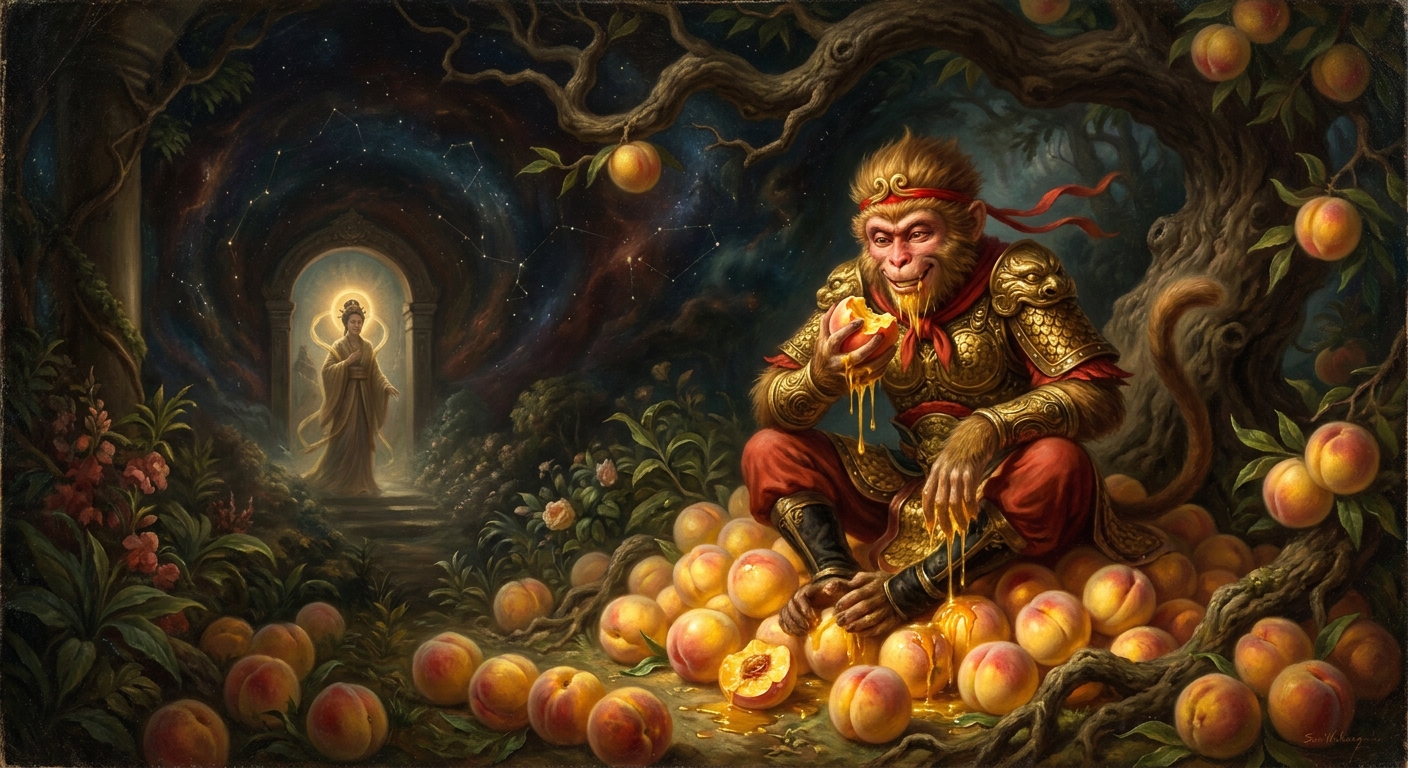
He eats his fill — not quickly, not furtively, but with the deliberate unhurriedness of someone who has decided that the question of whether he was invited is less important than the fact that the peaches are there. He eats the ripest ones, the ones that only bloom once every nine thousand years. He eats until the garden looks ransacked.
Then he wanders into Laozi’s laboratory — the Taishang Laojun, the deified Laozi, keeper of the Eight Trigrams Furnace — and drinks the golden elixir of immortality from the gourds like a man helping himself to wine from someone else’s cellar. Five gourds. He is already immortal from the peaches. He is now immortal in several additional ways.
When the enormity of what has happened registers across heaven, the reaction is proportional.
Heaven sends its best. Erlang Shen — the third-eye warrior, the Jade Emperor’s nephew, the general who has never lost — fights Sun Wukong in a battle of transformations that reshapes the sky. Fish and cormorant, sparrow hawk and crane, fish hawk and sea bird, each form countering the last in a chain of metamorphoses that reads like two sorcerers arguing in the grammar of every living thing. They fight to a standstill. The celestial army joins. Laozi himself drops his diamond bracelet from the sky to knock the monkey unconscious.
Even then, the celestial executioners cannot kill him.
They try fire: he does not burn. They try lightning: he does not break. Laozi volunteers his Eight Trigrams Furnace — the alchemical kiln that reduces anything to its essence. They seal the Monkey King inside and fire it for forty-nine days.
When the furnace opens, he leaps out. The fire did not destroy him. It forged his eyes: huǒyǎn jīnjīng, fiery golden eyes that see through every illusion, every disguise, every demon wearing a human face. He is angrier than before and more capable than before, which is the worst possible outcome of an attempt at execution.
He fights the entire heavenly army. The army cannot stop him.
The Jade Emperor sends a message to the West. The Buddha comes.
He comes without an army. He does not argue with the monkey, does not threaten him, does not offer him another title. He simply asks a question. “They say your powers are boundless. I say your powers have a limit. Prove me wrong: leap from the palm of my hand and reach the edge of the universe, and I will ask the Jade Emperor to give you heaven itself.”
Sun Wukong looks at the palm. It is a hand. He has leapt 108,000 li in a single somersault. He agrees to the terms.
He jumps.
He flies. Past clouds, past star-fields, past the dark between the stars, past the dark past the dark, until he sees five pink pillars rising from the floor of existence — the pillars of the world, the columns at the edge of everything, the proof that he has gone far enough. He has done it. He marks his arrival, because a monkey who has crossed the universe should leave a mark: he pisses on the base of the tallest pillar, then writes his name in the stone — Great Sage Equal to Heaven was here — in characters large enough to be read across a room.
He somersaults back.
He lands in the Buddha’s palm.
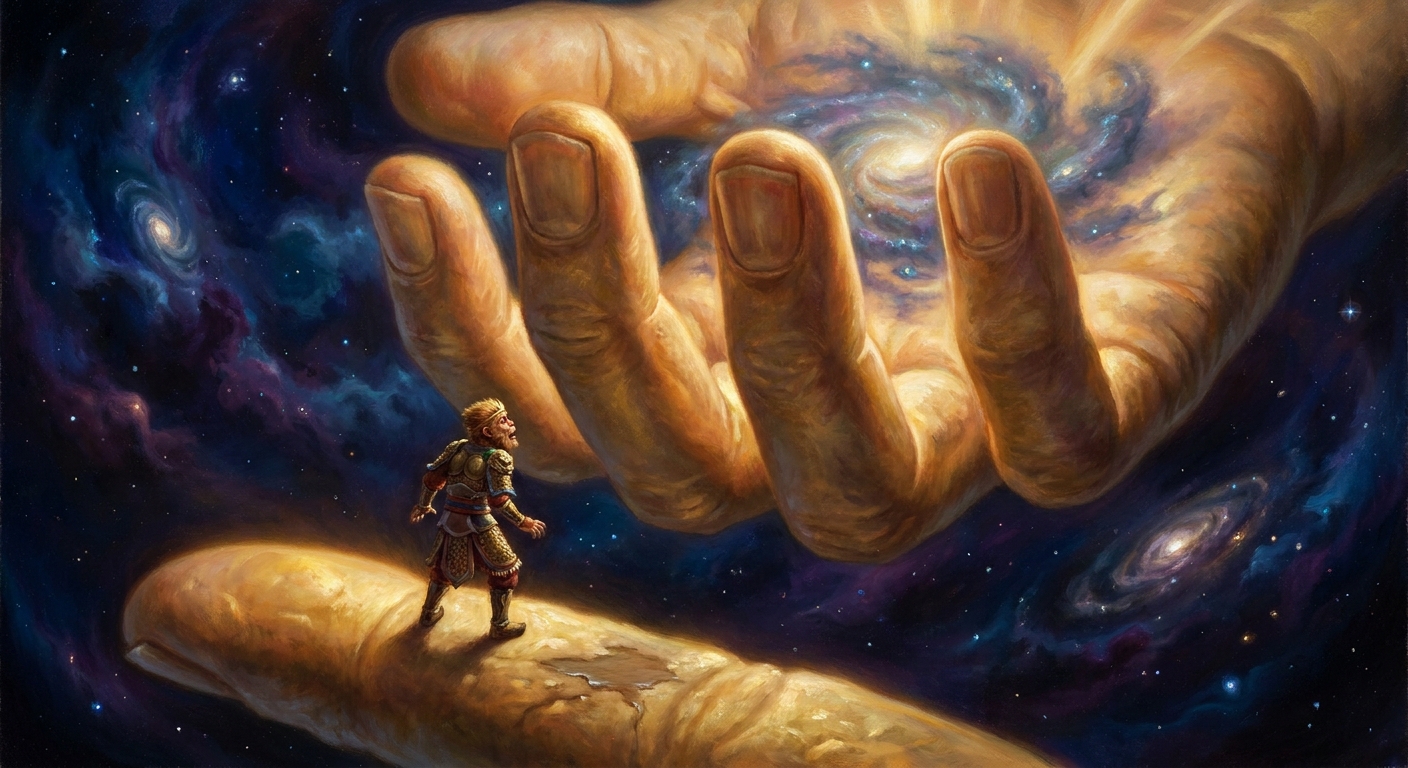
He looks where he arrived. The Buddha opens his fingers, and there, on the inside of the middle finger, is the legend in Sun Wukong’s own handwriting. The great pillar he pissed on was a crease in the Buddha’s hand. He flew, in his furthest leap, from one side of a palm to the other.
He never left.
The Buddha closes his hand. Turns it over. Presses it down. Five fingers become five mountains — Metal, Wood, Water, Fire, Earth — and the mountain buries the Monkey King to the shoulders. A seal is placed on the summit: Om Mani Padme Hum, the mantra that holds the world together.
Sun Wukong does not die. He cannot die. He sits under the Five-Elements Mountain with his head sticking out and the weight of stone above him, and he waits.
He waits for five hundred years.
When someone finally comes to free him — a monk, of all things, a monk with no weapon and no power and no plan — the Monkey King will not have changed. He will still be the strongest thing in any room he enters. He will still be unable to leave a fight unchosen or a truth unspoken. He will still have the staff behind his ear, the fiery eyes that see through lies, and the certainty, bone-deep and undefeated, that he was right.
He was right about the stable. He was right about the peaches. He was right that Equal to Heaven means something.
He was wrong only about one palm, measured against the universe.
That is enough, the Buddha seems to suggest, to teach a stone monkey what he could not learn by becoming immortal: that there are spaces too large for the fastest leap, and they do not look like the sky. They look like an open hand.
He waits. The mountain holds. The seal hums its mantra over his head like a lullaby he cannot quite unhear.
Loki is chained under a mountain with serpent-venom dripping on his face. Prometheus is chained on a rock with an eagle eating his liver. Iblis is given respite until the Day of Judgment. The rebel genius who finds the ceiling of the cosmos never gets to stay above it. The pattern is old enough to have worn a groove in the world.
What makes Sun Wukong different from the others is that his rebellion is correct in its premises and impossible in its conclusion. The Jade Emperor’s court is exactly as petty and bureaucratic as the Monkey King diagnoses it. The system of ranks and titles is exactly as arbitrary as he treats it. Heaven does not defeat him on the merits. Heaven calls in the Buddha.
That is not a refutation. That is a higher court.
Scenes
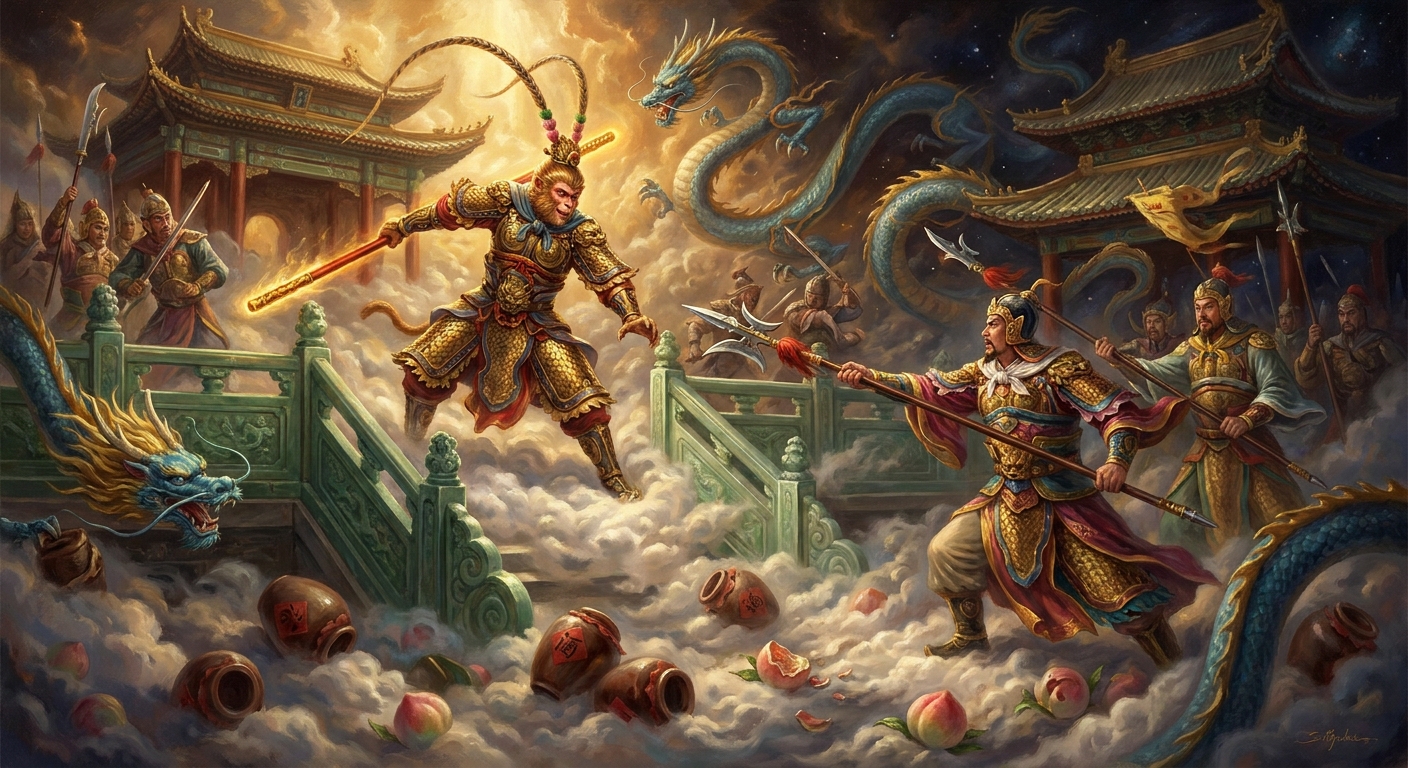
Sun Wukong storms the Jade Emperor's celestial court, iron staff in hand, demanding to be called Great Sage Equal to Heaven — and making it stick
Generating art… Drunk on the Peaches of Immortality in Xi Wang Mu's garden, the Monkey King eats his fill of fruit that ripens once every ten thousand years
 Generating art…
 At the edge of what he believes is the universe, Sun Wukong discovers he has never left the Buddha's open palm
 Generating art…
 Echoes Across Traditions
Entities
- Sun Wukong
- Jade Emperor
- Buddha
- Laozi
- Erlang Shen

Sources
- Wu Cheng'en, *Journey to the West* (Anthony C. Yu translation, University of Chicago Press, 4 vols.)
- Arthur Waley (trans.), *Monkey: Folk Novel of China* (1942)
- *Pingyao zhuan* (The Plum in the Golden Vase tradition; parallel trickster lore)