Confucius at the River
~482 BCE · Confucius's late years in Lu · The state of Lu, by an unnamed river
Contents
Seventy years old and rejected by every court in the warring states, Confucius sits by a river watching the water flow east and understands that civilization is preserved by the man who failed to fix it.
- When
- ~482 BCE · Confucius's late years in Lu
- Where
- The state of Lu, by an unnamed river
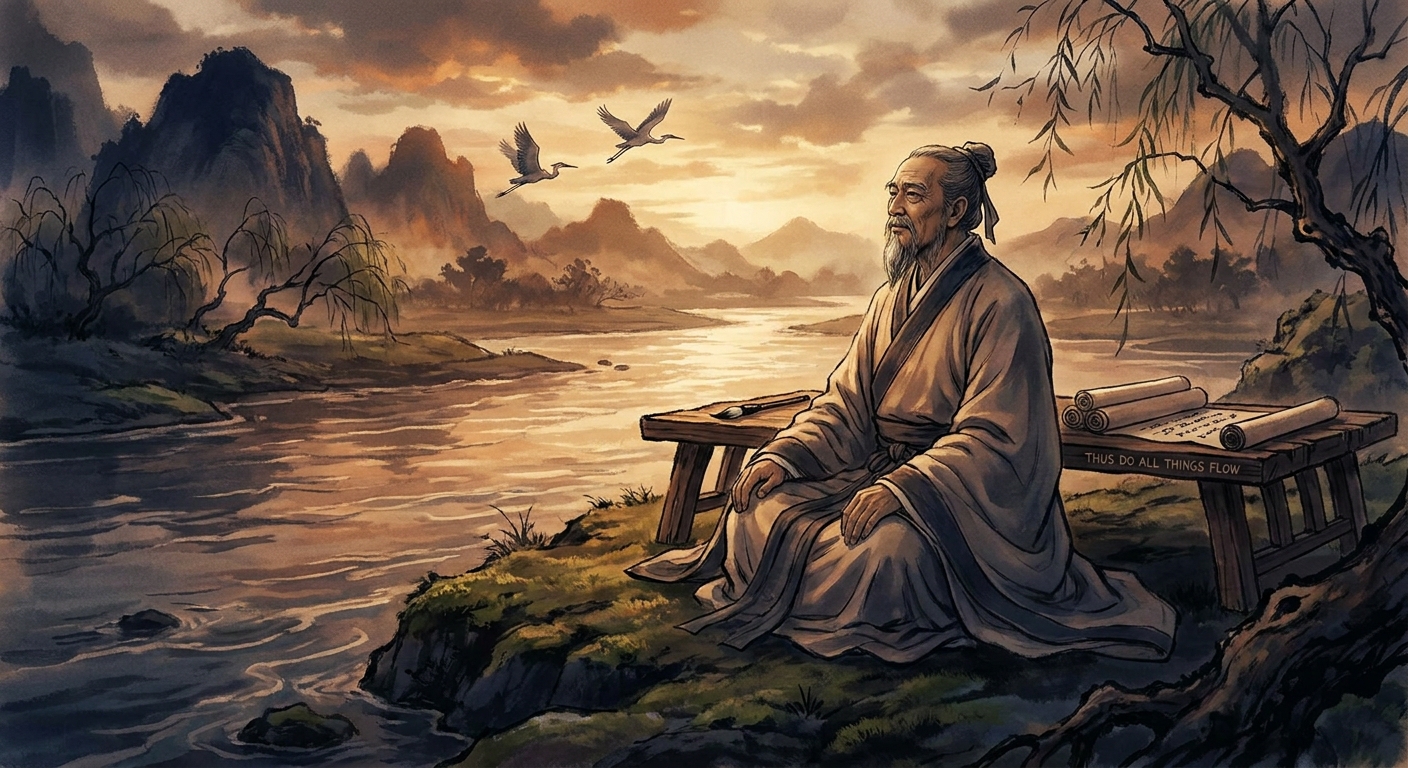
He stands at the edge of the river and watches it go.
He is seventy years old. His feet know every road in Lu, in Wei, in Chen, in Cai. For thirteen years he has traveled them — this man who taught that the virtuous ruler transforms the people the way wind bends grass, and who believed it enough to spend a decade and a half proving it to every court in the warring states. None of them wanted what he was selling. Most were polite about it. Some were not.
He watches the water move east.
“Thus do all things flow,” he says, to no one in particular. “Day and night, never ceasing.”
The river does not answer. It has no interest in propriety, no use for humaneness, no patience for the correct execution of the ancient rites. It simply flows, the way rivers flowed before Zhou, before Shang, before the Yellow Emperor gave names to things. The water that passes him now will be in the sea before his students wake tomorrow.
He has outlived the best of them already.
Yan Hui died young — the one student Confucius called genuinely good, not merely talented, not merely obedient. The one whose poverty did not diminish him. A bowl of rice, a ladle of water, a cramped lane, and Yan Hui remained himself: content, focused, inexhaustibly curious about what ren actually required in a given moment. When Yan Hui died, Confucius wept without restraint, loud enough that his other students remarked on it. He did not apologize. “If not for him, for whom should I grieve?”
Zilu is still alive, impetuous and loyal, the kind of man who would rather argue than flatter — which is why Confucius values him, and why every court found him inconvenient. Zilu will die in Wei in a few years, dying sword in hand, stopping to retie his cap before the killing blow because a gentleman does not die with his cap untied. It is the most Zilu-like death imaginable. But Confucius does not know this yet.
He only knows the river, and the road behind him, and how long the road was.
He had believed, genuinely and without performance, that the chaos of the warring states was a problem of ritual collapse. The Zhou court had broken down. Rulers behaved like warlords because no one had taught them otherwise, or because the structures that would have constrained them — the rites, the music, the careful architecture of social obligation — had been allowed to decay. Fix the rites. Restore the names to their proper referents. Call the ruler a ruler and the minister a minister and the father a father, and insist that each one act accordingly. The rectification of names. It sounds pedantic, stated plainly. It is not pedantic. It is a theory of political order based on the premise that civilization is a practice, not a fact — that it requires maintenance the way a canal requires maintenance, and that when you stop maintaining it, it fills with silt and the fields go dry.
He was right about all of this.
No one cared.
The courts of Lu, Wei, Chen, Cai: they listened, offered food and modest stipends and occasional titles without authority, and sent him along when something more pressing arrived. The pressing thing was always a war, or the threat of war, or the aftermath of war. The warring states were called that for a reason. A philosopher who wished to discuss the music of the ancient Zhou sacrifices was welcome to dinner and unwelcome at the council table.
He returns to Lu at seventy. He is done.
He is also, it turns out, just beginning.
He has in his possession the Book of Songs — three hundred and five poems assembled over centuries, the oldest of them reaching back to the early Zhou. Court hymns, folk songs, love songs that are probably not just about harvests, military odes. The entire emotional range of a civilization compressed into verse. He had used them in teaching — had told his students that without the Songs they would have nothing to say in conversation, nothing to express in the ancestral rites, nothing to name what they felt when they felt it. “The Songs,” he said once, “can rouse the mind, broaden observation, encourage fellowship, and teach the art of remonstrance.”
He sits down with the manuscript and begins to edit.
This is not despair. This is not resignation, exactly. It is something closer to what the river is doing — not forcing, not stopping, not reversing course. He has spent thirteen years trying to install virtue at the top of governments and found that governments have their own logic, and it runs faster and shallower than the Zhou rites allow for. He cannot fix the courts. He can fix the text.
He edits the Book of Songs. He works on the Spring and Autumn Annals, the chronicle of Lu that will become the model for all subsequent Chinese historiography — the first text to treat the moral evaluation of historical actors as itself a historical act. He teaches whoever will study with him, and many will. He transmits. He does not originate; he is explicit about this. The virtue he is transmitting is older than he is, older than Zhou, older than anything the warring states can break. He is a custodian, not an inventor. The distinction matters to him enormously.
“Does Heaven speak?” he asks his students, at some point in these late years. “The four seasons pursue their courses and all things are produced. Does Heaven speak?”
He means: the cosmos does not announce its principles. It enacts them. Spring does not explain itself; it simply comes and the things that were waiting grow. A teacher is like this, ideally. The dao does not speak; it flows. He has resisted this his whole life — he is a speaker, a classifier, a man who believes names matter and ambiguity costs lives. He and Laozi represent two true responses to the same broken world, and he has always known it: the Daoist sage follows the river, and he himself has been standing on the bank insisting the river go a different way.
Now he is seventy, and he watches the water go east where all things go.
He does not become a Daoist. He remains entirely himself: the man who cares about the correct forms, the man who weeps loudly when he loses someone, the man who believes that what you do in small rooms — how you treat a servant, how you conduct a funeral, whether you sit correctly at a meal — is the same thing as civilization, compressed. He does not stop caring. He stops trying to make governments care.
He edits the Songs. He teaches.
In 479 BCE, he dies in Lu, at seventy-two, having never held meaningful power. His disciples argue about what he meant for the next century. Mencius systematizes one reading; others systematize other readings. The Analects is compiled from their notes and their memory of his voice. In 136 BCE, Emperor Wu makes Confucianism the official ideology of the Han state — the operating system of Chinese civilization for two thousand years.
He did not fix the warring states. He preserved what the warring states would need when they were done destroying each other.
The river still goes east.
The Analects 9.16 records only the moment at the river, with no explanation: Confucius stood by a stream and said, “Thus do all things flow, day and night, never ceasing.” Commentators have argued over it ever since — is he lamenting time’s passage? Celebrating the ceaseless vitality of the dao? Making a point about moral cultivation? The text does not say. The silence is probably intentional. He spent a lifetime insisting that language be precise. When he chose, at the river’s edge, to say only that, he knew what he was doing.
Every civilization that survived its own collapse was preserved by someone who stopped trying to save it and started writing things down instead.
Echoes Across Traditions
Entities
- Confucius
- Yan Hui
- Zilu
Sources
- *Analects* 9.16 — Confucius at the river: 'Thus do all things flow, day and night, never ceasing'
- *Analects* 17.19 — 'Does Heaven speak? The four seasons pursue their courses and all things are produced. Does Heaven speak?'
- *Mencius* 4B:21 — on Confucius's editorial work and the preservation of the *Spring and Autumn Annals*
- Sima Qian, *Records of the Grand Historian* 47 — biography of Confucius, his wandering years and return to Lu
- Annping Chin, *The Authentic Confucius: A Life of Thought and Politics* (Scribner, 2007)