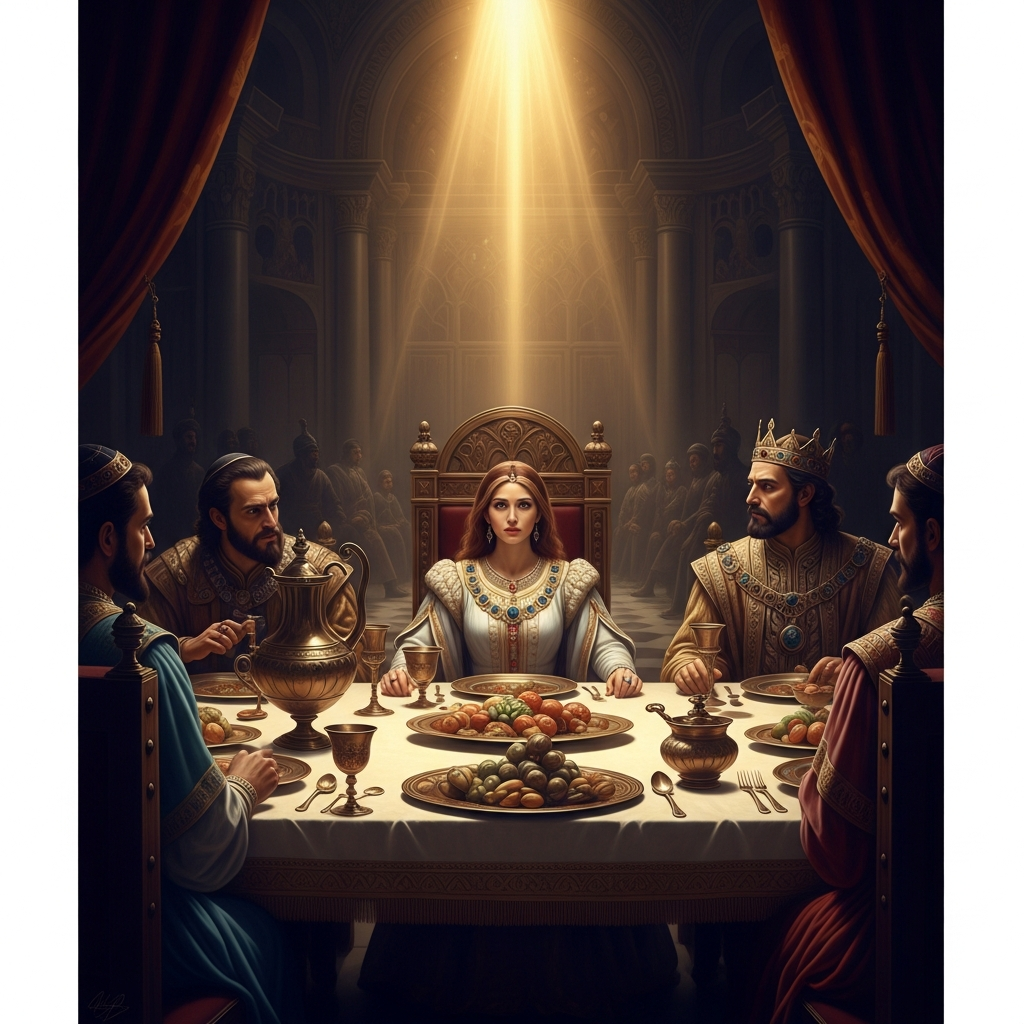
Esther's Two Banquets
5th century BCE · the Achaemenid court at Susa · Susa, the winter capital of the Persian Empire under Ahasuerus
Contents
A Jewish queen hides her people inside a Persian crown, sets two wine-banquets for the king and the man who has decreed her nation's slaughter, and waits for the right cup to name him.
- When
- 5th century BCE · the Achaemenid court at Susa
- Where
- Susa, the winter capital of the Persian Empire under Ahasuerus
She fasts for three days before she walks into the throne room.
No one is summoned to Ahasuerus uninvited. The law is plain: the king extends the gold scepter, or the guards remove the body. Esther crosses the inner court in her royal robes anyway, because Mordecai has told her the truth — the edict has been sealed, the date has been chosen by lot, and on the thirteenth of Adar every Jew in a hundred and twenty-seven provinces is to be killed. She is queen of an empire that has condemned her people without knowing she is one of them.
The king sees her. He extends the scepter. She touches its tip and breathes.
“What is your petition, Queen Esther? It shall be granted to you, even to half the kingdom.”
She does not ask.
She invites him instead — him and Haman, his vizier, the man who drew the lot. “Let the king and Haman come this day to a banquet that I have prepared.” Ahasuerus sends for Haman immediately. The wine is poured. The food is served. The king asks again, what is your petition? — and Esther says only: come back tomorrow. Bring Haman. I will tell you then.
Haman walks home swollen with the honor of it. Two private banquets with the king and the queen, and no one else in the room. He passes Mordecai at the gate. Mordecai does not bow. Haman goes home, builds a gallows fifty cubits high, and plans to ask the king in the morning for permission to hang the Jew on it before lunch.
The king cannot sleep.
He calls for the chronicles to be read aloud — the dullest possible cure for insomnia, the official record of his own reign. The reader’s voice finds, by chance or by something else, the entry from years before: Mordecai the Jew uncovered a plot against the king’s life. Two eunuchs hanged. The informer never rewarded.
“What honor has been done for Mordecai for this?” the king asks.
“Nothing,” the servants say.
In the outer court, Haman is arriving early to ask for the gallows. The king summons him in and asks: what should be done for the man the king delights to honor? Haman, certain it is himself, designs the most lavish public honor he can imagine — royal robes, the king’s horse, a herald crying through the streets. The king nods. Excellent. Do all of this for Mordecai the Jew, and leave nothing out.
The second banquet.
Esther waits until the wine has gone around twice. Ahasuerus asks her petition for the third time, and now she answers. “If I have found favor in your sight, O king — let my life be given me at my petition, and my people at my request. For we are sold, I and my people, to be destroyed, to be slain, and to perish.”
The king, who has signed the edict and forgotten it, leans forward. “Who is he, and where is he, that dared presume in his heart to do so?”
She does not raise her voice. She raises her hand.
“The adversary and enemy is this wicked Haman.”
Haman’s face goes the color of the wine.
The king walks out into the garden because he cannot trust himself to speak.
When he returns, Haman has thrown himself across Esther’s couch, begging — and the king, seeing it, snarls “Will he even force the queen before me, in my own house?” The guards cover Haman’s face. One of them mentions the gallows in the courtyard, fifty cubits high, that Haman built for Mordecai that very morning.
“Hang him on it,” the king says.
They hang him on it.
The edict cannot be undone — Persian law is irreversible — but a second edict goes out, sealed with the king’s ring, granting the Jews the right to defend themselves. On the thirteenth of Adar the killing comes, and it does not come the way Haman planned. The next day, the fourteenth, is feasting and gladness, and Mordecai writes the law of Purim — that every year the Jews shall remember.
The book of Esther never names God. Not once. The rabbis noticed. The reason given is that the deliverance comes so completely through human nerve that to name God in the text would be to take the credit away from the woman who earned it.
Purim is the festival of the hidden hand. The Jews read the scroll aloud every spring, and at every mention of Haman’s name they shout, stamp, spin noisemakers — the only liturgical act in Judaism whose explicit goal is to drown out a name. The empire forgot Haman. The synagogue makes sure to forget him on purpose, every year, forever.
A queen, two banquets, a sleepless king, and a gallows that found the wrong neck. The shape of the rescue is the shape of the lesson: when the empire signs your death warrant, you do not appeal. You set the table.
Echoes Across Traditions
Entities
- Esther
- Mordecai
- Ahasuerus (Xerxes I)
- Haman

Sources
- *Esther* 5-7 (Hebrew Bible / Tanakh)
- Robert Alter (trans.), *The Hebrew Bible* (2018)
- Adele Berlin, *Esther* (JPS Bible Commentary, 2001)
- Jon D. Levenson, *Esther: A Commentary* (1997)