The Coat and the Pit
Genesis 37–45 · ~1700 BCE traditional · Canaan, the pit at Dothan, Egypt
Contents
Joseph, the favored son, receives a coat of many colors and his brothers' undying hatred. They throw him in a pit, sell him to slave traders, and bring his father a goat-blood coat. But the story does not end in the pit. It ends in Egypt, decades later, with Joseph weeping and saying: it was not you who sent me here.
- When
- Genesis 37–45 · ~1700 BCE traditional
- Where
- Canaan, the pit at Dothan, Egypt
Jacob loves Joseph more than all his sons.
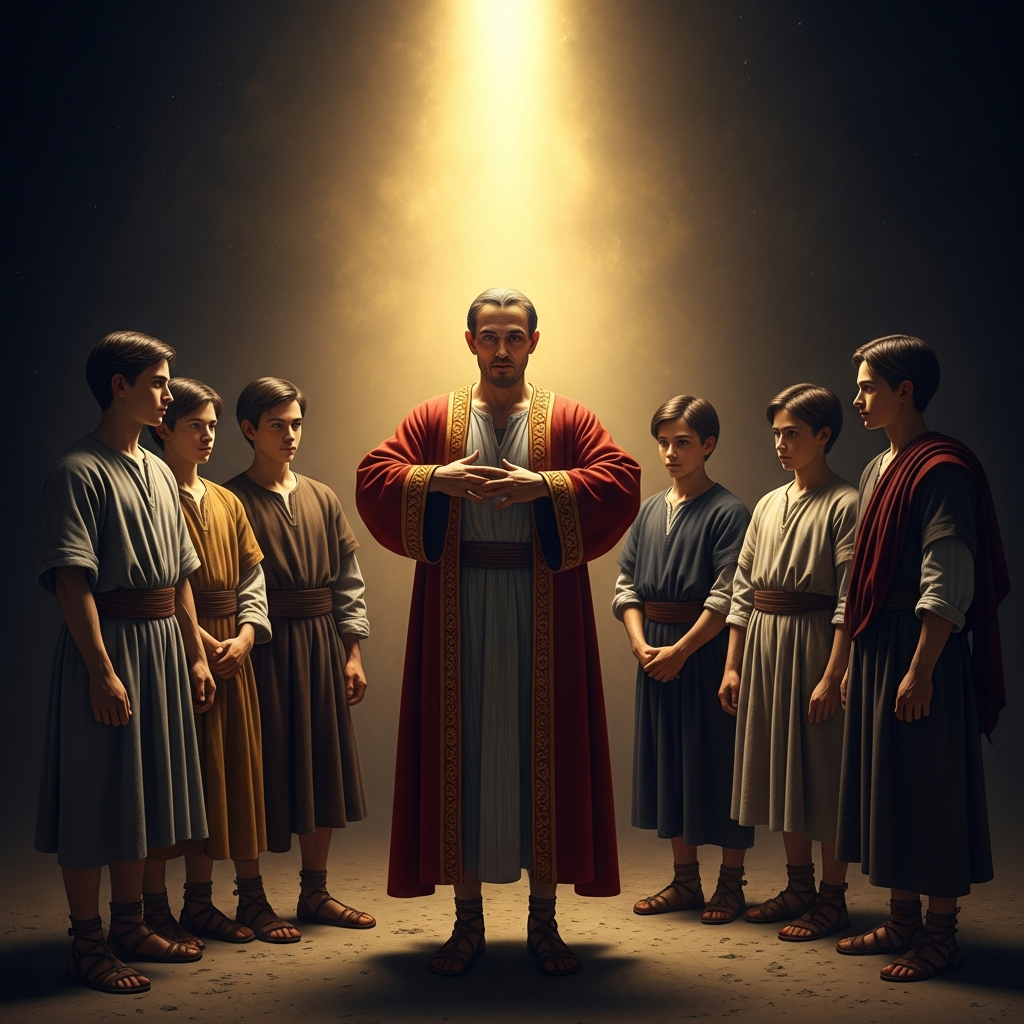
He does not hide this. He makes a coat for the boy — a ketonet passim, the exact phrase is disputed: many colors, or long sleeves, or a coat for a person of rank, or perhaps all of these at once — and the coat is itself a declaration. In the ancient Near East a long-sleeved robe means you do not do manual labor. It means you are being groomed for something. Jacob puts it on his son in front of the other ten and calls it a gift. The other ten see it for what it is: a verdict.
His brothers see that their father loves him more than all his brothers. And they hate him. And they cannot speak to him peaceably.
This is the trigger. But the brothers have been handed several triggers before the coat, because Joseph keeps bringing bad reports about his brothers to their father, and then Joseph dreams — twice, with the solar confidence of a seventeen-year-old who has never been seriously wrong — that his family will bow down to him. He tells them the dreams. Both times. He seems genuinely not to understand how this lands.
His brothers understand perfectly.
Jacob sends him north to check on them near Shechem.
He wanders the fields asking directions — the narrator includes this small detail, Joseph lost and asking strangers where his brothers are, the ordinary mechanics of a day that will turn on a hinge — and they see him coming from far off. They see the coat first, probably. From a distance, in strong light, the coat would be unmistakable.
Here comes the dreamer.
They agree to kill him. Throw him in a pit, say a wild animal devoured him. See then what becomes of his dreams. But Reuben, the oldest, intervenes: don’t shed blood, throw him in the pit alive. He is planning to come back and retrieve the boy later. This intention will not matter. He will be absent at the moment it matters.
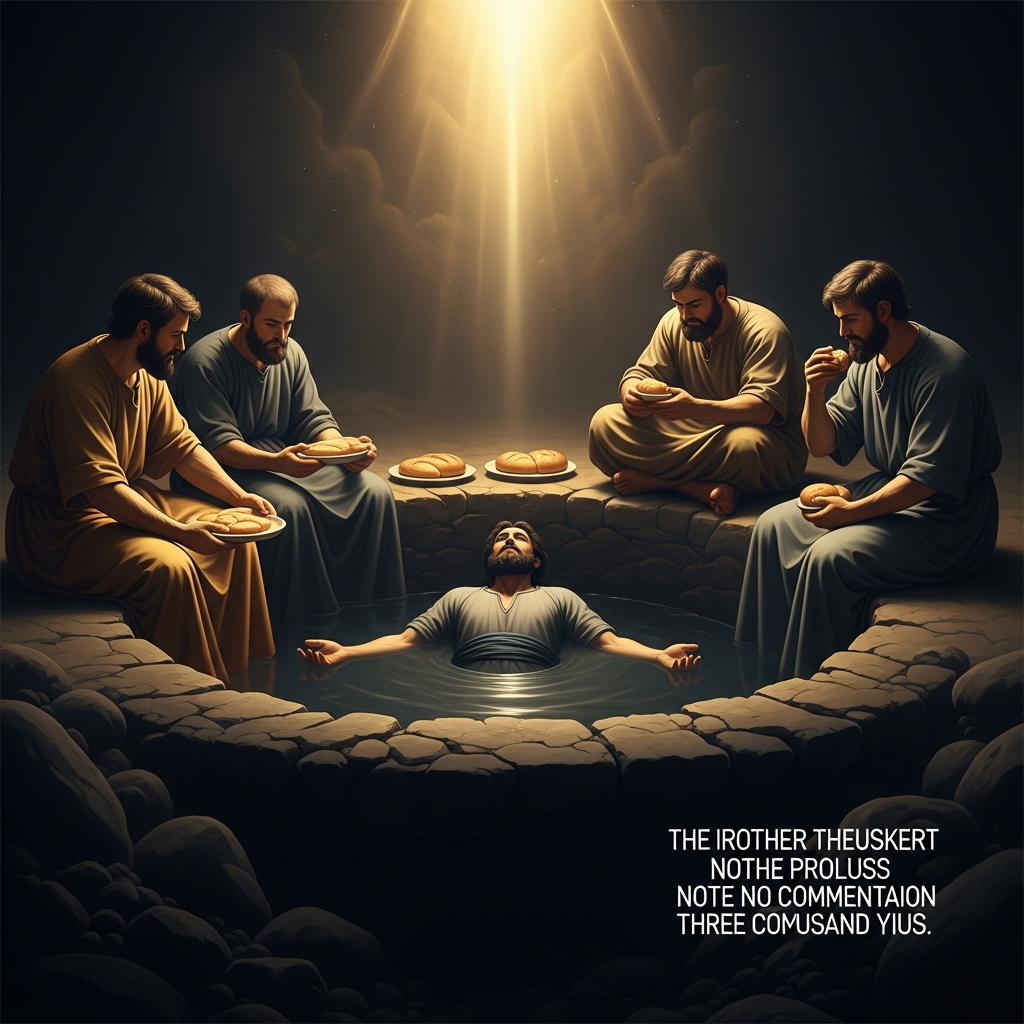
They strip the coat off Joseph. They throw him in the pit. And then — the detail that will not go away, that Thomas Mann will return to again and again across four volumes and three thousand pages — they sit down to eat.
The Ishmaelites appear on the road from Gilead, their camels loaded with spices and balm and myrrh, heading down to Egypt. Judah speaks.
What profit is it if we kill our brother and cover his blood? Come, let us sell him to the Ishmaelites and let not our hand be upon him, for he is our brother, our flesh.
This is called mercy. It is also commerce. They pull Joseph out of the pit and sell him for twenty pieces of silver and the traders take him south toward Egypt and the brothers return to their father with the coat. They have dipped it in goat’s blood. They present it to Jacob and ask: is this your son’s coat? They do not say he is dead. They let the coat do it.
Jacob tears his clothes. He puts on sackcloth. He mourns for his son many days. His sons and daughters try to comfort him. He refuses to be comforted. I will go down to my son mourning to Sheol. His father weeps for him.
Meanwhile, in Egypt, Joseph is sold to Potiphar, an officer of Pharaoh.
The years accumulate.
Joseph rises in Potiphar’s house because everything he touches succeeds and the Egyptians notice. Then Potiphar’s wife desires him, lies about him when he refuses, and he goes to prison. In prison he interprets dreams for a cupbearer and a baker — correctly, both times — and the cupbearer forgets him for two years, until Pharaoh himself has a dream that no one in Egypt can interpret, and the cupbearer suddenly remembers the Hebrew boy who knew things.
Pharaoh summons Joseph from prison. Joseph shaves and changes his clothes — these are the details the text bothers to include — and stands before the most powerful man in the world. Pharaoh tells him his dream. Joseph says: seven years of abundance, then seven years of famine, the famine will consume the abundance and it will be severe. Then he does something audacious: he volunteers a plan. Find a wise man and put him in charge of preparing. Store during the good years. Administer during the bad years.
Pharaoh looks at his court. Can we find such a man as this, in whom is the spirit of God?
He puts his own ring on Joseph’s finger. He puts him in a chariot and has runners cry out Abrech — bow the knee — before him in the streets of Egypt. Joseph is thirty years old. He has been in Egypt for thirteen years.
The famine hits Canaan like a hammer.
Jacob sends his sons to Egypt for grain. All of them except Benjamin, the youngest, the other son of Rachel, the replacement beloved. They are a delegation of ten aging men with empty sacks, and they arrive at the administrative center of the greatest food surplus in the ancient world, and the man running it is their brother. They bow down to him with their faces to the earth.
He recognizes them immediately. They do not recognize him at all.
He is the governor of Egypt. He speaks through an interpreter. He is wearing Egyptian clothing and an Egyptian name — Zaphenath-paneah — and they are looking at him with the full intensity of desperate men looking for grain, not for a dead brother. The distance between who they think they are seeing and who is actually seeing them is the distance between seventeen and thirty, between a dreamer in a coat and the administrator of an empire. They cannot cross it.
He speaks harshly to them. He accuses them of being spies. He puts them in prison for three days. He is not certain yet what he is doing; the text gives us a man improvising through shock, through years of anger and grief that he has never had anyone to show them to, and here they are, bowing down to him exactly as the dream said. He keeps Simeon as hostage and sends the others home with grain and a demand: come back with your youngest brother. He hides their payment in their sacks. He turns away and weeps. Then he turns back.
It takes famine and desperation and Jacob’s eventual surrender of Benjamin before they come back. When they do, Joseph sees Benjamin — the only full brother, the other son of Rachel, the one who was not there at the pit — and he has to leave the room again to weep in private. He washes his face and comes back out.
He cannot sustain it.
He cannot maintain the Egyptian administrator’s face against Benjamin’s actual face. He stages a final test — a planted silver cup, a threat to enslave Benjamin — and Judah, who sold him, steps forward. Judah, who suggested the silver, who held the twenty coins, gives a speech that Alter calls one of the most moving passages in the entire Hebrew Bible: I cannot go back to my father without the boy. His soul is bound up in the boy’s soul. If I come back without him my father will die. Take me as a slave instead.
Judah is willing to be a slave so his brother can go free. This is the moment Joseph has been waiting for, even if he didn’t know he was waiting for it. Whether or not they have changed. Whether or not they would sell another favorite son.
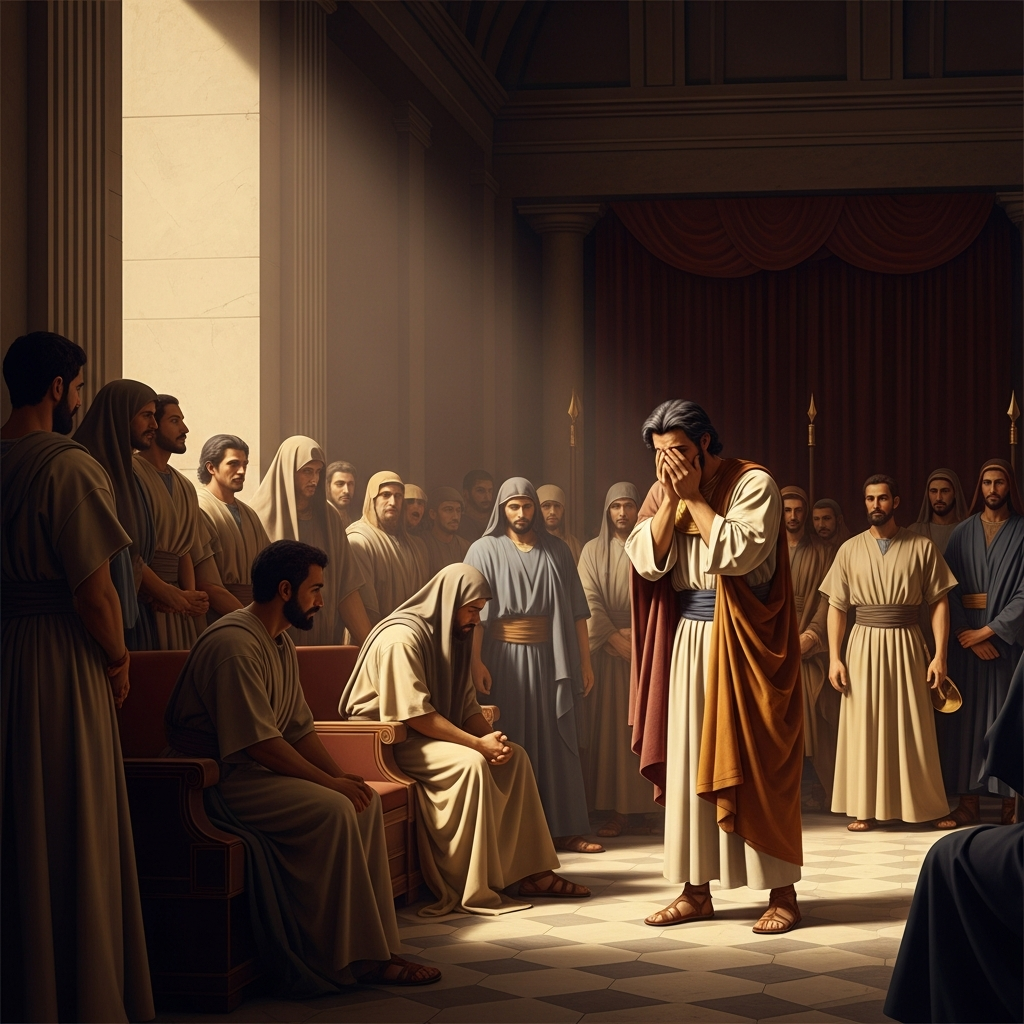
He cannot control himself any longer.
He orders all the Egyptians out of the room. The entire court clears. And Joseph — alone with his brothers for the first time since the pit, alone with the people who sold him — weeps. Loudly. The text says the Egyptians outside the doors can hear him.
I am Joseph. Is my father still alive?
They cannot answer. They are terrified. He says it again: I am Joseph your brother, whom you sold into Egypt. Then he says the thing that will be quoted across three thousand years of theology and depth psychology and literature: Do not be distressed or angry with yourselves that you sold me here, because it was to preserve life that God sent me ahead of you.
He does not say: it wasn’t really you. He does not say: I have forgotten. He says: it was you, and God used it. Both things are true. The wound was also the door. The pit was also the passage.
He falls on Benjamin’s neck and weeps. Benjamin weeps on his. He kisses all his brothers and weeps over them. And after that his brothers talk with him.
The pit was real. The years in Egypt were real. The coat torn from a boy’s back by his own brothers was real. And the man weeping in the administrator’s chamber in Egypt is also real, and the God who moved through the worst of it is real, and the word for what was done and what came of it is a word that Hebrew does not quite have and neither does any other language. Joseph does not offer forgiveness exactly. He offers something larger and harder: the reframing of the whole story from the vantage point of its ending.
Scenes
Jacob wraps the coat around his eleventh son
Generating art… The pit is empty of water
 Generating art…
 He cannot control himself any longer
 Generating art…
 Echoes Across Traditions
Entities
- Joseph
- Jacob
- Judah
- Pharaoh
- YHWH

Sources
- Genesis 37–45 (Robert Alter trans., *The Five Books of Moses*, 2004)
- Thomas Mann, *Joseph and His Brothers* (4 vols., 1933–1943)
- Nahum Sarna, *Understanding Genesis* (1966)
- Avivah Gottlieb Zornberg, *The Beginning of Desire: Reflections on Genesis* (1995)