The Binding of Isaac
Genesis 22 · ~1800 BCE traditional · Mount Moriah, the land of Moriah
Contents
God commands Abraham to sacrifice his only son. Three days on the road. The knife raised. Then — a ram in the thicket, and the name that echoes down three religions: the Lord will provide.
- When
- Genesis 22 · ~1800 BCE traditional
- Where
- Mount Moriah, the land of Moriah
The word comes at night.
It does not come gently. There is no preamble, no softening, no dream-vision to put distance between Abraham and what he is being told. The voice simply speaks: Take your son, your only son, the one you love — Isaac — and go to the land of Moriah, and offer him there as a burnt offering on one of the mountains that I will show you.
Abraham rises early the next morning. This is not a detail. The rabbis of the Talmud will mark it for centuries: he does not wait, does not argue, does not plead. He saddles the donkey himself, splits the wood for the offering himself — his own hands on the axe, his own sweat — and at dawn he sets out with his son and two servants toward a mountain he has not yet been shown.
Three days.
That is what the text gives us and nothing more. Three days on the road from Beersheba, with the wood on the pack animals and the fire ready to kindle and the knife somewhere on his person where the boy cannot see it. Three days in which Abraham knows what he is walking toward. Three days during which Isaac does not.
Kierkegaard will sit with these three days in 1843 and nearly lose his mind over them. He calls it infinite resignation — the moment a man surrenders everything he loves to an absolute demand — and then something further, something he cannot name cleanly, which he calls the movement of faith: the simultaneous certainty that God has demanded Isaac and the simultaneous certainty that God will give him back. Abraham does not march toward loss. He marches toward a contradiction, and he keeps walking anyway.
On the third day he lifts his eyes and sees the mountain.
He tells the servants to wait. We will go and worship, he says, and we will return. Plural. Both of us. Either this is a lie meant to spare the servants the knowledge of what is about to happen, or Abraham means it — genuinely, impossibly means it. The rabbis argue both. Neither answer is clean.
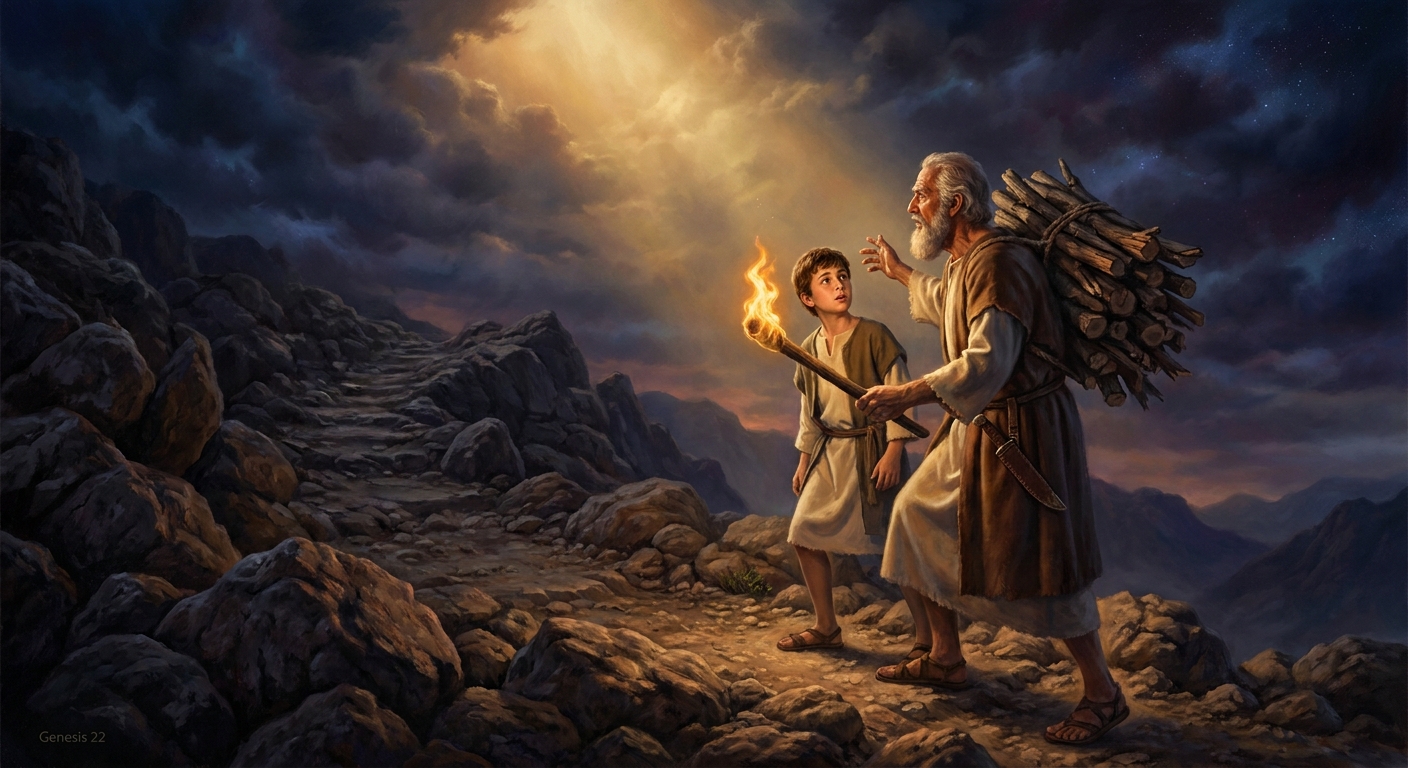
Isaac carries the wood.
This is the image the Christian tradition will not be able to let alone — the beloved son loaded with the timber of his own death, climbing the hill behind his father. Abraham carries the fire and the knife. They walk together.
Then Isaac speaks.
My father.
Here I am, my son.
Here are the fire and the wood, but where is the lamb for the burnt offering?
Four thousand years of commentary and the question still hangs in the air undeflected. Where is the lamb. He is looking at his father when he asks it. Abraham does not look away: God will see to the lamb for the offering, my son. And they walk on, together, and the word together appears in the Hebrew twice, once before the question and once after it, as if the author is marking something: the question did not break them apart. They are still walking together.
Do not soften this. Isaac is not a small child. The midrash says he is thirty-seven years old — a grown man who would have the physical strength to stop an old father’s arm if he chose. The rabbis read his silence as consent, as his own act of faith matching Abraham’s. He lays himself on the altar himself. He stretches out. He says: bind me well, so that I do not flinch and make the offering unfit.
Abraham binds his son.
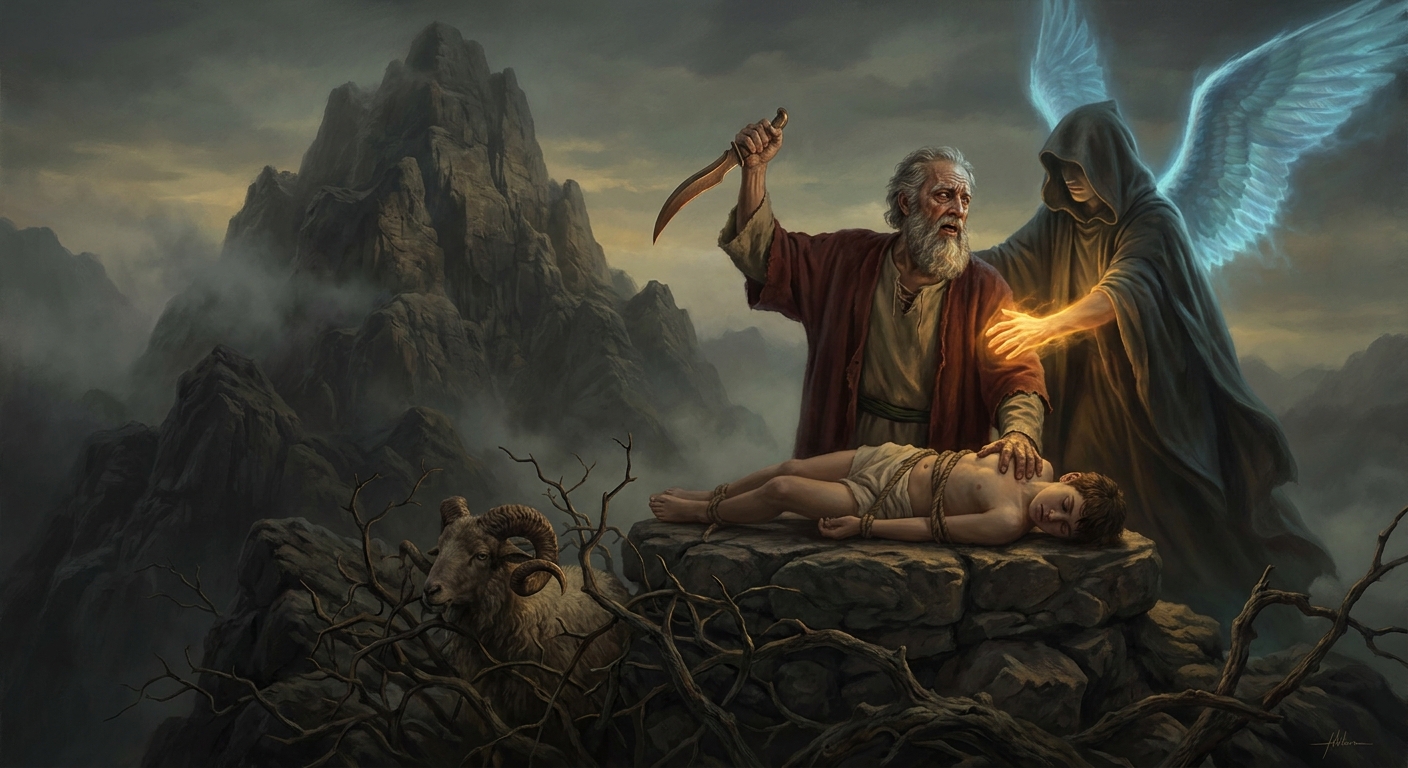
He lays him on the altar on top of the wood. He extends his hand and takes the knife.
The angel calls from heaven: Abraham. Abraham.
Here I am.
Do not stretch out your hand against the boy. Do not do anything to him. For now I know that you fear God, seeing that you have not withheld your son, your only one, from me.
Abraham lifts his eyes.
A ram, caught by its horns in the thicket. He had not seen it a moment before. The rabbis say this is because it was not there a moment before — that the ram was placed in that thicket before creation, in the six days when God was building the world and knew already what Moriah would require, and that it arrived in the undergrowth in the exact instant the knife was no longer needed.
He offers the ram in his son’s place.
He names the place Yahweh-yireh. The Lord will see, or the Lord will provide — the Hebrew verb carries both meanings simultaneously, seeing and providing as the same act, as if God’s attention is itself the provision.
The name sticks. The mountain becomes the mountain of the Temple. Solomon will build the first Temple there. The Dome of the Rock will rise there. Three religions will claim Moriah as the place where heaven touched the earth and something was given back that was thought lost.
What happened on that mountain is still being argued.
The straightforward reading: God tests Abraham, Abraham passes, the sacrifice is not required. A God who demands but does not ultimately take.
The Levenson reading: child sacrifice was real in the ancient Near East, the story is a polemic against it, YHWH’s last-moment intervention is the founding moment of substitutionary religion — the ram instead of the child, the animal instead of the person, the principle that something can stand in for something else in the economy of the sacred.
The Kierkegaard reading: Abraham commits what would be, by every ethical standard, murder — and is called righteous for it. The lesson is not that God is merciful. The lesson is that faith operates above ethics, outside the universal, in a space where the command to kill and the trust that life will be returned are held simultaneously without resolution. Faith is not reasonable. That is precisely what faith is.
The midrash reading: the angel did not arrive in time. The knife descended. A single drop of Isaac’s blood hit the altar. This is why, in Bereshit Rabbah, Isaac is called the one who was offered — not the one almost offered. Something died on Moriah. The Isaac who came down the mountain was not quite the Isaac who went up.
The Christian reading: this was always a prophecy. The beloved son carries the wood. The father does not spare his son. The ram is caught in a crown of thorns. Moriah is Calvary. Except: in the second telling, no angel comes.
All three Abrahamic traditions look back to this mountain. None of them fully agree on what occurred there. The story is old enough that it has absorbed every interpretation and still refuses to resolve. That may be the point.
The knife was raised. The ram appeared. Abraham named the place: the Lord will see. Three days on the road, one question from the boy, one moment at the summit, and the ground of three faiths.
The lamb was there all along. Or it wasn’t, until it was needed. The Hebrew holds both.
Scenes
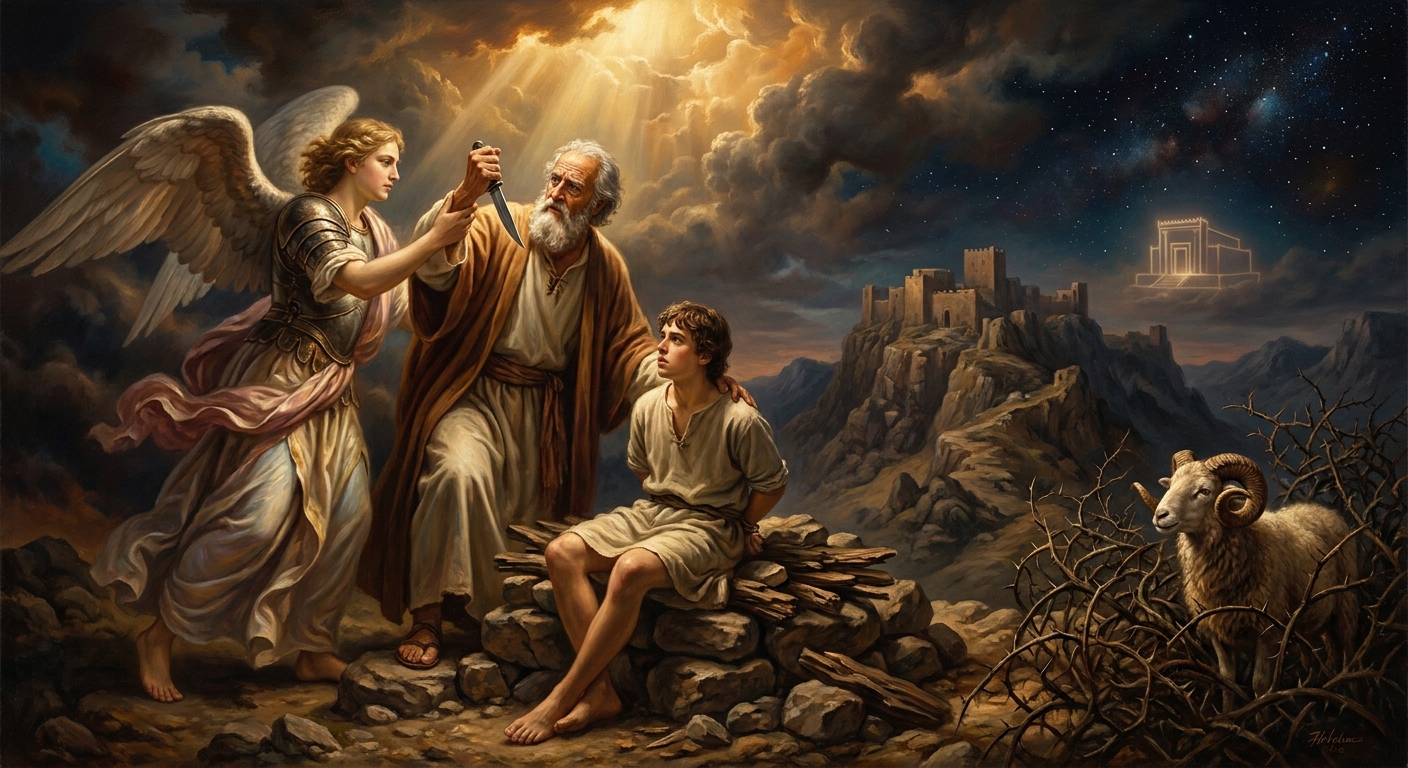
Abraham's hand tightens around the knife above his bound son
Generating art… Three days on the road from Beersheba
 Generating art…
 Caught by its horns in the undergrowth — the ram that was, the rabbis say, created at the close of the sixth day of creation, placed in this thicket before the world began, waiting for this exact morning
 Generating art…
 Echoes Across Traditions
Entities
- Abraham
- Isaac
- YHWH
Sources
- Genesis 22 (Robert Alter trans., *The Five Books of Moses*, 2004)
- Søren Kierkegaard, *Fear and Trembling* (1843)
- Jon D. Levenson, *The Death and Resurrection of the Beloved Son* (1993)
- Bereshit Rabbah 56