Inanna's Descent
Mythic Time · recorded ~1900-1600 BCE · Sumer — the Great Below, beneath the seven gates
Contents
The Queen of Heaven descends through the seven gates of the underworld, is hung as a corpse on a hook for three days, and is restored to life through the power of an outside intervention.
- When
- Mythic Time · recorded ~1900-1600 BCE
- Where
- Sumer — the Great Below, beneath the seven gates
She steps through the first gate.
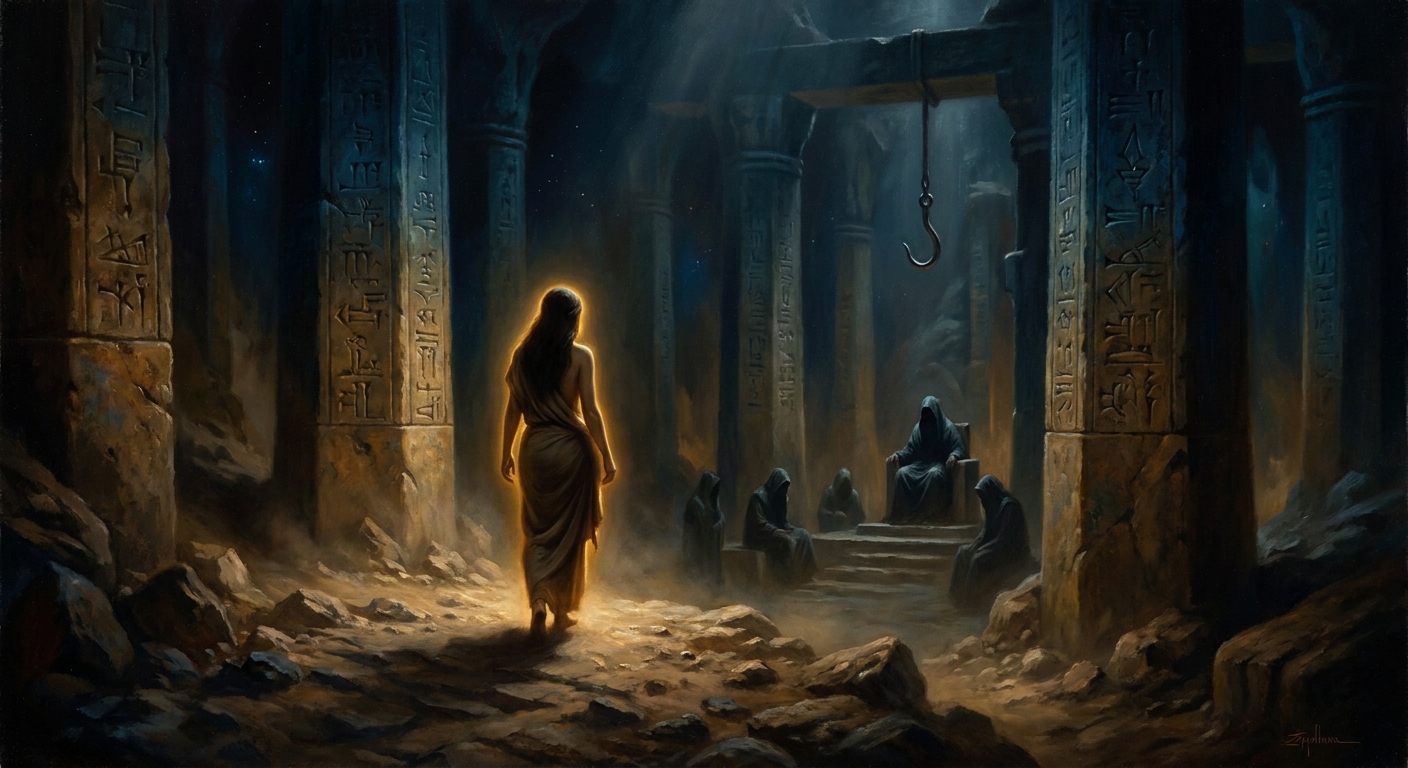
The gate of the Great Below swings inward, and she passes from daylight into a dark that does not admit light. Seven gates stand between the surface and Ereshkigal’s throne. Inanna has told no one where she is going. I will descend to the underworld, she told her priestess Ninshubur. If I do not return in three days, raise a lament for me. Use the old words. Break the begging bowl.
The gate attendant does not bow. In the Great Above, all bow to Inanna, Queen of Heaven, goddess of love and war, the Morning Star whose light breaks before dawn. Here, beneath the earth, the rules are written in stone that older stones have forgotten.
You must remove your crown, says the attendant.
This is the law of that place, the ancient text intones. No one ascends from the underworld. Whoever enters descends. Whoever descends — if she wishes to return — must provide a substitute.
At the second gate, she removes her robes of majesty.
At the third gate, her armor, the weight of battle and dominion.
At the fourth gate, her golden rings, each a city she has blessed or cursed.
At the fifth gate, her robes of divine authority, the symbols that say: I am above you.
At the sixth gate, she stands nearly naked.
At the seventh gate, she has become another body walking into the dark, stripped of everything that made her Inanna.
The attendants bring her before Ereshkigal.
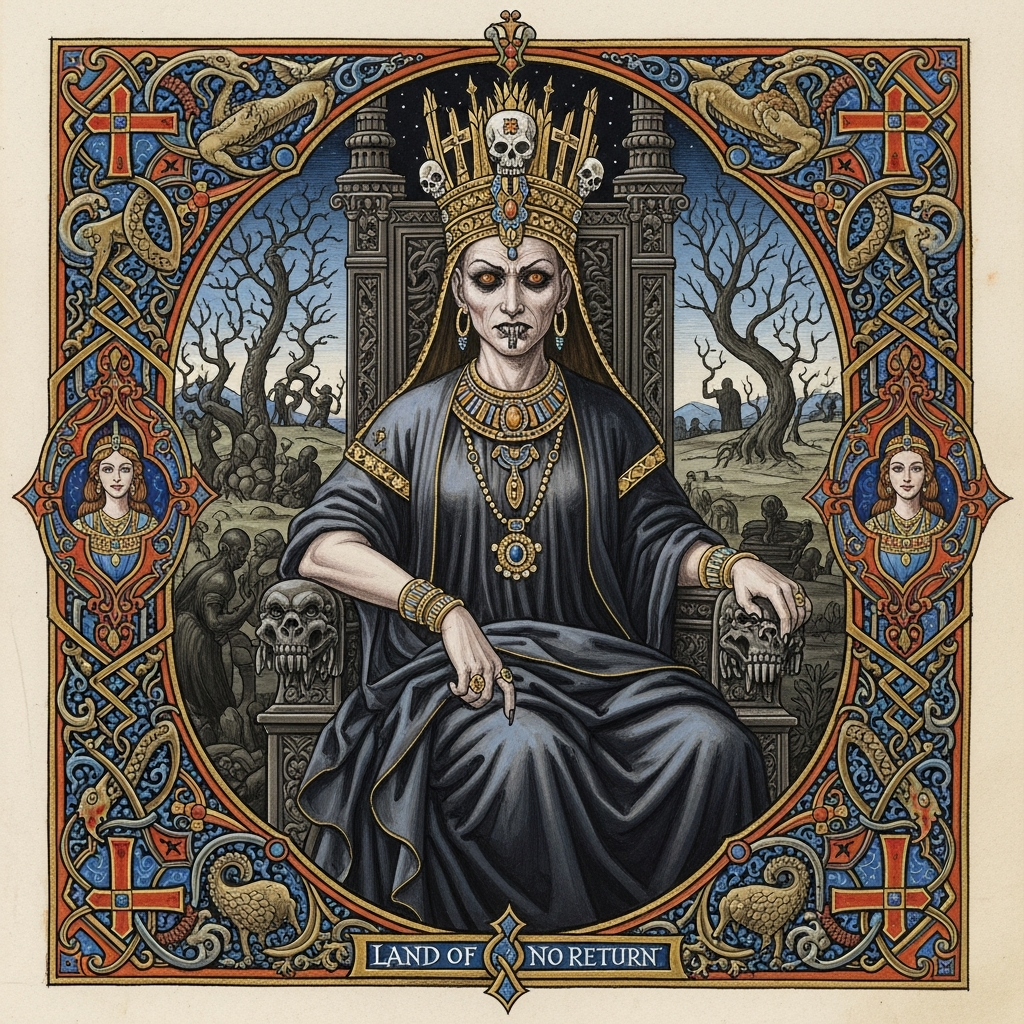
Ereshkigal sits on the throne of the underworld, her face expressionless. She does not greet her sister. There is no mercy in her domain. There is no love. There is only the law, ancient and absolute: whatever enters the Great Below does not leave.
Why have you come? Ereshkigal asks.
Inanna cannot answer. She has come to attend the funeral rites of Ereshkigal’s consort, she said, when the priestesses asked. But that was a story for the surface world. Below, there are no stories. There is only the fact of descent and the fact of the dead.
Ereshkigal’s judgment is swift. You have entered my realm without permission. You have come in defiance of my law. You will hang here.
The Annunaki, the judges of the underworld, fix their gaze upon her. Their eyes are stone. They pronounce the sentence. They do not speak it — they breathe it, and it becomes true the moment air leaves their lungs.
Inanna is seized. A hook is driven through her side — not through her flesh alone, but through whatever divinity she carried down. She is hung upon the hook the way a corpse is hung, the way meat is hung from a beam.
For three days and three nights, she hangs.
No one sees her.
Above, Ninshubur waits. The sun rises. The sun sets. The sun rises again. On the morning of the third day, when there is no sign, the priestess begins to weep the old laments. She tears her robes. She beats the drum that calls the great gods to council.
Inanna has descended to the Great Below, she cries. No one has brought her back. She is hung on the hook of the underworld. She is dead.
The great gods gather in Anu’s hall. They are unmoved. The laws of the underworld are ancient, they say. Ereshkigal rules that realm. We do not interfere.
But Ninshubur does not stop. She comes before Enki, the god of water and wisdom, the god of cunning.
Enki listens. He understands what the other gods have not: that the underworld, for all its absoluteness, is not entirely sealed. From the water, from the deep places where life and death touch, he fashions something new — a worm neither fully alive nor fully dead, a being that can exist in both the realm of light and the realm of shadow.
Go, he commands the creature. Find Inanna on the hook. Speak to her. Bring her back.
The worm descends. It passes through the seven gates without challenge — it is neither a god to be stripped, nor a soul to be judged. It finds Inanna hung upon the hook, her body gray as clay, her breath still.
The god of the waters has sent me, the worm whispers.
Inanna cannot move. Inanna cannot speak.
But something in her — something that is not body, not the divine authority that hung the crown, but something older and deeper — recognizes the voice of Enki. Recognizes that she is not abandoned.
The worm speaks the words of restoration. Not a command. Not a demand. A statement of the water’s own nature: You are the water that flows beneath all things. You are the depth that does not judge. You are the current that rises again.
Inanna’s body begins to change. Color returns to her face. Her eyes open.
She rises from the hook.
She walks back toward the gates of the underworld — but the law holds. She cannot ascend without providing a substitute, a life for a life, a body for a body.
Ereshkigal does not contest this. It is her own law. Who will take your place? she asks.
And Inanna, restored to fury now, restored to the will that shaped her in the beginning, speaks a terrible sentence. Let it be my beloved Dumuzi.
The shepherd-god is dragged below by the Galla demons — those hungry, merciless creatures who know no food that mortals eat, who accept no offerings, who have never tasted love. They pull him into the darkness and seal the gate.
Inanna ascends through the seven gates.
At each one, the attendants return to her the things she had stripped away. Her robes. Her authority. Her rings, each one a city saved. Her armor. Her majesty.
When she emerges into daylight, she is whole again. The Morning Star rises. The priestess Ninshubur sees her and understands that what descends need not remain below.
But Inanna does not forget what hung in the darkness. And in the dark, Dumuzi does not forget his lover’s choice. The seasons turn on this: half the year he is dead below, half the year he rises. And Inanna, having died and been restored, has become the only god who truly knows what death is — because she has worn it like a garment and cast it aside.
The descent to the Great Below is not optional. It is the one law that even the greatest gods cannot escape. Inanna’s victory is not that she was never hung — it is that she returned. And in returning, she did not go back unchanged. She emerged knowing something the gods of light had never known: that the underworld, for all its cold and weight, is not the end.
This story is 3,600 years old and it still teaches the same thing the Sumerian priestesses taught it: go down if you must. Go down if love demands it. Go down if wisdom will only be found below. But do not stay. Do not accept that the hook is permanent. Resurrection is not a miracle of the gods above — it is a refusal to abandon what has fallen.
Three days in darkness, and then the light.
Echoes Across Traditions
Entities
- Inanna
- Ereshkigal
- Dumuzi
- the Annunaki
- Ninshubur

Sources
- *Descent of Inanna* (Sumerian myth, cuneiform text)
- Stephanie Dalley (trans.), *Myths from Mesopotamia* (Oxford University Press, 1989)
- Samuel Noah Kramer, *Sumerian Mythology* (University of Pennsylvania, 1944)
- Betty De Shong Meador, *Inanna, Lady of Largest Heart* (University of Texas Press, 2009)