Marduk Slays Tiamat
Composed ~18th century BCE · Akkadian Enuma Elish · The primordial waters · before sky and earth
Contents
Before sky and earth existed, the young god Marduk stepped forward to fight Tiamat — the primordial salt sea in dragon form — and from her split body made the world.
- When
- Composed ~18th century BCE · Akkadian Enuma Elish
- Where
- The primordial waters · before sky and earth
The gods are afraid.
This is the first fact of the Babylonian universe: before there is sky, before there is earth, before there is a single grain of dust or a single ray of light, the gods are huddled together in the body of Tiamat like children in a womb, and they are terrified of what they have woken.
Tiamat is the salt sea. She is also the mother of everything that exists. She is also, now, a dragon forty miles long gathering an army of monsters in her depths — serpents, dragons, the Labbu, the horned serpent, the fish-man, the scorpion-man — because the younger gods would not stop making noise, and her first husband Apsu, the freshwater ocean, is dead. Ea killed him. Put him to sleep with a spell and slit his throat, then built his throne room over the corpse. Reasonable, from Ea’s perspective. The noise was necessary. What was Apsu going to do, let the gods keep existing?
Tiamat has decided to end the noise a different way.
The divine council convenes without walls, because there are no walls yet. Anu, the sky father, goes first. He travels toward Tiamat’s darkness, and he comes back without speaking. Something in her eyes stops him cold. The great gods pass the problem around like a cup none of them will drink from. Nobody moves. The army of monsters waits in the deep.
Then Marduk speaks.
He is young. His father is Ea, which means he was conceived and born inside the corpse of Apsu, which means he has never known a world without a body beneath him and a threat above him. He has four eyes and four ears. When he moves his lips, fire comes out. He does not look like a god who will lose.
“If I am to be your champion,” he says to the council, “give me authority. Make my word the word that unmakes and remakes. Whatever I say, let it be.”
They put a constellation in the center of the council. They tell him to speak.
He says: Disappear. The constellation vanishes. He says: Return. It comes back. The gods roar their approval. A deal is made. The boy who was born in a dead god’s body will face the dragon-mother of the salt sea, and in exchange he will be king of everything that exists after — which is to say, of everything.
He goes to Ea for weapons. Ea gives him what he has: the net of the four winds, the evil wind, the whirlwind, the hurricane, the fourfold wind, the sevenfold wind, the cyclone, the matchless wind. He gives him a spear and a mace and lightning. He gives him a flaming garment. He fills Marduk’s body with fire until he is more fire than flesh.
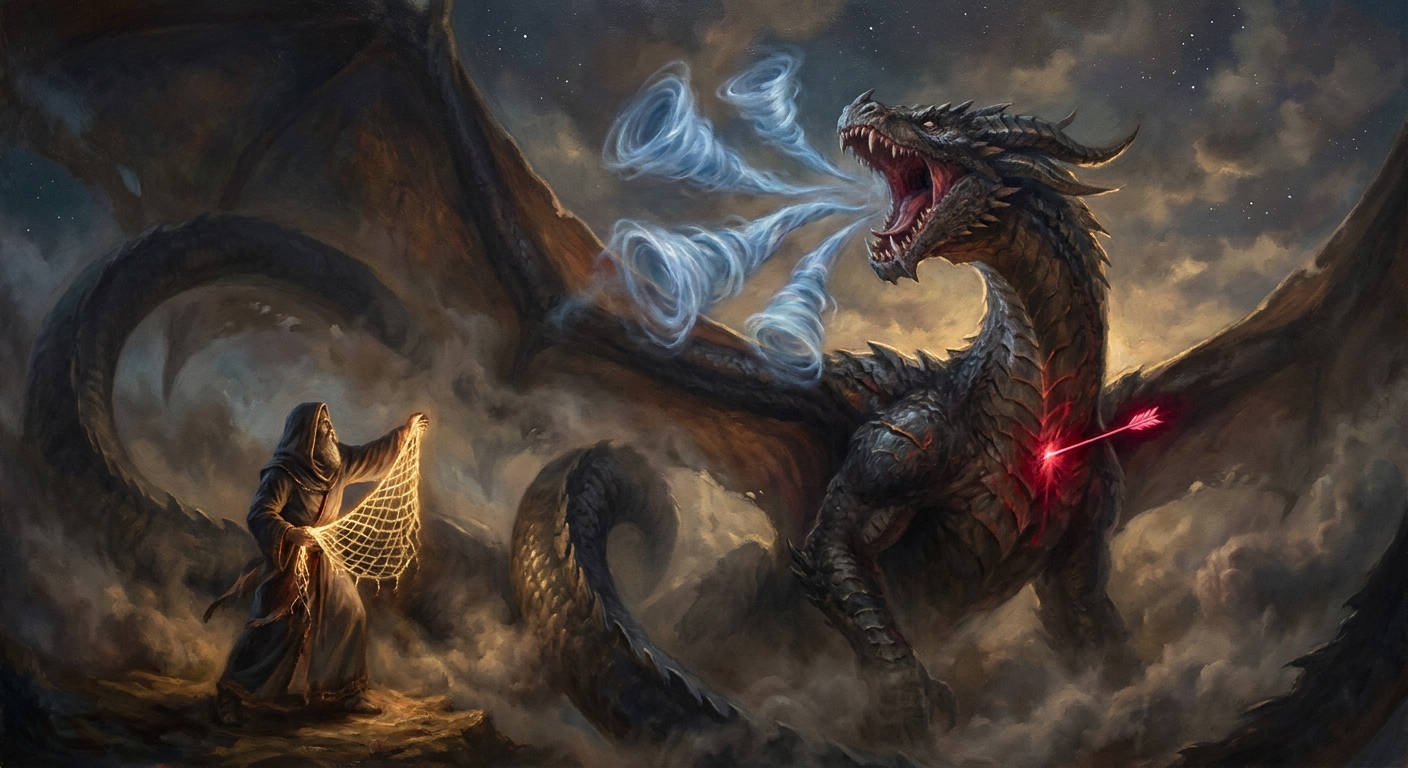
Marduk captures a net. He holds it open with the four winds at its corners, so that nothing inside it can escape. He loads his chariot with the Storm, the Killer, the Relentless, the Trampler — four horses who do not know the word stop. He takes an herb that prevents poison from reaching the heart. He holds his weapon in one hand, and he goes to meet Tiamat.
She is larger than he remembers. She is larger than he imagined.
He sings an incantation as he approaches, because this is the weapon Ea taught him — words of power before the spear — but Tiamat laughs, and the incantation dies in the space between them. She says: How many gods have come to me with words? She says: Your father Ea came with clever plans, and then he came with an army, and here you are alone, and you are a child, and I am the sea.
Marduk throws the net.
The four winds hold it open at its corners. Tiamat rears and breathes and the breath becomes a weapon — a divine wind, a storm to knock him from his chariot — but the net is already over her, and Marduk drives his own wind into her open mouth before she can close it. The evil wind, the whirlwind, the hurricane fill her body. She cannot close her jaws. She cannot swallow. She cannot breathe out the storm she has already begun.
She is vast and she is distended and she is held.
He drives his spear into her belly. He splits her down the center. He stands over the two halves of the primordial salt sea and breathes.
The world is a body now. That is what he makes from it.
He cuts her skull open and heaps up mountains from the bone. He draws back her eyelids and lets the Euphrates and the Tigris run from the sockets, because a god who can make rivers from eyes can be worshipped, and Marduk intends to be worshipped. He lifts one half of her body overhead and stretches it into a vault — the sky — and posts guards at its edges so the water does not run back down. He raises the other half beneath his feet and names it earth. He marks out the stations of the great gods as constellations. He makes the moon. He makes the year.
He makes humanity from Kingu’s blood — Kingu, who had been Tiamat’s general, who had carried the Tablet of Destiny around his neck like a weapon, whose blood is thick with divine rebellion. Humanity is made to serve the gods, to carry the corvée of heaven so the gods can rest. Marduk makes that decision in a single sentence. He does not ask the humans.
The gods build Babylon in a single year, working joyfully, because Marduk has taken their corvée from them. They lay the bricks of Esagila, the temple that mirrors the structure of heaven, and at the summit they place the throne room where Marduk will sit above the city that is above the world.
The Enuma Elish was chanted at the Akitu New Year Festival in Babylon — every year, at the turning of the year, the priests read the tablets aloud in the temple so the cosmos could be made again. Creation is not a one-time event in this theology. It is a ceremony. If you stop performing it, the world forgets its shape.
What Marduk demonstrates — what every dragon-slayer after him demonstrates — is not strength exactly. It is this: chaos does not go away. It is divided. The dragon-mother becomes the sky above and the earth below, and you live between the two halves of the thing that would have eaten you, and you call it home.
The tehom — the deep, the formless void of Genesis 1:2 — is the same word as Tiamat. When the Israelite scribes wrote that the spirit of God moved over the face of the deep, they were writing over something older: a goddess, a sea, a battle that had already happened, a dragon whose body was already the sky above their heads.
The combat myth is the oldest story in the world, or close to it. The pattern is always the same: the young champion, the chaos-dragon, the net, the wind, the sword. What changes is the theology layered on top. Marduk makes a kingdom. Indra releases rivers. YHWH divides waters and calls it good. Apollo builds an oracle. Thor dies.
In every version, the monster is not destroyed. It becomes the world. You are living inside the dragon. You always have been.
Echoes Across Traditions
Entities


Sources
- *Enuma Elish* (seven clay tablets, Old Babylonian period, ~18th century BCE)
- Stephanie Dalley, *Myths from Mesopotamia* (Oxford, 1989)
- Thorkild Jacobsen, *The Treasures of Darkness* (Yale, 1976)