Dumuzi the Substitute
Composed ~1900-1600 BCE · Old Babylonian Sumerian text · Sumer — the marshes, the sheepfold of Arali, the sister's hut, the Great Below
Contents
When Inanna ascends from the underworld, she must leave a body in her place. She finds her shepherd-husband Dumuzi seated on the throne in fine robes, untroubled by her absence — and her eye, the eye of death, settles on him.
- When
- Composed ~1900-1600 BCE · Old Babylonian Sumerian text
- Where
- Sumer — the marshes, the sheepfold of Arali, the sister's hut, the Great Below
She comes back wearing nothing.
The seven gates have given Inanna her clothes again as she ascended — the crown, the rod, the necklaces, the breastplate, the linen — but she walks past them without putting them on. She is reassembled and unconcealed. The galla demons walk behind her, two on her left, two on her right, four merciless escorts who do not eat what mortals eat, who do not drink what mortals drink, who do not sleep, who do not love, who exist for one purpose: to bring back the substitute. Without the substitute, Inanna has not been released; she has been loaned. The galla are the underworld’s collateral.
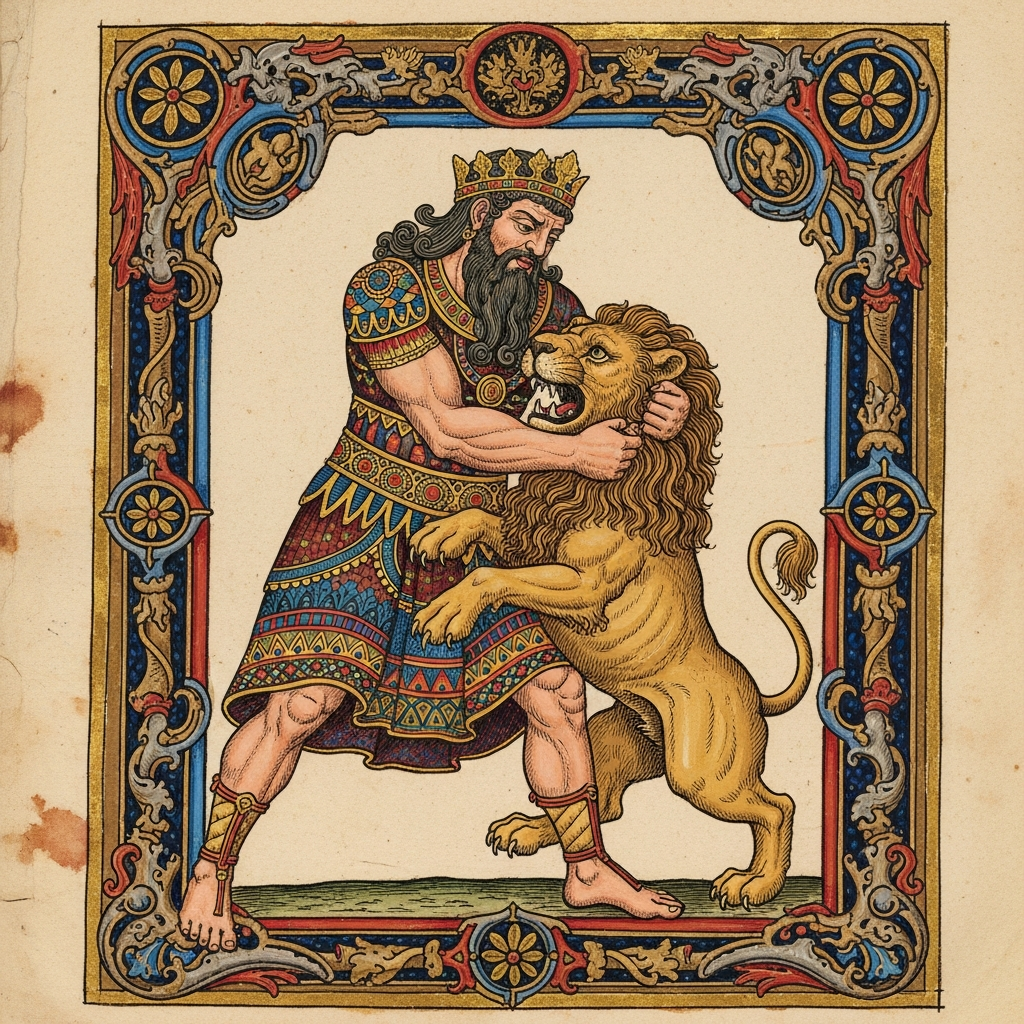
She walks across the courtyard of her temple in Uruk, and Dumuzi is sitting on her throne.
He has dressed for it.
This is the detail the Sumerian poets cannot forgive. They mention it with a precision that is almost surgical: He sat upon the magnificent throne. He wore the magnificent robes. He did not weep. He did not tear his clothes. He did not rub his face in the dust. While Inanna hung as a corpse in the Great Below for three days, the shepherd-king of Uruk — her husband, her chosen, the boy she had taken to her bed in the long sweet hymns of her courtship — enjoyed her absence. The throne suited him. The robes suited him. He has been ruling Uruk while she was dead, and he has been comfortable.
She sees this in a single glance.
The hymn says her eye fell on him. The eye of death. The same gaze Ereshkigal turned on her in the Great Below, the gaze that drove the hook through her ribs. Inanna, restored, has come back with that gaze inside her. She did not invent it. The underworld put it there. She turns it now on her husband.
She points. The galla move.
Dumuzi runs.
He is a shepherd. He knows the marsh. He knows where the reeds grow thick, where the channels braid, where a man can lie under water with a hollow stalk for breath. He runs from the city out into the country — to his sheepfold at Arali, to the hut of his sister Geshtinanna, to the open country where his flocks graze. The galla follow. They are not fast, but they are unstopping. They do not need to eat. They do not need to rest. A shepherd can outrun anything for an hour. Nothing for a week.
He prays to Utu, the sun god — Inanna’s brother, his brother-in-law, the only god in the pantheon who might be sentimental enough to help. Utu, you are her brother and I am her husband. Change my hands. Change my feet. Let me escape into the marsh as a snake.
Utu hears. The Sumerian gods are not stingy with transformation. Dumuzi’s hands become the smooth tapering of a serpent’s head. His feet become coil. He slips into the channel and disappears under the reed-mat.
The galla follow him into the water.
He becomes a gazelle.
Utu changes him again. Long-legged, panicked, eyes round with the terror of a prey-animal that has known itself only as a herder until this hour. He bounds across the desert toward Geshtinanna’s hut. The galla follow on foot, four shapes that do not vary their pace, that do not break into running, that simply advance.
He reaches Geshtinanna. She is the sister who reads dreams — earlier in the cycle, she had interpreted the dream that warned him this was coming, and he had not believed her, because no shepherd-king believes that the queen he has been replacing while she was dead might come back angry. Now he believes her. He hides in her hut. He weeps in his sister’s lap.
The galla come to the door.
Geshtinanna will not give him up. She refuses three times. She is beaten. She is offered gifts — gold, sheep, fields. She refuses each. The Sumerian poets emphasize this scene because they understand what it is: this is the one relationship in the cycle untainted by political ambition or sexual rivalry. The sister is the only person in the story who loves Dumuzi without strings. She would die in his place if she could.
The galla find him under the bed.
They take him.
Not gently. The hymn is specific about the violence. They strip his royal robes off — the same robes he had been sitting in on Inanna’s throne — and they bind his arms behind him with cord, and they lead him out of the marsh and toward the Great Below. He is no longer running. He is no longer transforming. The transformation magic only works while one is fleeing; once captured, the body returns to the body that was condemned.
He looks back once. Geshtinanna is in the doorway of her hut. She is not weeping. She is thinking.
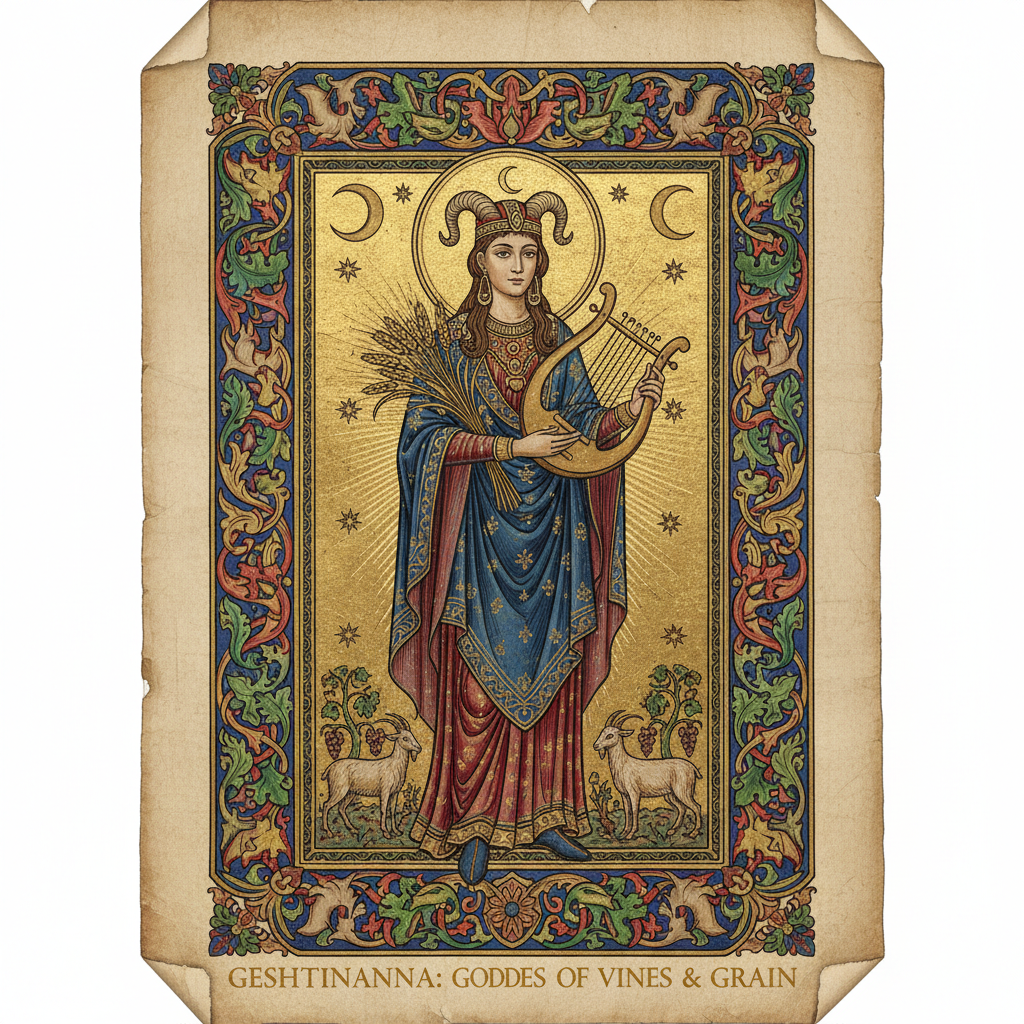
The Sumerian word for what she does next is sometimes translated as insisting, sometimes as bargaining, sometimes as refusing-to-leave-the-matter-alone. There is no single English equivalent. She follows the galla. She follows them out of her village, across the steppe, all the way to the gate of the Great Below. She demands an audience with Inanna. She makes a counter-offer.
Half the year, she says. I will spend half the year below in his place. He spends the other half. The substitution stands, but it is split.
Inanna agrees.
This is the part that makes the cycle bearable. The galla agree because the law of the substitute is satisfied either way — a body is in the underworld; the contract is upheld. Ereshkigal agrees because she does not particularly care which sibling is in her court. Geshtinanna agrees because she has chosen this. And Dumuzi — the unfaithful shepherd, the husband who sat on the throne in royal robes while his wife hung dead on a hook — Dumuzi agrees because the alternative is permanent.
He spends six months below.
Geshtinanna spends six months below.
When one is in the underworld, the other is on the surface. They never see each other except in the moment of the exchange — the half-second at the gate when the seventh door opens and one steps out as the other steps in. The Sumerian texts describe this hand-off with surprising tenderness. They embrace. They speak the words of release. The galla wait. They have been doing this for centuries, in the theology, by the time the hymn is being copied into the schools at Nippur.
The shepherd-god’s death and return is the calendar. Six months he is below, and the world above goes dry. The pastures yellow. The flocks thin. The flies thicken on the unwatered ground. Six months he is above, and the rains return, the lambs are born, the marsh greens. The Sumerians did not understand the agricultural year as a thing the climate produced; they understood it as the consequence of which sibling was currently dead.
Tammuz — Dumuzi’s name in Akkadian — was still being mourned a thousand years after the Sumerian hymns were composed. Ezekiel walks through the Jerusalem temple in the sixth century BCE and sees women weeping for Tammuz at the north gate (Ezek 8:14). The prophet is appalled. The cult had run continuously from Uruk to Jerusalem for two millennia, surviving the fall of Sumer, the rise of Babylon, the rise of Assyria, the rise of Persia. It would survive into the Greek period as Adonis. It would survive into the Roman period as Attis. It would echo into the Christian period as the dying-rising god the Mediterranean had been waiting for since before it knew it was waiting.
The substitution is the deepest mythic structure in the region. A god dies so another can live. The death is never quite final, because a sister or a wife or a mother — always a woman — refuses to accept the finality. She walks into the Great Below. She negotiates. She splits the sentence. She brings him back, partially, conditionally, on terms.
The Christian gospel inherits the structure and softens it. Christ dies once; Christ rises once; the substitution is permanent and total. The Sumerian original is harder and stranger. Dumuzi dies every year. Geshtinanna dies every year. The cosmos requires the death — not as a single transaction, but as an ongoing seasonal payment — and the women keep paying it.
The shepherd is unfaithful. The wife is vengeful. The sister is the one who saves him. The Sumerians understood, four thousand years ago, that the people who hold the world together are rarely the ones the world remembers.
Scenes
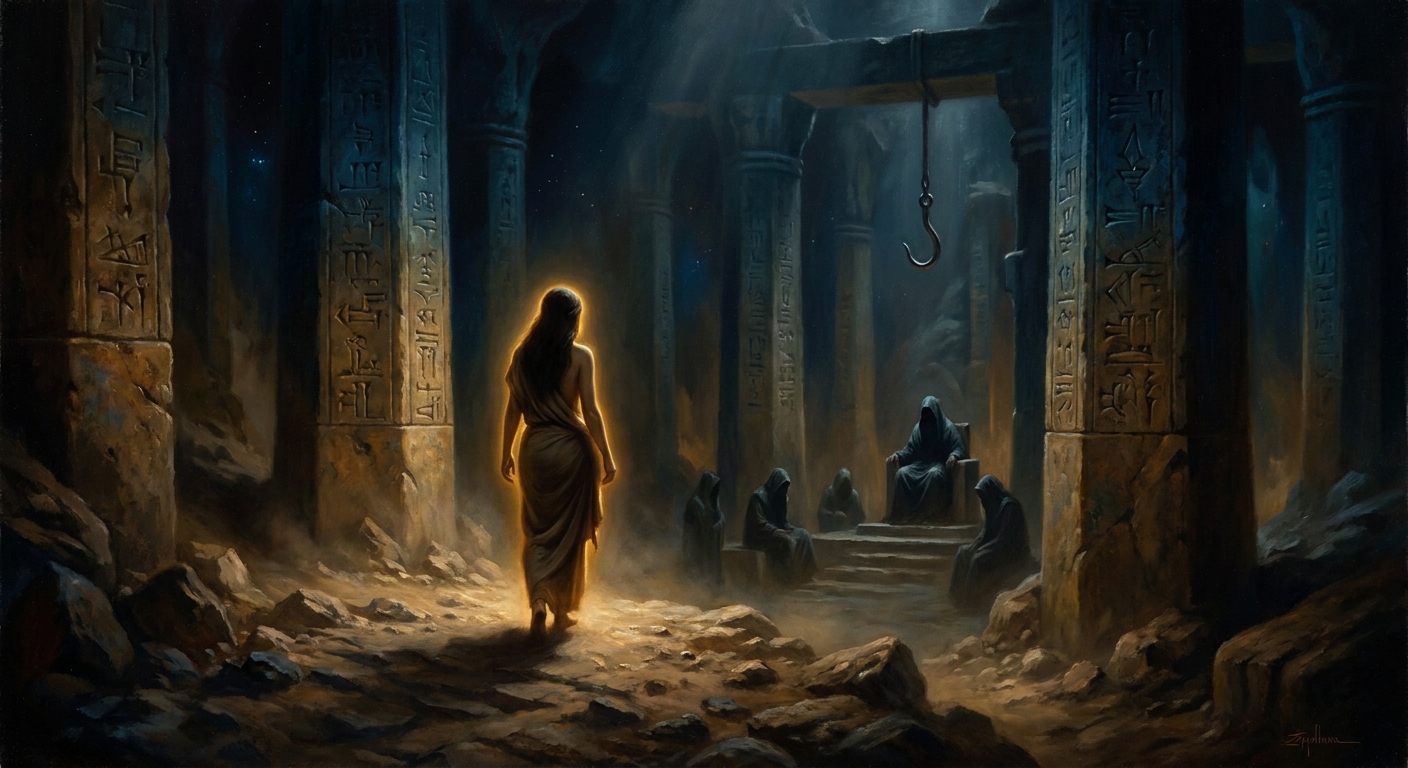
Inanna ascends from the seven gates with the galla at her shoulders — and her eye, the eye of death, finds Dumuzi seated on her throne in royal robes
 Generating art…
 Dumuzi runs through the reed-marsh of Arali, transformed into a snake, then a gazelle, then a sheep — the galla following him through every shape
 Generating art…
 Geshtinanna, the sister, walks into the Great Below to take her brother's place for half of every year — the first vicarious sacrifice in literature, paid by a sibling
 Generating art…
 Echoes Across Traditions
Entities
- Dumuzi
- Inanna
- Geshtinanna
- Ereshkigal
- the galla demons
- Utu


Sources
- *Inanna's Descent to the Netherworld* (Sumerian, ~1900-1600 BCE; ETCSL 1.4.1)
- *The Dream of Dumuzi* (Sumerian, Old Babylonian; ETCSL 1.4.3)
- Diane Wolkstein & Samuel Noah Kramer, *Inanna: Queen of Heaven and Earth* (Harper & Row, 1983)
- Stephanie Dalley (trans.), *Myths from Mesopotamia* (Oxford, 1989/2000)
- Thorkild Jacobsen, *The Treasures of Darkness* (Yale, 1976)
- Bendt Alster, *Dumuzi's Dream* (Akademisk Forlag, 1972)