Inanna's Tree and the Snake That Refused to Leave
Sumerian original c. 2100-2000 BCE; Old Babylonian composition c. 1800 BCE · The bank of the Euphrates and the holy garden of Inanna at Uruk
Contents
Before the great descent: Inanna finds a huluppu tree uprooted by flood on the bank of the Euphrates and plants it in her garden at Uruk, intending to make a throne and bed from its wood. A snake nests at the root. The Anzu bird nests in the branches. Lilith builds her house in the trunk. Gilgamesh drives them out with his axe. Creation of the first sacred furniture — and a Sumerian archaeology of the uncanny.
- When
- Sumerian original c. 2100-2000 BCE; Old Babylonian composition c. 1800 BCE
- Where
- The bank of the Euphrates and the holy garden of Inanna at Uruk
In the first days, after heaven and earth had separated, in the first days, after Anu had taken the heavens for himself and Enlil had taken the earth, the small huluppu tree is uprooted.
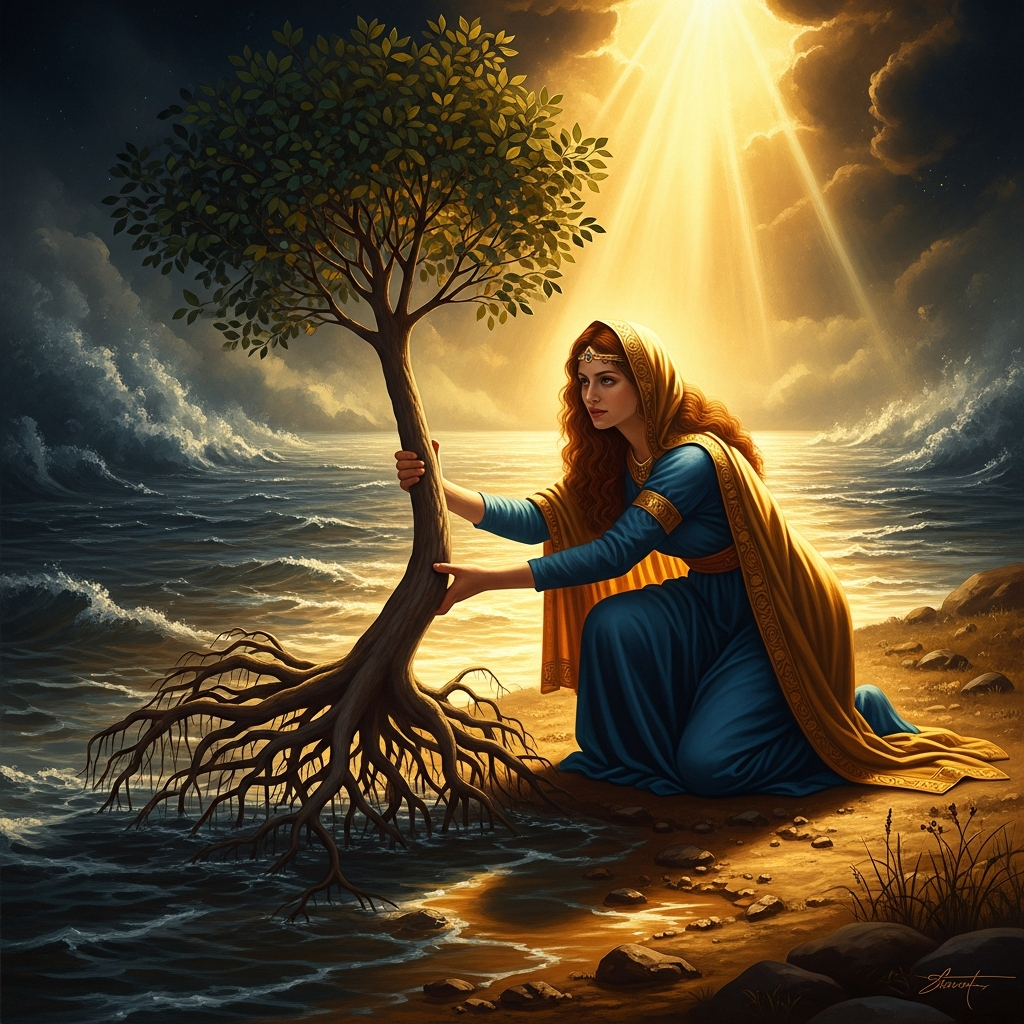
The great flood comes from the south. The Euphrates rises. The tree that grows on the bank of the river — a willow, a poplar, the word is huluppu and scholars have been arguing about the species since cuneiform was deciphered — is torn from the bank and tumbles into the rushing water, its roots bare, its trunk still upright, riding the flood south toward the sea. Inanna is walking on the bank. She sees the tree. She understands immediately that she wants it.
She steps into the water. She takes the tree in her arms. She carries it, barefoot in the flood, to her holy garden in Uruk, and she plants it in the soil there and tends it with her hands. She does not have servants do this. She waters it herself. She says: in five years, in ten, when the tree is grown and its wood is seasoned, I will cut it and make myself a shining throne. I will make myself a bed. I have been queen of heaven since Anu took the sky and I have never had furniture worthy of it.
She tends the tree for ten years. She tends it for ten years and it grows tall, and then she goes to harvest it, and she finds that she cannot.
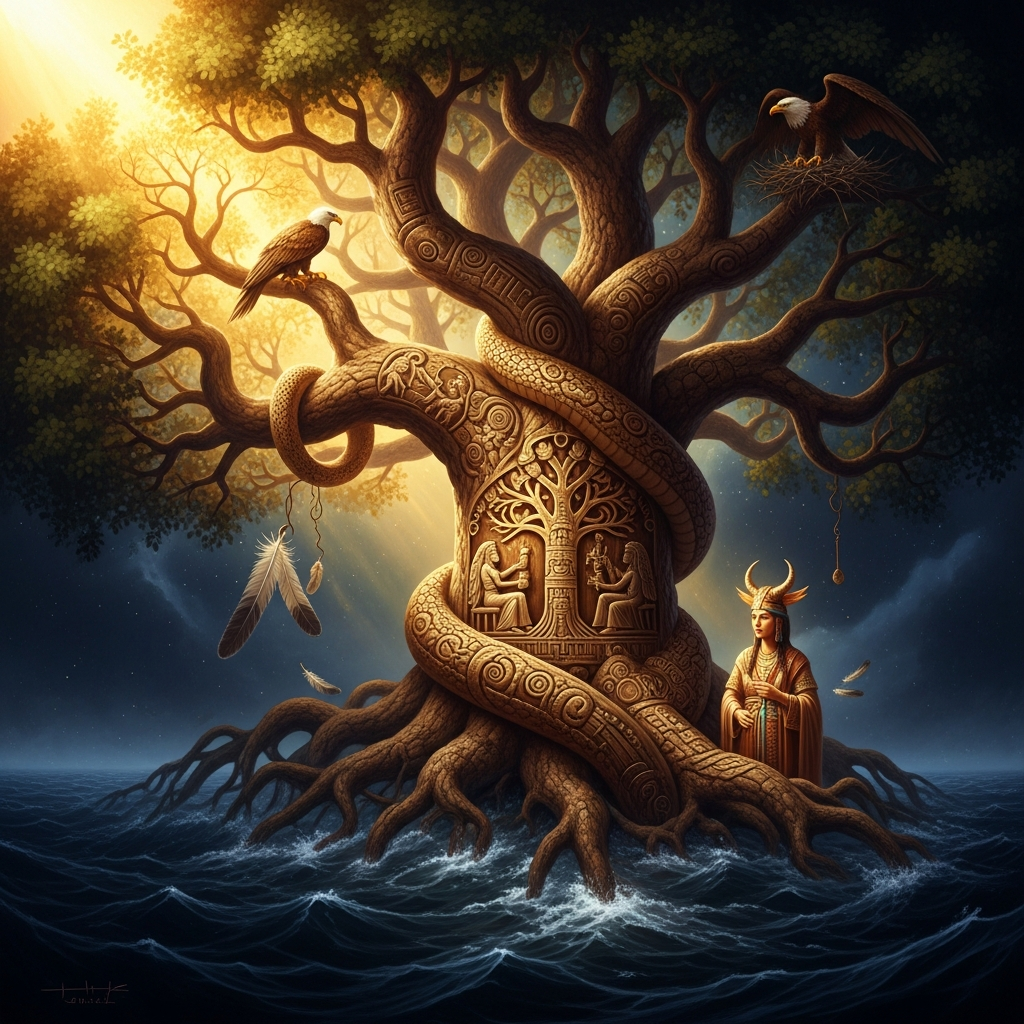
The snake who cannot be charmed has made his nest at the base of the tree.
He lives in the roots. He has made himself at home in the soil around the base of the trunk with the particular thoroughness of something that has decided this is where it lives. He is not aggressive. He does not threaten Inanna when she approaches. He simply does not leave, and when she tries the charms that should move him — the words of power that the me, the divine decrees, should give her authority to deploy — he remains in the roots. The snake who cannot be charmed is not charmed.
In the crown of the tree, the Anzu bird has built a nest for its young.
The Anzu is the great storm-bird, the creature that later texts will describe stealing the Tablet of Destiny from the sleeping Enlil and carrying it to the mountain, disrupting the divine order for the duration of the time it takes a hero to retrieve it. In Inanna’s garden the Anzu is not yet the cosmic thief. It is a bird nesting in the top of a tree, which in this context is the most intractable thing it could be. The bird is above Inanna. She cannot make it leave.
In the heartwood of the trunk, in the body of the tree itself, the ki-sikil-lil-la has built her house.
The dark maid. The one scholars later map to Lilith, the Semitic demon, though the connection is contested and the Sumerian term means something like the maiden of the empty place or the maiden of the wind. She is not a demon in this text. She is a figure who lives in the in-between space — not at the root, not in the crown, but in the wood itself, in the hollow center of the living tree. She has built a house there. She is not leaving.
Inanna weeps.
She has planted this tree, tended it for ten years, watched it grow tall enough to make the furniture of a queen, and she cannot get to the wood because something lives at every level of the tree that will not respond to her authority. She goes to her brother Utu, the sun god. She tells him about the snake. She tells him about the Anzu bird. She tells him about the dark maid in the trunk. She asks him to help her clear the tree.
Utu does not help her.
She goes to Gilgamesh.
The text does not explain why Gilgamesh, who is king of Uruk, is the one who can help where the sun god cannot, but the poem implies it: Gilgamesh is the most capable human being in the world, and the problem in Inanna’s tree is not a divine problem but a human one. A goddess cannot clear her own garden of its uncanny occupants because they occupy the space between the divine and the human, the space that is neither fully sacred nor fully mortal. You need a mortal with a very large axe.
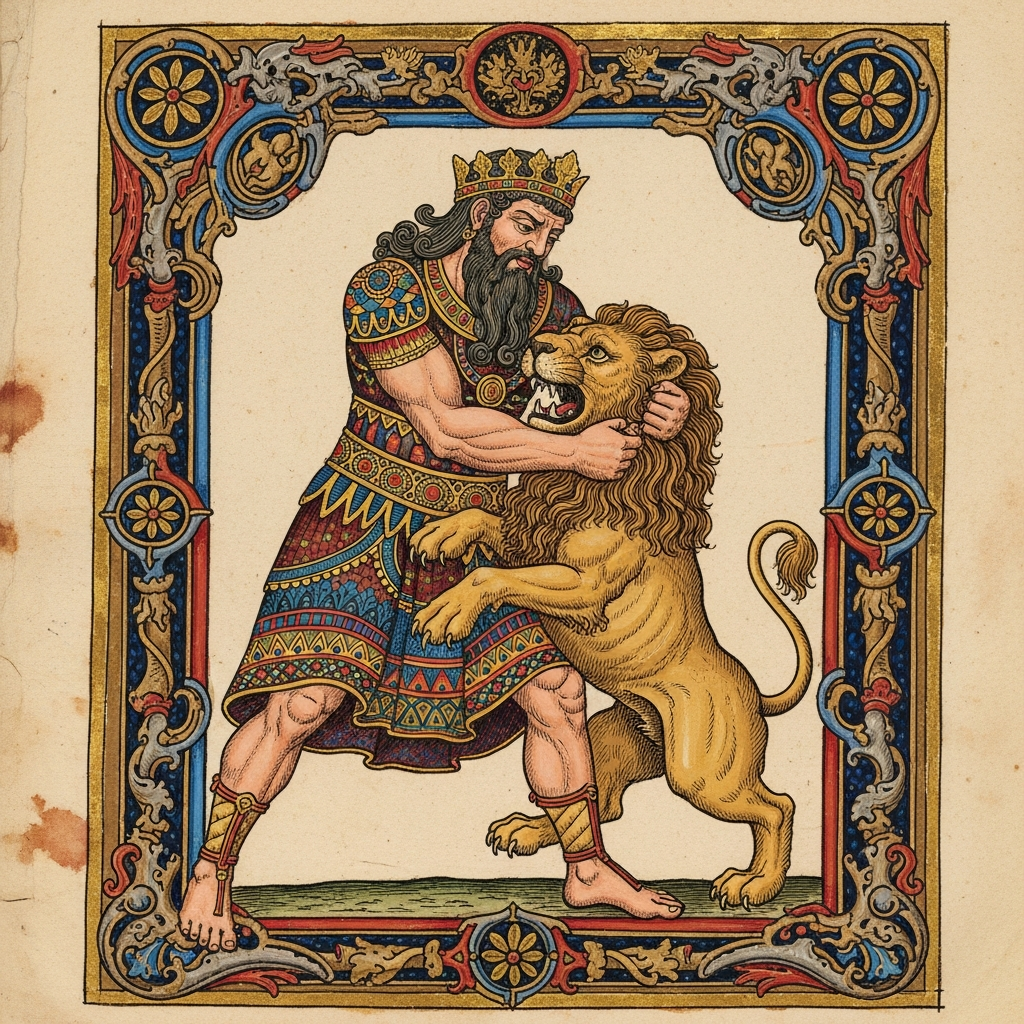
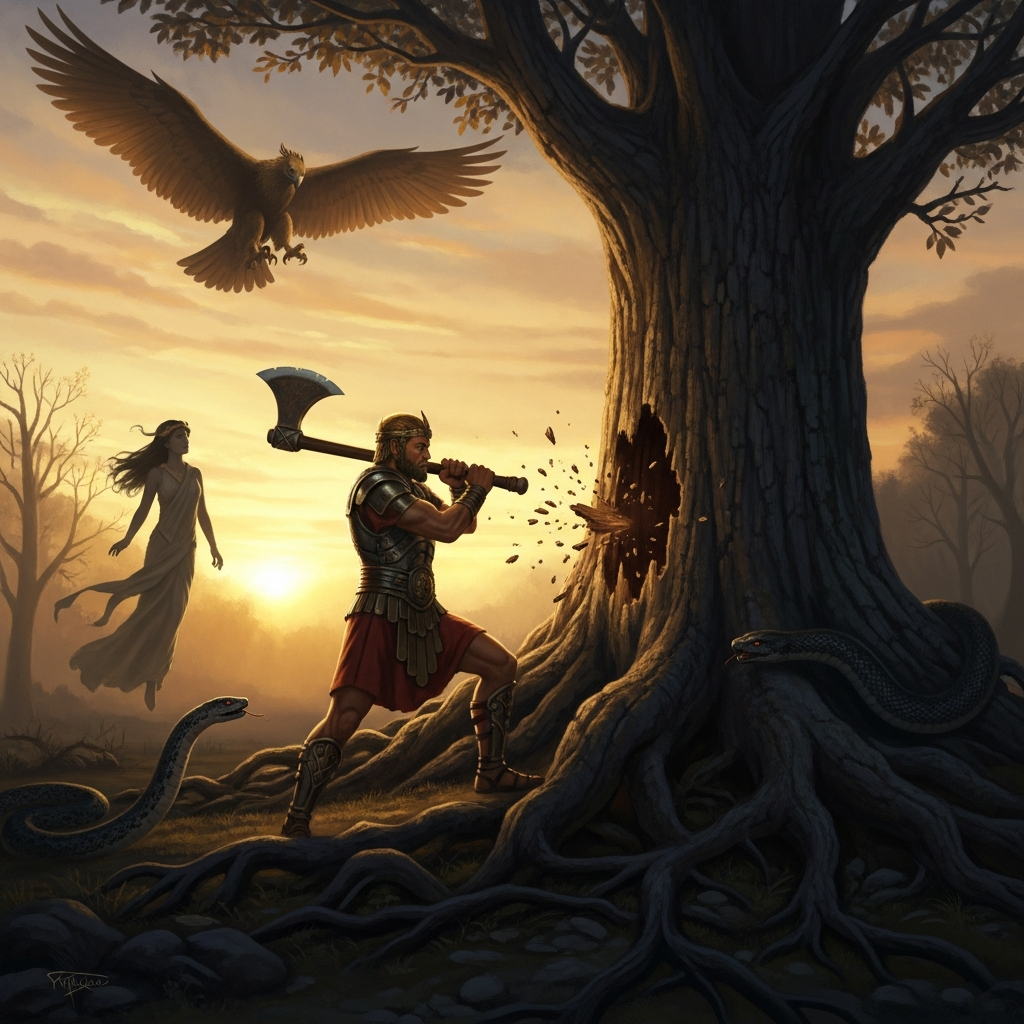
Gilgamesh puts on his armor of fifty minas. He picks up his axe of the road, its blade weighing fifty minas, which is described as the weight that a man of fifty minas carries in his hand. He walks to the huluppu tree in Inanna’s holy garden and he lifts the axe and he swings it at the base.
The snake flees into the earth.
The text says: the snake who could not be charmed. It says the snake departed into the earth. It does not say the snake was killed, because the snake who cannot be charmed cannot be killed, only displaced. It goes into the earth and it is gone from the tree, but it is in the earth under the garden, which is not the same as gone.
The Anzu bird picks up its young and flies to the mountains. The great storm-bird, the creature that will later steal the Tablet of Destiny, takes its fledglings and rises above Uruk’s walls and goes to the mountains, where no one can follow it, where it will wait until the next crisis.
The dark maid tears down her house in the trunk. She goes to the empty wilderness that the other texts will describe as her permanent residence — the desert, the waste places between cities where the divine order does not reach. She goes to where Inanna is not, which is the only place she can live.
Gilgamesh cuts down the tree. He gives the roots to Inanna for her throne. He gives the crown to Inanna for her bed. From what is left — the trunk, the heartwood that the dark maid’s house occupied — he makes two objects whose names are pukku and mekku. Scholars have argued about these words. They may be a drum and a drumstick. They may be a ball and a mallet. What the text says is that Gilgamesh carries them through Uruk, playing some kind of game or performing some kind of ritual with them, until the day he drops them through the hole in the ground into the Great Below, and they fall out of his reach, and that loss becomes the occasion for Enkidu to descend to the underworld to retrieve them, and the underworld kills Enkidu, and that is another story.
Inanna sits on her throne, which is made from the roots of the huluppu tree she carried from the flood-bank of the Euphrates.
She sleeps in her bed, which is made from the crown of the same tree.
The snake is under the earth. The Anzu bird is in the mountains. Lilith is in the wilderness. The furniture is made. The garden is cleared. What the story has established, in the quiet before the great narratives begin — before the Sacred Marriage, before the Descent — is the shape of what Inanna cannot govern alone: the things that live below, above, and inside the sacred space that is hers.
The snake who cannot be charmed. The bird too high to reach. The occupant of the in-between space who lives where neither the divine root nor the divine crown extends.
These three will appear in other forms in the stories that follow. The below, the above, the hollow middle. The tree is felled and the furniture is made and the garden is clear, and the text moves forward to the next event, but the snake is still in the earth under the garden.
The huluppu tree is a prequel and an archaeology. Before Inanna descends to face Ereshkigal, before she is stripped of every me at every gate, before she hangs dead on the hook in the underworld — she weeps in her garden over a tree she tended for ten years that she cannot clear alone.
The great goddess of heaven and war and love and the morning star goes to a mortal man with an axe and says: help me.
The uncanny departs. The furniture is made. Gilgamesh takes his new plaything through the city streets.
But the snake went into the earth, not away from it. It is still there, in the roots of every garden, in the dark below the sacred space, in the place the axe cannot reach.
Scenes
Inanna on the bank of the Euphrates during the great flood, finding the young huluppu tree uprooted by the waters, its roots bare, and deciding to carry it back to plant in her holy garden at Uruk
 Generating art…
 The huluppu tree in Inanna's garden, grown tall after years of tending: at the root, the snake who could not be charmed; in the crown, the Anzu bird with its young; in the trunk, the dark maid Lilith with her house built in the heartwood
 Generating art…
 Gilgamesh at the huluppu tree at dawn, his axe on his shoulder, the bronze blade fifty minas in weight
 Generating art…
 Echoes Across Traditions
Entities


Sources
- Diane Wolkstein and Samuel Noah Kramer, *Inanna: Queen of Heaven and Earth* (Harper and Row, 1983)
- Thorkild Jacobsen, *The Treasures of Darkness: A History of Mesopotamian Religion* (Yale University Press, 1976)
- Samuel Noah Kramer, *Sumerian Mythology* (Forgotten Books, 1944)
- Betty De Shong Meador, *Inanna, Lady of Largest Heart* (University of Texas Press, 2000)
- Jeremy Black and Anthony Green, *Gods, Demons and Symbols of Ancient Mesopotamia* (British Museum Press, 1992)