Lạc Long Quân and Âu Cơ: The Hundred Eggs
Mythic time — before the first kingdom, before the first king · The Red River Delta and the mountains of the north — the territory that will become Vietnam
Contents
At the beginning of Vietnamese time, a sea-dragon lord marries a mountain fairy. Their union produces a sac of one hundred eggs, from which one hundred sons hatch. The marriage cannot hold. The separation is not a tragedy — it is the point. Vietnam is both the mountain and the sea.
- When
- Mythic time — before the first kingdom, before the first king
- Where
- The Red River Delta and the mountains of the north — the territory that will become Vietnam
In the beginning there is the sea and there is the mountain, and they do not touch.
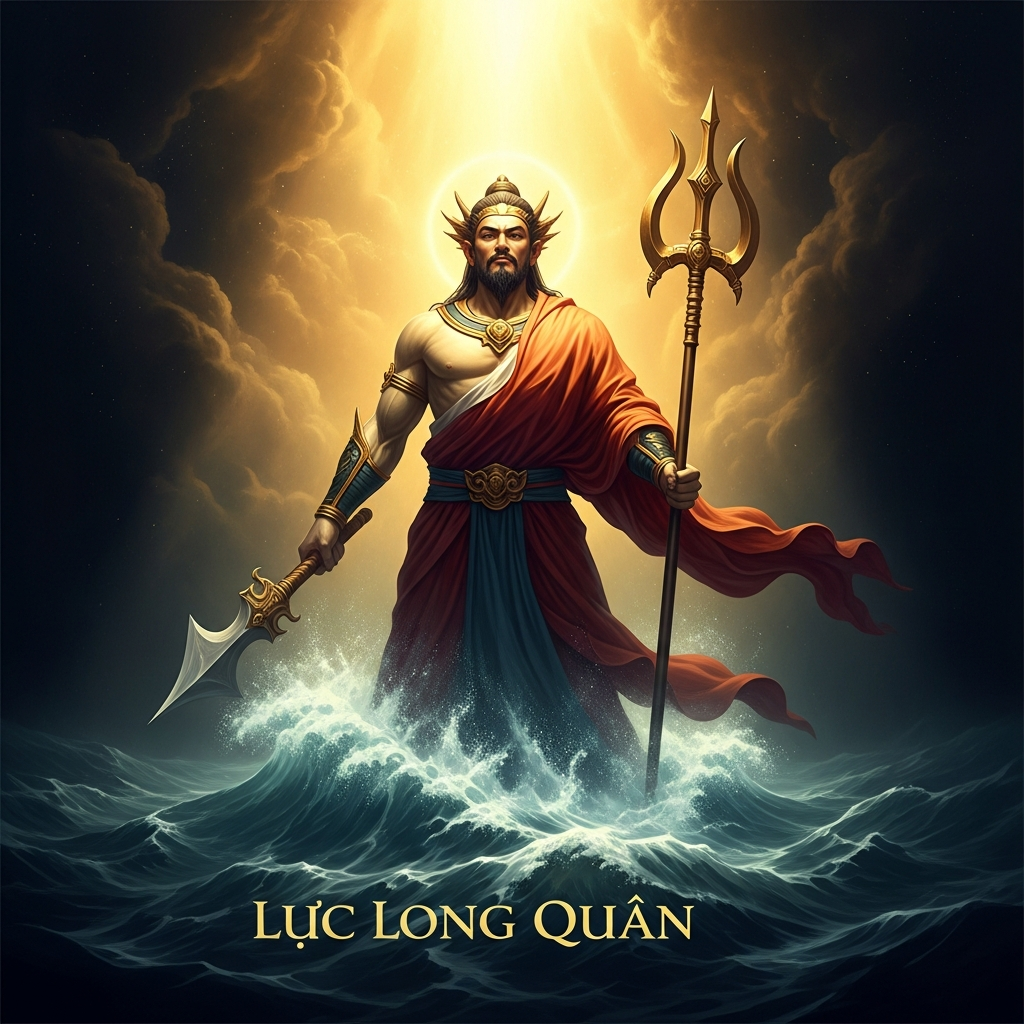
Lạc Long Quân lives where the rivers empty into the southern ocean. His father is Kinh Dương Vương, the first human king, whose own mother was a sea-goddess. His lineage runs deep into salt water, into the places where sunlight cannot reach, into the cold and dark and powerful domain of the dragons who govern the underwater world. He can breathe below the surface. He can speak to the river-spirits in their own tongue. He defeats the great fish-demon Ngư Tinh and the nine-tailed fox demon Hồ Tinh with the authority of one who belongs to the element they corrupted. The sea obeys him. The rivers know his name.
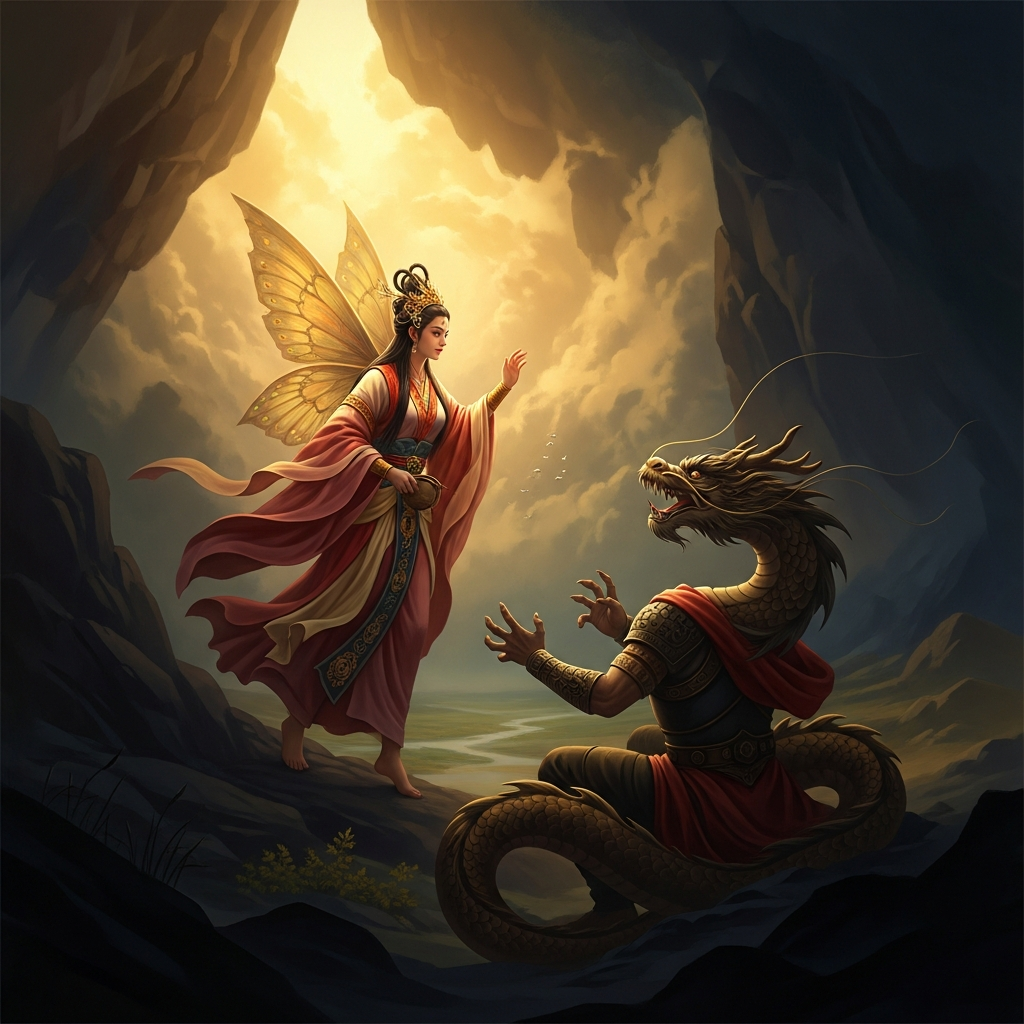
Âu Cơ comes from the north, from the highland country above the mist-line, from the domain of the Immortals who govern the mountain peaks. Her father is Đế Lai, a northern spirit-lord of great power. She is what her lineage makes her: a creature of altitude, of thin cold air, of the forest silence that lives above the clouds. When she descends to the low country of the Lac, she is descending into a world that is not quite hers.
She is beautiful in the way that mountain spirits are beautiful — with a clarity and a stillness that does not belong to the warm, brackish, fecund south.
They find each other in the lowlands between their two domains.
The chronicles do not explain what either of them is doing there. The Dragon Lord is perhaps patrolling his territory after driving out the demons. The Mountain Fairy is perhaps exploring the country her father rules. They meet somewhere in the Red River Delta, in the country that is neither quite sea nor quite mountain — the alluvial plain between the two, built from silt the rivers carried down from the high country and deposited here, at the edge of the sea, over thousands of years.
The land itself is a marriage of north and south. The land itself is already the thing they will become.
They marry. This is also not explained. The chronicles record it as a simple fact, because it is the kind of marriage that was always going to happen — water meets land, dragon meets fairy, south meets north, and the result is the world. Âu Cơ bears the dragon-lord a hundred children.
She does not give birth to a hundred children. She gives birth to a sac.
One hundred eggs.
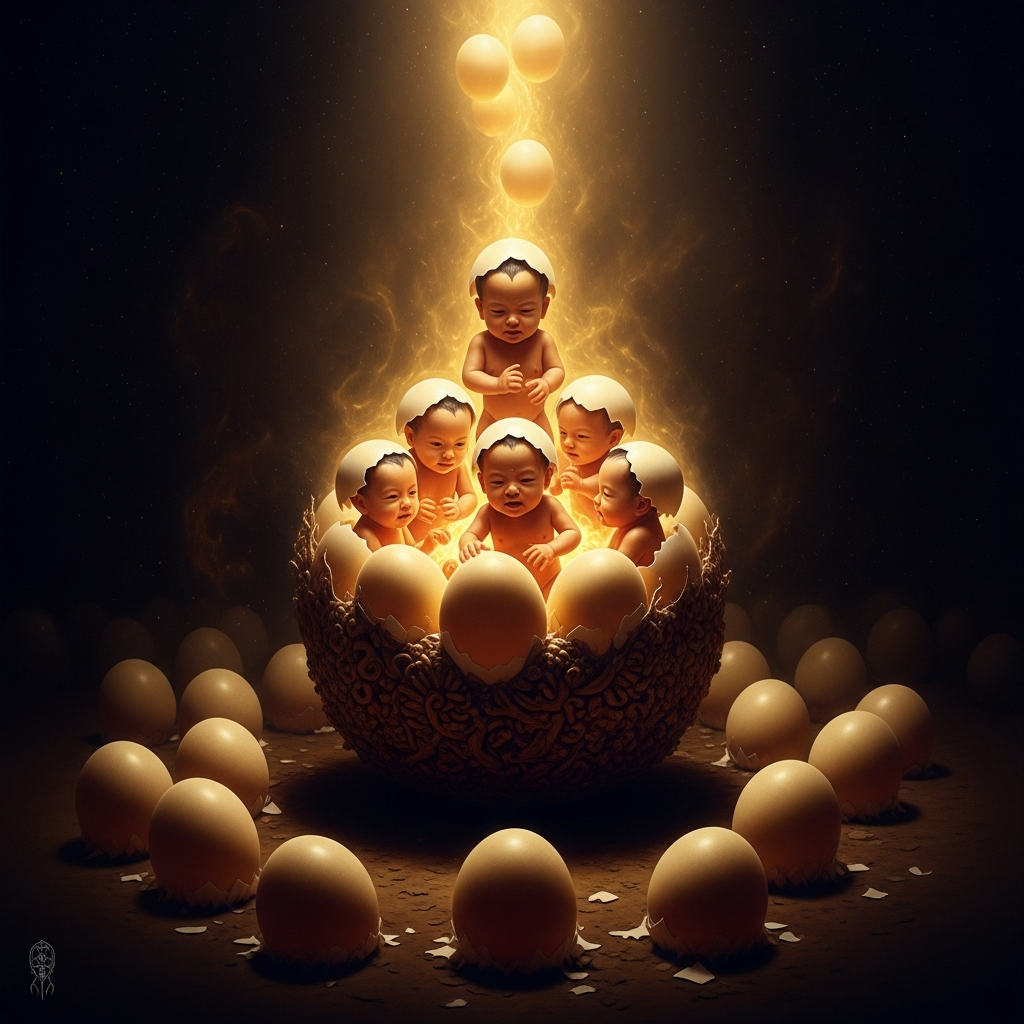
The texts describe it precisely: a single sac, smooth and round, from which one hundred eggs emerge, and from the eggs one hundred sons hatch, all at once, already strong, already beautiful, already the people they will become. They do not need to be nursed. They do not need to be named one by one. They arrive as a plurality — not a family but a people, not a lineage but a nation, already in the world and already many.
The household of the Dragon Lord and the Mountain Fairy grows overnight from three to a hundred and three.
They raise the sons on the alluvial plain. For a time — the chronicles do not say how long, because mythic time does not work in years — the household holds. Sea-lord and mountain-fairy and a hundred young men live together in the low country between their two domains. The plain sustains them. The sea provides fish; the mountains provide game; the delta provides rice. The world between the two extremes is, for this brief moment, enough.
But Lạc Long Quân is not a creature of the delta. He is a creature of the deep. He is pulled back toward the ocean with a longing that is not weakness or failure but nature — the way the tide returns not because something is wrong with it but because it is a tide.
And Âu Cơ is a creature of altitude. The lowland air is too warm for her, too thick, too close to sea-level. She begins to dream of the mountain country she came from.
They meet for the last time on the alluvial plain, with their hundred sons arrayed around them.
The Dragon Lord speaks first. He does not apologize for what he is. He does not pretend the marriage can continue. He says, with the clarity that belongs to beings who know their own nature: I am a creature of the sea. You are a creature of the mountain. We cannot inhabit the same place forever. This is not a failure — it is what we are.
Âu Cơ does not dispute it.
They divide their children there on the plain. Fifty sons go with the Dragon Lord to the coast, to the sea, to the southern lowlands. They will become the fishermen and sailors and coastal peoples of the south. Fifty sons go with Âu Cơ to the mountains, to the north, to the high country above the mist-line. They will become the highland peoples, the farmers of the mountain terraces, the guardians of the passes.
The eldest son who goes with Âu Cơ to the mountains becomes Hùng Vương — the first of the Hùng kings, the founding dynasty of the Vietnamese people, the monarchs who will reign for eighteen generations before their kingdom is absorbed by the expanding south.
The Dragon Lord returns to the sea. He does not disappear. He remains available. The chronicles record that he can be called on in times of need — that when Vietnam is threatened, the Dragon Lord of the Lac can be summoned from the southern ocean by those who know the proper forms. He never fully leaves. He is merely where he belongs.
This is the creation myth that Vietnamese children learn first: not a fall, not a punishment, not a sin that separates the first parents. A separation that was always coming, that was written into the nature of the two beings who married, that produces not tragedy but multiplicity.
The hundred sons are the point.
The Dragon Lord and the Mountain Fairy could not have stayed together. They were too different, too elemental, too fully themselves. But the hundred sons they produced carry both lineages. Every Vietnamese person is descended from both the sea and the mountain, from both the dragon and the fairy, from both the south and the north. The divide is not a wound. It is the founding fact. Vietnam is a country that has always been divided between coast and highland, between lowland wet-rice civilization and mountain peoples, between the pull of the southern ocean and the pull of the northern highlands.
The myth says: this is not a problem to be solved. It is an origin to be inhabited.
Âu Cơ goes up to her mountains. Lạc Long Quân goes down to his sea. Between them, the hundred sons build the country.
The Hùng kings reign for eighteen generations.
The chronicles give them a span of approximately two thousand years, which is mythic arithmetic — the kind that expresses duration as importance rather than counting actual years. They rule from Phong Châu, in the foothills above the Red River Delta, in the country that is neither quite mountain nor quite lowland. They are, in their placement, exactly what their ancestry requires: neither sea nor summit, but the middle country between.
Their festivals honor both lineages. The mountain offerings go to Âu Cơ. The river offerings go to Lạc Long Quân. Vietnamese religious practice, from the earliest period to the present, maintains both cults simultaneously — the mountain-goddess tradition and the dragon-and-water tradition — because the people who practice them understand themselves as descended from both.
The Dragon Boat Festival on the rivers. The mountain pilgrimage to Đền Hùng. The same people, doing both.
The Đền Hùng temple complex in Phú Thọ province is where Vietnamese people go now to honor the founding myth.
It sits on a mountain — of course — overlooking the Red River Delta below. The highest temple is dedicated to the sky. The middle temples honor the Hùng kings. At the base, near the water, the offerings go to the dragon lineage. The pilgrim moves between domains, up and down the same mountain, in a single day’s journey.
Every year, on the tenth day of the third lunar month, the Hùng King Festival draws hundreds of thousands of visitors. They come from the coast and from the highlands. They come from the cities of the south and the highland villages of the north. They come because the myth that made them is not a myth they have set aside — it is a myth they are still living, in the way that origin stories that are true remain alive in the people who embody them.
Lạc Long Quân is still in the sea. Âu Cơ is still in the mountain. Between them, the hundred sons are still building the country.
The Dragon Lord and the Mountain Fairy did not fail each other. They completed their marriage by separating — by going back to the elements they came from and leaving their children in the middle country that was neither element fully. This is the Vietnamese theological claim about origins: you come from opposites. The tension is not a problem. It is the engine.
Every monsoon, the sea pushes water up the river mouths. Every dry season, the mountains pull the rivers down. The delta is made from this argument, deposited year by year, grain of silt by grain of silt, at the place where the two forces meet and refuse to fully resolve. The people who live there are made from the same argument.
Lạc Long Quân calls from the south. Âu Cơ calls from the north. Vietnam answers both.
Scenes
Lạc Long Quân rises from the southern ocean — the Dragon Lord of the Lac, son of Kinh Dương Vương and the sea-goddess Long Nữ
 Generating art…
 Âu Cơ descends from the northern highlands — a fairy of the immortal mountain lineages, daughter of the god Đế Lai, her nature bound to altitude and forest and the cold air above the treeline
 Generating art…
 The sac of one hundred eggs, and from it one hundred sons
 Generating art…
 Echoes Across Traditions
Entities
- Lạc Long Quân
- Âu Cơ
- Kinh Dương Vương
- Hùng Vương
Sources
- Lĩnh Nam Chích Quái (Wonders Plucked from the Dust of Lĩnh Nam), compiled 13th–15th centuries CE — the primary Vietnamese mythological anthology
- Keith Weller Taylor, *The Birth of Vietnam* (University of California Press, 1983)
- Huynh Sanh Thong (ed.), *An Anthology of Vietnamese Poems* (Yale, 1996)
- Ngo Duc Thinh, *Mother Goddess Religion in Vietnam* (2012)
- Nguyen Ngoc Huy, *The Le Code: Law in Traditional Vietnam* (Ohio University Press, 1987)