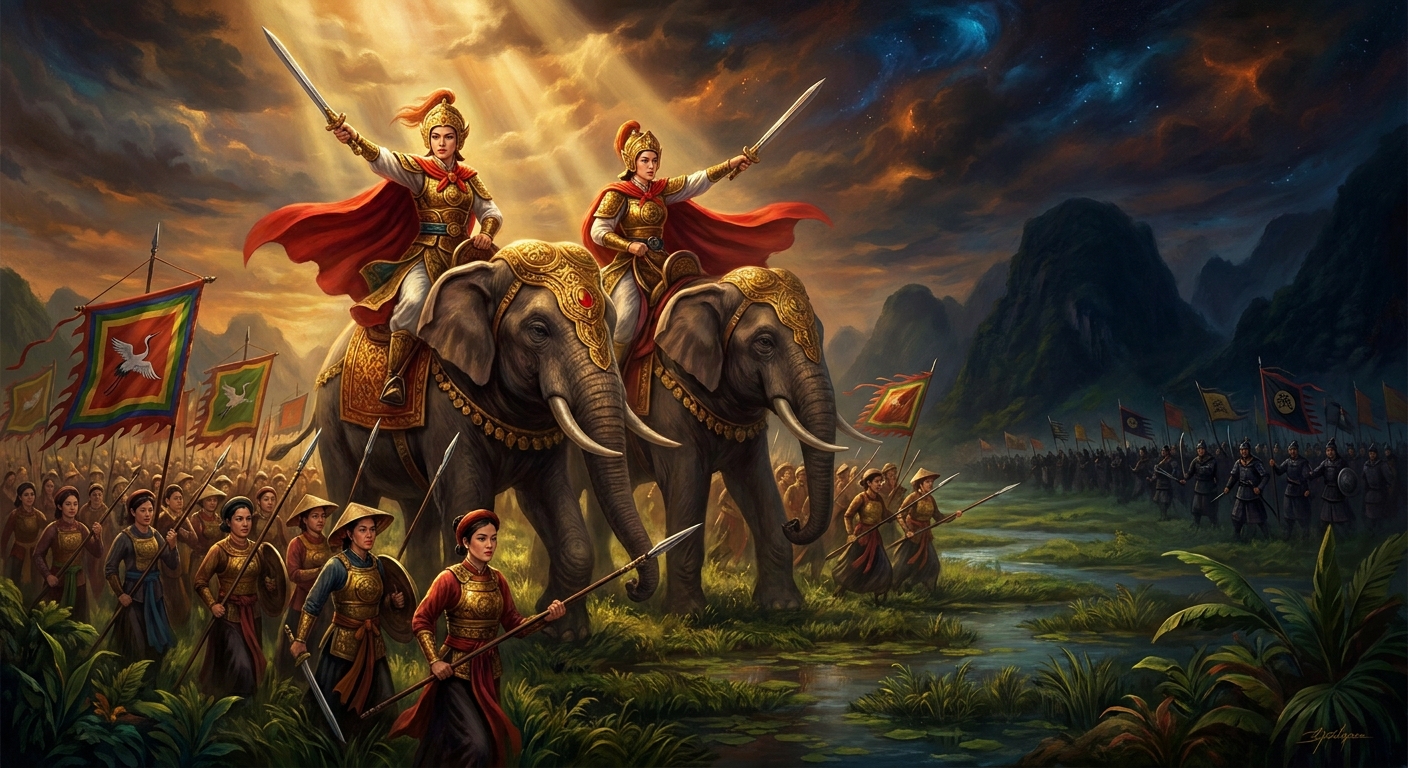
Sơn Tinh and Thủy Tinh: The War That Never Ends
Mythic time — reign of Hùng Vương the eighteenth · The Red River Delta and the mountains of Tản Viên — the territory of the Hùng kingdom
Contents
Two gods court the same princess. One arrives at dawn; one arrives at noon. The man who arrives at noon has been losing the same war ever since — driving his floods up the mountain every year, every monsoon season, for five thousand years. The Mountain Spirit always raises the ground higher. The story is why Vietnamese rivers flood.
- When
- Mythic time — reign of Hùng Vương the eighteenth
- Where
- The Red River Delta and the mountains of Tản Viên — the territory of the Hùng kingdom
The king has a daughter.
Her name is Mị Nương, and she is the daughter of Hùng Vương the eighteenth — the last and greatest of the Hùng kings, who rules the Văn Lang kingdom from Phong Châu, in the foothills above the Red River Delta. She is not merely beautiful in the way that chronicles record beauty. She is beautiful in the way that causes gods to alter their behavior. She is beautiful enough that two spirits come down from their respective domains to ask for her, and their competition reshapes the hydrology of a country.
Her father knows this is coming. He is a king who understands that when two divine suitors appear, the decision cannot be made by preference — it must be made by rule.
He sets the bride price.
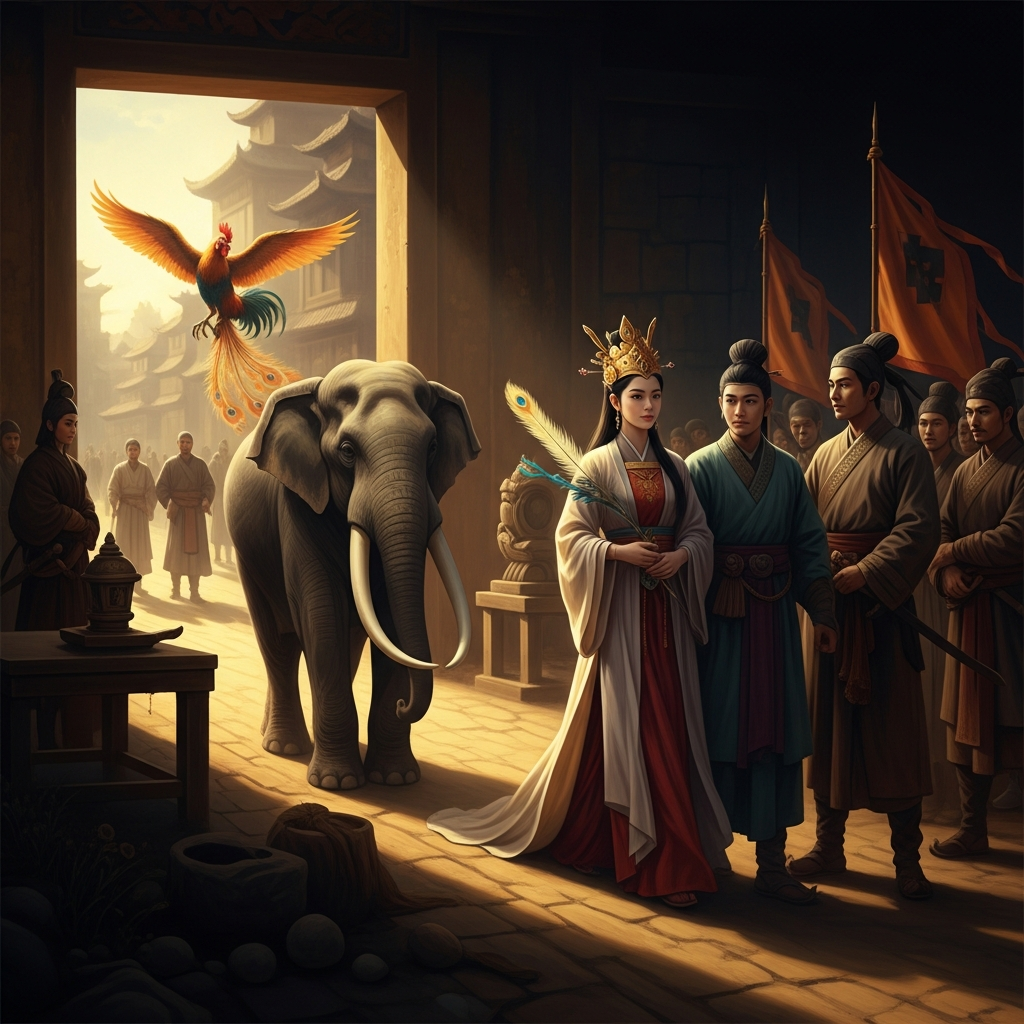
The gifts required are specific: elephant tusks, a nine-spur rooster, a phoenix feather, and rice cooked in a sealed bamboo tube — mountain gifts, forest gifts, the produce of altitude. Whoever arrives first with these gifts in hand wins the princess.
Sơn Tinh hears this list and smiles.
He is the Mountain Spirit, the lord of Tản Viên — the three-peaked mountain that rises above the Red River plain near where Hanoi will eventually be built. He governs the forest and the highland passes. Elephant tusks come from his domain. Phoenix feathers come from his domain. The nine-spur rooster is a highland breed his people have kept for generations.
He assembles the gifts that night.
He leaves for the palace at midnight.
He arrives at dawn, with his wedding retinue behind him and the bride-price gifts carried on platforms by his servants, and Hùng Vương comes out to meet him and the bargain is struck and Mị Nương comes out to meet her husband and the wedding is already beginning before the morning mist has fully cleared from the valley.
At noon, Thủy Tinh arrives.
He has the gifts.
This is the part that matters: Thủy Tinh is not late because he was careless, or because he did not try, or because he did not love the princess as fiercely as the Mountain Spirit loved her. He is late because he is the Water Spirit, the lord of the sea and the rivers, and the gifts the king required were mountain gifts that took time to source from beyond his domain. He gathered them. He came. He arrived at noon.
He arrives to find the wedding already begun.
Vietnamese tradition is careful about what happens next: Thủy Tinh does not rage at Hùng Vương. He does not dispute the terms — he set out to meet them and he failed to meet them in time, and a deal is a deal. He does not threaten the king. He looks at the man who has just married Mị Nương and decides that the mountain will pay.
That is when the war begins.
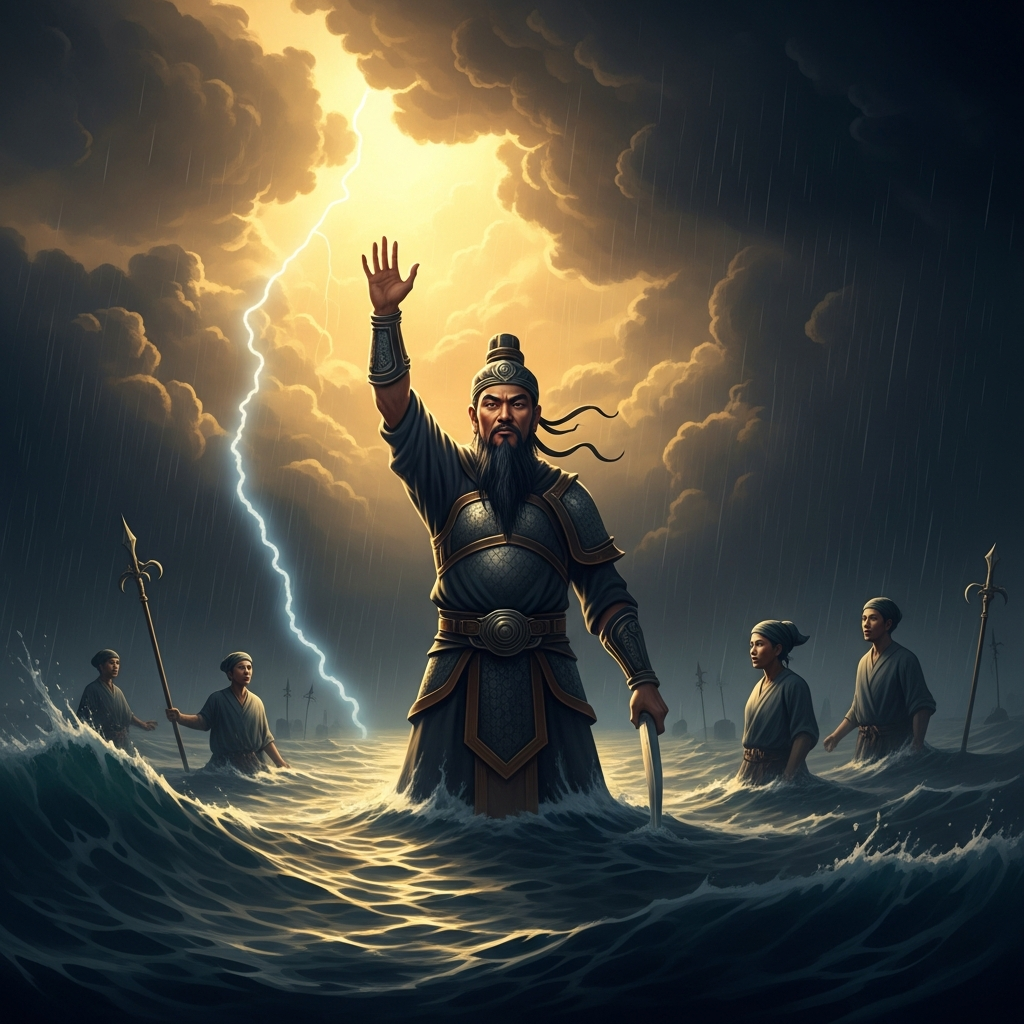
He sends the floods.
He calls the rain from the sky. He drives the rivers over their banks. He pushes the sea north up the river mouths. The water rises through the valley floors, through the rice paddies, through the villages, up the foothills toward the mountain where Sơn Tinh has taken his wife.
Sơn Tinh raises the mountain.
Each time the water rises, the mountain rises faster. Mị Nương is always above the flood line. This is the marriage in practice: she lives on a peak that is always ascending, because the man she married will not let the water reach her. Thủy Tinh drives his floods higher. Sơn Tinh lifts the ground higher. The mountain grows.
After some months — the chronicles do not specify how long, because the rhythm of this war is seasonal rather than narrative — the rains stop. The rivers fall back to their channels. The sea retreats to its proper shore. Thủy Tinh withdraws, exhausted, back to his underwater domain.
He waits.
The next monsoon season, he comes again.
This is the theological claim the story makes: not that the war ended, but that it repeats. Every year without exception. Every monsoon season, from the mythic time of the Hùng kings to the present, Thủy Tinh sends his floods up the valleys of the Red River Delta and Sơn Tinh lifts his mountain to keep his wife dry. The floods are not random. They are the annual expression of an ancient loss, renewed each year because the loss is annual — it happened at noon, and noon comes every day, and every monsoon season brings it back.
The Vietnamese farmer watching the river rise in September is not watching an impersonal weather event. They are watching a god who cannot accept what happened to him at noon on a specific day during the reign of Hùng Vương the eighteenth.
The river rises because Thủy Tinh is still angry.
The mountain holds because Sơn Tinh is still in love.
Tản Viên is the first of the Four Sacred Mountains of Vietnam.
It sits above the Red River plain at the edge of what is now Ba Vì National Park, visible from the outskirts of modern Hanoi on clear days. Its three peaks — Tản Viên, Ngọc Hoa, Út Rồng — are all named in the mythological tradition. The temples on its slopes are among the oldest continuously maintained religious sites in Vietnam. Pilgrims go there to honor Sơn Tinh, who is also called Tản Viên Sơn Thánh — the Holy Mountain Spirit of Tản Viên — and is considered one of the Tứ Bất Tử, the Four Immortals who protect the Vietnamese nation.
The temple at Đền Và, in the town of Sơn Tây at the mountain’s base, has been rebuilt dozens of times over two thousand years and is still there. The offerings are mountain offerings: fruits and grains that come from altitude, the things Sơn Tinh would recognize as proper tribute. The priests perform the rituals on the same calendar the Hùng kingdom followed, because the spirit they are honoring has not changed in character even as the country around him has changed in every other way.
Thủy Tinh has no temples.
This is notable. The Water Spirit, who drives the floods, who shapes the entire agricultural calendar of the Red River civilization, who determines whether the harvest survives or drowns — he has no temples. He receives no proper worship. He is propitiated at the river’s edge with offerings meant to appease rather than honor. He is the god of the annual catastrophe. He is the reason the dikes must be maintained and the flood channels kept clear and the rice planted in windows of time calculated against his anger.
You do not worship a god like that. You manage him.
The dike system of the Red River Delta is one of the longest continuously maintained hydraulic engineering projects in human history.
It began, by Vietnamese historical accounting, in the early centuries of the common era, when the Han Chinese administrators of Jiaozhi started organizing the local labor to channel and contain the river. It has been extended, rebuilt, and maintained by every Vietnamese government since — through the Ngô, the Đinh, the Lý, the Trần, the Lê, through the French colonial period, through the wars, through reunification. The dikes are now hundreds of miles long and have been maintained for nearly two thousand years without interruption.
This is Thủy Tinh’s gift, though he did not intend it as one.
The annual flood threat organized Vietnamese civilization around a single collective project. The dike cannot be private. The water does not respect individual property lines. Every family upstream affects every family downstream. The Red River Delta developed cooperative water management, village-level labor coordination, and hierarchical flood-control bureaucracy because Thủy Tinh drives his floods every year and the mountain cannot always be raised fast enough.
The god of the annual catastrophe produced the social infrastructure that made the civilization possible.
In September and October, the Red River runs red with highland silt, faster and higher than at any other time of year. Hanoi’s flood barriers go up. The farmers in the delta watch the sky and calculate.
They know the name of what is happening. They have always known it. The flood is not an emergency; it is a season. It is Thủy Tinh, who arrived at noon and has been paying the price for it ever since — who cannot stop trying, because trying is what love does when it has been refused, and because the Mountain Spirit who defeated him is still up there, still raising the ground, still keeping the princess above the water line.
Sơn Tinh lifts the mountain.
Thủy Tinh drives the flood.
The country is built in the space between them.
Thủy Tinh arrived at noon. The Mountain Spirit arrived at dawn. The margin was six hours, and the world has been arranged by it ever since. The floods are not wrong. The mountain is not wrong. The king set the terms and the terms were met in the order they were met, and this is the world.
The woman at the center of it — Mị Nương, who was given to the first man who arrived — does not speak in the chronicle. She does not express a preference. She lives on the mountain that keeps rising beneath her feet, high above the water that rises every year trying to reach her.
She is, perhaps, the country itself: the people who live above the flood line because someone who loves them is always lifting the ground.
Scenes
Sơn Tinh arrives at the palace at dawn
 Generating art…
 Thủy Tinh sends his armies: storms, tides, rivers climbing their banks, the rain that does not stop
 Generating art…
 Sơn Tinh raises his mountain
 Generating art…
 Echoes Across Traditions
Entities
- Sơn Tinh
- Thủy Tinh
- Mị Nương
- Hùng Vương
Sources
- Lĩnh Nam Chích Quái (Wonders Plucked from the Dust of Lĩnh Nam), compiled 13th–15th centuries CE
- Trần Thế Pháp, *Lĩnh Nam Chích Quái* (original compilation c. 14th century, modern Vietnamese edition 1960)
- Keith Weller Taylor, *The Birth of Vietnam* (University of California Press, 1983)
- Philip Taylor, *Goddess on the Rise: Pilgrimage and Popular Religion in Vietnam* (University of Hawaii, 2004)
- Nguyen Tu Cuong, *Rethinking Vietnamese Buddhist History* (University of Hawaii, 1997)