Lady Meng Jiang Weeps Down the Wall
Qin dynasty setting, 221-206 BCE; tale circulating in written form from Han dynasty onward · The Great Wall of China, northern frontier
Contents
Lady Meng Jiang's husband Fan Xiliang is conscripted to build the Great Wall and dies there, his body sealed inside the stone. She walks to the Wall in winter to bring him warm clothing. She weeps at its base. Her grief causes eight hundred li of Wall to collapse. The bones of the dead come tumbling out. She finds her husband among them by tasting his blood.
- When
- Qin dynasty setting, 221-206 BCE; tale circulating in written form from Han dynasty onward
- Where
- The Great Wall of China, northern frontier
The story is told at the Cold Food Festival and at grave-sweeping time and at any occasion when the dead are brought forward into the company of the living. In its earliest written forms it appears in the Han dynasty, already old, already wearing the smooth edges that tales develop when they have been told many times in many places. The version that survives in opera — the Meng Jiang Nu operas performed across China from the Tang dynasty onward, with their percussion-heavy scores and their weeping soprano climax — uses the story’s ritual dimension explicitly: her grief is a power. It is not merely feeling. It is a force that acts on the world.
This is the first thing to understand about the tradition. Her weeping is not weakness. It is efficacious. It does something.
They marry in the spring.
Fan Xiliang is a scholar who has taken shelter in the garden of the Meng family while fleeing the labor gangs conscripting men for the construction of the northern wall — the great project of the First Emperor, Qin Shi Huang, who has unified China by conquest and is now spending that unified empire’s labor force on the Wall. Fan Xiliang hides in the garden. Meng Jiang finds him. In the logic of the folk tradition, a man who arrives in a woman’s garden by crossing a wall at night has already made a kind of declaration that requires a response.
They marry. The wedding is modest, which is the folk tradition’s way of signaling that what follows will not be modest at all.
Three days after the wedding, the conscription officers come.
In the Tang dynasty version of the story, Fan Xiliang is taken within a week of the marriage. In the Song dynasty version, they have a year together. In either case, the event is the same: the state arrives and takes him. He goes to the Wall. She stays.
She sews.
The act of sewing is not incidental to the story. In the Chinese literary tradition, the wife who sews for her absent husband is performing a ritual of fidelity — each stitch is an act of connection, a thread cast across distance. She sews warm clothing for the northern winter, because the northern frontier is cold and the Wall is higher than the tree line and men who work there in winter die of exposure as readily as they die of exhaustion. She sews with the particular attention of someone who knows that the thing she is making will have to substitute for her presence.
She finishes the clothing. She waits for word.
No word comes. The workers on the Wall do not send letters because they do not have the means to send letters, because they are laborers, not scholars, and the Wall does not pause for correspondence. She waits until waiting becomes unbearable, and then she does the thing the story requires: she goes.
The journey north is the story’s central movement, and the versions of the story spend time on it. She walks. She begs at farmhouses and monasteries. She crosses the Yellow River in winter and the passes in winter and the northern plain in winter. The landscape is the landscape of Chinese folk painting — bare trees, snow, the distant suggestion of mountains, the figure of the woman small against all of it.
She arrives at the Wall.
She does not know where on the Wall Fan Xiliang is assigned. The Wall is thousands of li long. She asks. The overseers look at the records. The records are the kind of records that state power keeps about the people it uses: catalog numbers, labor units, disposition. Fan Xiliang is in the records. He is also in the Wall.
He died. He died of the cold or the labor or the beatings, the way men died on the Wall, and he was sealed in. This is the specific horror at the center of the legend: the Wall was built with human bodies inside it, and this is not poetic license. The construction consumed men in such numbers that the traditional way of disposing of bodies was incorporation. There was not time or space to bury them separately. They went in.
She stands at the base of the Wall.
She weeps.
This is not a metaphor. The weeping is the event. She weeps for her husband, for the winter clothing she carried across the northern plain that will never be worn, for the marriage that lasted three days or a year depending on the version, for the man who hid in her garden and who she found there and who she let herself love knowing that the world was not organized for that kind of luck to continue.
The Wall responds.
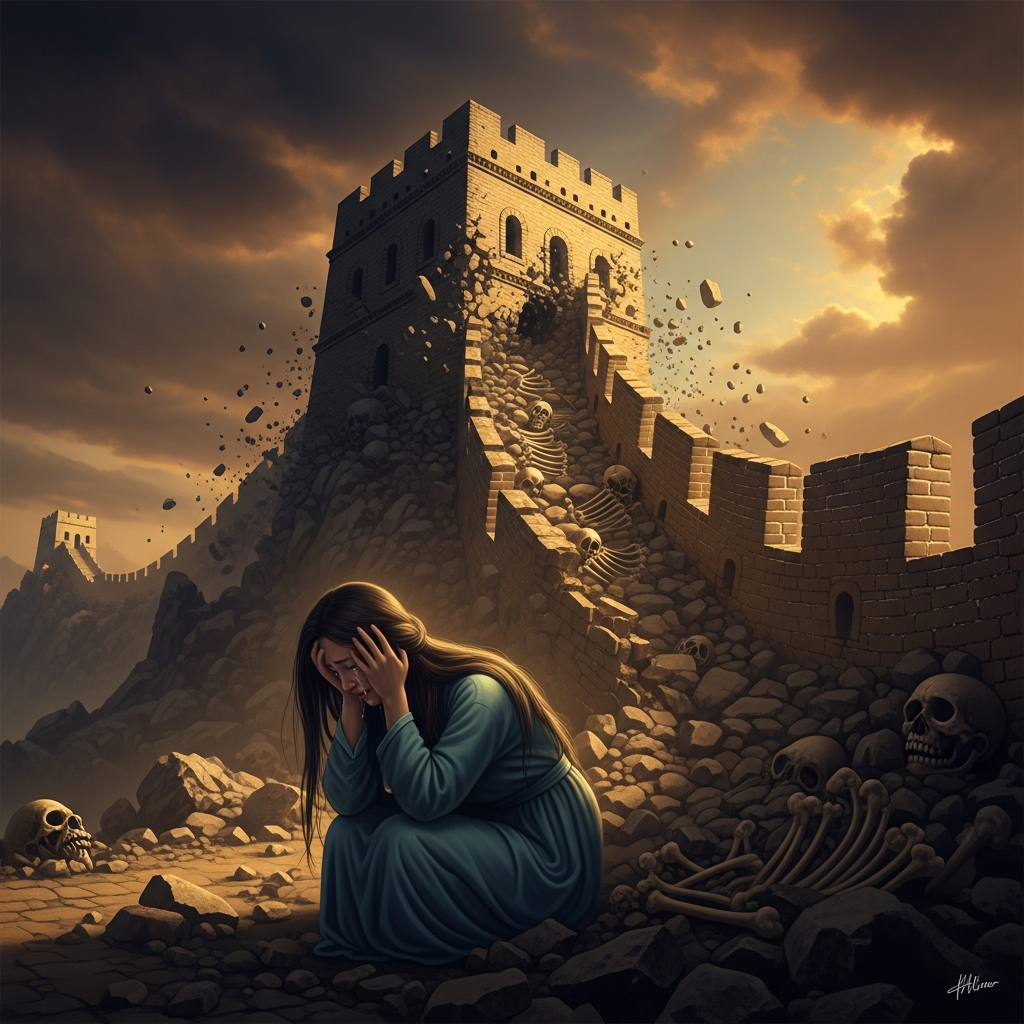
Eight hundred li of Wall — from the point where she stands to the point where something in the structure gives way — collapse. The stone comes down. The mortar releases. The sections topple one after another, slow at first and then faster, the collapse propagating along the Wall like a wave moving through water. The bones of the dead come tumbling out.
This is the part of the story that the opera makes spectacular and the folk tradition takes seriously. The Wall falls because her grief is real enough to move it. The tradition does not explain this in engineering terms because engineering is not the register the story is operating in. It operates in the register of yuan — grief-injustice, the accumulated weight of wrong done to the powerless, which in the Chinese cosmological imagination has physical consequences when it reaches a sufficient mass. The Wall is built on grief-injustice. Her grief activates it. The Wall comes down.
The bones are everywhere.
Hundreds of thousands of men died building the Wall. Hundreds of thousands of sets of bones are now scattered across the northern plain, and she must find her husband among them. This is the recognition scene, and every version of the tradition handles it differently.
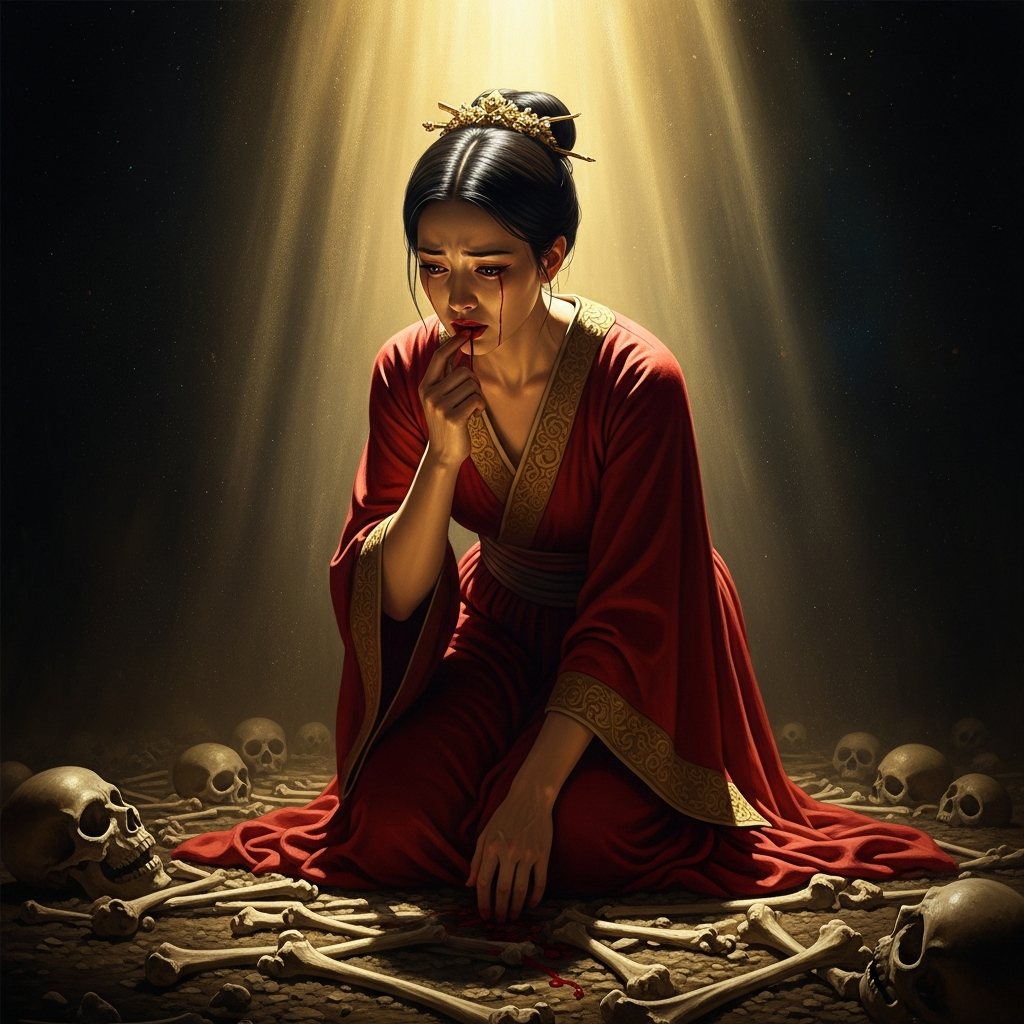
The most common version — the one that appears in the majority of oral traditions and in the opera cycle that codified the story during the Ming dynasty — has her use blood. She cuts her finger. She holds the blood over each set of bones. The bones of the man she is not looking for do not respond. The bones of Fan Xiliang drink her blood in — the blood seeps into the calcium, the color changes. She knows.
The act of recognition through blood is older than the story it appears in. It is a widespread folk method for identifying kin — the idea that blood calls to blood, that the bond of marriage or descent creates a specific resonance that can be read in contact. She tastes the bones with her own blood. She finds him.
She gathers the bones. She wraps them. She has carried warm clothing across the northern plain to give to him, and now she wraps his bones in it.
The Emperor hears about the collapse of the Wall.
Qin Shi Huang is not, in the folk tradition, a sympathetic figure. He is the embodiment of state power in its most absolute form — the man who burned the books, who buried the scholars, who unified China through the specific method of eliminating everyone who disagreed with the unification. He hears about a woman whose weeping collapsed eight hundred li of his Wall. He summons her.
The traditional versions diverge sharply here, and the divergence is revealing.
In the older versions — the ones that predate the Tang — she defies him and is killed, or she refuses to be consoled and kills herself over her husband’s bones. In the Tang and Song versions, the Emperor sees her and decides he wants to marry her, because she is beautiful in the specific way that grief produces beauty in the Chinese aesthetic tradition: hollowed out, luminous, past caring about ordinary consequences. She agrees to the marriage on three conditions. The conditions are ceremonial in their formulation but contain the essential demand: that Fan Xiliang be given a state burial with full honors, that mourning be observed for forty-nine days, and that the Emperor himself attend the ceremony.
He agrees. The burial happens. On the forty-ninth day, at the ceremony, she walks into the sea.
In the Ming and Qing versions, she jumps from a bridge over the sea and drowns. In some versions, she becomes a sea creature — a fish, a water deity, a spirit who hears the prayers of sailors. The sea swallows her and she is not destroyed but translated into something the sea produces.
The legend survives because it names something that official history does not name.
The Wall is a monument. Its monuments perspective is that it was built — that the Chinese civilization found the will and the organization to construct something visible from sufficient altitude. The legend’s perspective is that it was built by people who were taken from their homes and their new marriages and their winter gardens, and who died in the Wall, and whose bones were incorporated into the mortar, and whose wives walked north in the snow to find them.
Meng Jiang’s tears did not bring Fan Xiliang back. They brought his bones out. They made him findable. They turned an anonymous death in a state project into a grief that had a name and a location and a woman who could recognize him.
In China, when the Wall is spoken of with any honesty, her name is part of the conversation. She is built into it as surely as the bones she found. The Wall stands. Her grief is inside it.
The opera is still performed. The weeping soprano hits the note at the base of the Wall. The percussion section falls silent. The audience cries, not because they did not know this was coming, but because they always have.
Scenes
Lady Meng Jiang walking north through winter landscape toward the Great Wall, her arms full of winter clothing she has sewn for her husband
 Generating art…
 Lady Meng Jiang at the base of the Great Wall, weeping
 Generating art…
 Lady Meng Jiang kneeling among the scattered bones, pressing her finger to her lip — the act of recognition, tasting her own blood to mix it with the bones, reading her husband in the blood's response
 Generating art…
 Echoes Across Traditions
Entities
- Meng Jiang
- Fan Xiliang
- Qin Shi Huang
Sources
- Wolfram Eberhard, *Folktales of China* (University of Chicago Press, 1965)
- Anne Birrell, *Chinese Mythology: An Introduction* (Johns Hopkins University Press, 1993)
- Wilt L. Idema, *Meng Jiangnü Brings Down the Great Wall: Ten Versions of a Chinese Legend* (University of Washington Press, 2008)
- Donald Holzman, 'The Cold Food Festival in Early Medieval China,' *Harvard Journal of Asiatic Studies* 46.1 (1986)
- C.H. Brewitt-Taylor (trans.), *San Kuo, or Romance of the Three Kingdoms* (Kelly and Walsh, 1925)