Guan Yu Becomes a God
219 CE · Three Kingdoms Period · apotheosis cult developed through Tang, Song, Ming dynasties · Maicheng, Hubei Province · then every temple from Beijing to Singapore
Contents
Guan Yu, the Han dynasty general of the Three Kingdoms, is captured and beheaded in 219 CE — but his ghost refuses to leave because he died loyal, and loyalty in the Chinese cosmos is not a virtue but a force. Over a thousand years, he rises from local war god to the patron deity of soldiers, merchants, triads, and policemen simultaneously, a paradox the Chinese universe has no difficulty containing.
- When
- 219 CE · Three Kingdoms Period · apotheosis cult developed through Tang, Song, Ming dynasties
- Where
- Maicheng, Hubei Province · then every temple from Beijing to Singapore
He dies in the wrong direction.
This is what makes everything that follows impossible to stop. Guan Yu, Lord Guan, the Han Shou-ting Hou, commander of Jing Province, general of the left of the Shu Han forces loyal to Liu Bei of the Han restoration — he dies facing east, which is the direction of ambush, the direction from which Lu Meng’s Wu troops came by night while he was occupied besieging Fancheng. He dies trapped between two armies and betrayed by subordinates, and he dies still loyal, which in the Chinese cosmos is not a minor detail.
Loyalty is not an attitude in the Chinese universe. It is a force. The Han dynasty wrote it into the bones of civilization: zhong, loyalty to lord; xiao, filial piety to parents; yi, righteousness between brothers-in-arms. These are not suggestions. They are the load-bearing walls. A man who keeps them holds the world together. A man who breaks them contributes to disorder on a cosmic scale.
Guan Yu kept all three, perfectly, from the moment he swore brotherhood with Liu Bei and Zhang Fei in the peach garden until the morning Wu soldiers brought his head to Cao Cao in a lacquered box.
He kept them. And they killed him.
The head arrives at Cao Cao’s camp on the morning of the seventeenth day of the eleventh lunar month in 219 CE. Sun Quan of Wu has sent it as proof, as tribute, as an attempt to make Cao Cao responsible for the killing — if Cao Cao accepts the gift, the blame for the death of the great general travels with it. Cao Cao understands this immediately. He gives Guan Yu’s head a formal burial with a carved wooden body to replace the one Sun Quan kept, bestows him the posthumous title of Duke, and mourns in the precise, political manner of a man who respected the enemy he was trying to defeat.
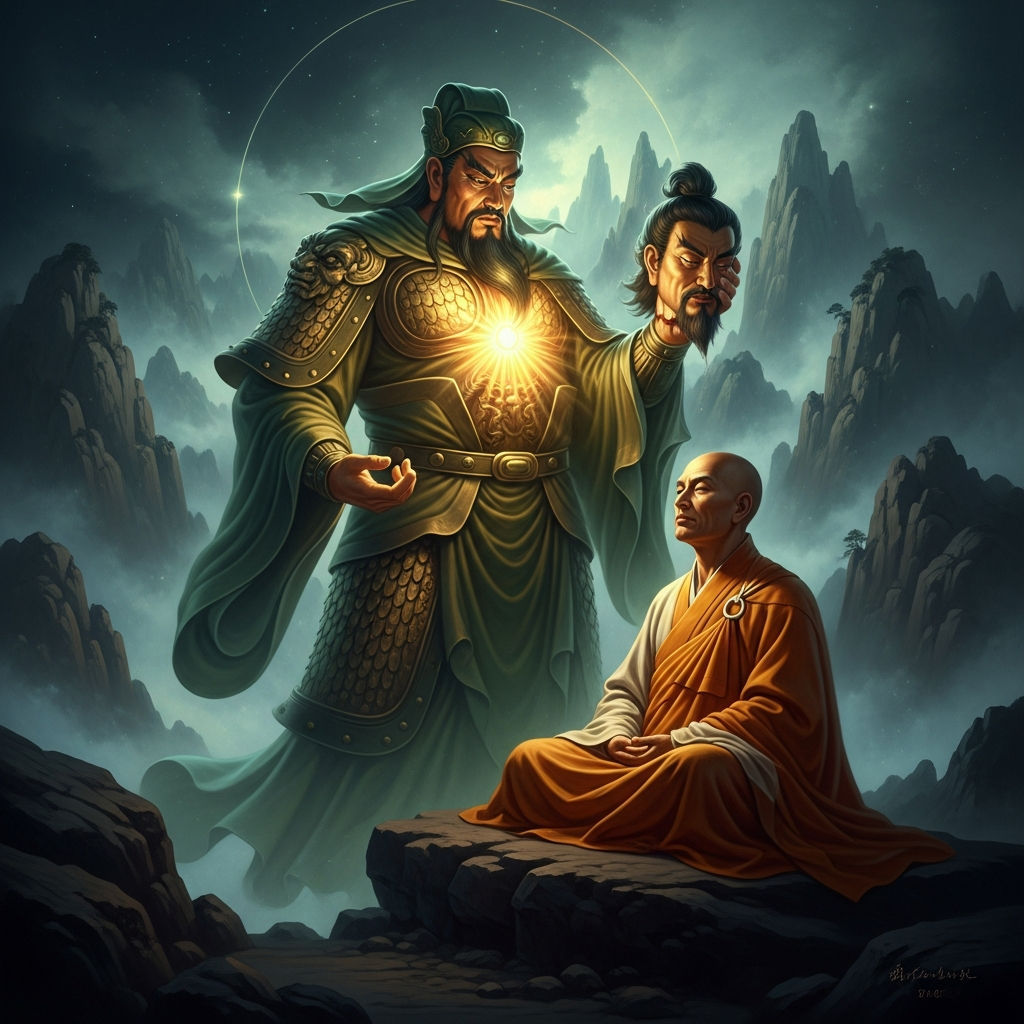
None of this is the point. The point is what happens forty-three miles north, at Yuquan Mountain in Dangyang County, where a Buddhist monk named Pujing is sitting in meditation in a stone hut when the fog comes.
It is not natural fog. The monk knows this because the fog carries sound — a voice, low and close, asking a question it already knows the answer to: Where is my head? Return my head.
Pujing, who has been a monk long enough to know that ghosts which demand explanations are ghosts that need them, asks the ghost to consider the dead it has killed, the heads it has taken on the battlefield. The ghost is silent for a moment. Then the monk hears it — recognition, or something like it. The ghost of Guan Yu receives the teaching. He is pacified. He is not gone.
He is, from this moment forward, available.
The cult does not spread quickly. It spreads correctly, which is a different thing entirely.
In the Tang dynasty, the ghost of Guan Yu appears to soldiers before battles. The Tang emperor Xuanzong encounters him in a vision and is grateful enough to grant him the title Faithful and Loyal King — the first imperial recognition that turns a local war ghost into a state deity. The bureaucratization of the Chinese afterlife means that state recognition is theological promotion: when the emperor names you, the Jade Emperor files the paperwork.
In the Song dynasty, he rises further. The Song are at war with the Jurchen Jin, and soldiers who need a patron god of warfare pray to the red-faced general. He appears in visions, his Green Dragon Crescent Blade Yanluo’s length from the ground, and where he appears, things go slightly better, or at least the survivors say so. He receives the title Martial Prince, then Martial King, then — under the Taoist Emperor Huizong — he ascends to the rank of the highest divine nobility.
In the Ming dynasty, the process completes. Guan Yu becomes Emperor Guan — Guan Di — a full deity of the first rank, a god of cosmic importance, his temples built in every city, his image placed in government halls as a protector of justice, his red face made vivid and permanent with lacquer that does not fade.
He sits in ten thousand temples by the time the Qing dynasty ends.
What is peculiar — what the western observers who come in the nineteenth century find bewildering and worth noting in their reports — is who is praying to him.
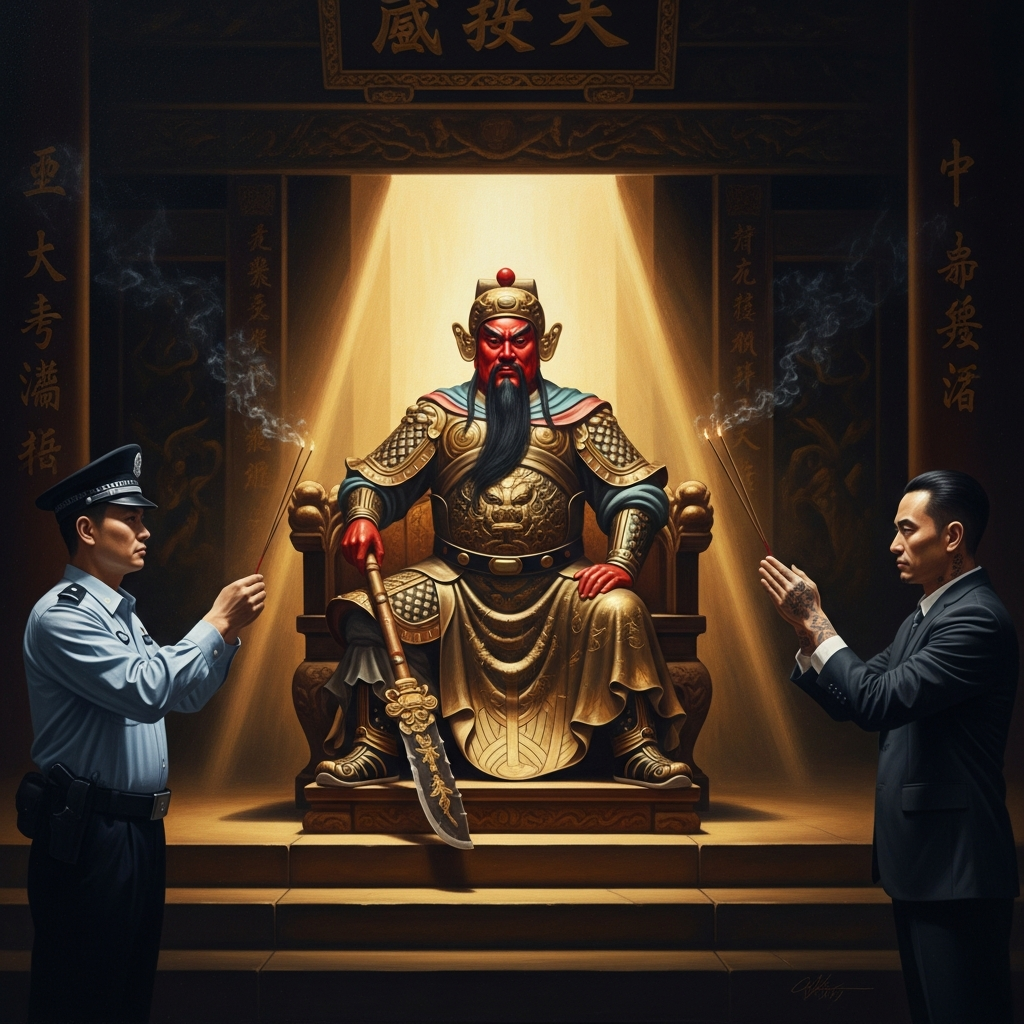
In the morning, before the incense from the previous evening has finished burning, a police constable enters the temple in Chaozhou and kneels before the great warrior god. He prays for help in catching criminals, for courage in dangerous moments, for the strength to remain incorruptible in a job full of inducements to be otherwise. He leaves an orange on the altar.
An hour later, a man whose face the constable would have recognized from a wanted notice kneels in the same spot. He prays to Guan Yu for brotherhood among his gang, for loyalty that will not break under pressure or profit, for the protection of his territory and the courage to defend it. He has been a triad member for eleven years and Guan Yu has been his patron deity for all eleven of them.
They do not meet. They have both prayed to the same god in the same temple on the same morning, and neither considers this contradictory.
The scholars who catalogue this phenomenon call it “the paradox of Guan Yu.” They mean the logical strangeness of a god worshipped by law enforcement and organized crime with equal sincerity. But the paradox dissolves the moment you understand what Guan Yu is actually the god of.
He is not the god of justice. He is not the god of law. He is the god of loyalty — of the commitment that holds between people who have sworn to one another, regardless of what they have sworn to do. The policeman’s loyalty to his superiors, his city, his code — real. The triad member’s loyalty to his brothers, his oaths, his organization — equally real. Guan Yu governs the quality of the commitment, not the content of the cause.
This is a theology the Chinese universe can hold without difficulty. The cosmos does not ask what you are loyal to. It asks whether you are loyal.
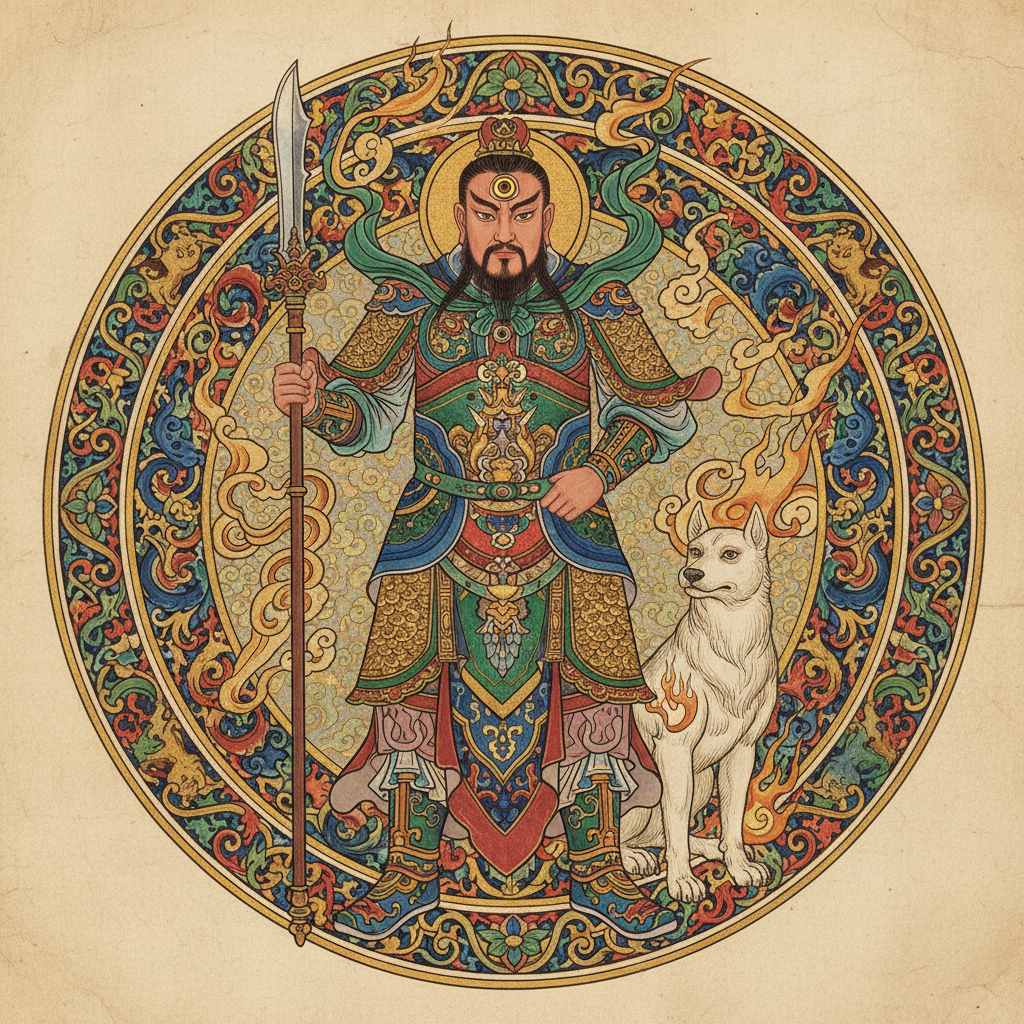
His iconography is specific and has not changed in a thousand years.
The face: red as a late sunset, as war banners, as the inner face of a pomegranate. Not the red of blood — that is a simpler color. The red of conviction held under pressure until it becomes a kind of light. He wears this face the way an emperor wears a crown: not as decoration but as evidence of what he is.
The beard: three feet of black silk, flowing in a wind that is never specified but never absent. He strokes it when he is reading, when he is thinking, when he is deciding something that needs to be right. Romance of the Three Kingdoms gives him this habit in a hundred scenes, and it has attached to every statue ever carved in his image.
The weapon: Green Dragon Crescent Blade, eighty-two jin of glaive-blade on a long haft, the color of old copper in dim temple light. He holds it upright beside him, not raised, not threatening — present, the way a principle is present, there if it is needed.
The book: in many temples he holds the Spring and Autumn Annals in his left hand, the text traditionally attributed to Confucius. He was said to have read it obsessively during the campaigns, holding it by torchlight in the tent the night before a battle. A god of war who reads moral philosophy is either a contradiction or a summary of what the Chinese tradition has always believed — that the highest form of strength is the strength to remain ethical when everything is burning.
He sits in temples from Beijing to Singapore, from Fujian to Tokyo, from Guangdong to San Francisco. Cops and criminals and merchants and soldiers file through. They light incense. They bow.
He is the same god to all of them, which says something about loyalty that is truer and stranger than anything his worshippers have managed to say about it explicitly.
The Chinese popular tradition produces gods from the material of history more readily than any other religious tradition in the world. It does this because it understands something that the theological traditions argue about: that what a human being does with their life is not erased at death. It accumulates. It spreads. It becomes a kind of force that other people can reach toward.
Guan Yu did not do anything miraculous. He was a general who kept his word in a political environment where word-keeping was the single most costly decision a man could make. He was loyal to a failing cause, loyal to a sworn brother who never held as much territory as he hoped, loyal to an ideal of the Han dynasty that was already two generations past saving when he died for it.
The ghost at Yuquan Mountain was not asking for revenge. It was asking to be recognized — for what it had done with its life to be acknowledged, recorded, not dissolved into the forgetting that claims everyone. The monks recognized it. The temples recognized it. The ten thousand worshippers recognize it every morning when they light incense in front of the red face and the upright blade.
You kept your word. We remember.
Scenes
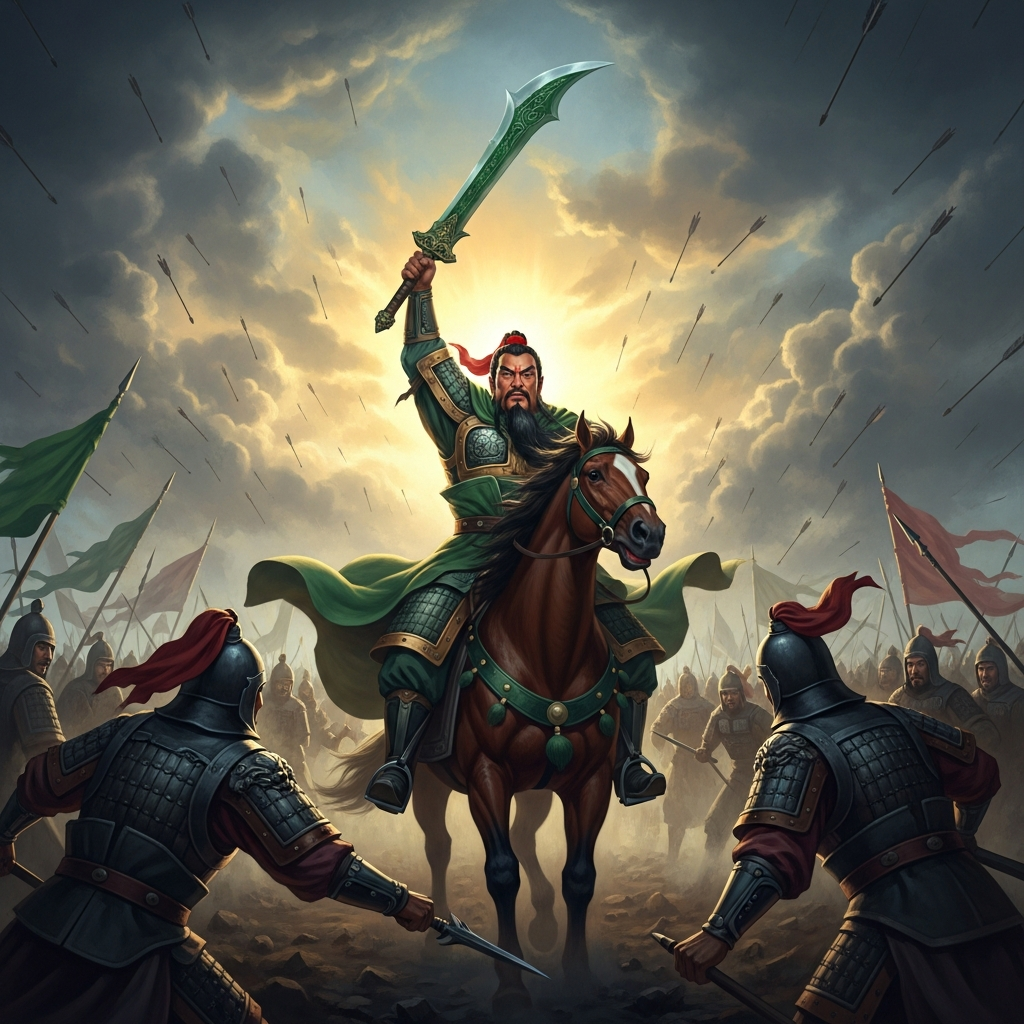
Guan Yu makes his final stand at the Battle of Fancheng, his green dragon crescent blade raised against a sky full of Wu arrows, his red face a lantern in the smoke
 Generating art…
 The ghost of Guan Yu appears to a Buddhist monk at Yuquan Mountain, his severed head asking not for revenge but for the return of what was taken: his name
 Generating art…
 In a temple in Fujian, Guan Yu sits enthroned in full armor, his face lacquered red as fresh blood, receiving incense from a policeman and a triad member who have not noticed each other
 Generating art…
 Echoes Across Traditions
Entities
- Guan Yu
- Liu Bei
- Cao Cao
- Jade Emperor
Sources
- Luo Guanzhong, *Romance of the Three Kingdoms* (trans. Moss Roberts, University of California Press, 1991)
- Prasenjit Duara, 'Superscribing Symbols: The Myth of Guandi, Chinese God of War,' *Journal of Asian Studies* 47:4 (1988)
- Barend ter Haar, *Guan Yu: The Religious Afterlife of a Failed Hero* (Oxford University Press, 2017)
- Meir Shahar and Robert P. Weller, eds., *Unruly Gods: Divinity and Society in China* (University of Hawaii Press, 1996)