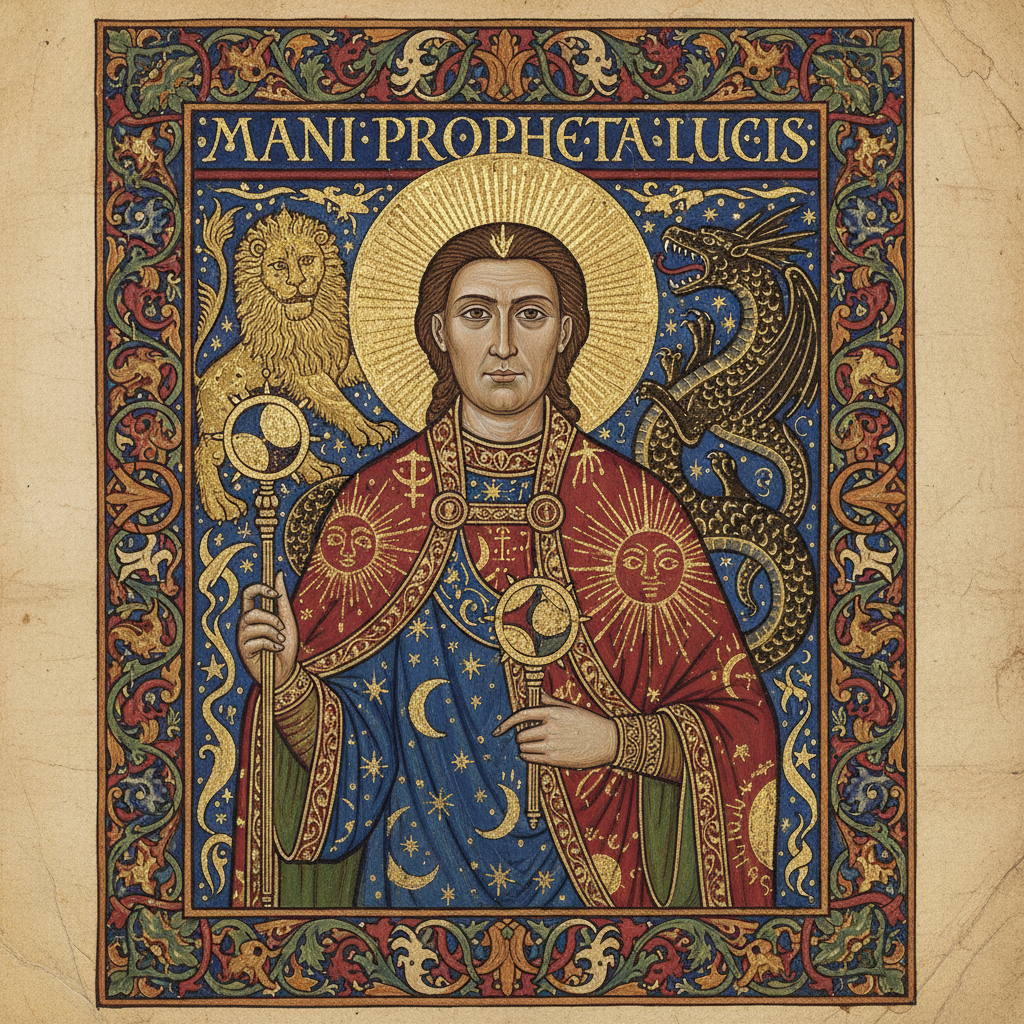
The Twin Appears to Mani
228 CE (first vision) · 240 CE (second vision and mission) · 274 CE (crucifixion) · Seleukia-Ktesiphon, Babylonia (modern Iraq) · then India, Persia, the Roman Empire
Contents
At twelve years old, Mani of Babylon receives a visitation from an angel he calls the Twin — his divine counterpart — who tells him he is the Paraclete, the final prophet. He spends the next sixty years building a religion of light and darkness that will outlast its own destruction by five hundred years.
- When
- 228 CE (first vision) · 240 CE (second vision and mission) · 274 CE (crucifixion)
- Where
- Seleukia-Ktesiphon, Babylonia (modern Iraq) · then India, Persia, the Roman Empire
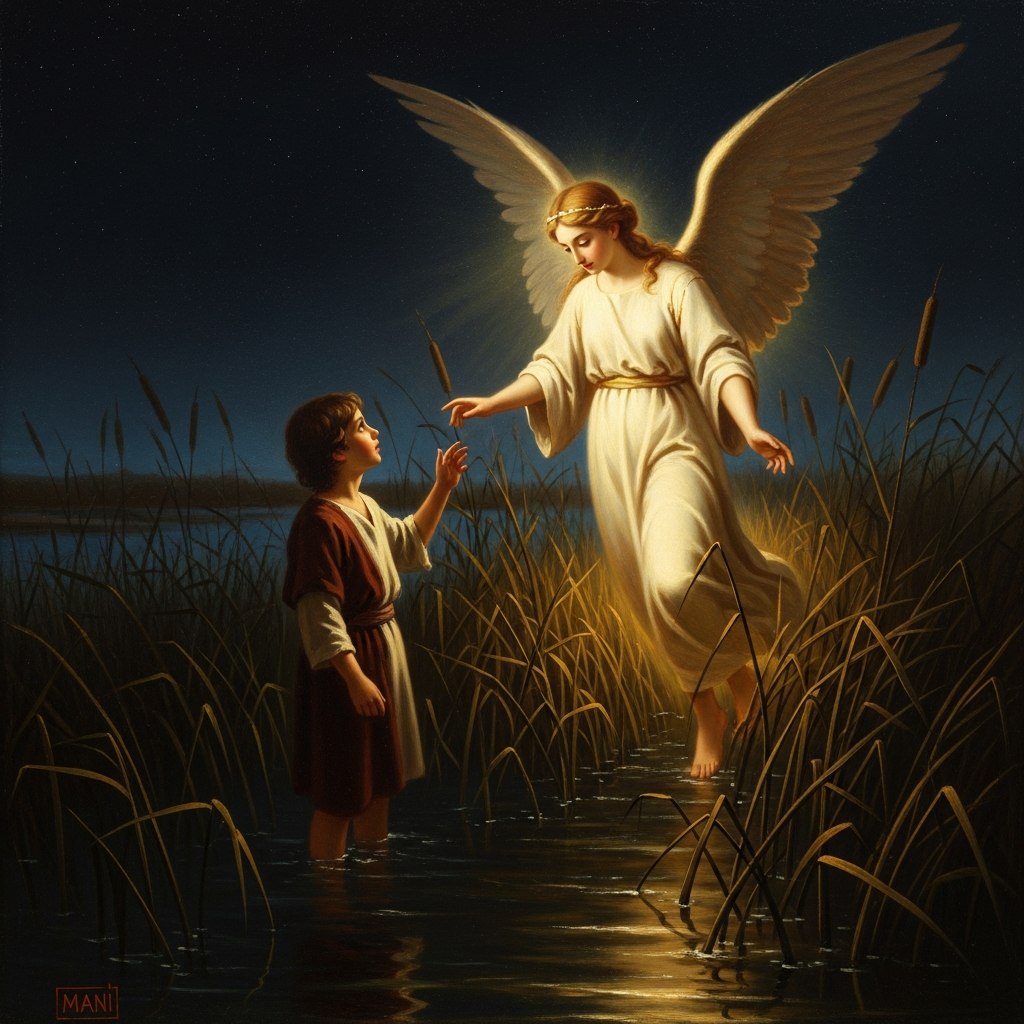
The boy stands at the edge of the reed marshes south of Seleukia-Ktesiphon and waits.
He has been told to wait. Not told in words — told the way twelve-year-olds are sometimes told, from the inside, in a language that does not come from the throat. He is the son of Patticius, who joined the Elchasaites — a Jewish-Christian baptismal sect — after a voice told him to abstain from meat and women. His mother is Persian aristocracy. He has grown up in a community that bathes itself in the Tigris repeatedly, that argues about ritual purity with the seriousness of men who have nothing else to argue about, that whispers about a prophet coming, a paraclete, a comforter.
Mani has read the gospel of John. He has read Zoroastrian hymns. He knows what a comforter is supposed to look like.
What appears at the water’s edge is not what he expects.
It has no wings. It is not a man made of fire. It is a being of light that looks like him — his exact height, his exact features, his eyes, his mouth, his hands — and it says, in the Aramaic he has spoken since before he could walk: Mani. It is time. But not yet. Serve me by being patient.
The Manichaean tradition will call this figure al-Tawm — the Twin. The divine counterpart. The perfect partner. Every prophet has one: Jesus had the Holy Spirit descend on him at the Jordan, Buddha had the bodhi tree and the earth-goddess to witness, Muhammad has Gabriel. Mani has his Twin, his other self, the piece of him that was never wrapped in flesh, watching him across the boundary between worlds.
The Twin tells him three things that morning. He is chosen. The time of his mission has not yet come. He must wait and learn.
Mani goes back to the Elchasaite community and says nothing. He waits twelve years.
He is twenty-four when the Twin comes again.
The second revelation is not gentle. It is a commissioning. Now is the time. Go. Preach. I am with you, I am your guardian, I will be beside you always. Mani understands, in this moment, what he is — not merely a prophet but the final prophet, the one who will succeed where Jesus and Zarathustra and the Buddha succeeded partially: the one who will synthesize all three into a single, portable, universally transmissible truth.
He leaves the Elchasaite community the same day. He travels first to India — to the Indus valley, to the court of the Turan Shah, where he preaches and makes converts and studies Buddhist monasticism with the attention of a man who is looking for transferable parts. He finds them: the organization of wandering monks who own nothing, the painting tradition that carries doctrine across language barriers, the emphasis on inner experience over outer ritual.
He carries it all home to Persia.
Shapur I, the Sasanian emperor who defeats the Roman emperor Valerian in 260 CE and has him kneel as a mounting-block, is an unusual man for his time: intellectually curious, politically tolerant, aware that an empire stretching from the Euphrates to the Indus requires a religion that can hold together Persian, Mesopotamian, Indian, and Christian subjects without burning half of them. He meets Mani. He is impressed. He grants him the right to travel freely throughout the empire and preach.
Mani, released from the margin into the center of the largest empire on earth, does not waste a day.
He travels west into the Roman Empire — to Antioch, to Alexandria, along the Mediterranean coast — and east again into Central Asia. He sends disciples ahead of him, behind him, in every direction. He writes seven canonical scriptures in Syriac, the lingua franca of the eastern empire. He translates them into Middle Persian himself. He writes letters to every community he has founded.
And he paints.
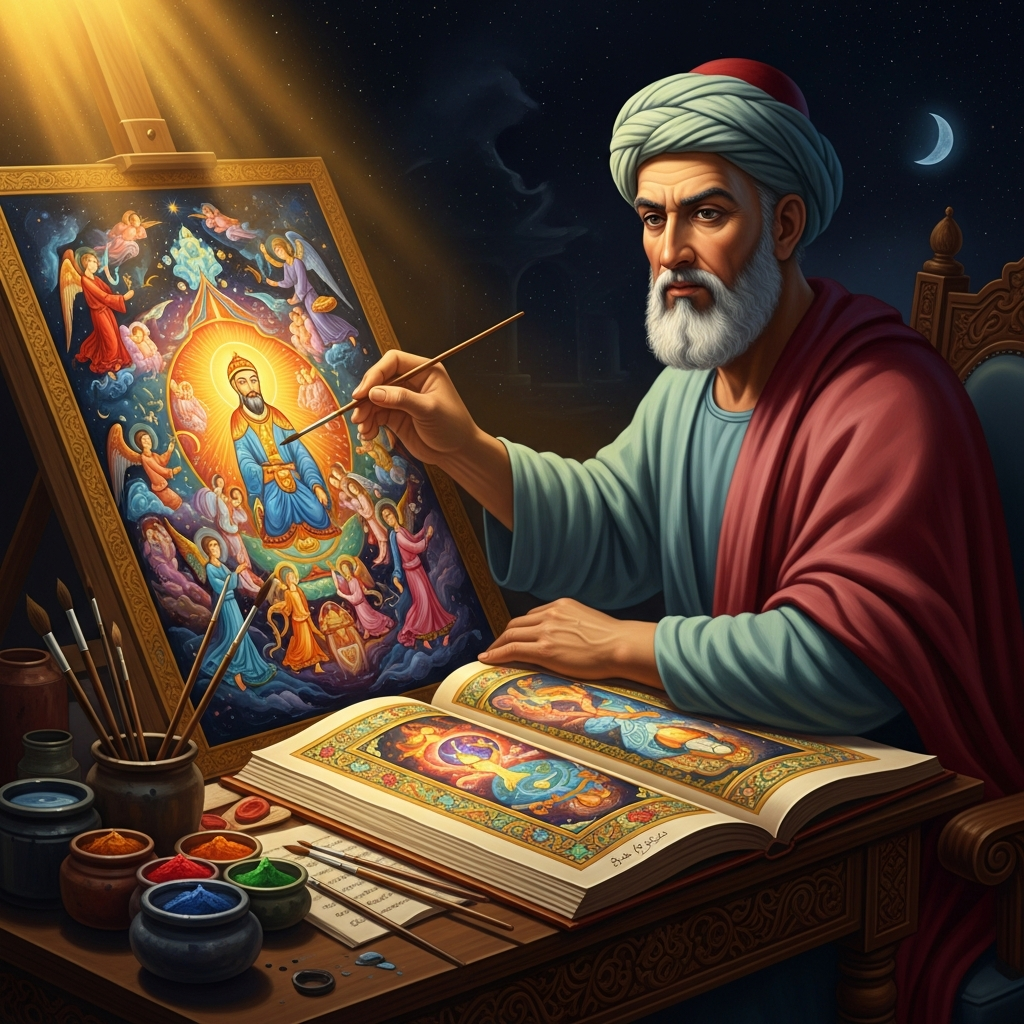
The Arzhang — the Book of Pictures — is the founding document of Manichaean art and the world’s first illustrated scripture. Mani paints it himself: the war in heaven, the Primal Man swallowed by darkness, the cosmic machinery by which light is slowly, grain by grain, extracted from matter and returned to the realm of pure light. His paintings are so accomplished, and so famous, that Persian miniature tradition will trace itself back to him for a thousand years after his death.
He is the first religious founder who understood that a picture can preach where a word cannot be read.
Shapur dies. His son Hormizd reigns one year. Then Bahram I takes the throne — and behind Bahram stands Kartir.
Kartir is the Zoroastrian high priest, and Kartir is what happens when a bureaucrat is given unlimited power over matters of purity. He has been building the Zoroastrian church as a state institution for thirty years — fire temples, orthodoxy lists, heresy tribunals. The inscription he has carved into the rock at Naqsh-e Rostam catalogs his achievements with the satisfaction of a man who has never doubted himself: he has suppressed the Jews, the Christians, the Buddhists, the Hindus, and the Manichaeans. He has driven them or killed them. He has made Persia clean.
Mani appears before Bahram I in the royal audience at Gundeshapur in 274 CE.
The confrontation is preserved in Manichaean martyrology: Bahram offers him freedom if he will be silent; Kartir stands beside the throne and waits. Mani refuses silence. He is told he has chosen wrong. He is chained.
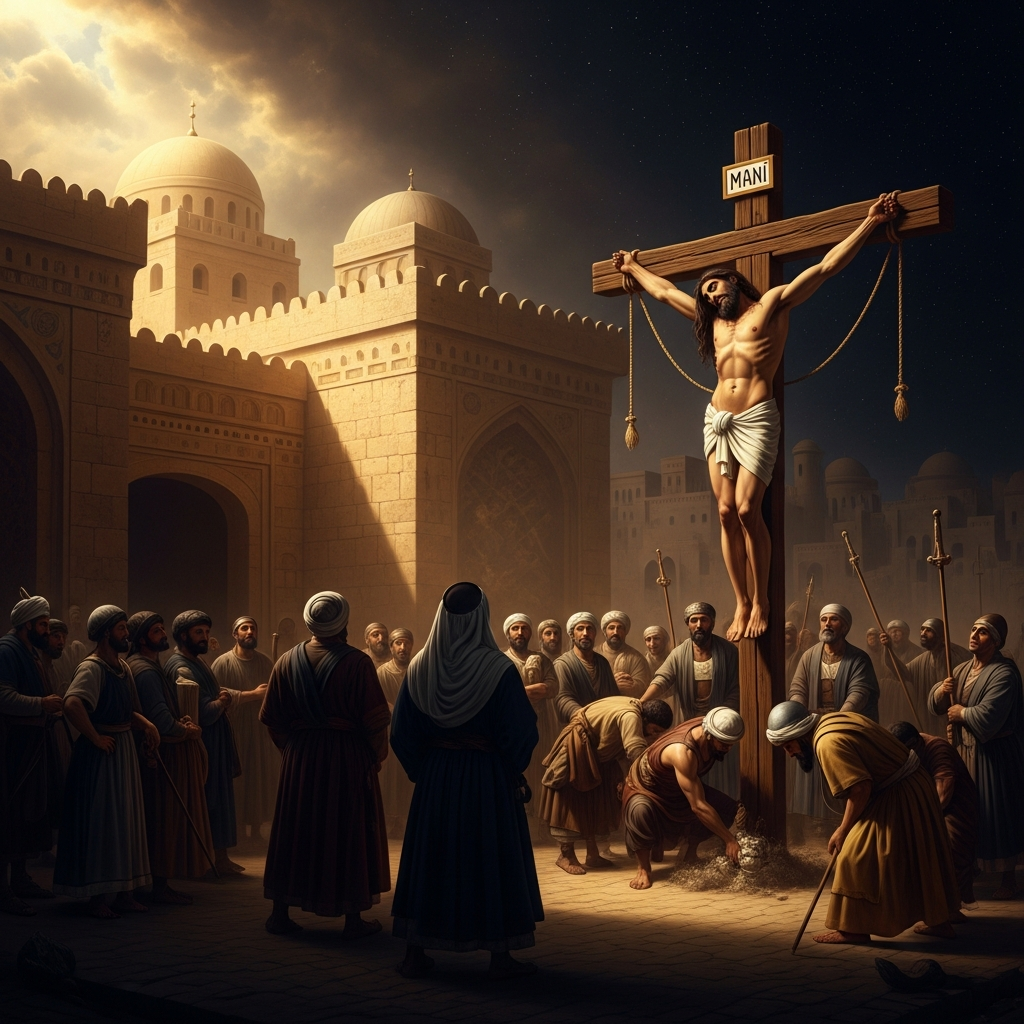
He sits in chains for twenty-six days, preaching to his followers through the prison window. Then he is executed. The tradition calls it crucifixion; his skin is stuffed and hung above the city gate as a warning.
The warning does not work.
Mani has built his religion with suppression in mind. The scriptures are in multiple languages simultaneously. The missionaries are already in the Roman Empire — Augustine of Hippo will spend nine years as a Manichaean before he finds his way to Christianity, and the traces of Manichaean dualism will run through his theology like iron through granite. Manichaean texts are being copied in Egypt, in Syria, in Sogdiana on the Silk Road. By the eighth century, Manichaeism is the state religion of the Uyghur Khanate. By the tenth, it has monasteries in Fujian, China.
The Cathars of medieval Languedoc — who call their God the Rex Mundi, the king of this world, and walk hand in hand into their own fires — almost certainly inherit their dualism from the Bogomils of Bulgaria, who inherit it from the Paulicians of Armenia, who inherit it from the Manichaeans of Persia.
Kartir’s stuffed warning decomposes. The religion travels on.
The Twin told Mani it was not yet time, and Mani waited twelve years. The patience of that waiting is the key to the life: a man who could have started sooner chose to learn everything there was to learn — the Elchasaites’ baptism, the Zoroastrian fire, the Buddhist organization, the Christian kerygma — before he opened his mouth.
He built his religion to be beautiful enough to make converts, portable enough to cross every border, and durable enough to survive any king. He almost got it right. The one thing he could not build was permanence: he is the only founder of a world religion whose tradition is genuinely extinct — no living Manichaean community survives today.
But the dualist imagination he assembled — the war between light and darkness, the spark trapped in the body, the long slow rescue — is not extinct. It has never been extinct. It is the recurring dream of every tradition that looks at the world and cannot believe the darkness is not purposeful.
The Twin is still there. Still waiting at the edge of the water.
Still patient.
Scenes
Seleukia-Ktesiphon, 228 CE — Mani at twelve, standing in the reed marshes at the edge of the Tigris, as the angel al-Tawm appears for the first time and speaks his name
Generating art… Mani paints a page of the Arzhang — the Book of Pictures — illustrating his cosmology in brilliant pigment so that the message can cross every language without a translator
 Generating art…
 Gundeshapur, 274 CE — Mani is crucified on the order of Kartir the high priest and Bahram I
 Generating art…
 Echoes Across Traditions
Entities
- Mani (216-274 CE)
- al-Tawm (the Twin)
- Kartir (Zoroastrian high priest)
- Shapur I (Sasanian emperor)
- the Arzhang
Sources
- Samuel N. C. Lieu, *Manichaeism in the Later Roman Empire and Medieval China* (2nd ed., 1992)
- Iain Gardner and Samuel N. C. Lieu (eds.), *Manichaean Texts from the Roman Empire* (2004)
- Jason David BeDuhn, *Augustine's Manichaean Dilemma*, 2 vols. (2009-2013)
- Werner Sundermann, *Der Sermon vom Licht-Nous* (1992)
- The *Cologne Mani Codex* (CMC) — a Greek biographical text, c. 5th century, containing the earliest account of Mani's revelations in his own words