Mani Receives the Final Revelation
c. 240 CE · Ctesiphon, Babylonia (Sassanid Persia) · Ctesiphon, Babylonia; subsequently the entire Sassanid Empire and beyond
Contents
Mani of Babylon, twenty-four years old, receives his second visitation from the Angel of Light — his divine twin, his heavenly counterpart — and understands that he is the Paraclete, the Seal of the Prophets, the last messenger sent to synthesize Zoroaster, Buddha, and Jesus into one final, complete religion. He will spend forty years building it. He will be executed for it.
- When
- c. 240 CE · Ctesiphon, Babylonia (Sassanid Persia)
- Where
- Ctesiphon, Babylonia; subsequently the entire Sassanid Empire and beyond
The angel comes at noon.
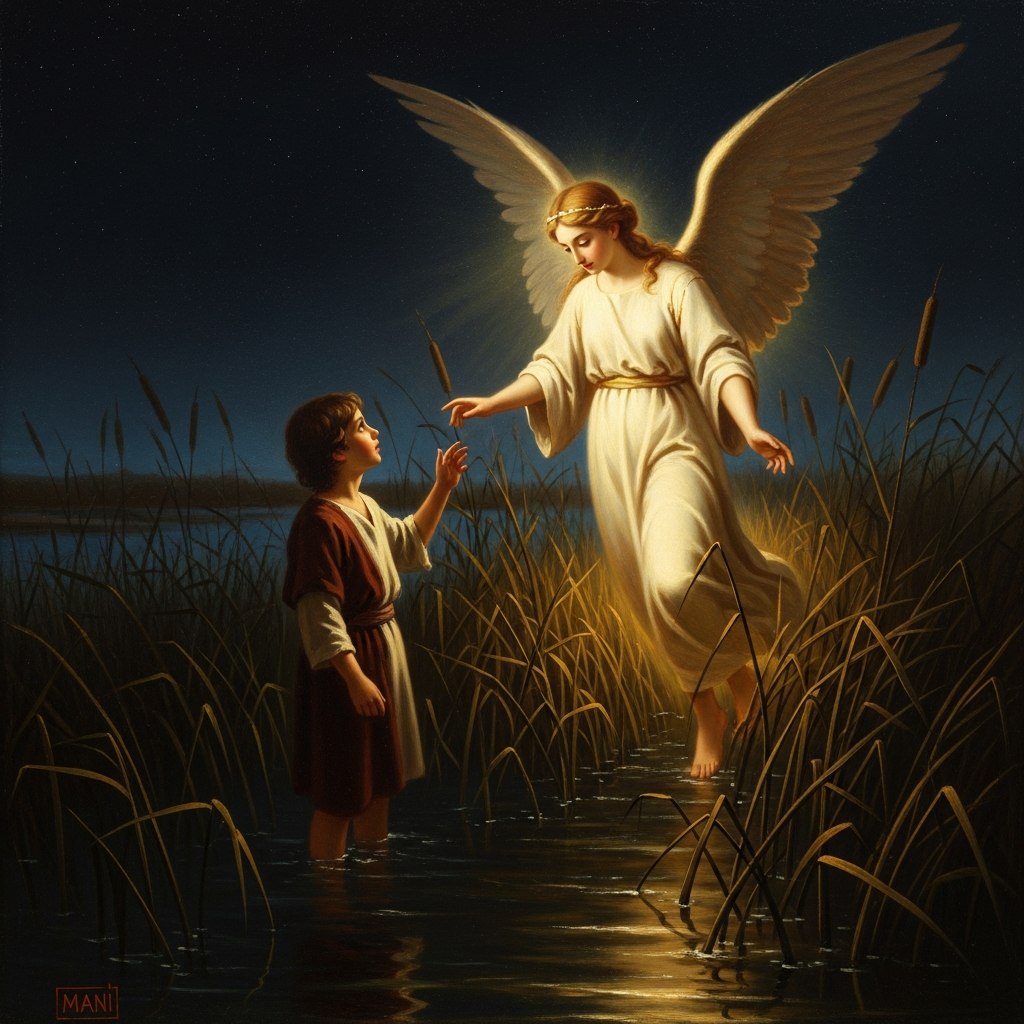
Not at night, not in the ambiguous dark of dreams, but at noon, in the full Babylonian sun, in the garden behind his father’s house near the banks of the Tigris — the Tigris he has lived beside all his life, whose mud-smell is the first thing he remembers, whose winter floods are his calendar. Mani is twenty-four years old. He was raised in a Baptist community, the Elkasaites, a Jewish-Christian baptizing sect that practices ritual purity through water and strict dietary laws and whose theology he has been questioning since he was old enough to question anything. He has been questioning it, specifically, since the first time the angel came — when he was twelve years old, and the luminous figure appeared beside him and said: the time has not yet come. Be patient. Observe the commandments of your community until I call you again.
He has been patient for twelve years. He has observed commandments he does not entirely believe. He has watched the world from the banks of the river.
Now the angel comes back.
The Manichaean texts call the angel by several names. Al-Tawm in Syriac: the Twin. Al-Ruh al-Hayy in Arabic: the Living Spirit. In the Cologne Mani Codex — the miniature Greek parchment book discovered in Egypt in the 1970s that contains Mani’s own autobiographical account — the figure is described as ho syzyges, the companion, the paired being. It is Mani’s divine counterpart, the heavenly version of himself, the self he would be if the self were not made of clay.
It says to him: Now the time has come. Go out into the world.
Mani sits in the garden with the angel’s light on his face and understands what this means. He has been preparing for it, in the way that a person prepares for something they cannot quite see but can feel the weight of, the way you feel a door in the dark before your hand finds the handle. He knows what he has to say. He has known, on some level, since he was twelve: the great prophets — Zoroaster in Persia, Buddha in India, Jesus in the West — were all genuine messengers from the world of light. They were all correct. They were also all partial. Each was sent to a specific people in a specific language, and the religion that developed around each of them was therefore particular, provincial, local in a way the universal truth could not ultimately be.
He has been sent to finish the work.
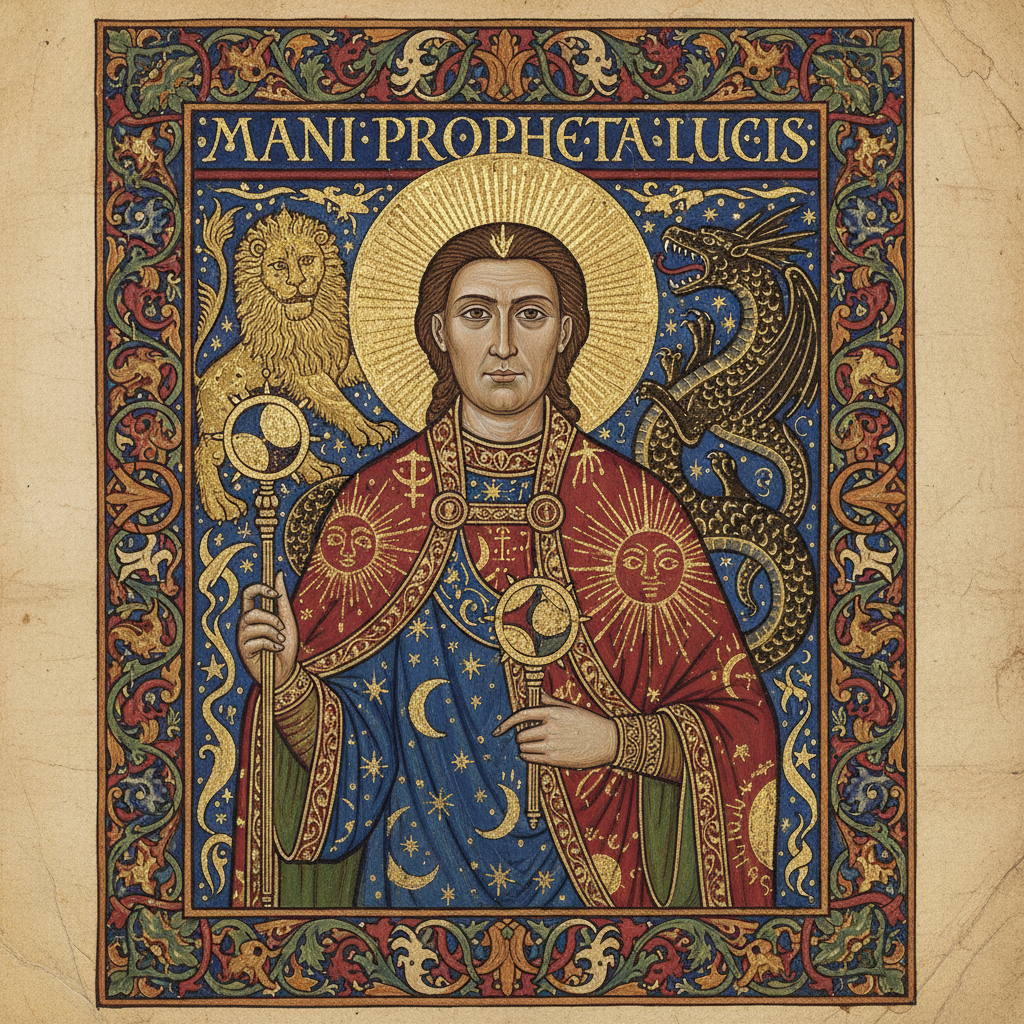
Not to supersede or replace them. To complete them. To produce the synthesis that each of them, working within the limitations of a single language and a single culture and a single century, could not produce alone. He will write his own scriptures — this is unprecedented; previous prophets left their scriptures to disciples, but Mani will write his himself, in seven books, in the Aramaic of his homeland. He will illustrate them. He is a painter, gifted with a facility for image that is not common among religious founders, and the images he produces — the cosmic battle between light and darkness, the particles of divine light trapped in matter, the mechanism of the Moon and the Sun drawing the light upward through the spheres — will become one of the most visually distinctive religious art traditions in history.
He will also travel.
His first journey is eastward, into the Kushan Empire, the territories that straddle the Hindu Kush where Persia and India and the remnants of Alexander’s world press against each other. He goes to understand the Buddhists. He goes because he cannot synthesize what he has not encountered, and the Buddha is one of the three prophets he must complete.
He spends years in the east. He learns. He brings back categories that will transform his system: karma as the mechanism by which the particles of light accumulate suffering through repeated incarnations; the Bodhisattva compassion as the model for the electi, the Manichaean elect who practice the strictest discipline so that the auditors, the laity, can be a little freer; the imagery of the wheel as the cycle of transmigration that the light must escape.
When he returns to Babylonia, the Sassanid Empire has a new king. Shapur I, who will become one of the greatest Sassanid rulers, is young, expansionist, curious about the world. He is also facing a Persian religious establishment — the Zoroastrian Magi — that is politically entrenched and resistant to innovation. Mani, who has a system that incorporates Zoroaster as a revered predecessor, who is willing to present his religion as the completion of Zoroastrian insight rather than its rejection, is useful to Shapur.
He is granted access to the court. He is permitted to travel and preach throughout the empire. For two decades he has imperial protection and uses it comprehensively, sending missions west into the Roman Empire and east into Central Asia and establishing the infrastructure — a hierarchy of archegos, bishops, priests, electi, and auditors — that will allow Manichaeism to function as a centrally organized world religion across every culture it enters.
He writes the Living Gospel.
It is the first of his seven canonical books and the most important: the comprehensive account of the cosmic drama, told not as myth but as fact, as the truth about the structure of reality that all the previous prophets glimpsed partially.
The story is this: before anything, there are two principles, Light and Darkness, coexisting without intersection. Then Darkness attacks. The Father of Light, rather than meeting darkness with violence — which would contaminate the light — sends a being called the Primal Man, who descends into the battle and is swallowed by the forces of Darkness. Swallowed, yes: defeated, temporarily. But the Primal Man’s divine armor — the five elements of light — is now inside the Darkness, and the Darkness, having consumed light, will never be able to fully expel it. This is the first act of the cosmic drama: the voluntary sacrifice that seeds the enemy with the thing that will eventually destroy it.
The material world is built from the mixture of light and darkness that results from this battle. Every plant, every animal, every human body contains particles of divine light imprisoned in matter — the atoms of the Primal Man’s armor, distributed through creation. The purpose of existence is to free these particles, to winnow the light from the dark, to send the light upward through the Moon and the Sun back to the Father of Light.
Human beings are simultaneously the most imprisoned and the most capable of liberation. The Elect — those who follow the strictest Manichaean discipline, who eat only the foods that contain the most particles of light (cucumbers, melons, bread), who do not eat meat (the light imprisoned in animal bodies would be further imprisoned by digestion), who do not procreate (creating new bodies creates new prisons) — are the mechanism of liberation. Every meal an Elect person eats releases light. Every prayer sends particles upward. Every body that dies and is not replaced is a net gain for the world of light.
This is why Augustine found it so compelling. It is a complete system. It has a creation story, an anthropology, an ethics, an eschatology. It explains suffering without making God responsible for it. It makes human behavior cosmologically significant: what you eat matters. What you do with your body matters. Every particle counts.
Shapur dies. His son Hormizd rules briefly. Bahram I inherits the throne and he is, in every way that matters to Mani, a different kind of king.
Bahram is Zoroastrian in the traditional sense: he values the Magi, distrusts religious novelty, and has no patience for a system that claims to incorporate Zoroaster rather than follow him. The Magi have been building a case against Mani for years. Now they have a king who will hear it.
Mani is summoned to the court.
The confrontation, preserved in Manichaean tradition as the Šābuhragān and in various Middle Persian and Coptic fragments, is remarkable for its tone. Mani does not recant. He does not minimize. He stands before the king and the assembled Magi and argues his case with the precision of a man who has spent forty years thinking about it and knows there is no better case to make. He tells Bahram what he has told everyone: that the light and darkness are real, that the particles of light are imprisoned in matter, that the liberation of the light is the purpose of the cosmos, and that he, Mani, has been sent to make this clear in a way no previous prophet could.
Bahram listens. He pronounces judgment.
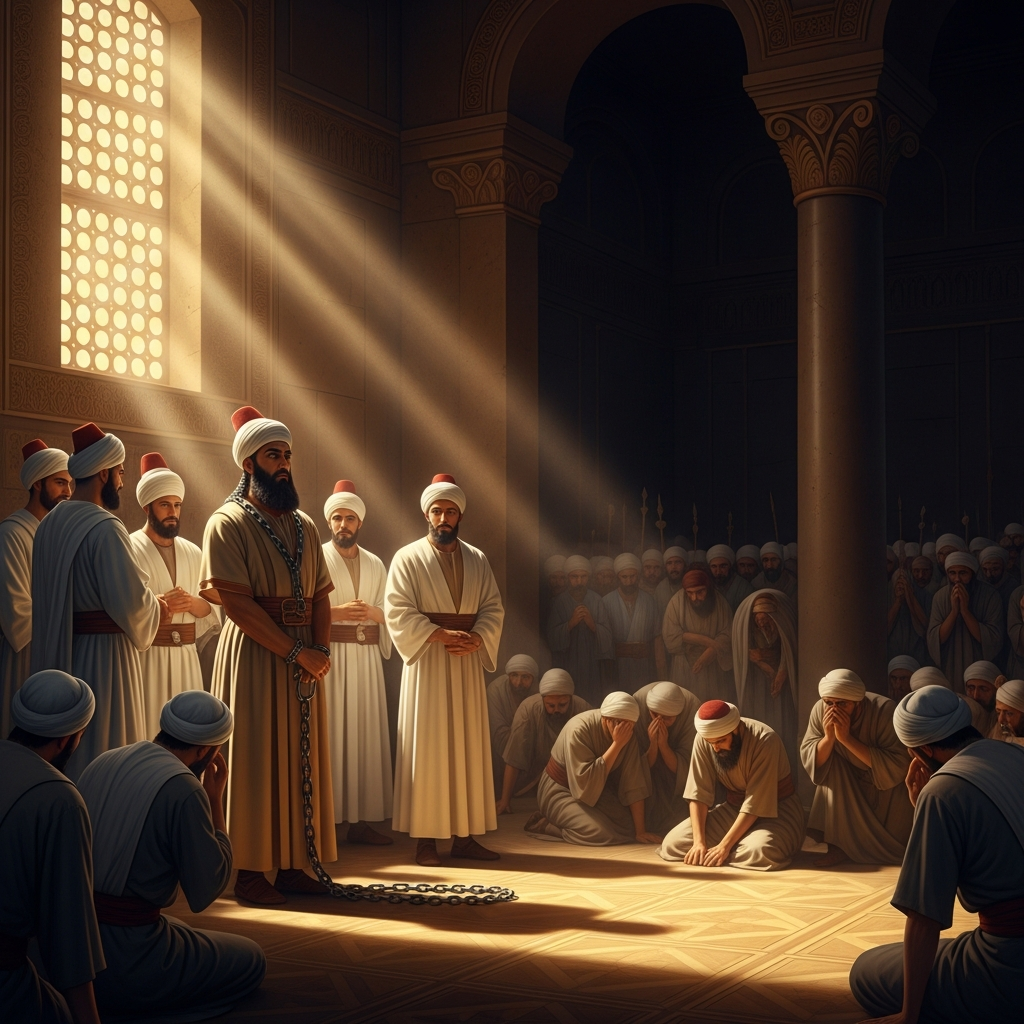
Mani is chained. The chains are heavy iron. He is imprisoned in what the Manichaean texts call the prison of chains, and he lives there for twenty-six days — time enough for the accounts of his final conversations to be preserved by disciples who are allowed limited access. He is teaching to the end, explaining the system, reassuring his followers, writing what he can write in the conditions he has.
On the twenty-seventh day, he dies. From the chains, from illness, from the conditions of imprisonment. He is perhaps sixty years old. His followers will say he was crucified, like Jesus. The historical sources suggest something less dramatic and more terrible: that he simply died in chains in a Persian prison, unmagnified by execution.
The Magi display his head on the city gate.
His missionaries are already on the road.
They are in Rome, in Carthage, in the Fayum. They are on the Silk Road, moving between the oases. They are in the Tarim Basin, where the desert air will preserve Manichaean manuscripts for fifteen hundred years. Within three centuries of Mani’s death, his religion will have more adherents than Judaism. Within five centuries, it will have communities from Ireland to China.
Augustine of Hippo, in North Africa, will spend nine years as a Manichaean auditor before his conversion to Christianity. He will spend the rest of his life arguing against Manichaeism — arguing, which means engaging, which means taking seriously, which means preserving in the act of refutation. His City of God is written partly in response to Manichaean cosmological claims. His theology of evil — that evil is not a positive force but the absence of good — is shaped by his need to answer the Manichaean claim that darkness is as real as light.
Mani’s final synthesis is still working.
The Cologne Mani Codex, the miniature Greek parchment discovered in 1969 in the Fayum, is forty-eight millimeters wide — smaller than a modern smartphone. It contains fragments of Mani’s autobiography in his own words, filtered through Greek translation. He describes the two visitations of the angel. He describes the commission. He writes about himself with the specific, careful precision of a man who knows that how he frames his own story will determine how everyone else frames it after him.
He frames it as a completion, not a revolution. He is the last, not the first. The prophets before him were genuine; he is final. This is the logic of a man who is trying to make something that will last: you do not topple the existing tradition, you stand on its shoulders.
From the Atlantic to the Pacific, in scriptures written in a dozen languages, the particles of light are described ascending: through the Moon, through the Sun, back to the Father of Light who sent the Primal Man into the darkness that was always waiting at the edge of the world. The mechanism is elegant. The sacrifice was real. The light is on its way home.
It takes time. The cosmos is large. The darkness is patient. But the light has been going up since before Mani was born, and it will keep going up after his name has been forgotten, and the moon — the same moon over Ctesiphon and Carthage and Chang’an — receives it every night.
Scenes
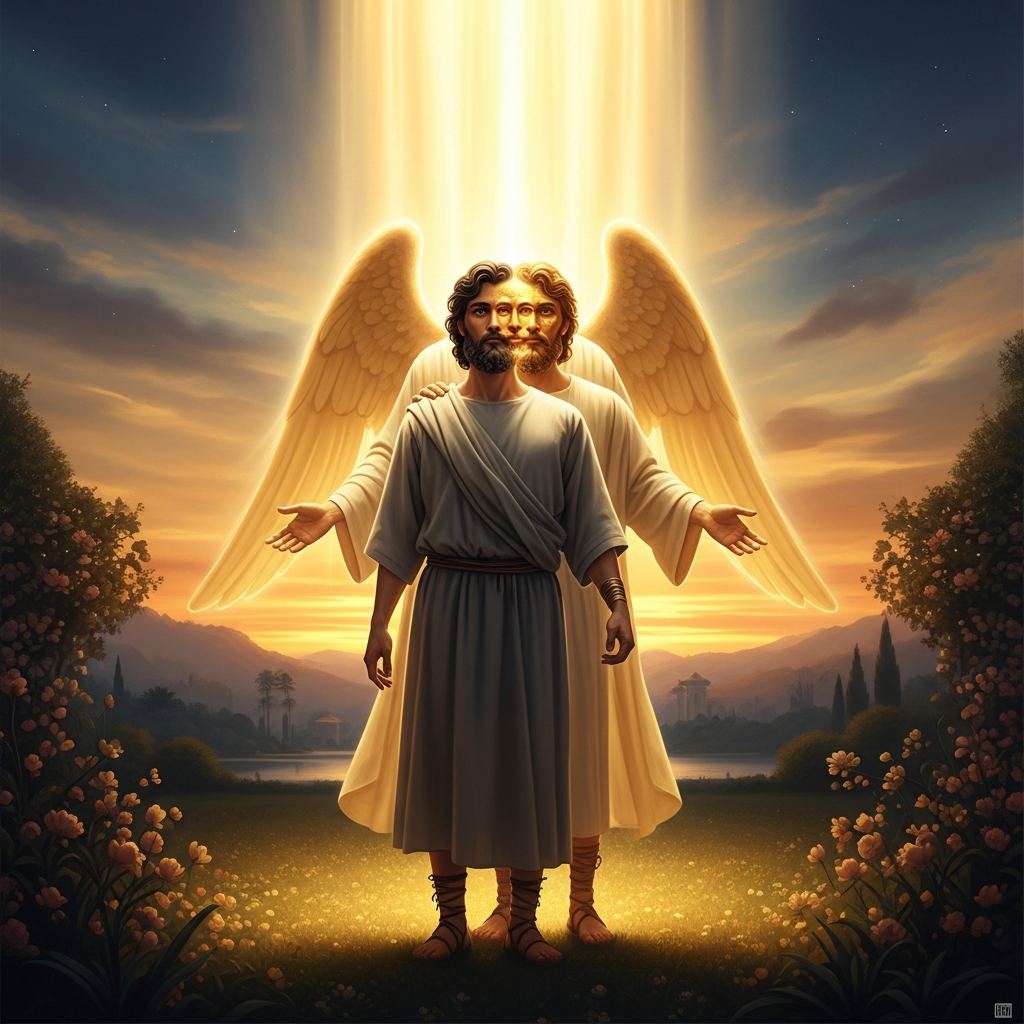
Mani at twenty-four standing in a garden near the Tigris at dusk, a figure of radiant light descending beside him — his divine twin, the Angel al-Tawm — both of them the same face, one made of flesh, one made of gold
 Generating art…
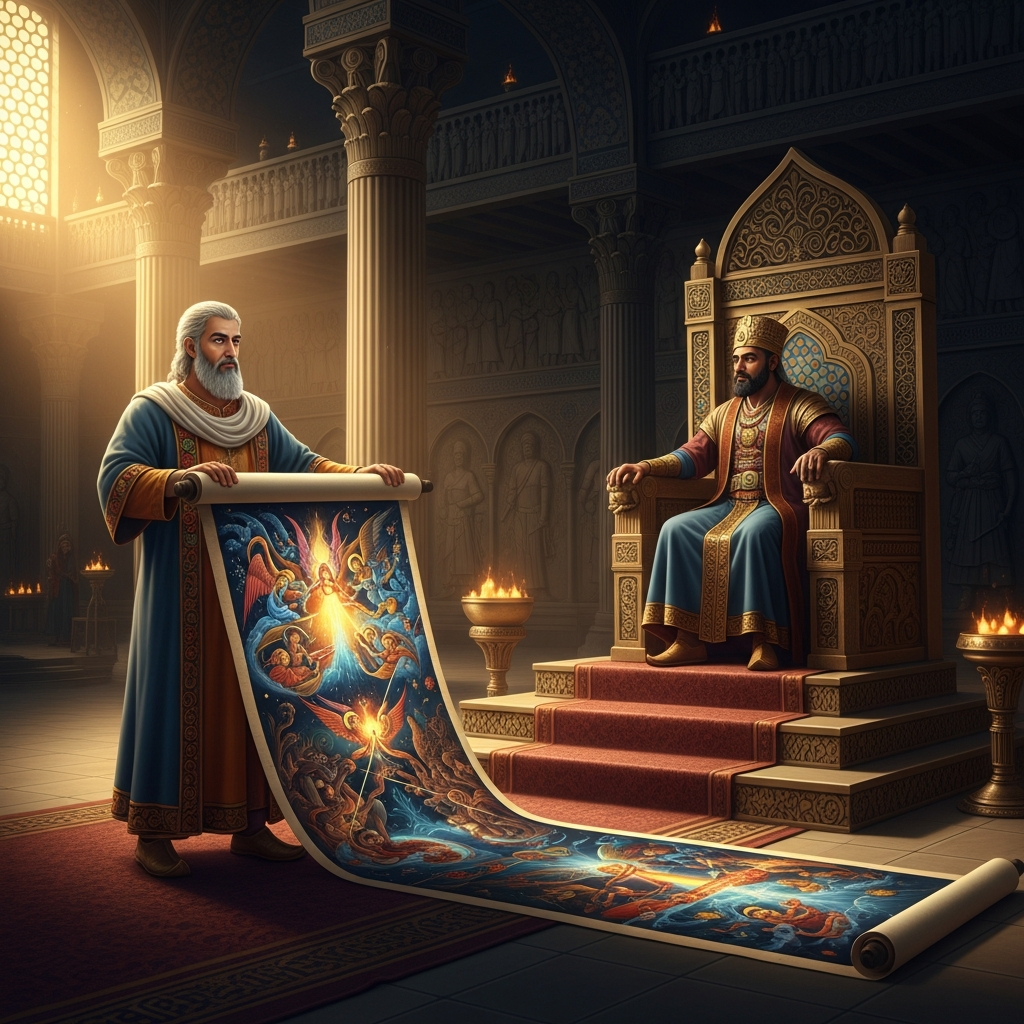
 Mani in the court of the Sassanid emperor Shapur I, unrolling a long painted scroll before the throne — the great cosmic battle between Light and Darkness illustrated in the luminous style that will define Manichaean art for centuries
 Generating art…
 Mani in chains in the court of Bahram I, face gaunt but composed, light streaming through a high window, surrounded by Zoroastrian priests in white who are his accusers and a crowd of his followers pressed against the walls weeping
 Generating art…
 Echoes Across Traditions
Entities
- Mani
- the Angel of Light (al-Tawm)
- Shapur I
- Bahram I
- the Living Gospel

Sources
- Samuel N.C. Lieu, *Manichaeism in the Later Roman Empire and Medieval China* (Manchester University Press, 1985)
- Jason BeDuhn, *The Manichaean Body: In Discipline and Ritual* (Johns Hopkins University Press, 2000)
- Hans-Joachim Klimkeit, *Gnosis on the Silk Road: Gnostic Texts from Central Asia* (HarperCollins, 1993)
- Iain Gardner and Samuel N.C. Lieu (eds.), *Manichaean Texts from the Roman Empire* (Cambridge University Press, 2004)
- Augustine of Hippo, *Confessions* III-V (c. 397 CE) — nine years as a Manichaean, then refutation