Contents
Plotinus, the last great philosopher of antiquity, refuses to have his portrait painted and dictates the Enneads while nearly blind. In his final lecture, he describes the moment the soul stops being itself and pours back into the source of all being — not as metaphor, but as personal report.
- When
- c. 244-270 CE
- Where
- Rome; Campania (deathbed)
The painter arrives on a Tuesday and Plotinus will not look at him.
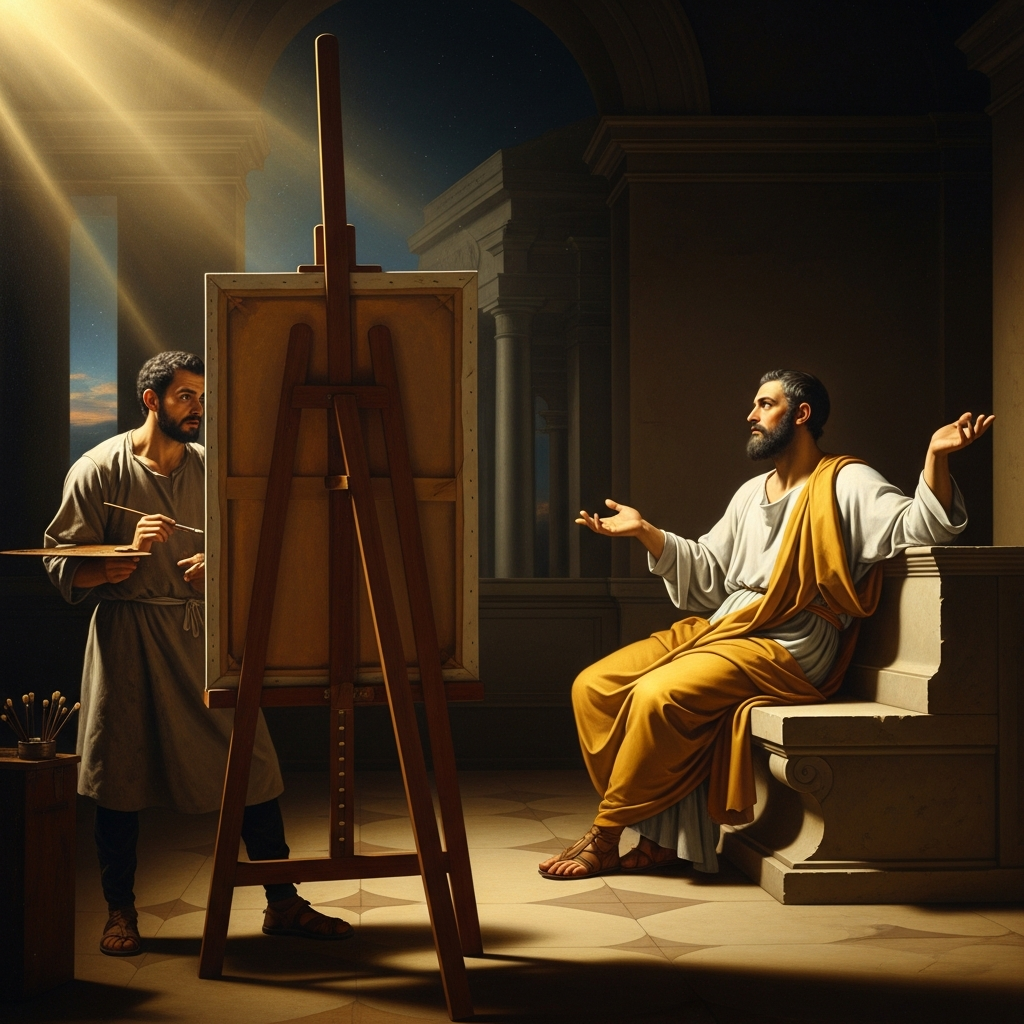
This is not rudeness. Plotinus is constitutionally incapable of rudeness — his student Porphyry, who will later edit his collected works and write the only biography we have, records that Plotinus never turned away a student, never raised his voice, never expressed impatience even when he was in pain. The refusal is philosophical. Why should I agree to leave behind me a likeness of the likeness? That is what he says to the painter, and the painter, who has been commissioned by Amelius and badly wants the commission, stands in the doorway holding his tablet and does not know what to do with this answer.
The body of Plotinus is a likeness — an image, a shadow, a projection of the real Plotinus, which is not his body but his soul, which is itself an image of something further back, which is Intellect, which is an image of something further back again, which is the One. You cannot get a portrait of Plotinus because there is no Plotinus to paint. There is a sequence of shadows cast by a light source that cannot be depicted, and then there is the shadow of the shadow, which is the flesh, which he occupies without any apparent enthusiasm.
He is sixty-nine years old. He is dying of a disease that begins by attacking the voice and ends by attacking the hands and feet — the ancient sources say it was something like tuberculosis or leprosy, a disease of surfaces and extremities, which for the philosopher who spent his life insisting the body was irrelevant is a particular kind of irony that he does not acknowledge because he does not acknowledge irony. The body is irrelevant. His body is currently disintegrating. The two facts are entirely consistent.
He came to philosophy the hard way.
Born in Egypt around 204 CE, he studied in Alexandria under Ammonius Saccas — a dockworker who became a philosopher, who had no school but a room, who left no writings — for eleven years before following the emperor Gordian III’s Persian campaign, hoping to learn something about Eastern wisdom from the Persian and Indian sages. The campaign collapsed. He escaped the disaster and made it to Antioch and eventually to Rome, where he opened a school at thirty-nine and taught for twenty-five years.
What he taught was this: all reality flows from a single source, the One, which is beyond being, beyond thought, beyond the categories that language can name. The One overflows — not because it chooses to, not because it needs to, not because it is lonely or creative or purposeful, but because it is the nature of perfection to overflow, the way a full cup does not decide to spill, it simply spills. From the overflow comes Intellect — Nous — which is Being thinking itself, the realm of the Platonic Forms, pure thought contemplating pure objects. From Intellect overflows Soul — the world-soul and individual souls — which is life, time, the animating principle that descends further into Matter, which is the furthest point from the One, the last faint echo, almost nothing, almost darkness.
And then everything wants to return. The soul turns back toward its source the way a river turns back toward the sea. This is what philosophy is: not the acquisition of information, but the turning of the soul toward its origin.
He never calls this a religion.
He dictates without stopping.
This is remarkable to everyone who witnesses it. Porphyry records that Plotinus would receive a visitor, conduct a long conversation, return to his writing without reviewing what he had written before the interruption, and continue as though no interruption had occurred — as though the thread of thought was running somewhere beneath the surface of ordinary time, unaffected by the noise above it. He writes without revising. He dictates without false starts. Porphyry edits, corrects the spelling, and organizes the fifty-four treatises into the Enneads — Nine-fold, nine groups of nine, a numerologically satisfying arrangement that Plotinus himself did not design.
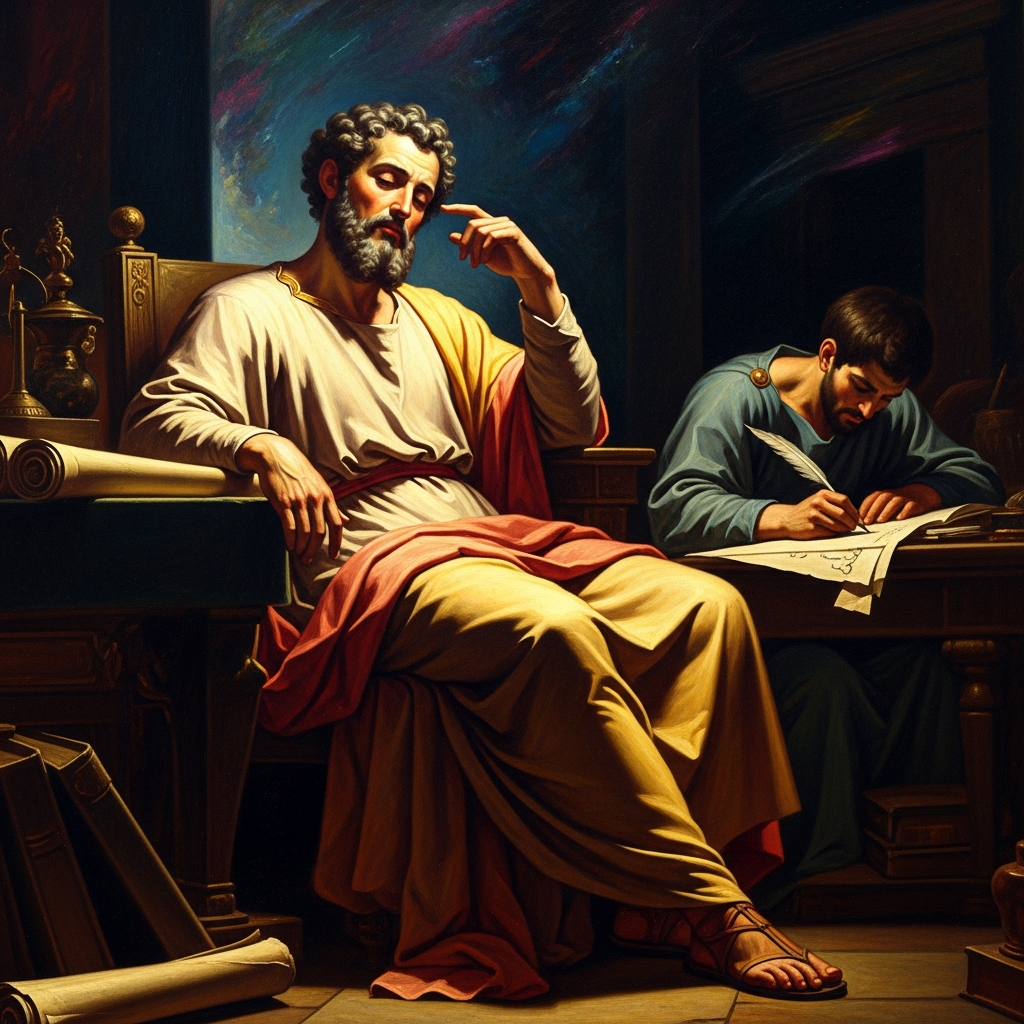
Now his eyes are failing. The disease has taken his hands and feet and is working toward the center, and his eyes, which never focused quite normally — students report that he seemed to look through them rather than at them, as though the visible world were a transparency through which he was reading something further away — are clouding over. He dictates in the mornings when the light comes through the window at a useful angle, and in the evenings when Porphyry lights the lamps at precisely the distance that makes the task possible, and by the time Porphyry writes down the last line of the last treatise and reads it back, Plotinus cannot see Porphyry’s face.
He does not remark on this either.
The last lecture comes in summer.
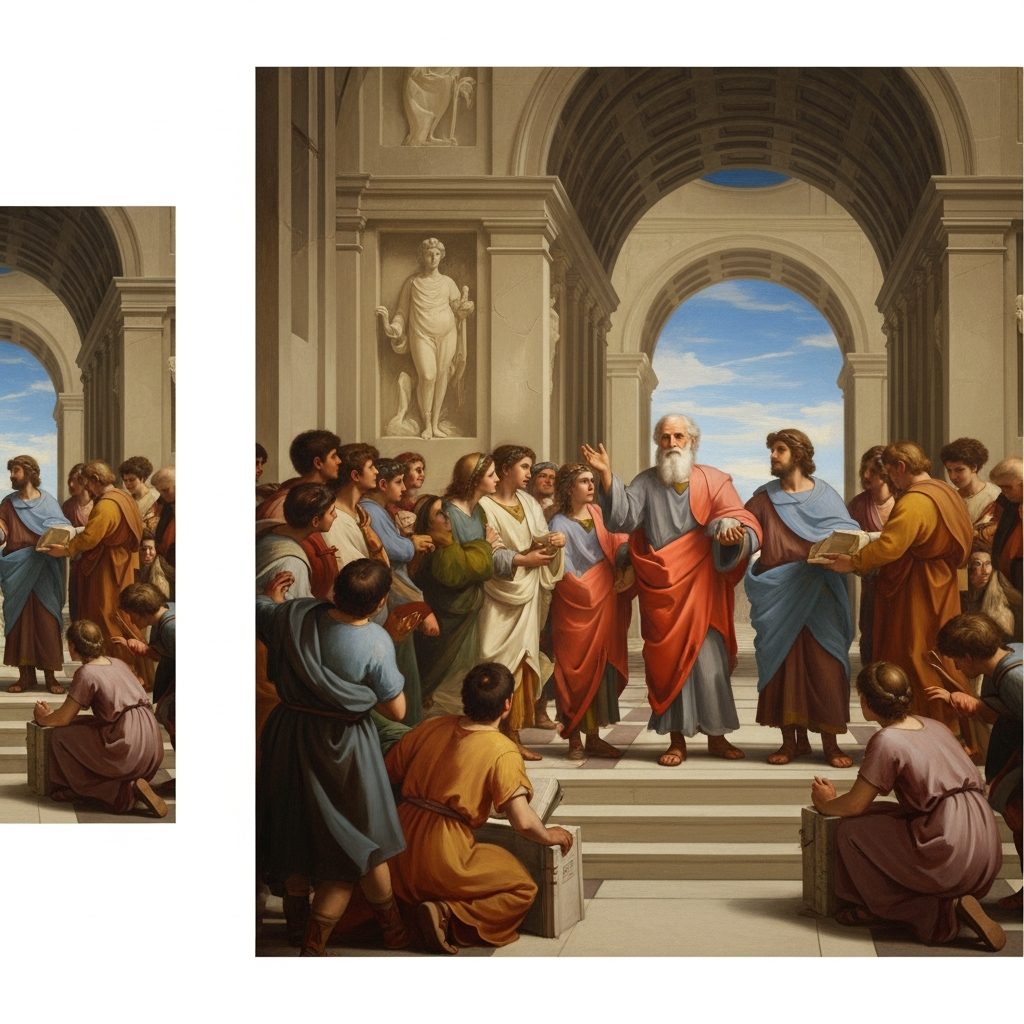
The school in Rome is a converted house, not much — benches in rows, a low lectern, the smell of the city coming through the shutters in the heat. There are perhaps thirty students. Porphyry is in the front row with his wax tablet. Amelius is there. Several senators who have been studying with Plotinus for a decade and have never managed to quit, even though Plotinus offers no credentials, no social cachet, no practical benefit whatever.
He stands without notes. His face is white and thin and precise, the face of a man who has been burning fuel faster than his body can replace it for thirty years. He begins in the middle of a thought — this is always how he begins — and the students realize after a few minutes that he is describing the mystical union, the moment he calls the flight of the alone to the Alone, when the individual soul stops being individual and pours back into the One like a drop of water finding the ocean.
He has described this before. He has described it in the treatises. But tonight the description is different. Tonight he is not reporting it as theoretical possibility; he is reporting it as personal event. He says: Many times it has happened. Lifted out of the body into myself; becoming external to all other things and self-encentered; beholding a marvelous beauty; then, more than ever, assured of community with the loftiest order; enacting the noblest life, acquiring identity with the divine. Poised above the Intellectual by virtue of that activity — stationed in it and yet gazing beyond it.
The room is absolutely silent. Porphyry has stopped writing.
He says: In this state there is no longer sight of beauty, or the memory of it. It is the One, undifferentiated, unmarked by form, and it is not a sight but a kind of contact, a touching, a being touched, a coincidence.
He pauses. He closes his eyes, or appears to — his eyes at this stage are nearly opaque. He says: What we see in the beautiful is an image, a trace, a shadow. But the One is not beautiful because beauty is a quality and the One has no qualities. The One simply is. And when the soul reaches the One, the soul does not see it. The soul becomes it, for a moment, for a moment that is outside time and has no duration that time can measure.
Nobody says anything for a long time after he stops.
He retires to a country house in Campania to die.
His friend Eustochius, a physician, is with him at the end. He says, in Eustochius’s account, something like: I was waiting for you, to give back the divine in me to the divine in the all. Then a snake slides under the bed, or out from under it — the sources are inconsistent — and Plotinus dies, and the snake disappears into a crack in the wall, and Eustochius is left sitting beside the body of the last great philosopher of the ancient world in a Campanian farmhouse in 270 CE, not entirely sure what he has just witnessed.
The body is cremated. Porphyry, who was not present — he was in Sicily, where Plotinus had sent him to recover from a depression that had been moving toward suicide, because Plotinus was practical about some things — receives the news and sits down to organize the fifty-four treatises. He spends years on this. He writes the biography to introduce the collection. He tries to explain to a reader who never heard Plotinus speak what it was like to be in the room when the description came from the inside, when the philosopher stopped describing a destination and started describing an arrival.
He does not fully succeed. He knows this. He includes the failure in the text.
There is no image of the One, Plotinus had written. The soul that reaches it has reached what words were invented to avoid: the silence on the other side of every sentence, which is what the sentences were always about.
Plotinus had himself painted once, in a manner of speaking — in language. The Enneads are a self-portrait of the soul rather than the face, a record of fifty years of practice, of turning toward the light. It is the most complete philosophical account of mystical experience in Western antiquity, and it cost him his body to produce it.
Every Christian mystic who ever wrote about union with God — Meister Eckhart, John of the Cross, the author of the Cloud of Unknowing — was working in the space Plotinus mapped. Every Islamic Sufi who wrote about fana, the annihilation of the self in the divine, had a predecessor in this half-blind Egyptian in Rome who refused to sit for his portrait.
The One has no image. Plotinus accepted this fully, absolutely, and then spent his life making images of it anyway, because the alternative — silence — was not available to someone who had students, who had Porphyry, who had the gift of precise and beautiful language.
He dictated until he could no longer see. The work was not finished. The work is not the kind of thing that finishes.
Scenes
Plotinus seated in lamplight, eyes half-closed, dictating without pause to Porphyry who writes furiously in the corner
 Generating art…
 A painter stands with his tablet before Plotinus, who turns away with a gesture of complete indifference — not contempt, indifference
 Generating art…
 The school at Rome, the last afternoon
 Generating art…
 Echoes Across Traditions
Entities
- Plotinus
- Porphyry
- the One
- the Soul
- the Intellect
Sources
- Plotinus, *Enneads* (trans. A.H. Armstrong, Loeb Classical Library, 1966-1988)
- Porphyry, *Life of Plotinus* (c. 300 CE)
- Lloyd P. Gerson (ed.), *The Cambridge Companion to Plotinus* (1996)