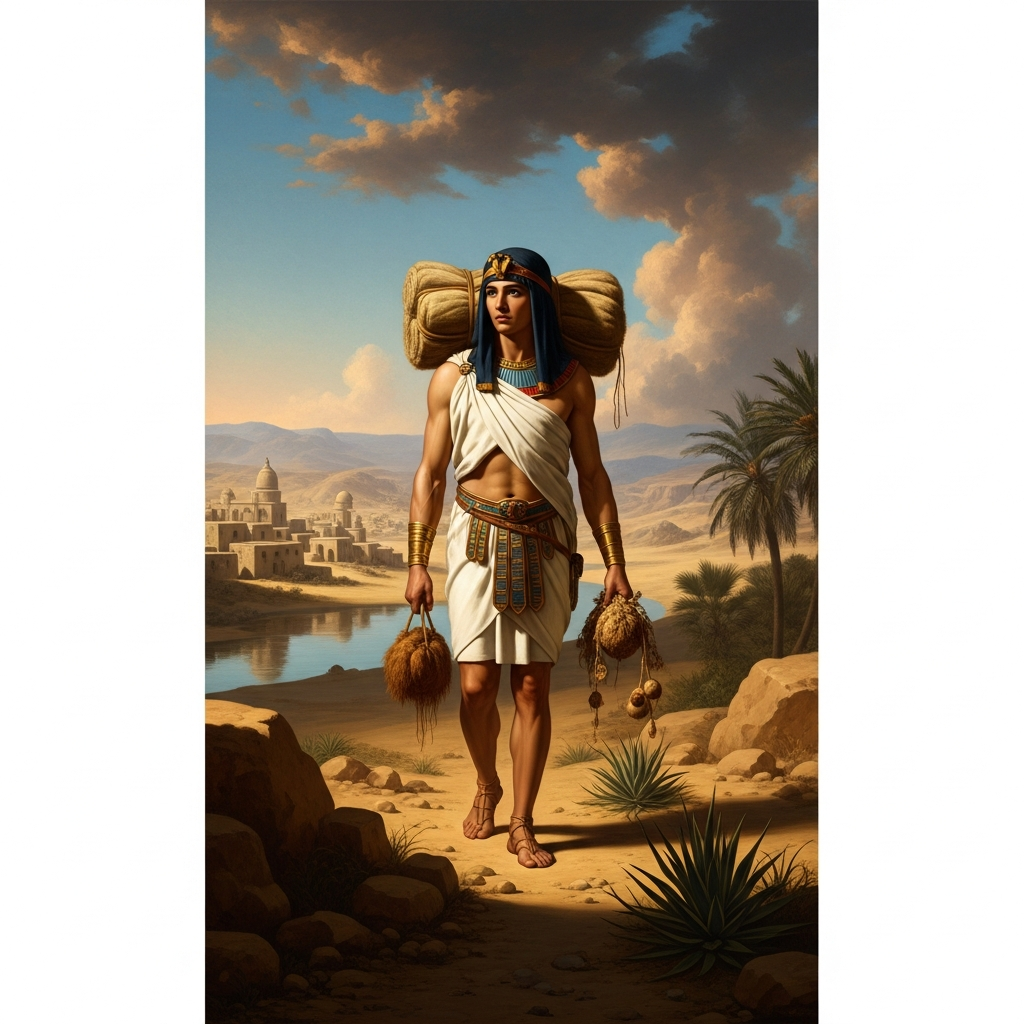
Antony in the Desert
c. 270 CE (entry into the desert); c. 305 CE (emergence); 251–356 CE (his life) · The desert of Egypt — first the village outskirts near Alexandria, then an abandoned Roman fort in the outer desert, finally the inner mountain near the Red Sea
Contents
A young Egyptian of moderate wealth walks into a church one Sunday morning in 270 CE and hears a single line of the gospel read aloud. He walks back out, sells his estate, hands his sister to a community of virgins, and walks into the desert. He does not come out for twenty years. When he finally emerges, the visitors who have come expecting a withered hermit find a man of extraordinary peace, and the template of Christian monasticism is set.
- When
- c. 270 CE (entry into the desert); c. 305 CE (emergence); 251–356 CE (his life)
- Where
- The desert of Egypt — first the village outskirts near Alexandria, then an abandoned Roman fort in the outer desert, finally the inner mountain near the Red Sea
He is twenty years old when he loses his parents.
The estate is substantial — three hundred acres of good Egyptian farmland in the village of Coma, in the Nile valley about sixty miles south of the delta. His parents have left it to him and to his younger sister, and Antony, suddenly the head of a household at twenty, is trying to figure out what to do with a life that was supposed to belong to people older than him.
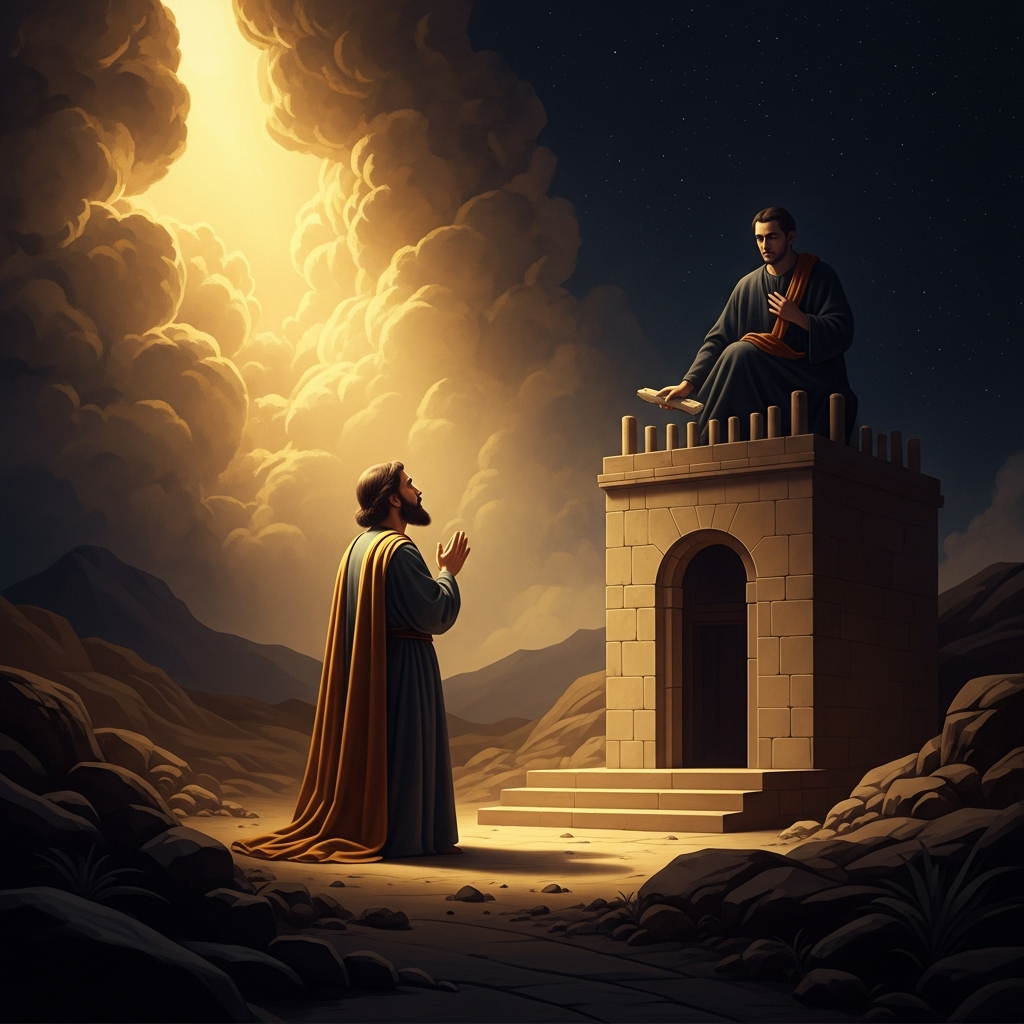
Six months after the funeral, he walks into the village church.
The reading that morning is from Matthew. He has heard the gospels his whole life — his parents were Christians, the village is mostly Christian, the priest is reading the verses he has read a hundred times. But this morning Antony hears one line as if it has been spoken directly into his head, intended for him, requiring an answer.
If you would be perfect, go, sell what you have and give to the poor, and you will have treasure in heaven; then come, follow me.
He walks out of the church and does it.
He does not do it gradually.
He sells the three hundred acres to the villagers for cash. He distributes the cash to the poor of the village, keeping back a small amount for his sister. He hears the next gospel reading — do not be anxious about tomorrow — and gives the rest away too. He places his sister in a community of virgins in the village, an early form of women’s monastic life that already exists in Egypt before any institutional form has been written down.
Then he walks out to the edge of the village and sets himself up in a hut, near an old man who is known locally as someone who lives quietly and prays.
The old man is the model of what later monks will call an abba: a spiritual father, an elder, a man who has done it longer than you have. Antony watches him. Antony watches other quiet ascetics on the village outskirts — there are several, scattered along the fringes, men and women who have been doing some version of this for years before Antony’s birth. He learns from each of them. Then, after some years of this, he walks further out.
He is going where the demons live.
The Egyptians have always known this about the desert.
The land beyond the Nile valley is not just inhospitable. It is the country of seth — of the disorder that the cosmos has been pushed back from. It is where the Pharaohs sent the criminals. It is where the gods do not live. The Christians who go out into it are walking into territory that every previous Egyptian generation has understood as the dwelling place of forces that do not love human beings.
Antony walks until he finds an abandoned Roman fort.
It is empty. It is sealed. It is far enough from the valley that he can hear nothing of human life. He has someone bring him bread twice a year — every six months, a friend will leave loaves at a designated spot — and he goes inside the fort and bars the door.
He stays there for twenty years.
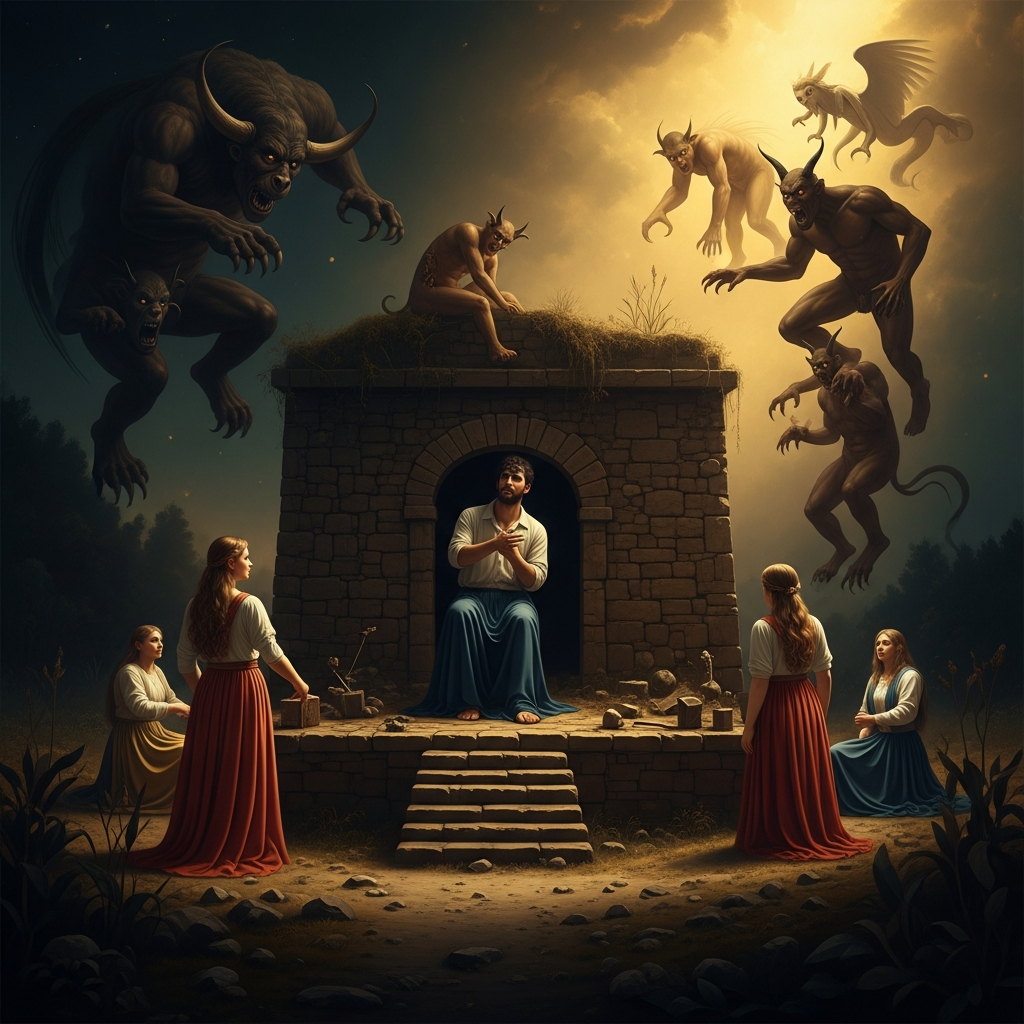
The demons come.
This is the part that strains modern reading. Athanasius’s biography spends pages on it: the visions, the assaults, the apparitions. Sometimes they come as wild beasts — lions, bulls, snakes — and the fort fills with the noise of an entire menagerie. Sometimes they come as beautiful women, sitting beside him, speaking gently. Sometimes they come as his own thoughts, but louder than his own thoughts, arguing with him in the voice of his own mind, telling him that twenty years of his life have been wasted, that he could still go back, that his sister has died waiting for him, that God does not exist.
The neighbors hear the noise.
They stand outside the fort sometimes and listen. They hear Antony shouting back at things they cannot see. They hear what sound like fights. They hear silence. They hear weeping. They hear, occasionally, what they decide must be the voice of someone praying with a clarity they have not heard before. They do not enter. He has asked them not to enter. They leave the bread and they go away.
What is happening inside the fort is the work of the desert.
The tradition that grew up around this — the desert literature, the Apophthegmata, the centuries of monastic teaching that flowed out of Antony — is unanimous about what the demons are. They are the contents of the unrenounced self, made visible. The lust, the pride, the resentment, the grief, the boredom, the hatred, the doubt — all of it, dragged out of the unconscious where it normally lives, given shape, given voice, made into things that can be argued with and faced and refused. The desert is not a place where the demons happen to live. The desert is the place where the demons of the self can no longer hide behind the city’s distractions.
Antony stays. He does not negotiate. He does not leave. For twenty years he refuses every offer the demons make.
He is being remade.
In 305 the door is broken open.
A group of pilgrims has decided they will not be turned away any longer. They have heard about him for years — the rumors of the man in the fort, the saint, the lunatic, the holy person, the hermit — and they push the door open expecting to find a corpse. The Egyptian desert kills people. They are prepared to bury what they find.
What they find is a man.
He is fifty-four years old. He is healthy. His body has not wasted in the way they would expect. His skin is not weathered to leather. His eyes, the visitors will say afterwards, are calm in a way that is hard to describe. He greets them. He answers their questions. He talks about God in language that is simple and direct and bears no resemblance to the philosophy his visitors have been taught. The peace that surrounds him, in the descriptions, is something his visitors had not previously known was possible.
The story of what they saw spreads.
For the rest of his life, Antony cannot get rid of his visitors.
He moves further into the desert, to an inner mountain near the Red Sea, to escape them. They follow. He retreats again. They keep coming. Disciples cluster around his cave. They ask for his teaching and he gives it grudgingly, in short sentences that the disciples write down and pass around. The sayings of Antony become the seed of an entire literature: Apophthegmata Patrum, the sayings of the desert fathers.
He visits Alexandria twice in his life.
Once during the persecution under Maximinus Daia, when he goes to the city deliberately, hoping to be arrested and martyred, walking up to the prisons to encourage the imprisoned Christians. The authorities know who he is and refuse to arrest him. He is too famous. They do not want a martyr who could become a riot.
The second visit is in 338, at the request of his friend Athanasius, who is fighting the Arians. Antony comes out of the desert at eighty-seven to denounce Arianism in the streets of Alexandria. The whole city pours out to see him — pagans, Christians, Arians, Manichees — and Athanasius records that on the day Antony walked through Alexandria, more pagans converted than in any year before.
He goes back to his mountain. He dies there in 356, at one hundred and five.
Athanasius writes the Life.
It is the most influential biography of the early church. It is translated into Latin within a few years of its composition, and the Latin version travels. Augustine, in Milan in 386, hears the Life of Antony read aloud — the story of two Roman officials who heard it and immediately walked away from their careers — and Augustine’s own conversion, days later in the garden, is happening in the shadow of that story. He writes about it in the Confessions. The unlettered Egyptian peasants, he says, are taking heaven by storm, and we educated Romans are still arguing about it.
Antony is the seed.
Pachomius, a few decades later, will take the seed and grow a different thing from it: the cenobitic monastery, the community with a Rule. Cassian will take that pattern to Gaul. Benedict will write his Rule on Cassian’s foundation. The whole Western monastic tradition — Cluny, Cîteaux, the Cistercians, the Carthusians, every cloister and library and choir of monks — descends in a clear line from a twenty-year-old in a village church hearing a line of the gospel and walking out.
The desert is not the absence of the world. It is the world stripped of distraction. Antony walked into it because he had heard a sentence and could not unhear it. He stayed because the sentence kept being true. The demons that came for him were the residue of the life he had walked away from, and the work he did was the work of refusing to take it back.
When the door of the fort opened in 305 and the pilgrims looked in, what they saw was a man who had been remade by twenty years of saying no. The peace he carried out of that room is the peace that founded a thousand monasteries. The pattern of withdrawal he set is one of the most durable spiritual technologies the human species has produced. It is older than Christianity — the Buddhists already knew it, the Jewish ascetics already knew it, the desert peoples of every continent had already known it — but Antony made it Christian, and the Christianity of the next sixteen centuries would carry his footprints in its soil.
Scenes
Antony at the threshold of the desert
Generating art… In the abandoned fort, the demons come
 Generating art…
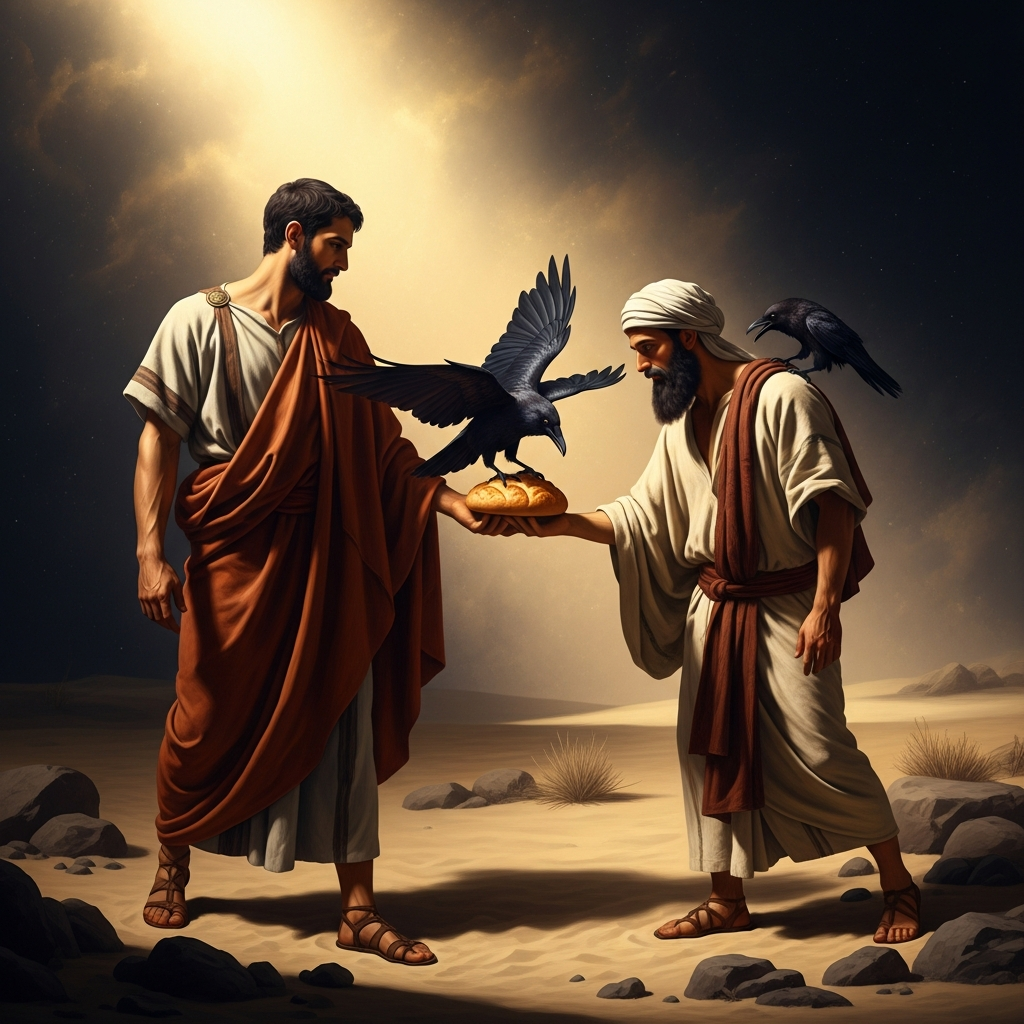
 Late in his life, Antony walks deeper into the desert and finds Paul of Thebes, who has been alone for ninety years and is fed by a raven that brings him half a loaf each day
 Generating art…
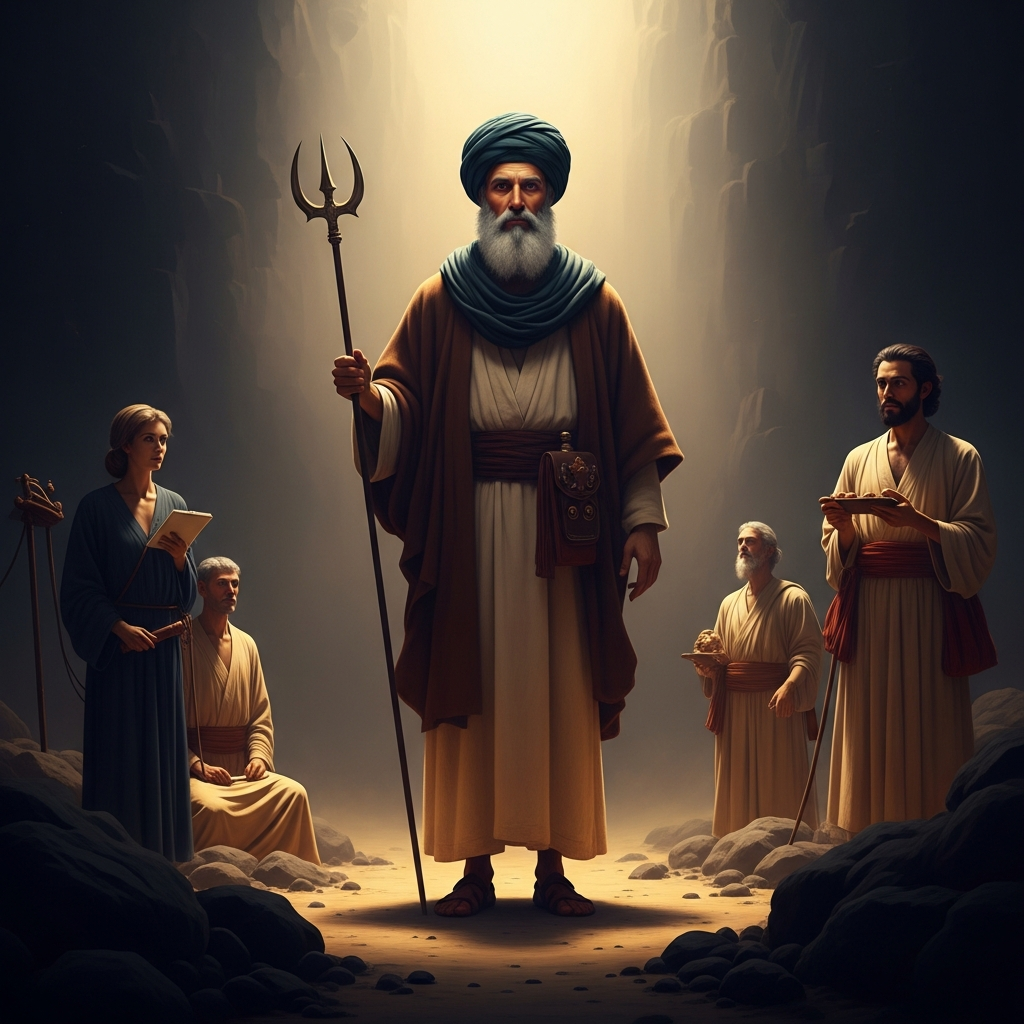
 When the door of the fort is finally broken open, the visitors expect to find a corpse, or a madman
 Generating art…
 Echoes Across Traditions
Entities
- Antony of Egypt
- Athanasius of Alexandria
- Paul of Thebes
- Pachomius
- the demons
Sources
- Athanasius, *Life of Antony* (c. 360 CE; trans. Robert Gregg, 1980)
- Palladius, *Lausiac History* (c. 419 CE)
- Derwas Chitty, *The Desert a City* (1966)
- Peter Brown, *The Body and Society* (1988)
- Douglas Burton-Christie, *The Word in the Desert* (1993)