Amma Syncletica: The Desert Mothers
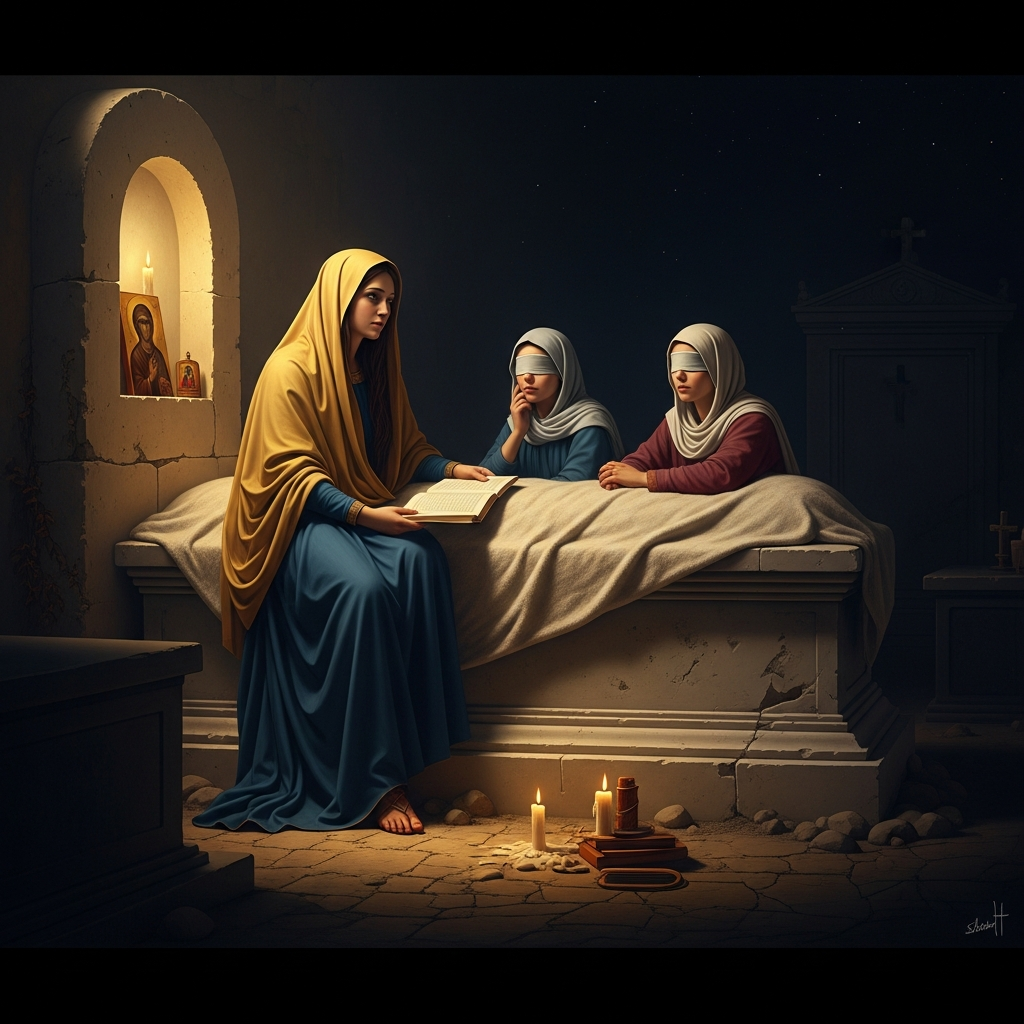
c. 270–350 CE · Alexandria, Egypt — a tomb in the cemetery outside the city walls, which she and her sister occupy as their cell
Contents
The Desert Fathers are famous. The Desert Mothers were always there too — the *ammas*, the women who walked into the same wilderness, sat under the same sun, fought the same demons, and gave the same hard counsel to the disciples who came looking for them. The most prominent is Syncletica of Alexandria, a wealthy woman who gives away her estate, takes her blind sister, moves into a tomb on the edge of the city, and starts speaking sentences that the desert tradition will be quoting for sixteen hundred years.
- When
- c. 270–350 CE
- Where
- Alexandria, Egypt — a tomb in the cemetery outside the city walls, which she and her sister occupy as their cell
She is born to wealth.
The family is Macedonian Greek by ancestry, settled in Alexandria for generations, owning estates and ships and slaves. Syncletica’s parents have given her every advantage available to a fourth-century woman of her class: education, languages, music, the supervision of household budgets. She is beautiful in the conventional sense and her parents are arranging marriages for her by the time she is twelve. She refuses each one.
She refuses them because she has read.
The catechetical school of Alexandria is at this point producing teachers and books in volume. The Life of Antony is circulating. The earlier writings of Clement and Origen are circulating. The Egyptian church has more women living some form of vowed religious life — virgins in households, widows attached to congregations, ascetic groups in the back streets — than any other church in the empire. Syncletica reads all of it. By the time she is grown, she has decided.
Her parents die. Her brother dies. Her younger sister, who is blind, becomes her dependent. Syncletica sells everything.
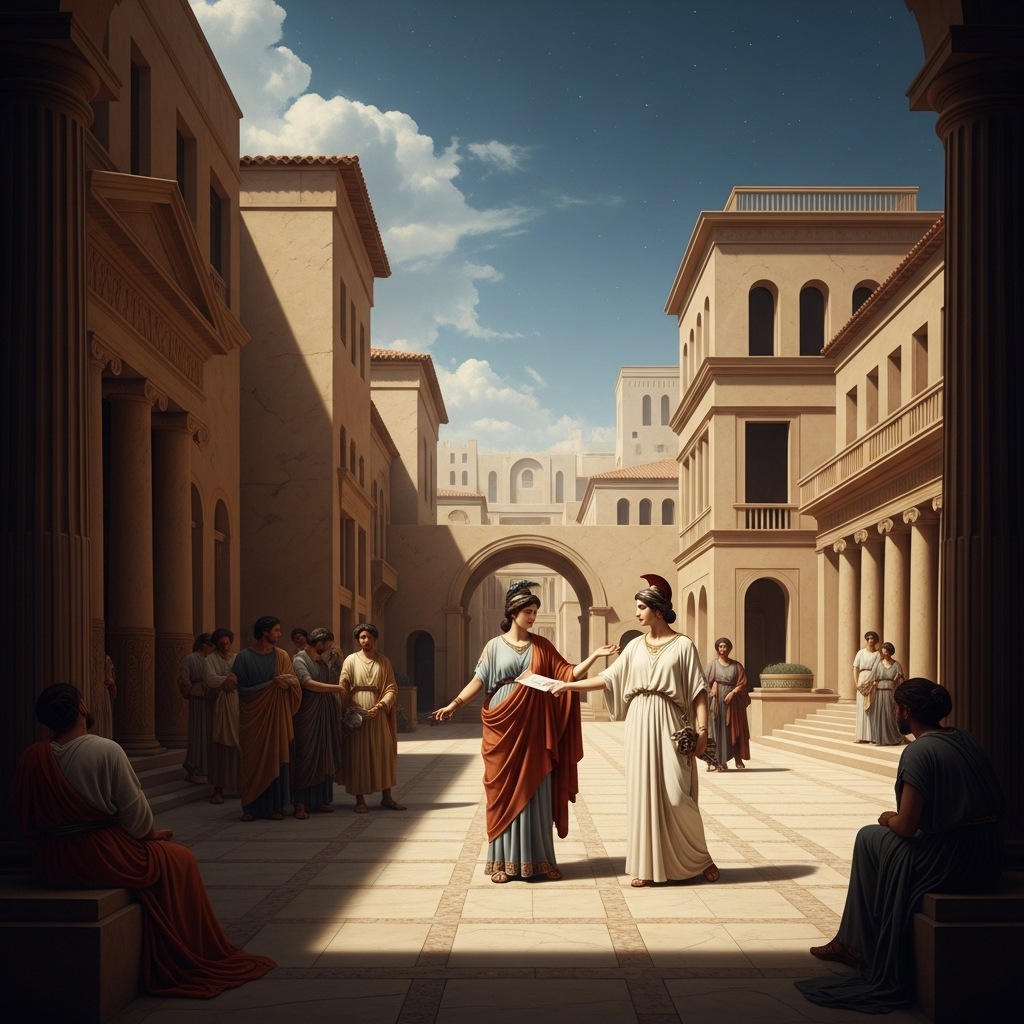
She does it the way Antony did it: she does it all at once, and she does it completely. The estates are sold. The proceeds go to the poor of Alexandria, distributed by the bishop’s clergy. The household slaves are freed. She keeps a small sum for the support of her sister. Then she takes her sister and walks out of the city to the cemetery.
The Egyptian cemeteries outside the cities are honeycombed with tombs cut into the rock, some of them old, some of them empty. She finds an empty one. She moves in.
The tomb is the cell.
This is not a metaphor. The early ascetics deliberately chose burial places to live in. The symbolism was active: she was already dead to the world. The world’s measures of life — money, marriage, social standing — no longer applied to a woman who had moved into a sepulcher. The dead are not concerned with promotions. The dead are not concerned with whether their houses are admired. She has crossed the line between the living and the dead while still breathing, and the cell is the visible sign of the crossing.
Her sister sits with her. The blind sister, whose name has not been preserved, is by all accounts as committed to this life as Syncletica is. The two of them keep the hours of prayer together. They eat once a day, sometimes once every two days. They pray the psalms aloud — Syncletica reading, the sister joining from memory. They take turns on the small physical tasks: drawing water from the well in the cemetery, cleaning, mending the single tunic each owns.
They expect to be alone.
They are not alone for long.
The disciples find her.
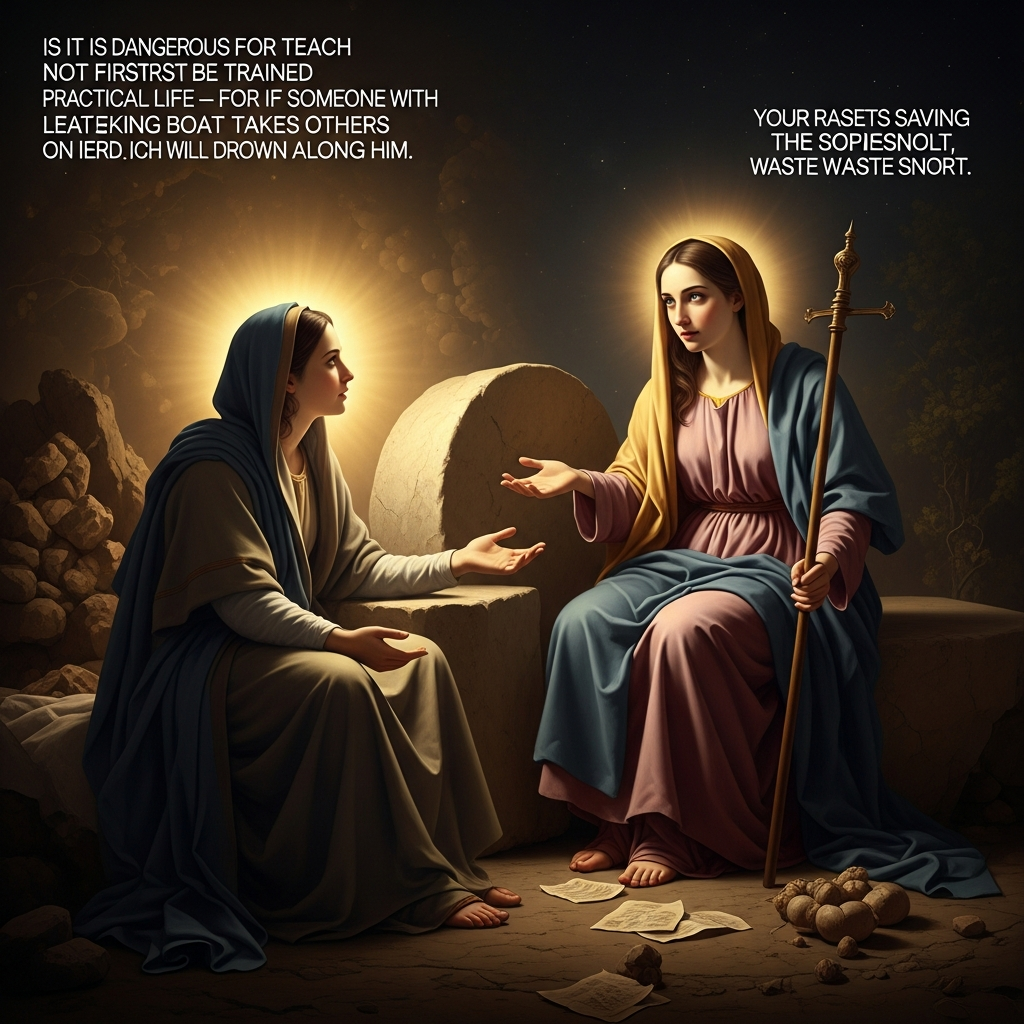
They are mostly women — younger women from Alexandrian Christian families who have heard about her, walked out to the cemetery, and asked to learn from her. Some of them want to do what she has done. Some of them have not yet decided. They come at first one at a time, then in groups. They want her to teach them.
She refuses.
This is one of the most consistent notes in the whole desert tradition: the great teachers do not want disciples. Antony fled deeper into the desert to escape his. Sarah, another amma, lived for sixty years on the bank of the Nile without ever looking at the river, refusing the visitors who wanted spectacle. Syncletica’s refusal is in the same tradition. I am not your teacher, she says. I am still learning. Sit with me if you must. Do not call me a teacher.
But they sit. They keep sitting. They wear her down, slowly, with the simple persistence of presence. Eventually she begins to speak. Her sayings begin to circulate in Alexandria. They are written down — at first by the women themselves, later by male clergy who recognize that what is being said in the tomb outside the city is not different in kind from what the celebrated abbas are saying in the desert.
The sayings are sharp.
It is dangerous for anyone to teach who has not first been trained in practical life. For if someone whose own boat is leaking takes others on board, they will drown together.
In the beginning of our life of devotion there is much labor and toil for those who are coming to God, but afterward it is unspeakable joy. Just as those who would build a fire are at first plagued with smoke, but afterwards the wood catches and burns clean.
If you find yourself in a community and you are tempted to leave for somewhere quieter, do not leave. Because the temptation is the demon’s, not the place’s. Wherever you go, you will take yourself with you, and the same demon will find you.
There is a useful asceticism and there is an asceticism that is the demon’s work. The demon can simulate fasting, vigils, almsgiving. Test the practice not by its harshness but by its fruit. If it is making you irritable, prouder, more contemptuous of others — the demon is at the wheel. Stop.
The collected sayings of the desert mothers, when finally compiled, are fewer in volume than the men’s. The transmission was thinner. But the percentage of high-quality material — sentences that the tradition kept reusing for centuries because they kept turning out to be true — is, on a saying-for-saying basis, very high. Syncletica’s are among the most quoted.
She is also, the tradition says, a remarkable diagnostician.
The women who come to her with troubles do not always want her to give them advice. Sometimes they want her to tell them what is actually happening in them. The desert tradition has a name for this — diakrisis, discernment of spirits — and Syncletica’s reputation is for the precision of it. She listens, she watches, and she names what is in the room. The grief that the disciple has been calling devotion. The pride hiding inside the asceticism. The avoidance of marriage that is not a vocation but a fear of being touched. She names it without cruelty. The naming is the freedom.
The illness comes when she is eighty.
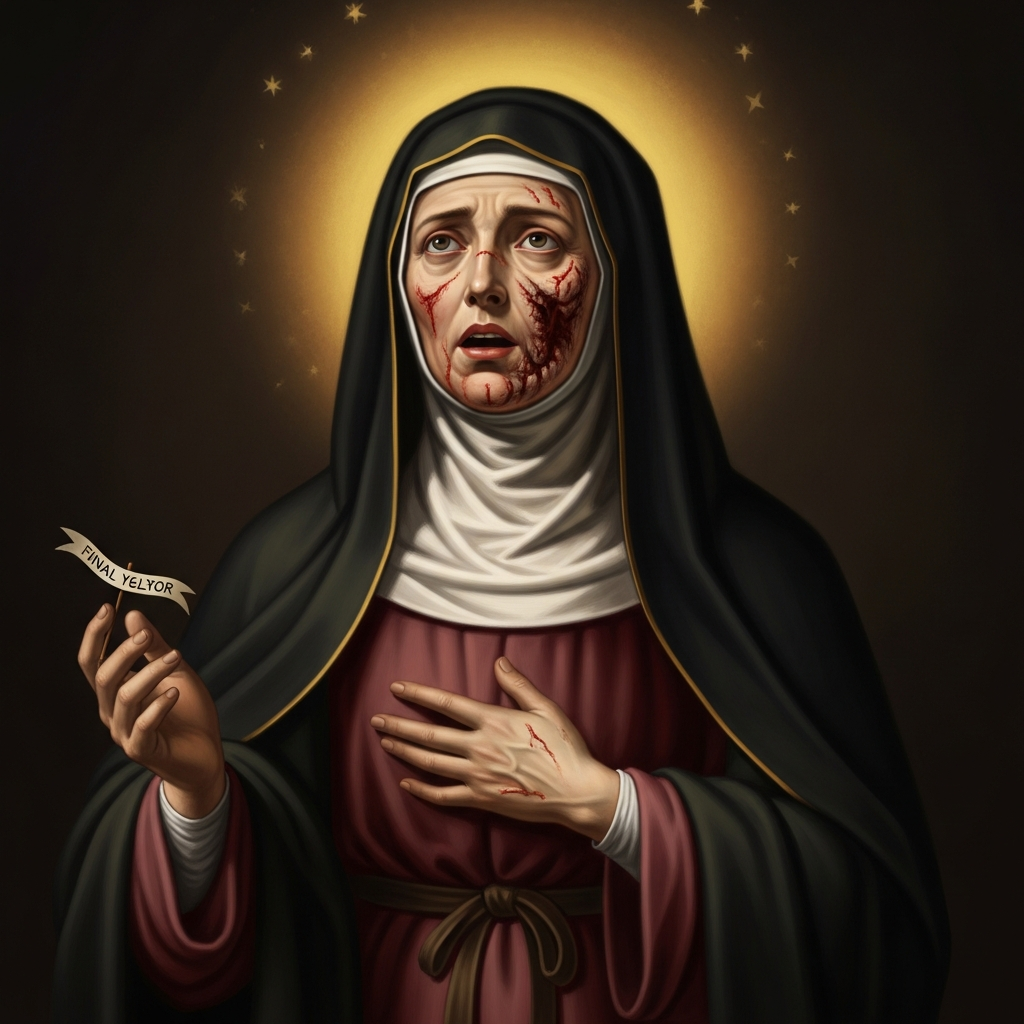
The biographer — pseudo-Athanasius, writing perhaps a generation later — describes it without the usual hagiographic euphemism. It is something like a cancer of the face and the lungs. It begins in her mouth and progresses outward and downward. It eats the flesh of her cheek. The smell, in the small tomb-cell, becomes intolerable. The disciples bring perfumes; she refuses them. The body is being purified by what is happening to it, she says. Let the body do its work.
She refuses opiates. She refuses the medical treatments that some of the wealthier disciples want to bring. She continues to teach.
The teaching during the illness is recorded with particular care because the disciples knew they were watching the application of everything she had taught them. The principles she had been transmitting in words for forty years were now being demonstrated in a body. The illness is not the demon, she said. Pain is not the enemy. The enemy is what pain wakes up — the self-pity, the resentment, the bargaining with God. Notice those. Refuse those. Endure the pain itself; pain is just sensation.
The illness lasts three years. She becomes unable to eat. She becomes unable to speak; the disciples write down her last sayings as she whispers them in fragments. She dies in her tomb-cell, in her sister’s company, sometime around 350 CE. She is buried where she has been living. She had never moved.
The tradition keeps her.
Palladius, traveling Egypt thirty years later to gather material for the Lausiac History, asks the surviving Alexandrian Christians about the women of the previous generation, and Syncletica’s name comes up first. Her sayings are copied into the Apophthegmata Patrum — the great anthology of desert wisdom — alongside the men’s. The pseudonymous Life of Syncletica is composed, attributed (falsely) to Athanasius to give it imperial-level authority. The Byzantine church places her on its calendar.
But the transmission is uneven.
The Western Latin tradition, which translated huge portions of the desert literature into Latin and carried it into Gaul and Ireland and Britain, includes some of the ammas but de-emphasizes them. The patristic anthologies that medieval and early modern Christians read had more men than women. By the time the modern scholarly editions were prepared in the nineteenth century, the women had become footnotes. The reconstruction has been the work of the last fifty years — Benedicta Ward at Oxford, Laura Swan, scholars in feminist theology and patristics — recovering the texts, retranslating the sayings, locating Syncletica and Sarah and Theodora and the others within the tradition where they had always belonged.
She did not become an institution. She did not write books. She lived in a tomb on the edge of Alexandria for fifty years with her blind sister, refused to be called a teacher, and could not stop her disciples from writing down what she said. The illness that killed her was unspeakable; she met it with the same equanimity she had taught her disciples to meet smaller things. The body that had been a privilege at sixteen was a wreck at eighty, and she had been ready for either.
The Desert Mothers were not an alternative to the Desert Fathers. They were the same tradition, with women in it, doing the same work and arriving at the same conclusions. The tradition that wrote them out of its histories was poorer for the writing-out. The tradition that has begun, in the last half-century, to write them back in is healing a wound it did not know it had.
Syncletica’s leaking-boat saying is still quoted. It is still true. The boat with the leak in it is still everywhere, and she still sees it from the cemetery outside Alexandria, sixteen hundred years ago.
Scenes
Syncletica in the courtyard of her family's Alexandrian estate, distributing the inheritance
 Generating art…
 The cell
Generating art… The disciples have found her
 Generating art…
 Her last illness
 Generating art…
 Echoes Across Traditions
Entities
- Amma Syncletica
- her blind sister
- Amma Sarah
- Amma Theodora
- Mary of Egypt
- Palladius
Sources
- Palladius, *Lausiac History* (c. 419 CE)
- *Apophthegmata Patrum* — the Sayings of the Desert Fathers and Mothers
- Pseudo-Athanasius, *Life of Syncletica* (4th–5th century)
- Benedicta Ward, *Harlots of the Desert* (1987)
- Laura Swan, *The Forgotten Desert Mothers* (2001)
- Mary Forman, *Praying with the Desert Mothers* (2005)