Constantine at the Milvian Bridge
October 27–28, 312 CE · The Milvian Bridge, north of Rome
Contents
On the eve of battle, Constantine sees a cross of light blazing over the sun. His soldiers paint the Chi-Rho on their shields. By nightfall the next day, Maxentius is face-down in the Tiber, and the Roman Empire belongs — for the first time — to a man who prays to Christ.
- When
- October 27–28, 312 CE
- Where
- The Milvian Bridge, north of Rome
He is marching south when he sees it.
The army is strung out along the Via Flaminia, shields slung, dust rising in columns above the column of men. It is the middle of the afternoon — the sun high and pitiless over the Italian hills — and Constantine is looking at the sky the way a general does: reading weather, counting light, calculating how many more hours of march he can demand before morale frays.
Then the cross appears.
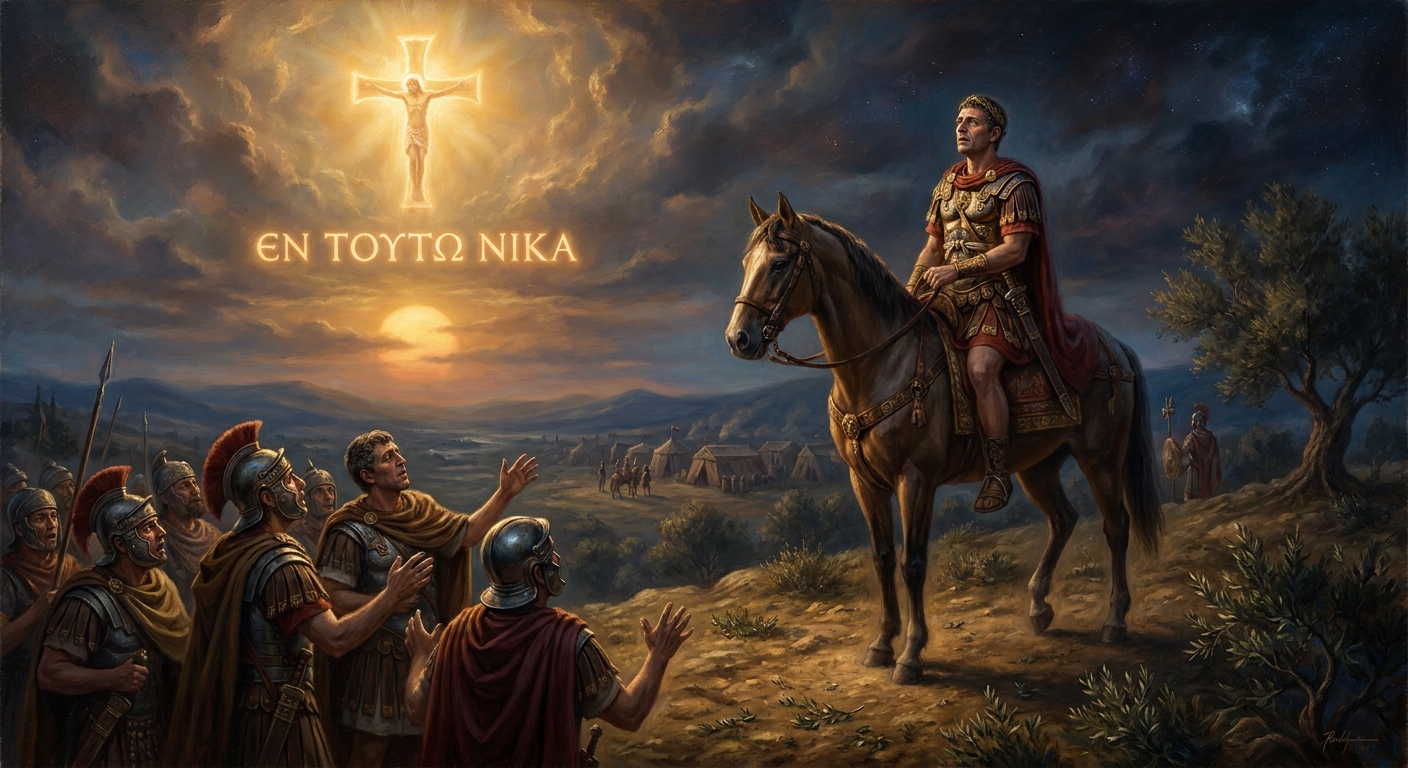
Not a shadow. Not a suggestion. A structure of light, brighter than the sun itself, planted in the sky above it. And beneath the cross, letters assembled from the same burning matter, in Greek: ΕΝ ΤΟΥΤΩ ΝΙΚΑ. In this, conquer.
His officers see it too. He will confirm this later, obsessively, in the decades when the story is already legend and skeptics have had time to form. They all saw it. The army sees it. Thirty thousand men stand in the road looking up at the sky, and the sky has something to say.
That night he dreams of Christ.
He does not know this god well. His family worships Sol Invictus — the Unconquered Sun, the soldier’s deity, the light that cannot be put out. His father Constantius was favorably disposed to the Christians, did not persecute them in the West when Diocletian’s purges ran east, but that is policy, not piety. Constantine has spent his life in the language of omens and auguries and divine favor, but it has always been the old language: birds, entrails, the will of Jupiter.
The figure in the dream is not Jupiter.
It shows him the sign again — the Chi-Rho, ☧, the superimposed first two letters of Christos in Greek — and it says: use this. Put it on your soldiers’ shields. Fight under this sign.
He wakes before dawn.
He gives the order without explaining it.
This is what generals do. He calls the standard-bearers, calls the officers, says: the shields will be marked with this sign before we cross the Tiber. He draws the Chi-Rho himself so there is no confusion. Most of the men do not know what it means. Some of the Christians in the ranks know exactly what it means and are not sure whether to be afraid or grateful.
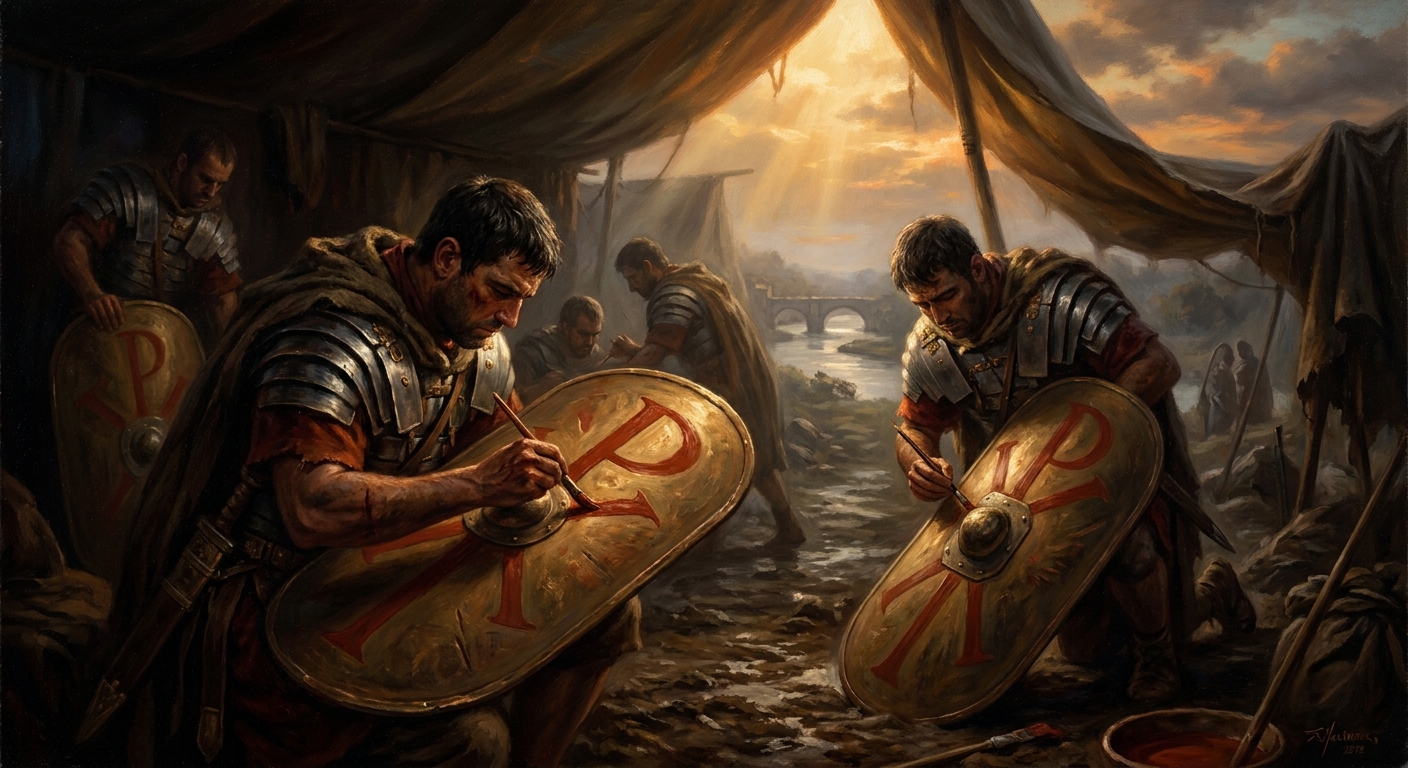
By torchlight, the army paints.
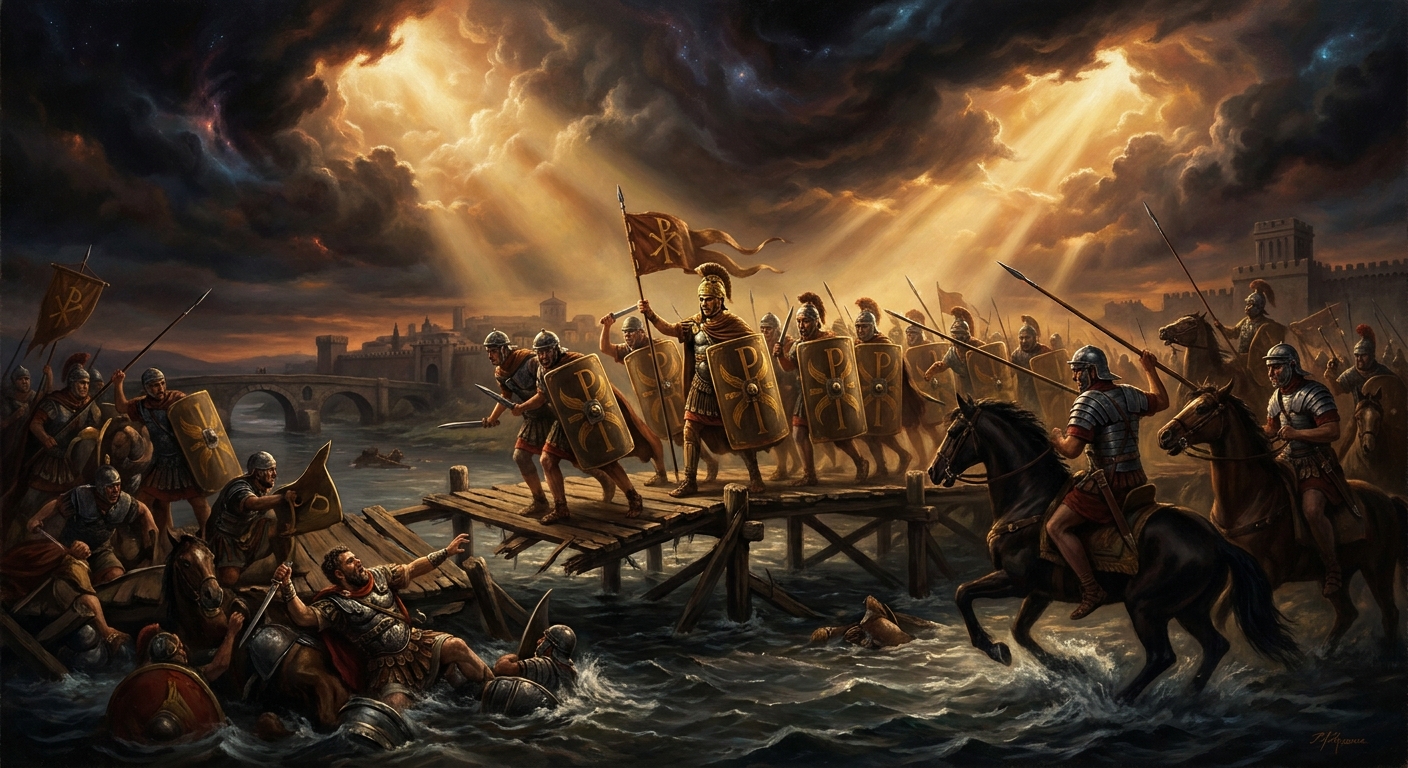
The Chi-Rho goes on thirty thousand shields. It goes on the labarum, the imperial battle-standard. It is a commitment made in paint and lamp-black, announced to no one except God and the army and the morning.
Maxentius has made a mistake.
He holds Rome. He holds the treasury, the grain supply, the old legitimacy of the Senate. He has been emperor of the West for six years, has survived three rivals already, and has no particular reason to leave the walls. His advisers tell him to stay. The auguries — his auguries, the traditional Roman ones — tell him to stay. Rome’s walls have held against harder men than Constantine.
But Maxentius is convinced, by other omens or by pride or by some deeper miscalculation that history does not record, that he must go out and fight in the field. He crosses the Milvian Bridge on the morning of October 28. He positions his army with the Tiber at his back.
It is the single worst tactical decision of the year 312.
Constantine hits the line and it breaks.
His cavalry sweeps the flanks. His infantry, marked with the ☧, holds the center the way Romans can hold a center when the thing they are fighting for is clear. Maxentius’s men had the walls behind them as a comfort; now the walls are behind them as a trap. When the rout begins, they run toward the bridge.
The bridge is a pontoon structure Maxentius has lashed together to supplement the stone one, and it cannot hold the weight of an army in full panicked retreat. The lashings go. The boats separate. Men go into the Tiber in full armor.
Maxentius goes in with them.
He is found later, downstream, and they know him by his armor. They pull him out, take his head, and mount it on a spear. Constantine enters Rome behind it. The Senate meets him in the Forum. He does not go to the temples to sacrifice to Jupiter as every Roman victor has done since the city was a city. He goes to the palace. He does not explain.
He does not need to.
Within a year, he and Licinius issue the Edict of Milan. Christianity is legalized. The persecution is over. Churches can be built, property returned, the faith practiced in daylight. This is not yet the establishment of Christianity as the religion of empire — that takes another century — but it is the hinge. The door has opened.
Within twelve years, Constantine convenes the Council of Nicaea. The bishops of the known world gather under his roof to settle the question of Christ’s nature. He does not vote. He does not have to. His presence is sufficient. The empire is now in the room.
Within twenty-three years of the Milvian Bridge, Christianity is the official religion of the Roman state. The faith that began with twelve men in a province, that survived three centuries of intermittent slaughter, that spread through the trade routes and the slave quarters and the women’s rooms of the empire — that faith now is the empire.
What happened in the sky above the Via Flaminia?
Eusebius, who heard the story from Constantine’s own mouth, says the emperor swore an oath to the truth of it. Lactantius, writing closer to the events, describes the dream but says nothing of the midday vision. Historians since have proposed a solar halo — a rare atmospheric phenomenon where ice crystals refract sunlight into luminous arcs and crosses — and the physics of this is real, documented, capable of producing exactly what the sources describe.
It does not settle anything.
What Constantine saw, whether he saw it in the sky or in his own ambition or in some place where sky and ambition and the numinous all occupy the same coordinates — this is not recoverable. What is recoverable is what he did with it. He painted the shields. He crossed the river. He won. And then, when he had the power to do anything, he used it to open the prisons where bishops sat and return the property that had been seized from the churches.
The vision produced the Edict. The Edict produced the Council. The Council produced a creed that a billion people still say aloud every Sunday.
The sign in the sky is contested. The transformation of history is not. On October 28, 312, the Roman world had one set of possibilities. On October 29, it had another. Every church built in the next seventeen centuries, every crusade launched, every cathedral raised, every Inquisition convened, every missionary dispatched — all of it traces back to a man looking up at the midday sun on a road in northern Italy, seeing something that changed what he thought was possible, and acting on it before he could talk himself out of it.
Empires are made of exactly this: the moment when a man with power believes something new.
Scenes
The cross of light blazes above the midday sun
Generating art… By torchlight the night before battle, legionaries paint the Chi-Rho — ☧, the overlapping first letters of *Christos* — onto their shields
 Generating art…
 Maxentius's cavalry breaks against Constantine's disciplined line
 Generating art…
 Echoes Across Traditions
Entities
- Constantine
- Maxentius
- Christ
Sources
- Eusebius, *Life of Constantine* I.27–32
- Lactantius, *De Mortibus Persecutorum* 44
- Peter J. Leithart, *Defending Constantine* (2010)
- A.H.M. Jones, *Constantine and the Conversion of Europe* (1948)