
The Good Samaritan: Who Is My Neighbor?
~28–30 CE · Public ministry, possibly in or around Judea · Told in response to a legal question; the story is set on the Jericho road, a real descent of roughly 27 kilometers from Jerusalem (800m elevation) down to Jericho (258m below sea level), notorious in antiquity for bandits
Contents
A legal expert asks Jesus a trick question: who qualifies as a neighbor under the commandment to love your neighbor as yourself? Jesus answers with a story. A man is beaten half to death on the Jericho road. A priest passes. A Levite passes. A Samaritan — the despised outsider — stops, binds the wounds, and pays for the recovery. Jesus asks: which one was the neighbor? The expert cannot say the word Samaritan. He says: the one who showed mercy.
- When
- ~28–30 CE · Public ministry, possibly in or around Judea
- Where
- Told in response to a legal question; the story is set on the Jericho road, a real descent of roughly 27 kilometers from Jerusalem (800m elevation) down to Jericho (258m below sea level), notorious in antiquity for bandits
The question is designed to trap.
A lawyer — nomikos, an expert in the Torah and its interpretation — stands up to test Jesus. Teacher, what shall I do to inherit eternal life? Jesus turns the question back on him: what does the law say? The expert recites the two great commandments precisely: love God with all your heart, soul, strength, and mind; love your neighbor as yourself. Jesus says: you have answered correctly. Do this and you will live.
The expert is not satisfied. Luke says he wanted to justify himself, which means the answer was too easy and also too hard — easy to recite, hard to live with, and the hardness is in the word neighbor. So he asks the second question: And who is my neighbor?
The question is not naive. It is a legal question with a long history. The Torah’s command in Leviticus 19:18 uses the word rea’ — a fellow Israelite, a member of the covenant community. The debate among rabbis about whether rea’ extended to resident aliens, to proselytes, to the poor of other nations was already centuries old. The expert is asking Jesus to take a position in that debate. He expects a rabbinic answer.
Jesus tells him a story instead.
A man is going down from Jerusalem to Jericho.
The road is real. It drops 1,000 meters in 27 kilometers, a steep descent through a wilderness of limestone crags, dry wadis, and blind curves that was notorious for ambushes. Josephus calls the region a haunt of robbers. Every person in the crowd listening to Jesus knows exactly what road he means and exactly what the road is like.
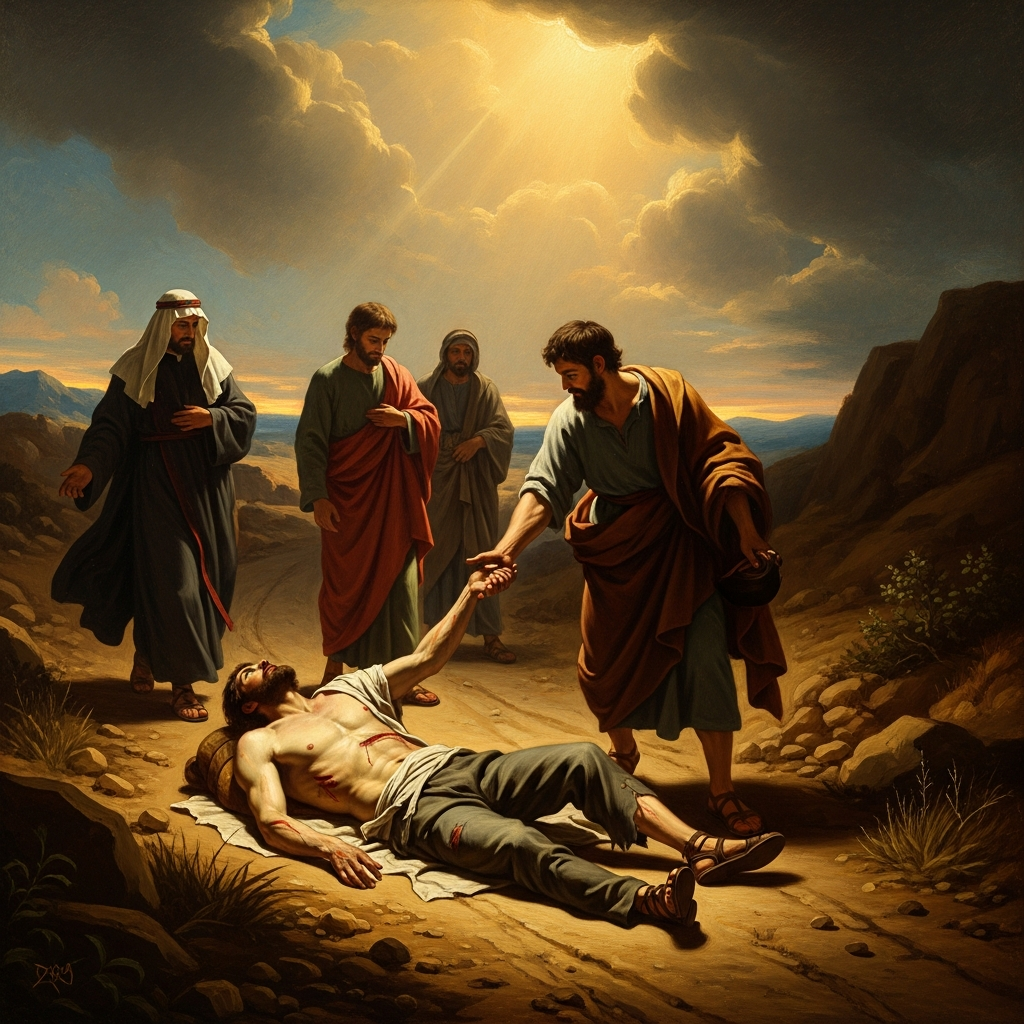
The man is attacked. He is stripped — his clothing gone, which means every visual marker of identity, ethnicity, and social status is gone. He is beaten. He is left half-dead. The Greek is hēmithanē — half-dead, ambiguous, a man who could still be either alive or dead depending on the next hour. And the next person who comes along.
A priest comes down that road.
He sees the man. He passes on the other side. Luke uses the same verb for both the priest and the Levite who follows: they see, and they pass on the other side. The text does not explain their reasoning. The pastoral tradition has spent centuries explaining it for them — the purity laws, the risk of corpse contamination, the assumption that touching a dead or dying man would render them unfit for Temple service. Kenneth Bailey argues these are generous excuses; the priest is heading away from Jerusalem, his service already completed, and he still passes. Whatever the reason, the man who is professionally obligated to represent God’s care for the covenant people looks at a bleeding man in the road and walks on the far side.
A Levite comes. He comes near. He looks. He passes on the other side.
Then a Samaritan comes to where he was.
The crowd hears a certain Samaritan and the word lands like a stone. For a Jewish audience in the first century, Samaritans are the worst possible choice for hero. They are not merely foreigners. They are the specific group that Jews regard with a mixture of contempt and ritual disgust — descendants of the northern tribes who intermarried with the nations brought in by the Assyrian conquest, who worship on the wrong mountain, who accept only the Pentateuch, who have defiled the Jerusalem Temple on at least one occasion, and who are neither Jew nor Gentile but something the taxonomy cannot accommodate. The legal expert asking this question would have known dozens of Samaritan-enemy jokes the way every group knows jokes about the people they despise.
This is the hero.
He comes to where the man is — the Greek verb is erchomai pros, he comes toward him rather than skirting him — and he sees him, and he has compassion. Splanchnizomai: moved in the gut, in the viscera, the ancient world’s seat of deep feeling. He does not deliberate. He does not calculate whether the man is worth helping or who the man is. He sees a human being in extremis and he responds with his body before his mind has time to construct a reason not to.
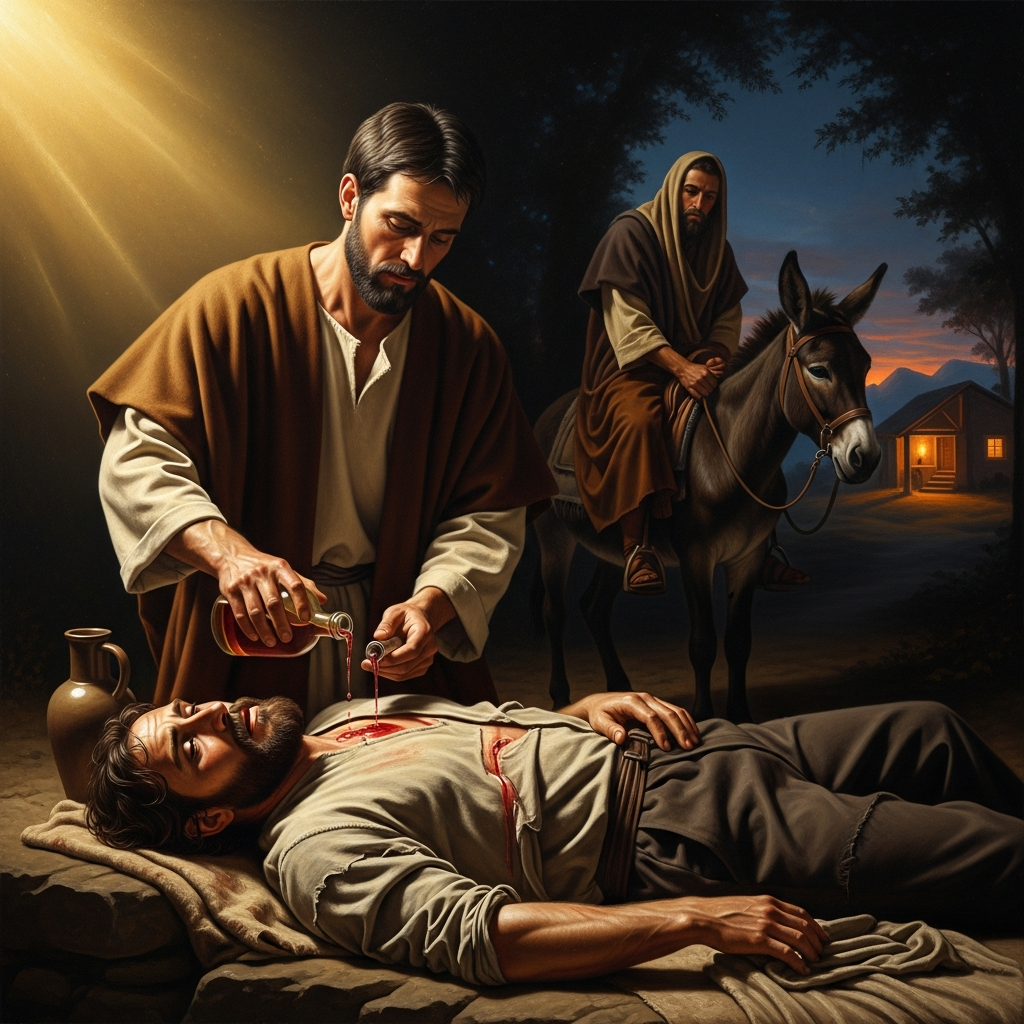
He pours oil and wine on the wounds — oil to soothe, wine to clean and disinfect. He binds them. He lifts the man onto his own animal, which means he walks while the wounded man rides. He brings him to an inn. He takes care of him through the night. In the morning he takes out two denarii — two days’ wages — gives them to the innkeeper, and says: take care of him. Whatever more you spend, I will repay when I come back.
He does not ask who the man is. He does not check whether the man is Jewish, Samaritan, Roman, or Greek. He does not receive any thanks — the man is too badly injured to speak. He pays for a stranger’s recovery out of his own pocket with an open-ended promise to cover additional costs, and then he continues his journey.
Jesus looks at the legal expert. Which of these three, do you think, proved to be a neighbor to the man who fell among the robbers?
The question is the pivot. The expert came in asking: who is my neighbor? The question meant: define the category so I know who falls inside it and who falls outside it, who qualifies for my care and who does not. Jesus has inverted the question: not who is the neighbor to you, but who proved to be a neighbor to the man? The question is no longer about the limits of the obligation. It is about whether the obligation was performed.
The expert cannot say the word.
He has been listening to this story and he knows the answer is the Samaritan. He knows that to say the Samaritan is to admit that the man he has been taught to despise performed the act that the men of his own tradition failed to perform. He cannot make himself say the name. He says: the one who showed mercy.
Jesus accepts the circumlocution. Go, and do likewise.
The command is deceptively short.
Go and do likewise does not mean: go and find a wounded Samaritan to help so you can demonstrate you are not prejudiced. It means: when you encounter suffering, do not ask if the person suffering belongs to the category of people whose suffering you are required to address. The category question is the wrong question, and it will always be the wrong question, because the man in the ditch is already there and the only question the ditch asks is what you do next.
The priest and the Levite in the story are not villains. They are professional religious people who have learned to ask the right questions about purity and obligation, and the questions killed the compassion. The Samaritan has no credentials and no standing in the system the questioner comes from — and he acts immediately, from the gut, without deliberation.
The parable has been used in every century to redraw the line: the good outsider, the unexpected hero, the person the speaker’s tradition despises who turns out to be the one who did the thing. It has been used well and it has been used sentimentally. The sentimental reading makes the Samaritan a feel-good reversal — see, outsiders can be good too. The harder reading is what Jesus actually asks: which one was the neighbor? Not: which one deserves the label. Which one acted like one.
The legal expert asked a definitional question about nouns. Jesus gave him a story about a verb. The answer to “who is my neighbor?” is not a list of qualifying categories. It is: the one who showed mercy. Go and do the verb.
Scenes
Half-dead on the Jericho road — stripped, beaten, robbed, unable to move
 Generating art…
 He pours oil and wine, binds the wounds, sets him on his own animal, brings him to the inn — not the minimum required, not gestures of obligation, but the full measure of what the situation demands
 Generating art…
 Jesus asks: which of these three do you think was a neighbor to the man? The legal expert — who asked the question — cannot say the word
 Generating art…
 Echoes Across Traditions
Entities
- Christ
Sources
- Luke 10:25–37
- Leviticus 19:18
- Mencius (*Mengzi*) 2A:6
- Kenneth Bailey, *Poet and Peasant* (1976)
- Amy-Jill Levine, *Short Stories by Jesus* (2014)