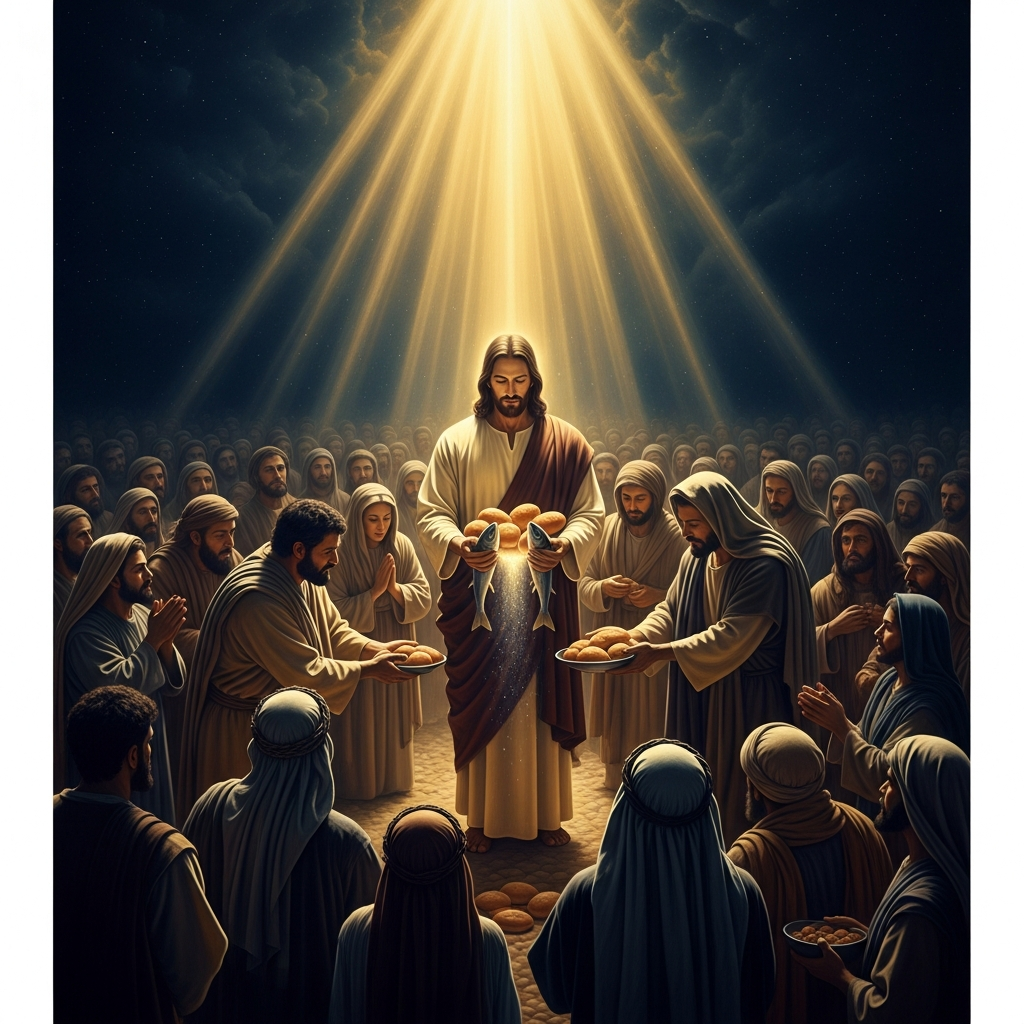
The Prodigal Son: The Father Who Ran
~28–30 CE · Public ministry in Judea and Galilee · Told aloud in the context of Luke 15 — to Pharisees who were grumbling about Jesus eating with sinners
Contents
A younger son demands his inheritance before his father is dead, wastes every coin in a foreign country, and hits rock bottom shoveling slop for pigs. He walks home rehearsing a speech about being unworthy. While he is still far down the road, his father — who has been watching — starts running. The parable has three characters. It is unclear which one you are.
- When
- ~28–30 CE · Public ministry in Judea and Galilee
- Where
- Told aloud in the context of Luke 15 — to Pharisees who were grumbling about Jesus eating with sinners
The younger son goes to his father and states what he wants.
He wants his share of the estate. Now. While the father is alive. In first-century Judea this is not merely rude — it is a way of saying, in the hearing of the village, that you wish your father were dead. Kenneth Bailey’s careful reading of the Palestinian context makes this plain: the request amounts to a social killing. The father would be within every cultural right to refuse, to disinherit, to have the son beaten for the insult. The village expects one of those things.
The father divides the inheritance between them.
He does it quietly. He does it that day or shortly after, because the younger son does not linger — he gathers everything, converts it to portable wealth, and leaves for a distant country. Luke says he squanders the inheritance in asōtos bios — reckless or dissolute living. That is all we are told. The details have been supplied by two thousand years of imagination: wine, prostitutes, gambling, bad friends who vanish when the money does. The text is neutral. The money is gone. That is the fact.
A severe famine hits the distant country. This is the second blow the story does not soften.
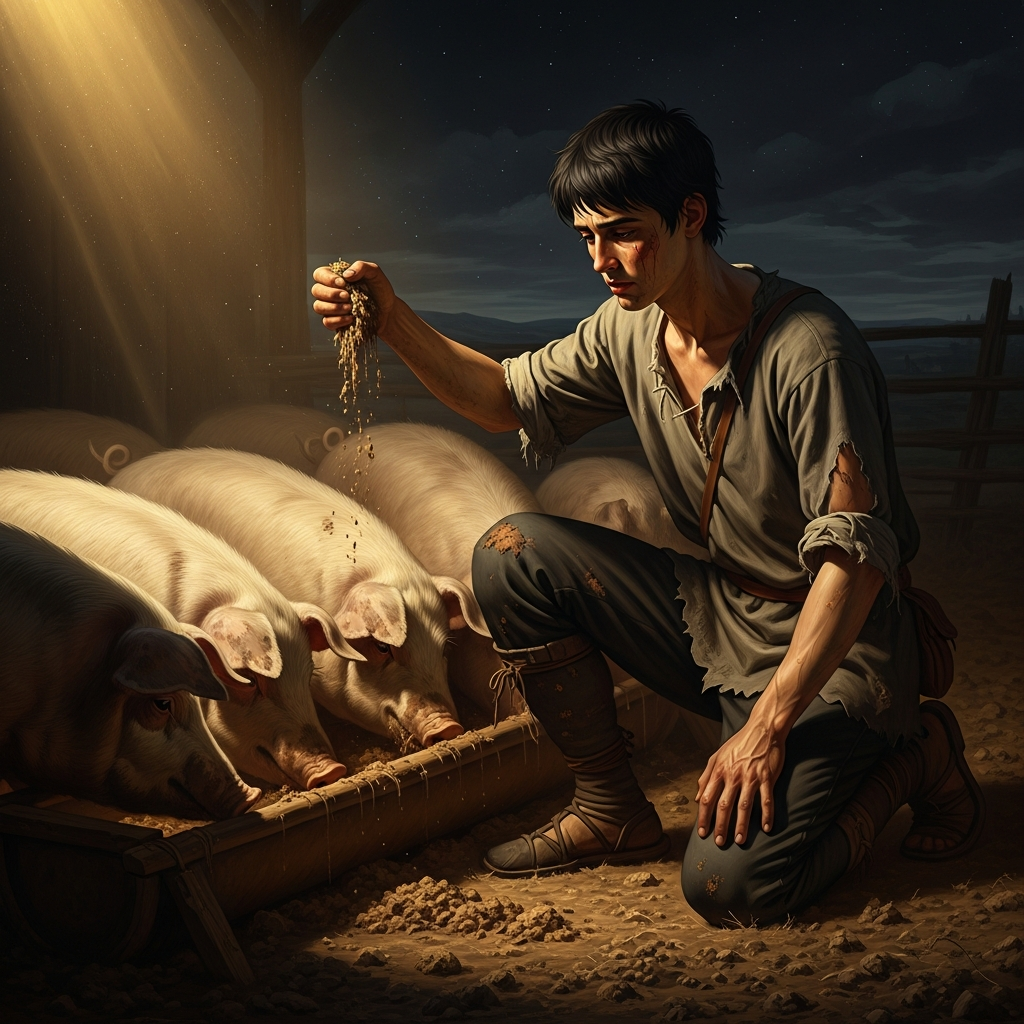
He is now broke in a country experiencing food scarcity, which means he is at the bottom of every available hierarchy. He hires himself out to a citizen of that country, who sends him into the fields to feed pigs. For a Jewish young man, this is not merely poverty — it is ritual contamination. Pigs are the unclean animal. The fields are foreign soil. He is as far from Jerusalem, from Torah, from his father’s table as the geography of the ancient world makes possible.
He is hungry enough to eat the pods he throws to the pigs. No one gives him anything.
Then he comes to himself. Luke’s phrase is exact: eis eauton de elthon — he came to himself. As if he has been away from himself as long as he has been away from home. He runs the numbers in his head. His father’s hired servants have bread to spare. He has none. He will go back. Not as a son — he has used up son. He will ask to be taken on as a hired servant, one of the men who sleep in the workers’ quarters, not the house. He rehearses his speech. Father, I have sinned against heaven and before you. I am no longer worthy to be called your son. Treat me as one of your hired servants. He gets the words right. He starts walking.
The father sees him while he is still far off.
This detail is load-bearing and most readings rush past it. The father sees him while he is still far off — which requires that the father has been watching the road. Bailey argues this is deliberate in the original telling: any Palestinian audience would recognize immediately that a man watching that road daily is a man who has not given up. The son has been gone long enough to convert an inheritance to cash, travel to a distant country, spend everything, work through a famine, and survive to walking-distance from home. That is not days. That is possibly years. And the father has been watching the road.
He runs to meet him. This is the other detail that would register sharply for Luke’s original audience: a dignified elder does not run in public. Running means lifting the robe, showing the legs, abandoning the gravity that rank requires. The father abandons it. He runs down the road and reaches the son while the son is still rehearsing his speech, and he falls on his neck and kisses him. The word is kataphileō — he kisses him repeatedly, effusively, before the first word is spoken.
The son begins his speech. Father, I have sinned against heaven and before you. I am no longer worthy to be called your son—
The father interrupts him. He has already turned to the servants with orders. The best robe. A ring for his hand. Sandals for his feet. Kill the fattened calf. We will eat and celebrate, because this my son was dead and is alive again; was lost and is found.
The son never finishes the speech. The third line — the request to be hired as a servant — is never delivered. It is preempted by the running.
The feast begins. Music. Dancing. The smell of roasting meat reaching the fields.
The elder son is coming in from the day’s work when he hears it. He calls over one of the servants and asks what is happening. Your brother has come, and your father has killed the fattened calf, because he has received him back safe and sound. The elder son goes still. Then he is angry, and he will not go in. His father comes out to him — which is, again, the dignified older man crossing the distance to reach the one who will not approach. He entreats his son. Come in.
The elder son says what he has been not-saying for however many years have passed. Look, these many years I have served you, and I never disobeyed your command, yet you never gave me a young goat, that I might celebrate with my friends. But when this son of yours came — who has devoured your property with prostitutes — you killed the fattened calf for him.
This son of yours. He will not say my brother. He needs the father to hear the grotesquerie of it from the outside. And the grotesquerie is real. He has worked faithfully. He stayed. He kept the household running during the years the younger son was burning through his share. Now the prodigal returns, ruined and smelling of pig, and the father throws a party that the elder son has never been given.
The father’s answer is precise and does not concede the elder son’s point.
Son, you are always with me, and everything I have is yours. This is factually true: the inheritance has already been divided; the elder son’s portion is intact. But the father is also saying something harder than arithmetic. You are always with me. The elder son has been in the house, in the fields, in proximity to the father every day — and has apparently not noticed that this constitutes its own form of daily feast. The party was never necessary because the presence was always there. The tragedy of the elder son is not that he was deprived. It is that he did not know what he had.
It was fitting to celebrate and be glad, for this your brother was dead and is alive; he was lost and is found.
This your brother. The father corrects the pronoun deliberately. Not my son — your brother. The relationship the elder son refused in his speech is the one the father hands back to him in the final sentence.
The parable ends there. The door is open. The music is playing. The elder son is standing outside with his hands still closed. We are not told what he does.
The story is told to Pharisees who are grumbling about Jesus eating with sinners and tax collectors. The younger son is obvious. The elder son is the pointed one — the person who has been faithful by the rules, who has grounds for grievance, and who stands outside the feast because he cannot make himself walk through a door thrown open by a mercy he did not earn and cannot endorse.
Jesus leaves the parable unfinished. The father is still outside, still entreating, still holding the door. Every reader who reaches the last line and thinks “the elder son was right” has just told you which character they are.
Scenes
A Jewish son in a foreign field, feeding pigs he cannot eat, too hungry even to be disgusted — the furthest possible point from home, from the Law, from himself
 Generating art…
 The father sees him while he is still far off — which means he has been looking
 Generating art…
 The elder son stands in the field with his fists closed, hearing the music from inside the house, unable to enter — faithful, furious, and more lost than his brother ever was
 Generating art…
 Echoes Across Traditions
Entities
- Christ
Sources
- Luke 15:11–32
- Lotus Sutra, Chapter 4 (Saddharmapuṇḍarīka-sūtra)
- Rumi, *Masnavi* I.1–18
- Henri Nouwen, *The Return of the Prodigal Son* (1992)
- Kenneth Bailey, *Poet and Peasant* (1976) — on first-century Palestinian context of the father's running