Yahia the True Prophet Baptizes in the Jordan
c. 28-30 CE · the Jordan River, Judea; tradition maintained continuously to present · Jordan River, Judea; subsequently Iraq, Iran, and diaspora
Contents
The Mandaeans remember John the Baptist not as the forerunner of Jesus but as the true prophet himself — the master of the living water who has been betrayed by a student who twisted his teachings into a new religion. For two thousand years, Mandaean priests have performed John's baptism continuously, the only unbroken initiatory tradition in the Western world.
- When
- c. 28-30 CE · the Jordan River, Judea; tradition maintained continuously to present
- Where
- Jordan River, Judea; subsequently Iraq, Iran, and diaspora
The river is cold in the morning before the sun finds it.
Yahia Yuhana — Yahia in Mandaic, the same name the Arabs will call him, the same name the Hebrew Yochanan becomes when it descends through Aramaic into the language of the Nasoraeans — stands in the Jordan at the place where the current runs clearest, where the yardna, the living water, moves over smooth stone without eddying, without pooling, without going still. This matters. The water must be moving. Stagnant water does not carry the prayer upward. Stagnant water is what the world becomes when the light leaves it.
He has been in this river since before dawn.
The first person came at first light — a woman from the village above the ford, carrying a clay lamp she set on the bank before she waded in. He took her hands. He asked the questions: Do you turn from the darkness? Do you turn toward the light? Do you receive the word of life? She answered. He immersed her — masbuta, the sacred submersion, the going-down that is also a going-up — and the river took her under and gave her back, and she wept in the way that people weep when something that has been closed inside them for a long time comes open.
There have been twenty people after her. He is not tired. He is never tired in the river. This is the one thing he knows about himself absolutely: in the Jordan, in the moving water, he is exactly what he is supposed to be.
The Mandaean texts are honest about what Yahia Yuhana is not.
He is not the supreme being. He is not the Father of Lights who sits at the top of the world of light, beyond all the heavens, beyond the uthras and the malwashe and all the celestial beings who populate the divine pleroma of Mandaean cosmology. He is a human being, born of a human mother — Elizabeth, whom the Mandaean texts call Nišbai — and a human father, Zachariah the priest. He was conceived miraculously, in old age, in the way that the texts of the tradition keep returning to: the miraculous birth that is not the same as the divine birth, the holy man who is not a god but is fully and utterly aligned with the light.
He is the manda d-hiia — the knowledge of life — made flesh. Not the knowledge itself, which is divine and eternal, but the living embodiment of the knowledge in a human body, in a specific place and time, doing a specific thing: baptizing in the Jordan.
The Ginza Rba, the great scripture of the Mandaeans, gives him speeches that have the cadence of someone who has thought very carefully about what it means to be the prophet of living water in a world that prefers its religion without the river. He teaches the value of the body — not its denigration, as some Gnostic schools teach. He teaches the specific holiness of flowing water. He teaches that the soul is a stranger in the world of matter but not the enemy of it, and that the way back to the world of light runs through the body, not away from it.
He is standing in the river when the young man from Nazareth arrives.
The Mandaean texts present this moment as the great catastrophe of sacred history.
Yeshu-Mšiha — Jesus the Messiah — comes to Yahia requesting baptism. In the canonical gospels this is the moment of recognition: the dove, the voice from heaven, the beginning of Jesus’s public ministry as authenticated by John. The Mandaean texts keep the structure but reverse the valence entirely.
Yahia baptizes him. He is, after all, the prophet of living water. He does not refuse the people who come to him. He baptizes Yeshu, and what he gives him in that submersion is real: the transmission of light, the connection to the world above, the opening that comes through the water.
What Yeshu does with it is the problem.
He takes what Yahia gave him and builds something new from it — a new teaching, a new community, a new theology that incorporates the baptism as one element among several and eventually reduces Yahia to a supporting role in his own story: the forerunner, the voice in the wilderness, the one who points at someone else. In the Mandaean reading this is not merely a theological error. It is a personal betrayal. The student has exceeded his authorization and turned the teacher’s gift into an advertisement for himself.
The Mandaean liturgy for the Day of the River, Dihba Rba, contains prayers that speak of Yahia’s grief at this. He who gave and was diminished by the giving.
He continues baptizing.
This is what the Mandaean tradition holds most dear — not the confrontation with Jesus, not the theological controversy, not the martyrdom, but the continuity. Yahia Yuhana baptizes in the Jordan until Herod Antipas has him arrested and beheaded, and then his disciples carry the practice forward, and their disciples carry it forward, and theirs carry it forward, across the desert from Judea into Babylonia, across the centuries of Persian rule and Roman rule and Parthian rule and Sassanid rule and Arab conquest and Mongol invasion and Ottoman governance and British mandate and Ba’athist dictatorship and the sectarian violence that has reduced the Mandaean community of Iraq from fifty thousand to perhaps five thousand in the last three decades.
Every Mandaean priest must perform masbuta in flowing water. The water must be yardna — literally, Jordan, but by extension any river, any moving stream that connects to the world’s arteries of living water. Before every major ritual, before weddings, before ordinations, after contact with death, after illness, before prayer of certain kinds — the Mandaean must enter the moving water and be immersed.
The priest wears white. Always white: the color of the world of light. He says the ancient prayers in Mandaic, the Eastern Aramaic dialect that Yahia’s disciples spoke, that no community has spoken as a mother tongue for over a thousand years but that Mandaean priests still use for ritual because the language of the baptism is the language in which the baptism was given. You do not translate a gift. You transmit it in the form in which it was received.
The Ginza Rba gives Yahia Yuhana a death scene.
He is in prison. He has been arrested for speaking against Herod’s marriage — the canonical account is close enough. He knows what is coming. He asks the utra Anush — the celestial being of healing light who serves as his divine companion and helper throughout the Mandaean texts — to come and receive his soul when the time comes.
Anush descends from the world of light. He comes to Yahia in his cell in the form of a young man, a helper, bringing the specific comfort of the world above: You have done your work. The water received the prayers. The sparks in the bodies of the people you baptized know now where they came from. This is enough. Come.
Yahia is not afraid. He is tired, and his hands smell of river clay, and he can hear the guards outside the door, but he is not afraid. He knows what the water knows, which is where it goes and where it comes from. He knows the soul is stranger in the world of matter but not imprisoned there. He knows the way back.
Salome comes with the platter.
Anush is already there.
The Mandaeans who survived Iraq are scattered across Australia, North America, New Zealand, Sweden. There are perhaps 60,000 to 100,000 of them in the world — estimates vary because counting a diaspora is difficult and because many Mandaeans have learned, through two millennia of minority existence among hostile majorities, to be discreet about what they are.
They carry the baptism with them into exile. A Mandaean priest in Sydney will seek the closest river — not the ocean, not a pool, not a man-made lake; it must be flowing, it must be moving, it must be yardna. He will enter it in white robes in the Australian winter if the liturgical calendar requires it. He will say the ancient prayers in the language of Yahia’s disciples. He will immerse the worshipper three times and speak the words of restoration.
The Parramatta River is not the Jordan. The priest knows this. The practice knows this. The tradition holds that all living water is connected — that the yardna of every river runs back, underground, through the world’s arteries, to the source of all living water, the river of light that flows from the world above through all the worlds below.
Yahia Yuhana is in all of them.
The Mandaeans’ existence is the most inconvenient fact in the history of John the Baptist. They cannot be explained away as a later invention: they have liturgical texts, a priestly hierarchy, a living language, a continuous practice, and a tradition of endogamy that has preserved their community across twenty centuries of hostile environments. They are not converts to a John-veneration movement. They are the John-veneration movement, unbroken, waiting for the rest of the world to notice.
Their testimony about Jesus is not what Christians want to hear. But their testimony about John — about what it means to be the living transmission of a practice, the holder of a gift that must be given and given and given in perpetuity without diminishment — is among the most astonishing things the history of religion has produced.
They go into the river. They come out. They go back in. The water is always moving. The prayer is always the same.
Yahia Yuhana is still there.
Scenes
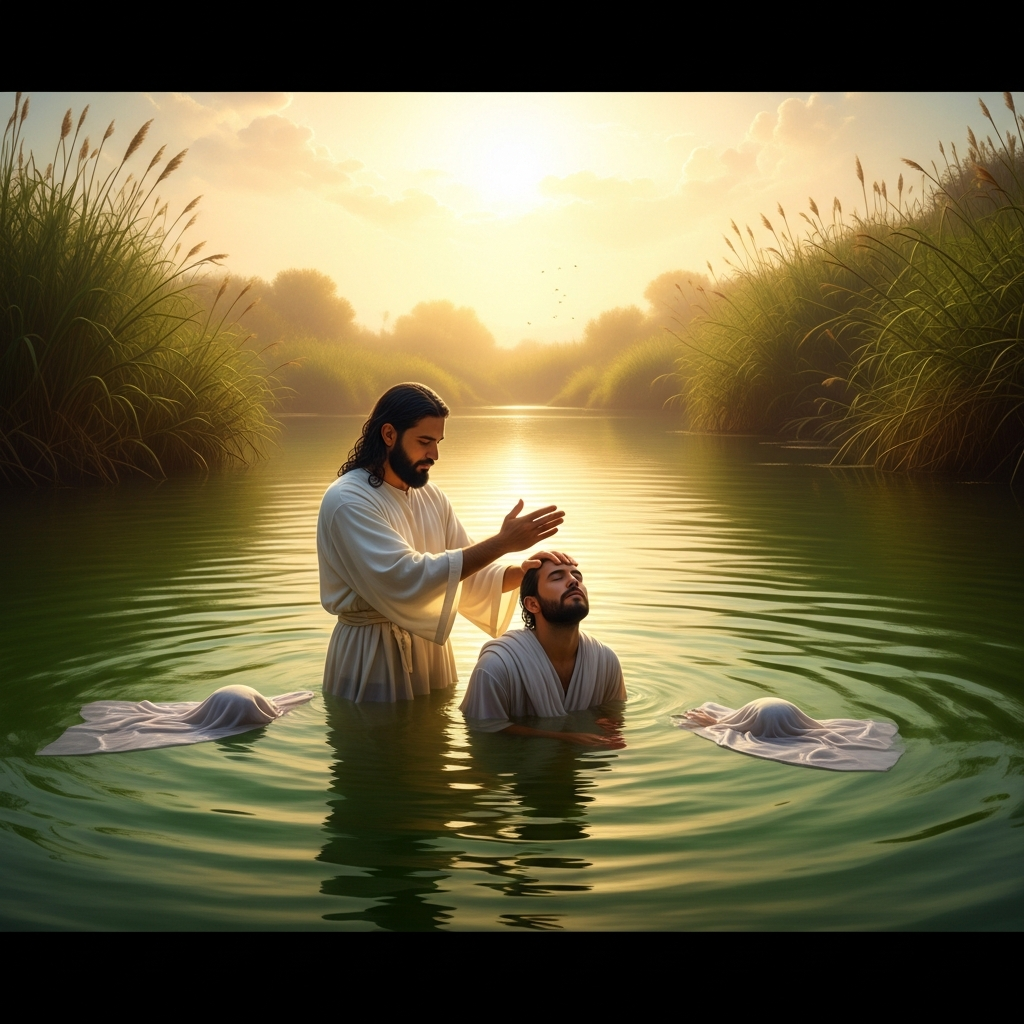
Yahia Yuhana standing waist-deep in the green waters of the Jordan at dawn, white robes floating around him, both hands raised over the head of a kneeling figure being immersed — the light golden, the riverbanks lush with reeds, the sky enormous
 Generating art…
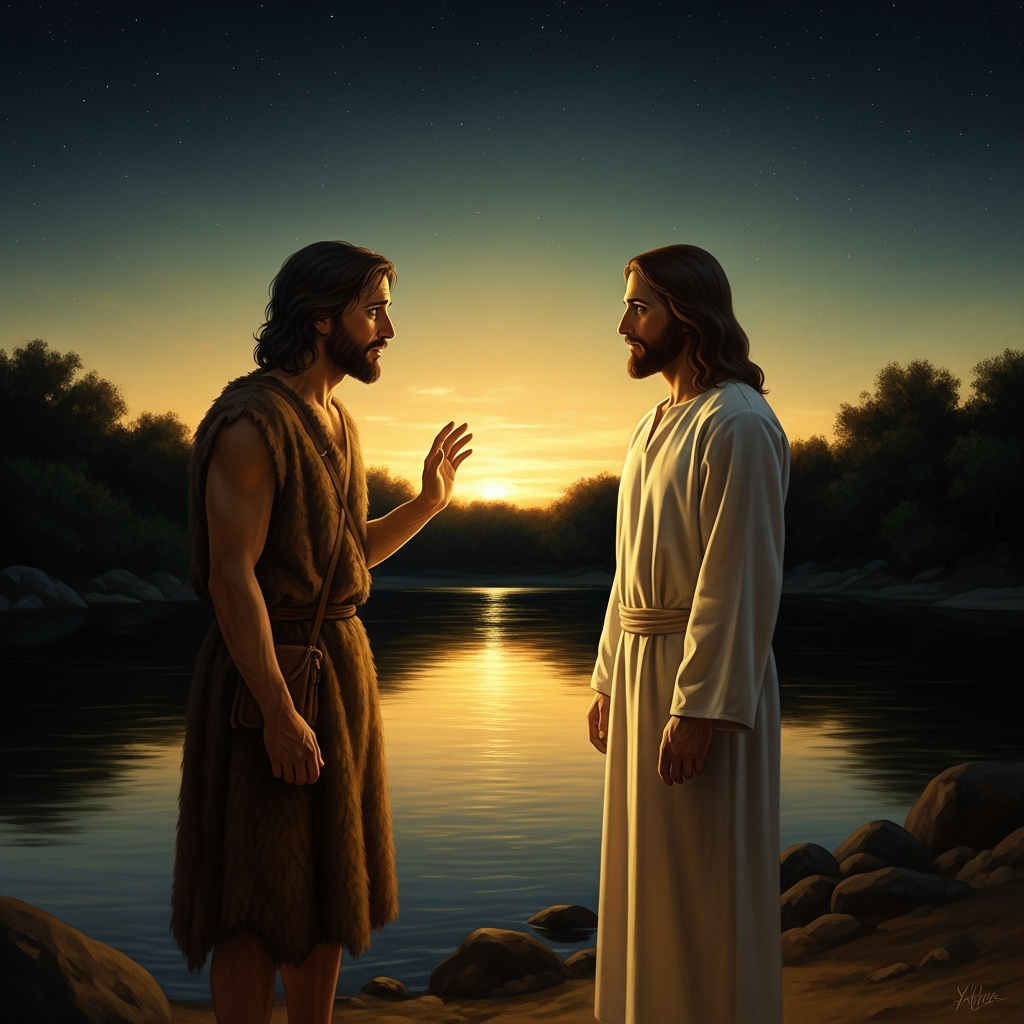
 Yahia and Yeshu facing each other on the riverbank at dusk, the Jordan behind them, Yahia in the posture of a teacher about to refuse — his hand raised slightly, his expression troubled, knowing what this encounter will cost
 Generating art…
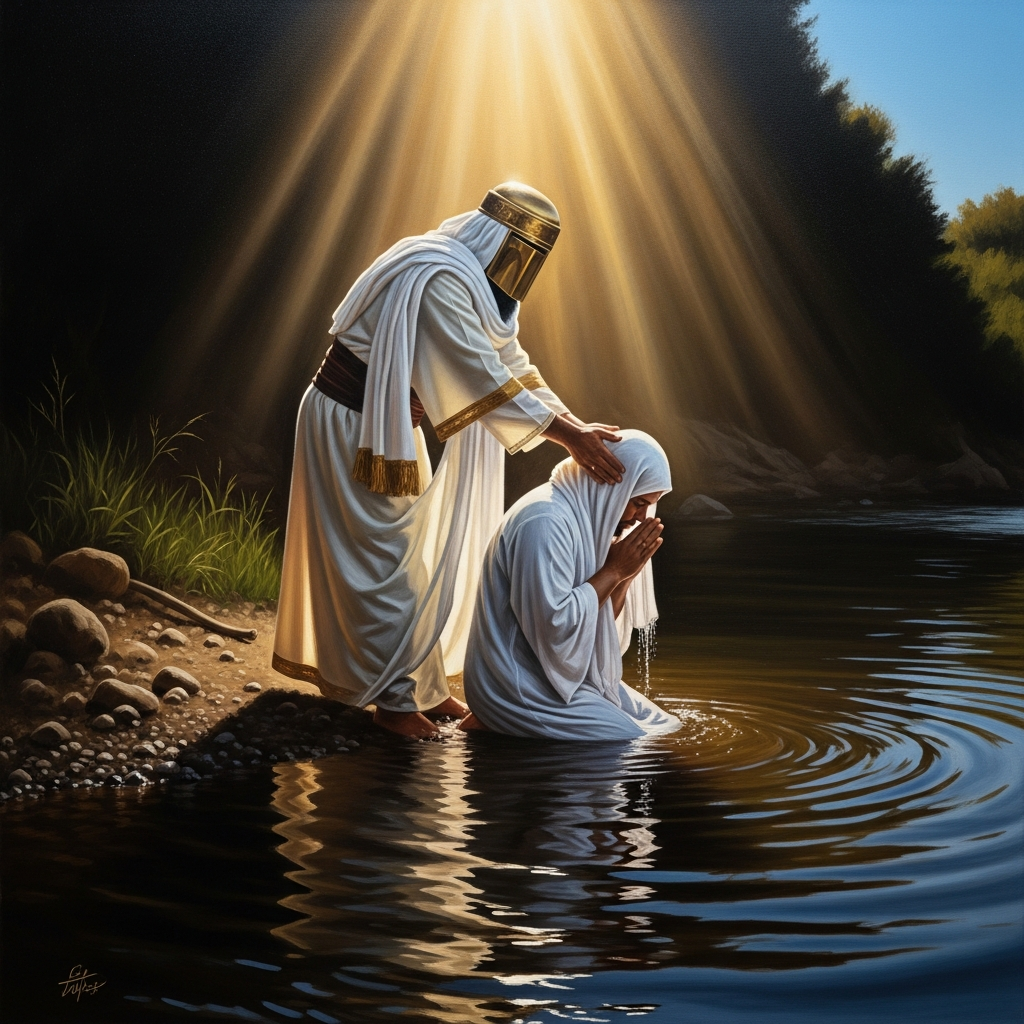
 A Mandaean priest in white robes performing masbuta at the edge of a river, immersing a kneeling worshipper in flowing water under a clear sky — the same ritual unchanged for two thousand years, somewhere in Iraq or diaspora
 Generating art…
 Echoes Across Traditions
Entities
- Yahia (John the Baptist)
- Yeshu (Jesus)
- Anush-Uthra
- Miriai
- the Ginza Rba
Sources
- *Ginza Rba* (The Great Treasure; Mandaean scripture, compiled ~7th century CE but preserving earlier material) in Jorunn Jacobsen Buckley (trans.), *The Mandaeans: Ancient Texts and Modern People* (Oxford University Press, 2002)
- E.S. Drower, *The Mandaeans of Iraq and Iran* (Clarendon Press, 1937)
- Jorunn Jacobsen Buckley, *The Mandaeans: Ancient Texts and Modern People* (Oxford University Press, 2002)
- Charles Haberl and James McGrath (trans.), *The Mandaean Book of the Zodiac* (Gorgias Press, 2019)
- Jason BeDuhn, *The Manichaean Body* (Johns Hopkins University Press, 2000)