Pachomius and the Voice at Tabennisi
c. 320 CE (the founding vision); 292–348 CE (his life) · Tabennisi, in the Thebaid (Upper Egypt), on the east bank of the Nile, about six hundred miles south of Alexandria
Contents
A former Roman soldier, recently baptized, is living as a hermit in the Egyptian Thebaid in 320 CE under the guidance of an old desert father named Palamon. One evening a voice comes to him in the silence — or a vision; the sources hesitate — and tells him to stay where he is and build a dwelling, because many will come to live with him for the saving of their souls. He builds the dwelling. The first monastery in human history begins.
- When
- c. 320 CE (the founding vision); 292–348 CE (his life)
- Where
- Tabennisi, in the Thebaid (Upper Egypt), on the east bank of the Nile, about six hundred miles south of Alexandria
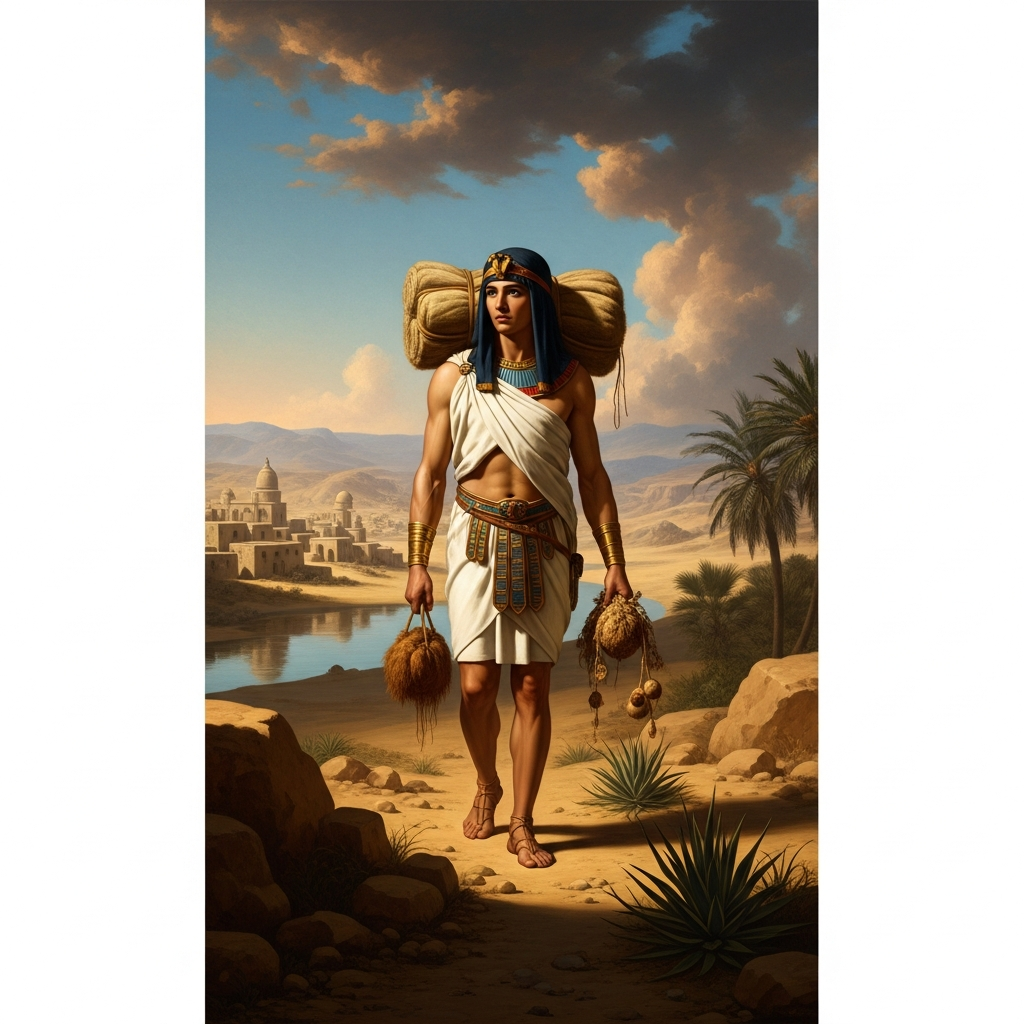
He is twenty years old when he is conscripted.
The empire is in civil war — Constantine and Maximinus and Licinius are fighting each other over the wreckage of Diocletian’s tetrarchy — and the recruiting officers are taking every able-bodied young man they can find in the Egyptian villages. Pachomius is from a pagan family in the Thebaid, the long Upper Egyptian region that runs along the Nile six hundred miles south of Alexandria. He has never been a soldier. He does not want to be a soldier. The choice is not his.
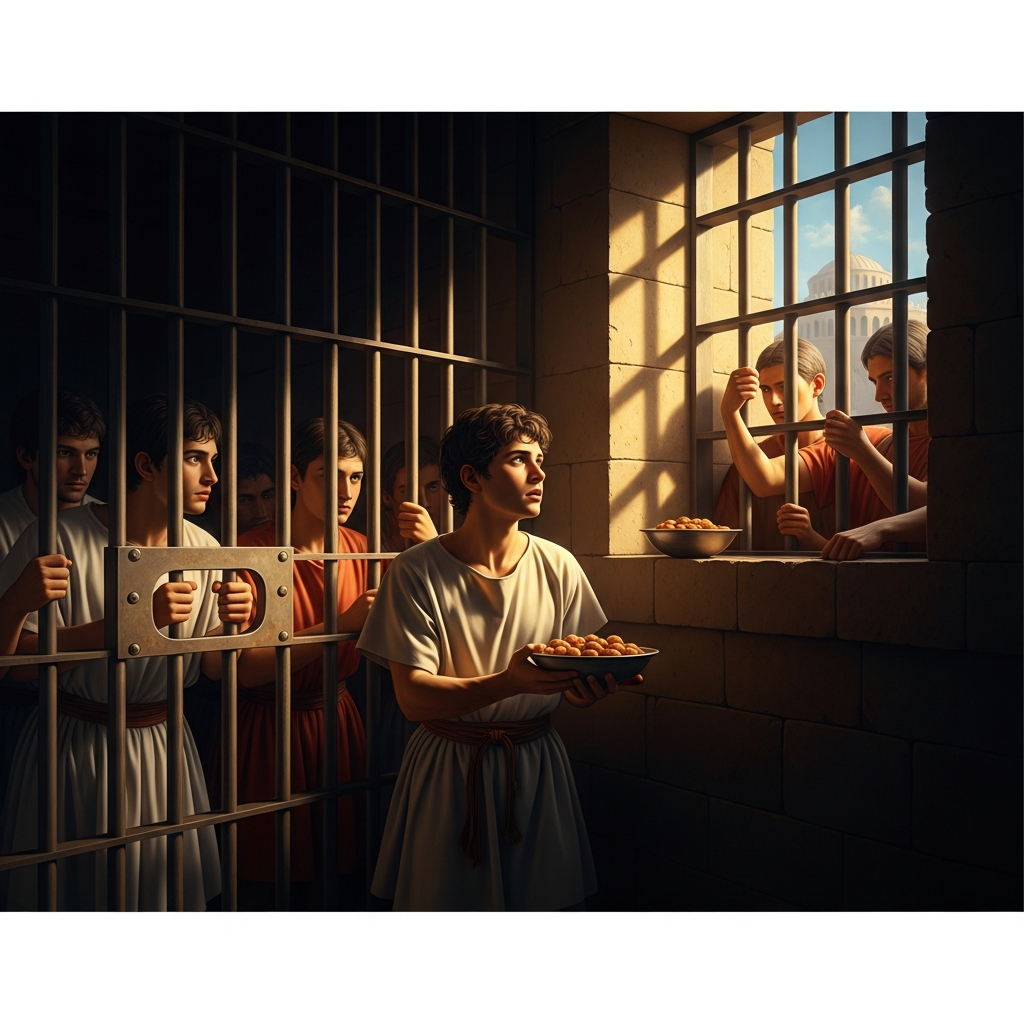
They march the new conscripts north under guard, locking them at night in prison-barracks to prevent desertion. At Thebes, the largest city of the region, the conscripts are held for several days while the supply train forms up. They are given the minimum to keep them alive: water, hard bread, the occasional bowl of grain.
On the second night, food appears.
It is not the army’s food. Local people are bringing it through the prison gate — bread, fruit, jars of beer, blankets — and distributing it to the prisoners. They are quiet about it. They expect nothing in return. They look at the conscripts with a kind of attention Pachomius has never received from a stranger.
He asks who they are.
They are Christians. He has heard the word. He has not until this moment understood what it meant. They are bringing food to prisoners they do not know because the prisoners are made in the image of God and because, they say, this is what their teacher commanded. Pachomius watches them come back the next night and the next.
He vows that if he survives the campaign, he will become whatever they are.
The campaign ends within months. The conscripts are released. Pachomius walks back south, finds a Christian community at Chenoboskion, and asks for baptism. He is not sure exactly what the religion teaches. He knows only that he met something the night the food arrived in the prison, and he intends to find his way back to it.
He is baptized. He apprentices himself to an old hermit named Palamon.
Palamon is a desert father of the strict school — disciplined, exacting, fluent in fasting, suspicious of converts who come in too quickly and too eagerly. He tests Pachomius. He warns him that the desert life is harder than the boy thinks. Many have come, Palamon says, and few have stayed. Do not begin what you cannot finish. Pachomius says he wants to stay. Palamon takes him in, and for seven years Pachomius lives the standard solitary ascetic life: long fasts, vigils, manual work, the slow education of the body in the absence of sleep and the absence of food and the absence of conversation.
He learns the practice. He has the temperament for it.
But he is also watching the limits of it.
The hermits around Palamon are doing fine. They are men who have been chosen by the desert and who can survive its weight. Pachomius, who is unusually clear-eyed about other people, can see that they are not typical. The pilgrims who keep arriving from the Nile valley wanting to imitate Antony and Palamon are mostly not going to survive it. They will quit. They will go mad. They will come out broken. The solitary life is for a few. The instinct of most people is to live with other people.
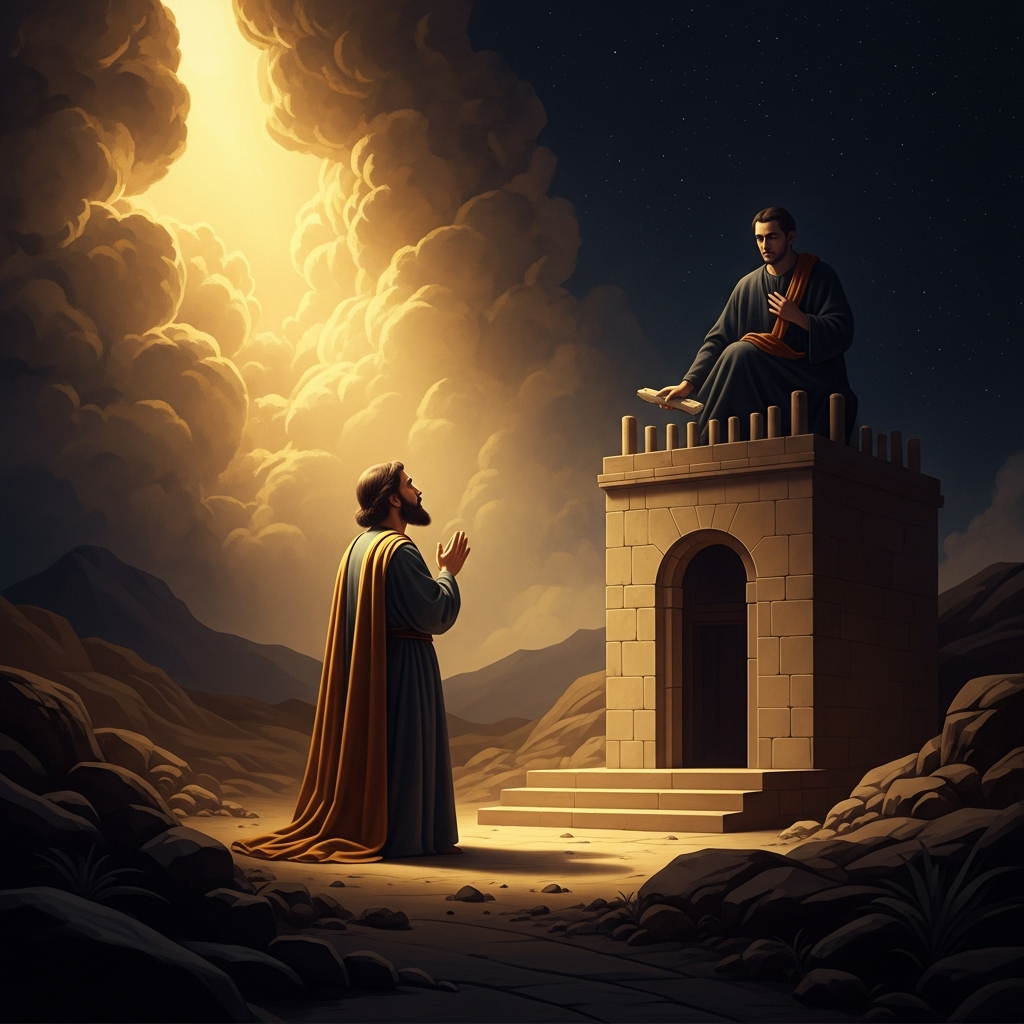
He is at Tabennisi when the vision comes.
He has moved there from Palamon’s site after the old man’s death, looking for a deeper solitude near an abandoned village on the riverbank. He is alone. He is praying. The sources — there are several lives, in Greek and Coptic and a Latin translation by Jerome — describe what happens differently, as if the tradition itself is unsure how to register it. Some say a voice speaks to him. Some say a figure appears. Some say a brilliance fills the small clearing where he is sitting. The content is the same in every version.
Stay here and build a dwelling. Many will come to you to be monks for the saving of their souls.
He builds the dwelling that night. A simple rectangular structure, walls of mud-brick and reed mats, a single room. He waits.
The first to arrive is his brother John.
John is also a recent Christian, also drawn to the ascetic life, and he wants to live with Pachomius. The two of them set up together. John, however, has imagined the project as a return to the older solitary pattern: he wants to live near his brother but separately, each in his own cell, each on his own schedule. Pachomius wants something different. He has had a vision and the vision was not about solitude. He wants a community.
There is friction. John eventually relents and submits to his brother’s vision. Then more arrive. Three young men come down from the village. Then five more. Then eight. Within two years there are thirty men sharing the small compound at Tabennisi.
Pachomius begins to write the Rule.
This is the hinge moment. Antony had no Rule. Palamon had no Rule. The desert tradition before Pachomius is a tradition of charismatic teachers transmitting an unwritten practice through one-on-one apprenticeship. The teacher said do this, and you did it, and either you understood or you did not. There was no document. There was no schedule. There was no policy.
Pachomius writes a document. He writes a schedule. He writes policy.
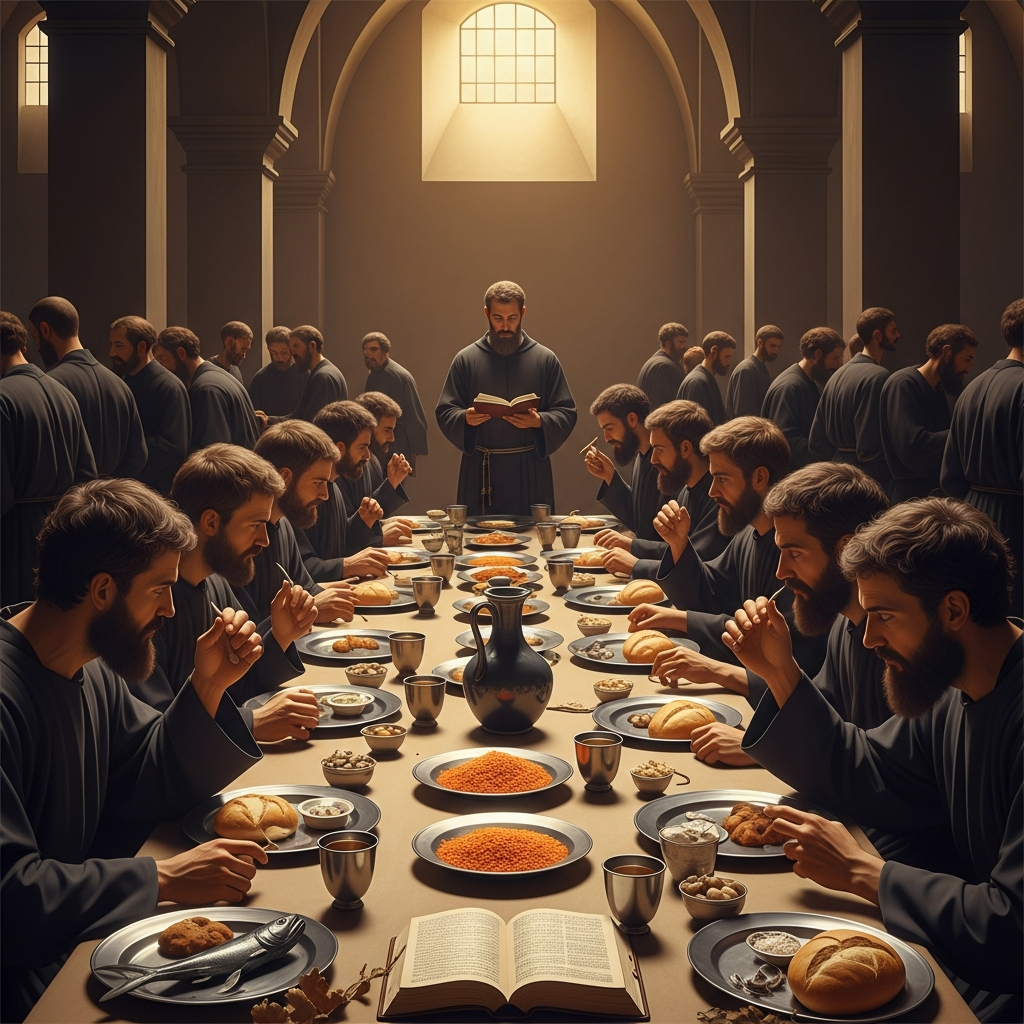
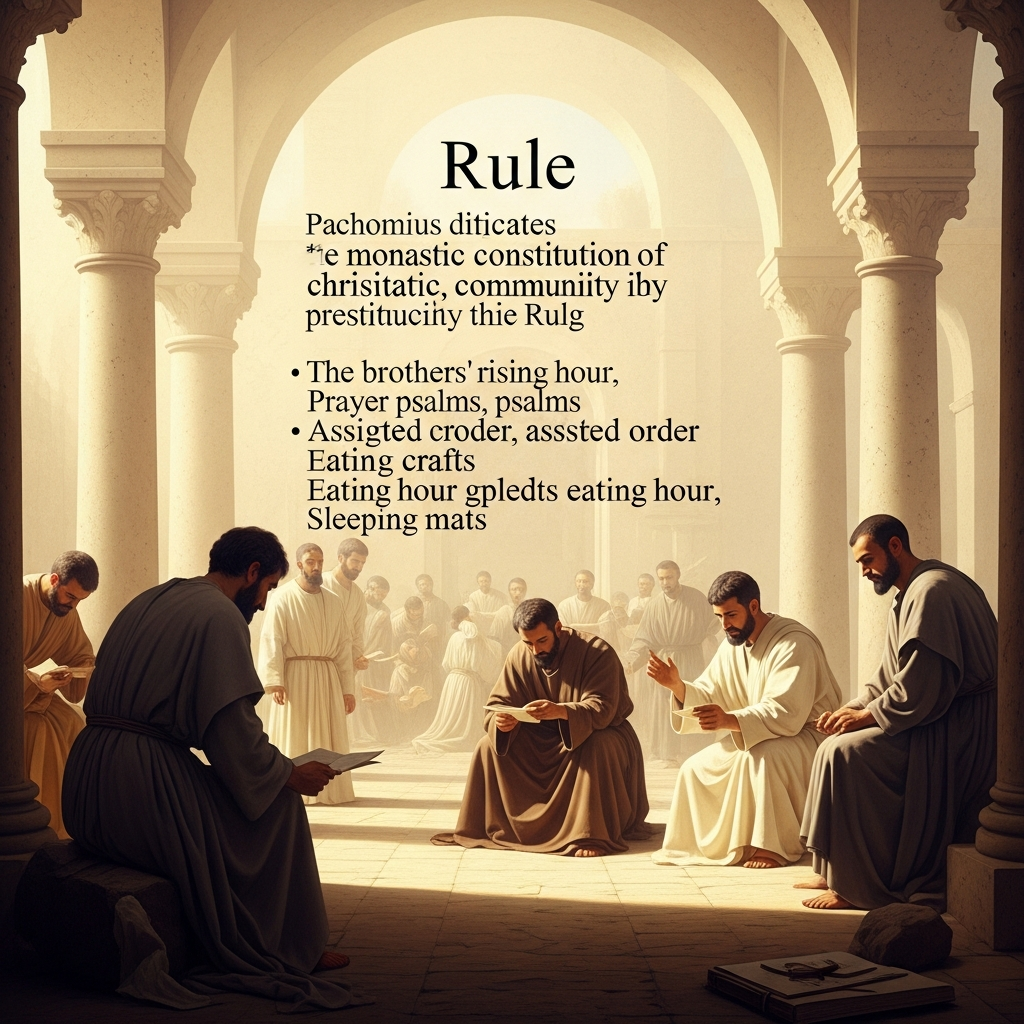
The brothers will rise at the third hour of the night. They will pray these psalms in this order. They will work in their cells at these crafts — basket-weaving, rope-making, copying — and the income from the work will go to the community treasury. The whole community will eat together at the sixth hour and the eleventh hour, in silence, while one brother reads aloud from scripture. Twice a week the whole community will gather for catechesis from the abbot. Each cell will sleep three. The bedding will be a rush mat on the floor and a single woolen blanket. There are detailed regulations for sickness and travel and the admission of new brothers and the disciplining of disorder. The Rule is the first written constitution of a religious community in Christian history.
The community grows.
By 330, ten years after the vision, the population at Tabennisi has reached several hundred. Pachomius has founded a second monastery a few miles away, and a third, and a fourth. By his death in 348, there are nine male monasteries and two female ones, with somewhere between three thousand and seven thousand monks and nuns total. (The numbers vary in the sources; Palladius says seven thousand at Tabennisi alone, which is probably exaggerated but indicates the scale.)
His sister Mary founds the first women’s monastery. The sources describe Pachomius writing her a Rule, parallel to the men’s, organizing the women’s community on the same lines: shared work, shared meals, common Rule, an abbess who guides the community. Pachomius and Mary, the brother and sister, become the joint founders of male and female cenobitic life simultaneously. The convent is built at a deliberate distance, separated by water, and the men and women interact only at funerals — a Mary nun is buried with her sisters at the convent, with the brothers attending across the water — but the institutional structure is the same on both sides.
The work output is enormous. The monasteries become economically self-sufficient and then surplus-generating. The brothers grow grain, raise livestock, weave linen and rope and baskets, copy manuscripts. They distribute food to the poor of the surrounding villages. They take in orphans and travelers. They create the first hospital. They create the first school open to anyone who can show up. They create, as a side effect of their religious life, an entire alternative civil society that has none of the violence of the Roman state and most of its administrative competence.
Pachomius dies in 348 of plague.
A wave of sickness sweeps the monasteries — the close communal living that is the institutional advantage becomes, in plague years, the institutional liability — and Pachomius, going from cell to cell to nurse the sick, contracts it himself. He dies after several days. His successor Horsiesios takes over. The community he leaves behind has institutional momentum that will continue for centuries.
The pattern travels.
A young Latin-speaking monk named John Cassian comes to Egypt at the end of the fourth century, lives for a decade among the Egyptian monks, and goes back to Marseille in southern Gaul to write his Institutes and Conferences — the books that introduce the Pachomian and other Egyptian patterns to the Latin West. Two centuries after Cassian, an Italian monk named Benedict of Nursia takes Cassian’s writings and the Pachomian tradition they carried, and writes the Rule of St. Benedict. Benedict’s Rule will govern Western monasticism for fifteen hundred years.
Every Benedictine monastery, every Cluniac reform, every Cistercian foundation, every Trappist house, every cathedral school that grew out of monastic teaching, every medieval hospital, every preserved manuscript — the entire civilizational achievement of Western monasticism — descends in an unbroken institutional line from a former soldier in Upper Egypt who heard a voice and built a dwelling.
Pachomius did not invent the desert life. Antony had already done that, and the Buddhists and the Essenes and a dozen other traditions had done it before Antony. Pachomius invented the institution that could carry the desert life into history.
The genius was the recognition that solitude is not for everyone, that most people who want what the hermits had cannot survive the route the hermits took, and that the alternative is not a watered-down hermit life but a different kind of life — a life of structured community, where the demons one fights are not the wild apparitions of a fortress in the dunes but the ordinary failures of living with other people, and where the discipline is held in place not by the heroic individual but by the Rule and the abbot and the brothers.
He saw what the long-term institutional pattern would have to be, and he wrote it down. Sixteen hundred years later, monks and nuns are still rising at the third hour of the night to pray the psalms in the order he set, eating in silence while one of them reads aloud, working at crafts whose income goes to the common purse, and trying — with the imperfections of any human community — to live the life that came to him in a vision at Tabennisi in 320, when he was alone on the bank of the Nile and a voice told him not to leave.
Scenes
Pachomius, twenty years old, conscripted into the Roman army during the civil wars, locked in a prison-barracks at Thebes with other recruits
 Generating art…
 The vision at Tabennisi
Generating art… The first refectory
 Generating art…
 Pachomius dictates the *Rule*
 Generating art…
 Echoes Across Traditions
Entities
- Pachomius
- Palamon
- Mary, sister of Pachomius
- Horsiesios
- John Cassian
Sources
- *Pachomian Koinonia* (3 vols., trans. Armand Veilleux, Cistercian Studies, 1980–82) — collects the Greek, Coptic, and Latin lives and rules
- Palladius, *Lausiac History* (c. 419 CE)
- Derwas Chitty, *The Desert a City* (1966)
- Philip Rousseau, *Pachomius: The Making of a Community in Fourth-Century Egypt* (1985)
- James Goehring, *Ascetics, Society, and the Desert* (1999)