The Council of Nicaea: The Vote That Made Christ God
May–June 325 CE · Nicaea, Bithynia (modern Iznik, Turkey) — the imperial palace Constantine built for the council
Contents
It is May 325. Three hundred bishops, many of them carrying scars and missing eyes from Diocletian's persecutions, sit under the roof of an emperor who has built them a palace. The question on the table is not academic. It is whether Christ is God or only the highest of God's creatures. The answer they vote will be recited by a billion people every Sunday for the next seventeen centuries.
- When
- May–June 325 CE
- Where
- Nicaea, Bithynia (modern Iznik, Turkey) — the imperial palace Constantine built for the council
He arrives by ship.
Constantine has spent the spring crossing his empire to reach Bithynia, and the bishops have been gathering for weeks — some on horseback, some on donkey, some carried in litters because they cannot walk anymore on legs broken in the prisons. Many of them carry their persecution on their bodies. Paphnutius of Egypt is missing an eye and the tendons of one leg. Paul of Neocaesarea cannot use his hands; the Roman state cut every nerve in them. Some of the older men were arrested under Diocletian only twelve years ago and remember the work in the porphyry mines.
These are the men Constantine has summoned to define Christ.
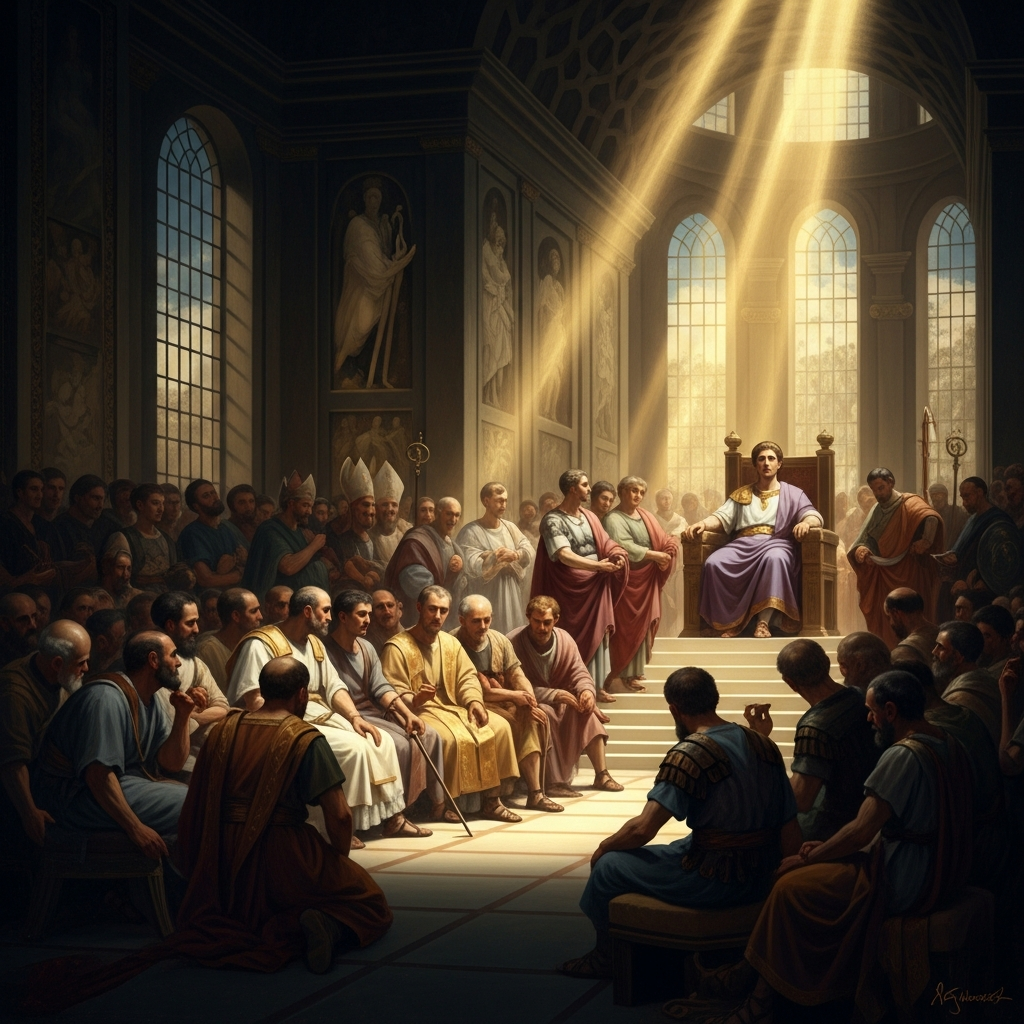
The hall he has built for them is enormous, lined with imperial purple, with a throne at the head where the emperor will sit. He sits below the dais, in a deliberate gesture of subordination to the bishops. He kisses the wounds. He weeps over Paphnutius’s blind eye. The men he is honoring are men his predecessors tried to kill, and the strangeness of this — the persecuted church seated at the right hand of the empire that persecuted it — is not lost on anyone in the room.
The agenda is short. The crisis is one priest in Alexandria.
Arius is tall and thin and popular.
He has the great Egyptian gift for catechesis: he sets his theology to song, and the dockworkers of Alexandria sing his hymns while they unload grain. The hymns teach what Arius teaches. There was a time when the Son was not. The Father alone is unbegotten, eternal, without origin. The Son is the first and greatest of God’s creations — the instrument through whom God made everything else — but he is a creature. He had a beginning. He is not God in the way the Father is God.
The teaching is enormously appealing. It preserves Jewish monotheism. It explains why Christ prays to the Father, why he says the Father is greater than he, why he does not know the day or the hour. It makes sense of the gospel in a way the alternative struggles to do.
Half the empire’s bishops, perhaps more, are inclined toward some version of it.
Bishop Alexander of Alexandria has condemned Arius. A regional synod has condemned him. Arius has gone on teaching. He has powerful protectors — Eusebius of Nicomedia, the bishop closest to the imperial court, supports him. The dispute has become a riot. In Alexandria the streets are unsafe. Constantine, who came to Christianity for what it could give him politically, did not bargain for this. He needs the question settled.
So he settles it.
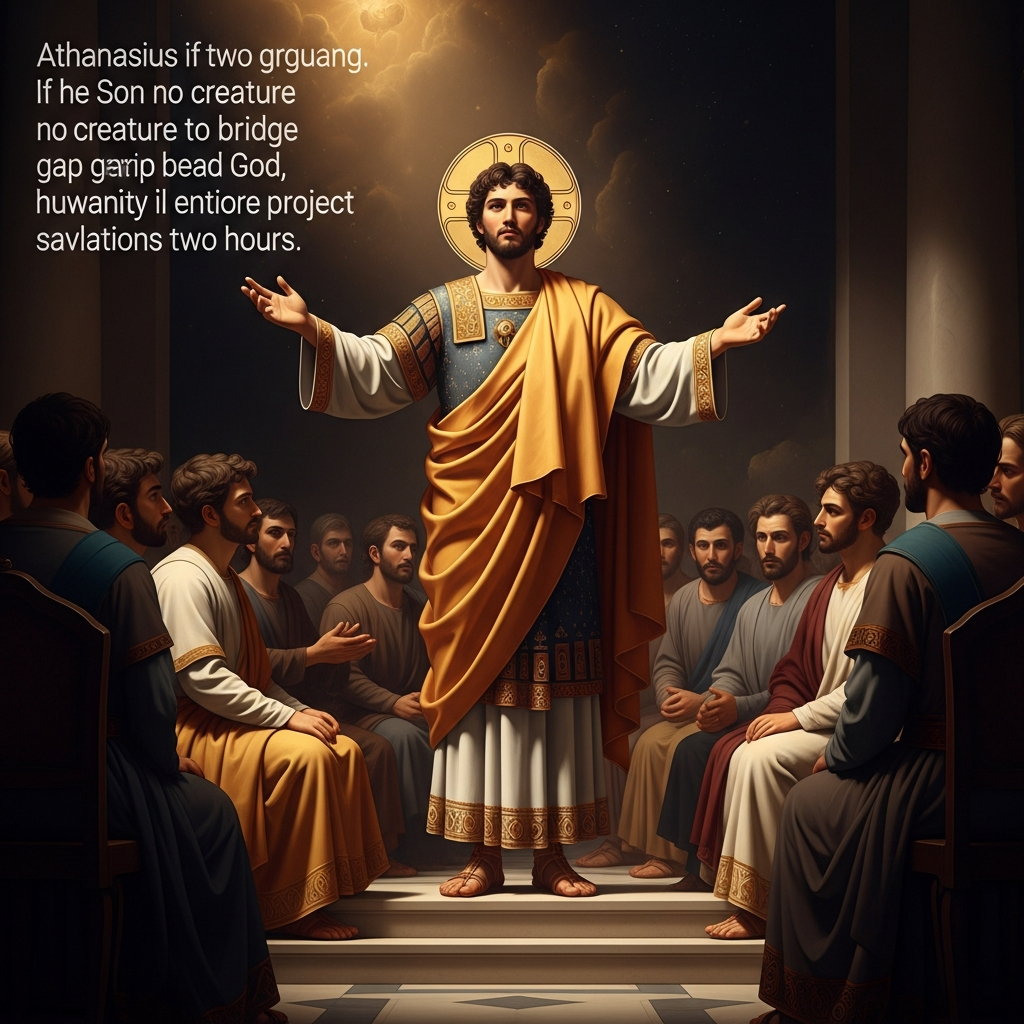
Athanasius is twenty-eight and not yet a bishop.
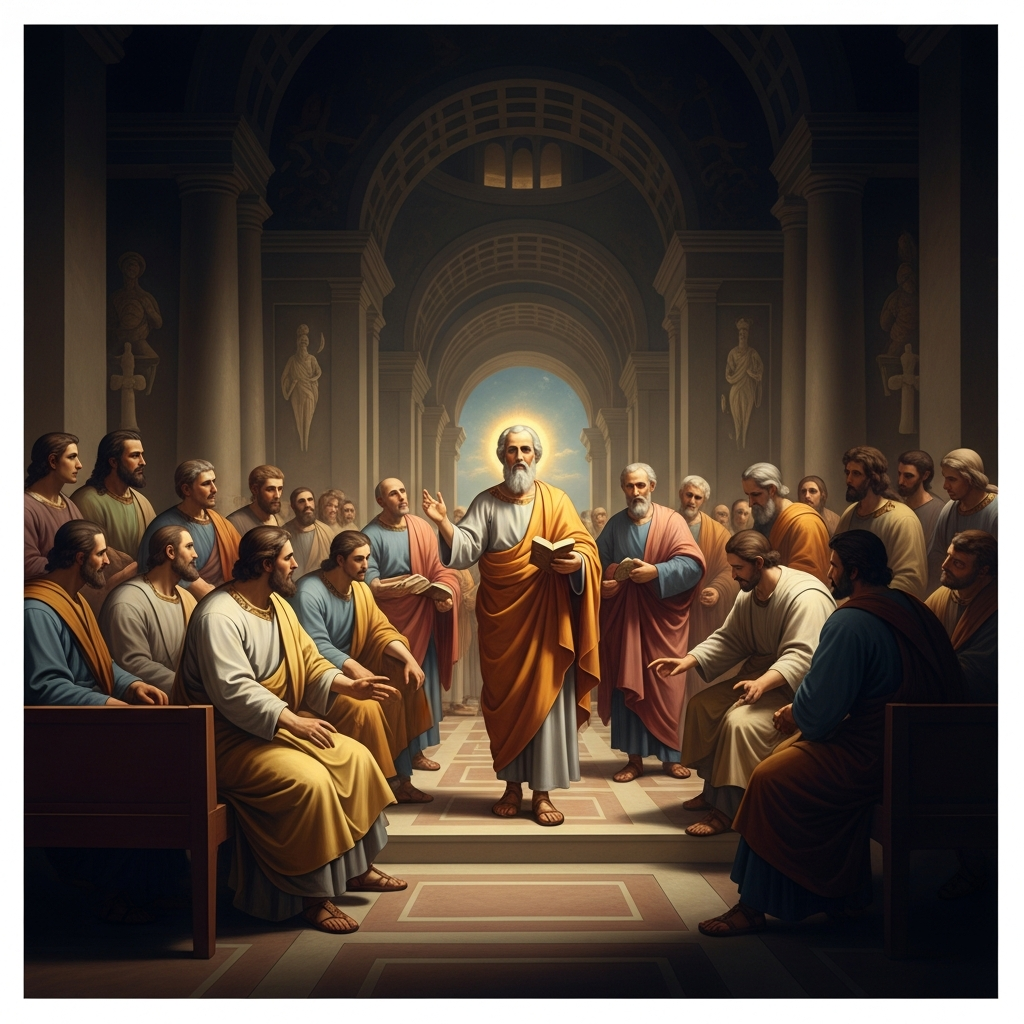
He is in the room as Alexander’s deacon and secretary, present to brief his bishop, allowed to speak when invited. He is small, dark, intense, and he has been thinking about this question since he was a boy. His argument, once he is given the floor, has the simplicity of a hammer.
If the Son is a creature, he cannot save us.
The whole point of the Incarnation is that something has crossed the infinite distance between God and humanity. A creature cannot cross that distance, no matter how exalted, because a creature is on this side of the gap by definition. Only God can bridge what only God could span. If Christ is the highest of created beings — magnificent, primordial, but still a creature — then when he dies on the cross, a creature dies. Creatures die all the time. It accomplishes nothing.
But if Christ is God — fully, without qualification, of the same substance as the Father — then on the cross, God himself enters human death and breaks it from the inside. The whole architecture of salvation depends on this single point. Either Christ is divine, or the gospel is decorative.
The hall listens.
Athanasius is not the most senior figure speaking. He is not even the principal speaker on his side — that is Alexander, his bishop. But the argument is in his mouth and the bishops in the room recognize that he has thought about this longer and more carefully than anyone else present. The future of the church will turn on what he has just said, and many of them know it before they leave the hall.
The word is homoousios.
Of the same substance. Of one being. The bishops settle on it after weeks of fighting because every weaker word — like the Father, similar to the Father, from the Father — leaves room for Arius to claim he agrees. Homoousios leaves no room. It says: whatever the Father is, the Son is exactly that. Same divinity. Same eternity. Same substance.
Some of the bishops do not like it. The word is not in scripture. It has a Gnostic odor — Sabellians have used it, Valentinians have used it, and the bishops are nervous about importing a term from heresy. Hosius of Córdoba, Constantine’s chief theological adviser, presses for it anyway. So does Alexander. So, increasingly, does the emperor, who wants the question closed and does not propose to be bothered with semantic objections.
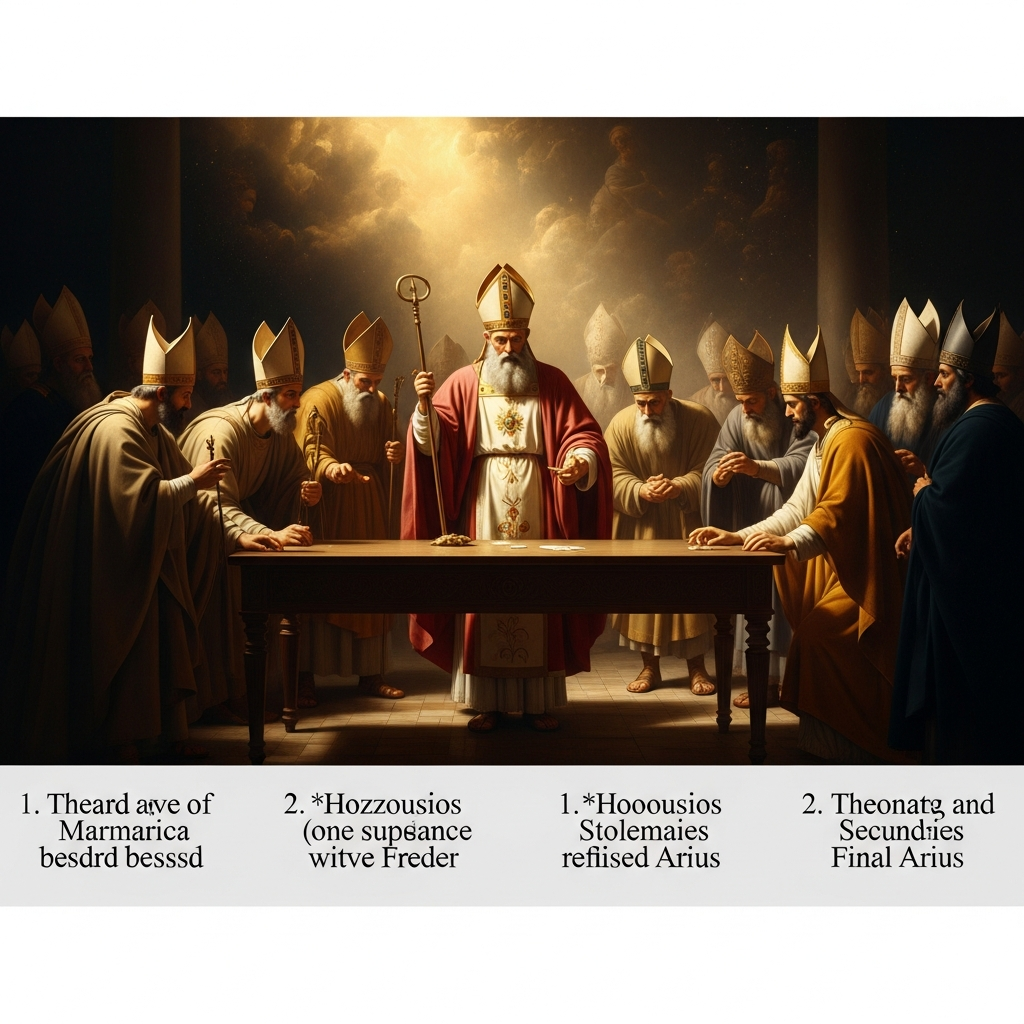
The Creed is drafted. It is read aloud. The bishops are asked to sign.
They line up. One by one, they walk to the table where the secretaries are inking the document, they sign their names beside their sees, and they file out. Eusebius of Nicomedia, Arius’s protector, signs — and is exiled three months later for hedging. Theonas of Marmarica refuses. Secundus of Ptolemais refuses. They are exiled with Arius. The rest, including some who did not believe a word of homoousios, sign anyway.
The Creed of Nicaea is now the law of the church.
It does not hold immediately.
Within five years Constantine recalls Arius from exile. Within ten years Athanasius is himself in exile, hounded out of Alexandria by the imperial court. He will be exiled five times in his life, will spend years hiding in the desert with the monks of Pachomius and Antony, will be denounced as a forger and a murderer and a sorcerer, and will outlive every emperor who hates him. The Arian controversy nearly destroys the church. For most of the fourth century, Arian Christianity is the version that the emperors prefer and the version that the German tribes adopt as they cross the Rhine. The Goths are Arian. The Vandals are Arian. The Lombards are Arian. The Creed of Nicaea, when it finally wins, has to win again and again against political support for the alternative.
It wins because Athanasius does not stop saying what he said in the hall.
He says it from exile. He says it from monastic cells in the Egyptian desert. He says it in the margin of every other crisis. By the time he dies in 373, the tide has turned, and at the Council of Constantinople in 381 the Nicene Creed is reaffirmed, expanded, and made the binding profession of the imperial church.
It has not been seriously challenged since.
A billion people say it on Sunday morning.
In Greek and Latin and Slavonic and English and Tagalog and Swahili. Light from light, true God from true God, begotten not made, of one substance with the Father. The phrases were forged in a hall in Bithynia in May 325, and they were forged because three hundred men with broken bodies and an emperor who needed them and a young deacon with a hammer for a mind decided that the question of what Christ was could not be left vague any longer.
What was settled at Nicaea was the architecture of salvation.
If they had voted the other way — and they nearly did, more than once, and the empire would have preferred a softer compromise — the religion that emerged would have been something else. Christianity would have been a school of moral teaching with a venerated founder, like late Stoicism or like the Buddhism that some Roman traders had heard about along the eastern routes. It might still have spread. It would not have produced cathedrals or icons or the Eucharist as Catholics and Orthodox understand it. The Trinity would not exist as a doctrine. The Incarnation would be a metaphor.
The vote was close. The argument continued for sixty years. The Creed held.
Three hundred bishops in a hall in Bithynia decided what Christianity would mean. They were tired men, scarred men, men whose bodies remembered the prisons of an empire that was now feeding them. The emperor who fed them needed an answer, and the deacon who gave it to them was twenty-eight. The phrase they chose — homoousios — had no biblical pedigree and they knew it. They chose it anyway, because the alternative left a door open that the door could not be allowed to leave open.
Every creed recited on Sunday is the echo of that vote. Every cathedral built since traces back to it. The young deacon’s hammer became the iron in the spine of two thousand years of theology. He did not live to see how completely it would hold. He only kept saying it, from exile, until he died.
Scenes
Three hundred bishops fill the great hall
Generating art… Arius rises to defend his teaching
 Generating art…
 Athanasius, deacon of Alexandria, not yet thirty, makes the counter-argument
 Generating art…
 The Creed is read out
 Generating art…
 Echoes Across Traditions
Entities
- Constantine
- Arius
- Athanasius
- Hosius of Córdoba
- Eusebius of Nicomedia
Sources
- Eusebius of Caesarea, *Life of Constantine* (c. 337 CE)
- Sozomen, *Ecclesiastical History* (c. 445 CE)
- Henry Chadwick, *The Early Church* (1967)
- Rowan Williams, *Arius: Heresy and Tradition* (1987)
- Lewis Ayres, *Nicaea and Its Legacy* (2004)