Augustine and the Voice in the Garden
Summer 386 CE · A walled garden in Milan, behind the house Augustine shares with his mother and his friend Alypius
Contents
A 31-year-old rhetoric professor sobs under a fig tree in Milan, hears a child's voice chanting 'tolle, lege,' and opens Paul's letter at random. The Roman Empire's most influential theologian is born in a single sentence.
- When
- Summer 386 CE
- Where
- A walled garden in Milan, behind the house Augustine shares with his mother and his friend Alypius
He is thirty-one and he cannot stop crying.
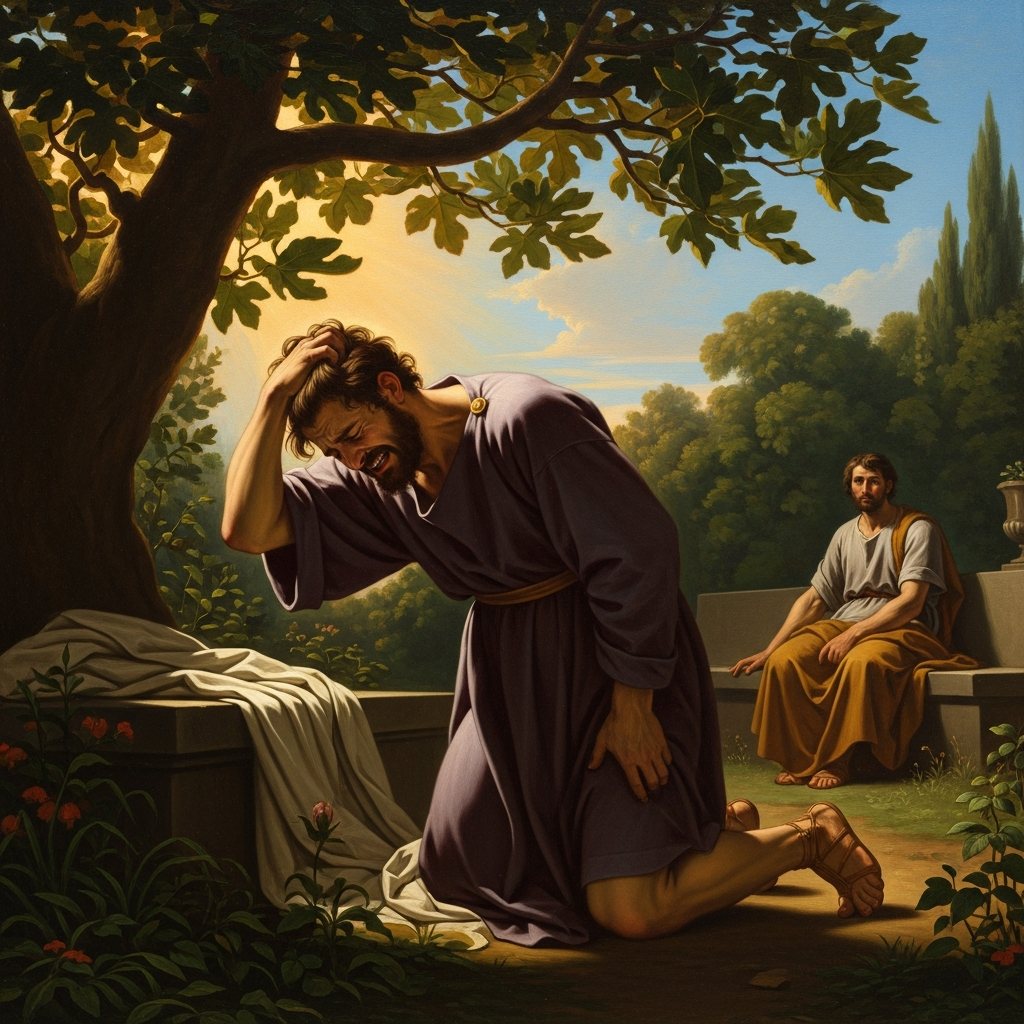
The garden behind the house is small, walled, hot in the Milanese summer. A fig tree throws shade over a patch of dirt. He has thrown himself under it the way a man throws himself off a horse — without dignity, without choosing the landing. Alypius sits a few paces away on a bench, watching, saying nothing. The two of them have spent the morning reading the Life of Antony, and the story has done what stories do when they arrive at the right hour: it has split him in half.
He pulls his hair. He beats his forehead. He clasps his knees. None of it works. The thing he wants, he wants. The thing he wants, he cannot bear to want.
He has been arguing with himself for years.
His mother Monica wants him baptized. His mistress of fifteen years has been sent away — the wound still open, still seeping. His career is rhetoric: he teaches the sons of senators how to lie beautifully in Latin. He has read the Platonists, the Manicheans, the Stoics. He knows the arguments. He has won them all and converted no one, least of all himself.
“Make me chaste, O Lord,” he has prayed for a decade, “but not yet.”
Two wills inside one chest, he will write later — one new, one old, one carnal, one spiritual. They tear him at the seams. He is not a soul with a body. He is a civil war.
The voice comes from over the wall.
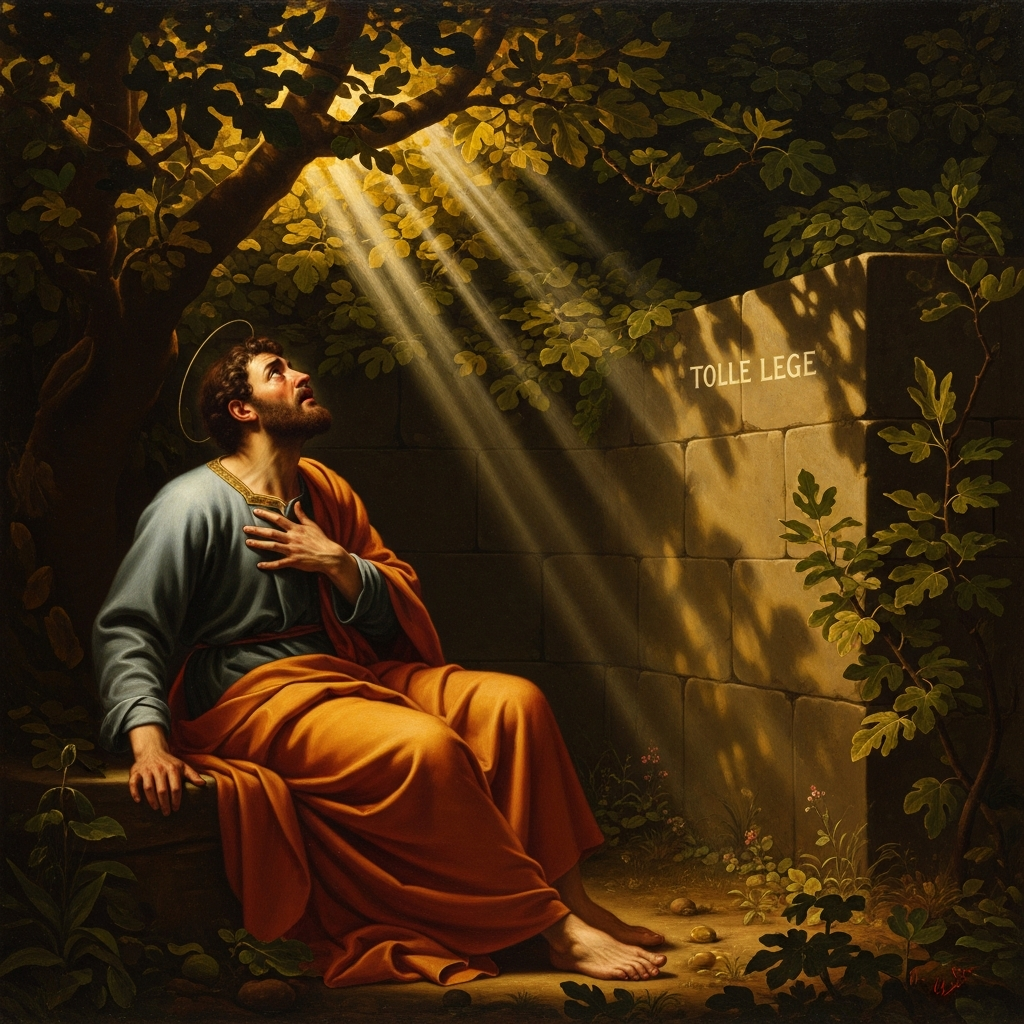
A child’s voice — boy or girl, he cannot tell, and will never decide — singing the same two words over and over in a sing-song the way children turn anything into a game. Tolle, lege. Tolle, lege. Take and read. Take and read.
He stops crying.
He has never heard this in any children’s game. Not in Carthage, not in Rome, not in Milan. He sits up under the fig tree. The cicadas. The heat. The voice over the wall, unwavering. He thinks of Antony, who once walked into a church and heard a verse read and obeyed it as if it had been spoken to him alone. He decides — the way a man decides to step off a cliff — that the voice is for him.
The codex is on the bench beside Alypius.
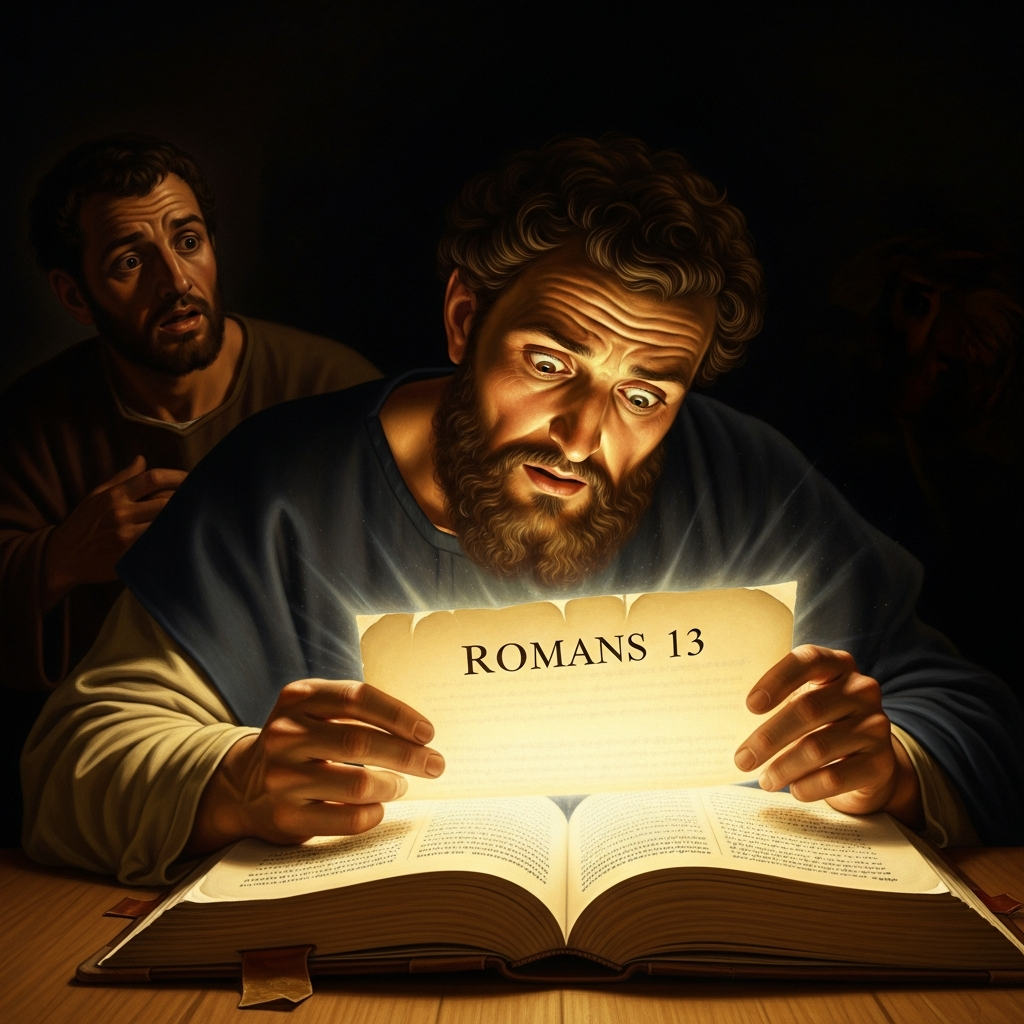
Paul’s letters. He has been reading them all summer — the way a starving man circles a meal he is not sure he is allowed to eat. He stands. He walks to the bench. He picks up the book. He opens it without looking, the way a Roman opens the Aeneid for an oracle, the way his mother would shake her head at — the sortes, the lottery of the divine.
His eye falls on Romans 13:13-14.
“Not in rioting and drunkenness, not in chambering and wantonness, not in strife and envying: but put ye on the Lord Jesus Christ, and make not provision for the flesh, to fulfill the lusts thereof.”
He does not need to read the next verse. He does not need to read anything ever again. The civil war ends in a single sentence. The two wills become one. The thing he could not bear to want, he now wants and only wants, with a calm that arrives the way weather arrives — without explanation, without warning, without permission.
He marks the place with his finger and closes the book.
He turns to Alypius, who has been watching the whole time, and tells him quietly what has happened. Alypius asks for the codex. He reads the verse. He reads the next verse — Him that is weak in the faith receive ye — and applies it to himself, on the spot, without theatrics. Two conversions in one bench, one fig tree, one afternoon.
They walk into the house together. They tell Monica. She has been praying for this moment for thirty-one years — through Carthage, through Rome, through the mistress, through the Manicheans, through every dead-end argument her brilliant son has talked himself into. She does not weep. She has already wept. She praises God in a voice that, Augustine will later write, sounded older than her body.
He is baptized at Easter the following year by Ambrose of Milan. He returns to North Africa. He becomes bishop of Hippo, a small port town on the edge of an empire that is already beginning to fall.
He writes the Confessions at forty-three. He writes On the Trinity, The City of God, the long and the short anti-Pelagian treatises, the homilies, the letters — five million words, give or take, more than any other ancient author. He invents introspection in Latin. He invents original sin as a doctrine. He invents the medieval university curriculum’s spine. He dies in 430 CE while the Vandals are besieging his city, with the penitential psalms tacked to the wall of his cell so he can read them as he goes.
But the hinge is the fig tree.
The hinge is always the fig tree.
Augustine’s conversion is the template the West would use for the next sixteen hundred years: the agonized seeker, the ambient sign, the book opened at random, the instant of surrender. Every later evangelical altar call, every Pascal sewn into his coat, every Luther in the thunderstorm, every Wesley with his heart strangely warmed — they are all standing in Augustine’s garden, hearing Augustine’s voice over the wall.
The mystery is that it works. A child sings a game. A man opens a book. The empire’s most consequential theologian is born in the gap between two heartbeats.
Take and read.
Scenes
The agony in the garden — Augustine tearing his hair, weeping, splitting himself in two against his own will
 Generating art…
 The child's voice — tolle, lege, tolle, lege — drifting over the wall from a neighbor's house
 Generating art…
 The codex opened at random — Romans 13:13-14 — and the instant the will breaks
 Generating art…
 Echoes Across Traditions
Entities
- Augustine of Hippo
- Alypius
- the Apostle Paul
- Monica

Sources
- Augustine, *Confessions* Book VIII (398 CE)
- Peter Brown, *Augustine of Hippo: A Biography* (1967, rev. 2000)
- Garry Wills, *Saint Augustine* (1999)
- James J. O'Donnell, *Augustine: A New Biography* (2005)