The Old Monk Who Walked to the Buddha's Homeland
399–414 CE · Chang'an (Xi'an) → Gobi Desert → Kashgar → Ganges Plain → Bodh Gaya → Sri Lanka → Indian Ocean → Qingzhou (Qingdao)
Contents
At sixty years old, a Chinese monk decides his country's translations of the Buddhist texts have drifted from the originals. He sets out west, on foot, to bring back the source. He returns fourteen years later, the first of his people to have walked to the Buddha's birthplace and back.
- When
- 399–414 CE
- Where
- Chang'an (Xi'an) → Gobi Desert → Kashgar → Ganges Plain → Bodh Gaya → Sri Lanka → Indian Ocean → Qingzhou (Qingdao)
He is sixty years old when he leaves.
His full name is Sehi, but the world will know him as Faxian — Brilliance of the Dharma. He is born in Pingyang, in northern China, around 337 CE, into a family that has lost three sons in infancy. His father, terrified that Sehi will follow them, gives the boy to a local Buddhist monastery before he is four years old. The boy is supposed to come home when his immediate health crisis passes. He never does. Whenever his father attempts to retrieve him, Sehi falls deathly ill; whenever he is returned to the temple, he recovers. The family eventually understands what they have been told. The boy belongs to the dharma.
He is ordained as a shramanera — a novice — at ten. As a bhikshu — a fully ordained monk — at twenty. He spends the next forty years studying the Buddhist texts available in Chinese translation. He is patient. He is methodical. He is also, gradually, dissatisfied.
The translations are inconsistent. The same Sanskrit term is rendered five different ways across five different texts; key passages disagree in points of doctrine; whole sections of the Vinaya — the monastic code — are missing entirely from the Chinese versions. Faxian comes to the conclusion that the Chinese sangha is operating on imperfect documents. The originals — the actual Sanskrit texts the Indian masters used — must be brought back. He has been thinking this for years. By the time he is fifty-eight he is no longer thinking it; he is planning.
In the spring of 399 CE, Faxian gathers four traveling companions — Huijing, Daozheng, Huiying, and Huiwei — and tells them his plan. They will leave Chang’an, the capital of the short-lived Later Qin dynasty. They will walk west across the Gobi Desert. They will cross the Pamirs. They will descend onto the plain of the Ganges. They will go to Pataliputra, where the Vinaya of the Mahasanghikas is said to be intact. They will copy what they need. They will return.
The companions agree. They are all younger than Faxian; he is the senior monk by two decades. They set out.
The Gobi nearly kills them.
Faxian’s own description, written down years later, is famously stark:
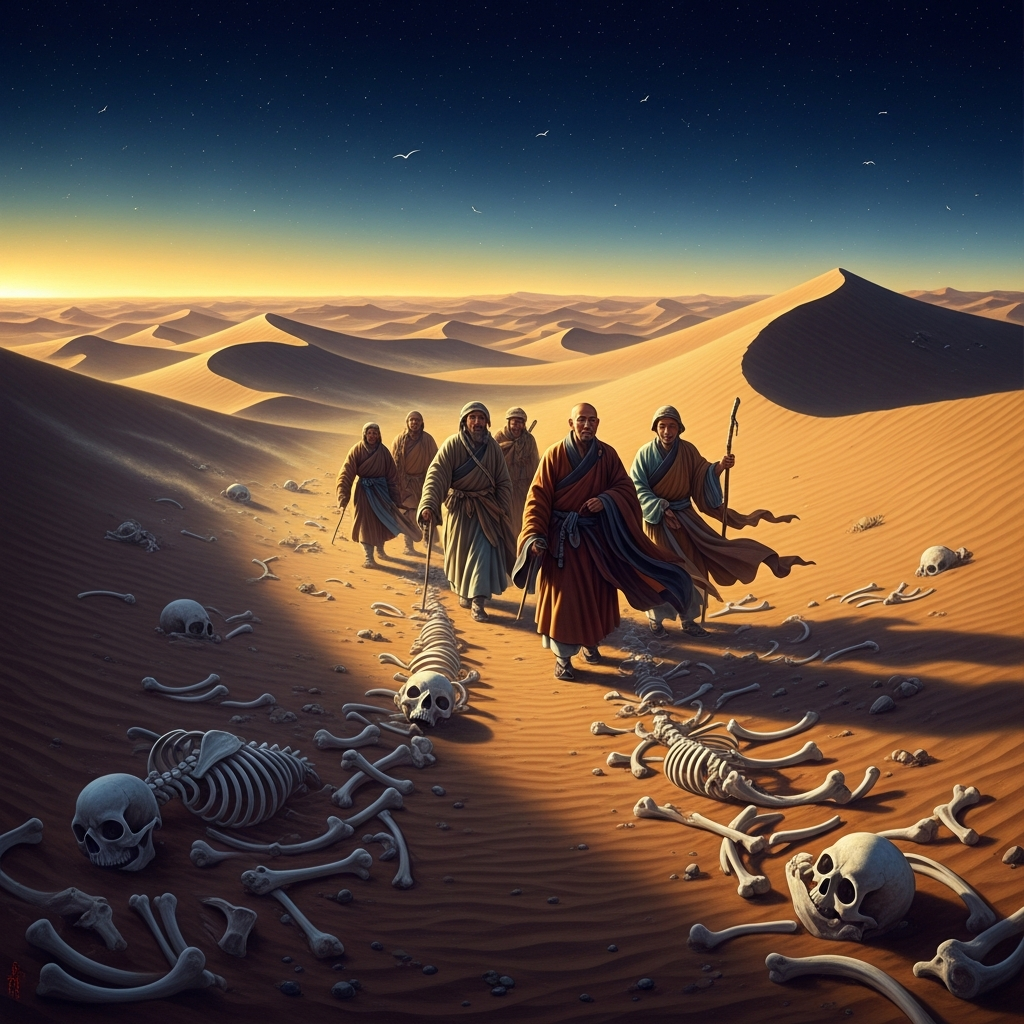
In this desert there are many evil demons and hot winds. Those who encounter them perish to a man. Above, there are no birds; below, there are no animals. Looking on every side as far as the eye can reach to mark the track, no guidance is to be obtained save from the rotting bones of dead men, which point the way.
They follow the bones. They walk for seventeen days through wind and salt and skeletons. They lose the path twice. They drink from holes in the ice in the morning. They sleep in the lee of dunes that move three feet in a single night. They reach the oasis of Dunhuang. They rest. They continue. They cross the Tarim Basin. They reach Khotan, where there is a flourishing Mahayana community and seven thousand monks. They stay for three months observing the Khotanese ceremonies. They continue.
The Pamirs are worse than the Gobi.
The mountains are covered with snow both in winter and summer. There are also venomous dragons in them, which, when angered, spit out poisonous winds, rain, snow, drift sand, and gravel. Not one in ten thousand of those who encounter these dangers escapes alive.
The companions are sixty, and seventy, and beyond. They climb passes at fifteen thousand feet. They cross suspension bridges woven of yak-hide ropes over gorges so deep the river at the bottom is invisible. One of them, Huijing, falls ill in the high passes and asks Faxian to leave him. Faxian refuses; the man dies in his arms; Faxian buries him with stones piled on his body and walks on with the survivors. He is now sixty-three years old. The original group has begun to split — some going home, some choosing to remain at intermediate monasteries — and the original five who left Chang’an are already reduced.
He keeps going.
He reaches the Indian plain.
He descends the Indus. He walks through the country of Udyana, then Gandhara, then through the Punjab. He visits the great monastic centers of the northwest — places where the Buddha himself was said to have left his shadow on a cave wall, places where the bowl of the Buddha was venerated, places where the relics of his disciples were kept in stupas the size of small mountains. Faxian stops at every one. He prostrates. He records. He notes the size, the layout, the ceremonies, the number of monks, the relationship between the sangha and the local kings. The notes will become a manual, two centuries later, for Xuanzang.
He reaches Mathura. He reaches the Yamuna. He turns east along the Ganges. He arrives at Sankasya, where the Buddha was said to have descended from the Trayastrimsa heaven on a triple staircase of jewels. He arrives at Kanyakubja. He continues east. He reaches Sravasti, where the Buddha taught for twenty-five rains-retreats; he sees the Jetavana monastery, then in the slow process of decline. He reaches Kapilavastu, the Buddha’s own birthplace, where the city has fallen into such ruin that he describes it as only a few families of common people, no king, no officials. He reaches Lumbini and stands at the spot where the Buddha’s mother gripped the branch of the sal tree and gave birth to the awakening one. He reaches Kushinagar, where the Buddha lay down between two sal trees and entered parinirvana. He reaches Vaishali. He reaches Pataliputra.
He has been walking for six years.
Pataliputra is the city he came for.
It is, in 405 CE, the capital of the Gupta empire under Chandragupta II. The city is at the height of its prosperity. The streets are wide. The monasteries are large and well-funded. The university at Nalanda is operating at its full strength. Faxian is treated with respect. He is given access to the manuscripts.
The texts he has come for are real. The Vinaya of the Mahasanghikas, complete in Sanskrit, is in the Pataliputra monastery. Faxian sets up a desk. He copies. The work takes three years. He copies the entire Mahasanghika Vinaya. He copies the Sarvastivadin Vinaya in addition. He copies the Samyukta Pitaka — the Connected Discourses of the Buddha. He copies the Mahaparinirvana Sutra. He copies the Vaipulyaparinirvana Sutra. He copies the Mahasanghika Abhidharma. The pile of manuscripts grows. He is the first Chinese monk to have made it this far; he is determined that he will not be the last to benefit from the trip.
His companions begin to leave.
Daozheng, who has been with him since Chang’an, stays in India. Daozheng tells him: I will not return. The Buddha-dharma is here in its original form. To go back to China is to leave the source. I will spend the rest of my life at Pataliputra. Faxian honors the choice. He himself does not waver. The Buddha-dharma is in China, he answers. It is in imperfect form. I have come for the originals. I must take them back. The sangha at Chang’an needs them.
He continues to copy.
He sails from Tamralipti in the year 411.
He has spent eleven years on the road. He is now seventy-one years old. He has been alone, since Daozheng’s decision, for almost a year. He has the manuscripts wrapped in oiled silk in waterproof bundles. He boards a merchant ship at the mouth of the Hooghly bound for Sri Lanka.
In Sri Lanka — at the great monastery of Abhayagiri in Anuradhapura — he stays for two more years. He copies more texts: the Dirghagama, the Samyuktagama, the Misrakapitaka. He sees the tooth-relic of the Buddha taken in procession through the streets. He sees jade Buddha statues. He sees a young Sri Lankan monk recite the entire Vinaya from memory. The community at Abhayagiri is unlike anything in China. He stays as long as he can. Eventually he boards a second merchant ship — this one bound, in theory, for Guangzhou.
The ship is caught in a storm.
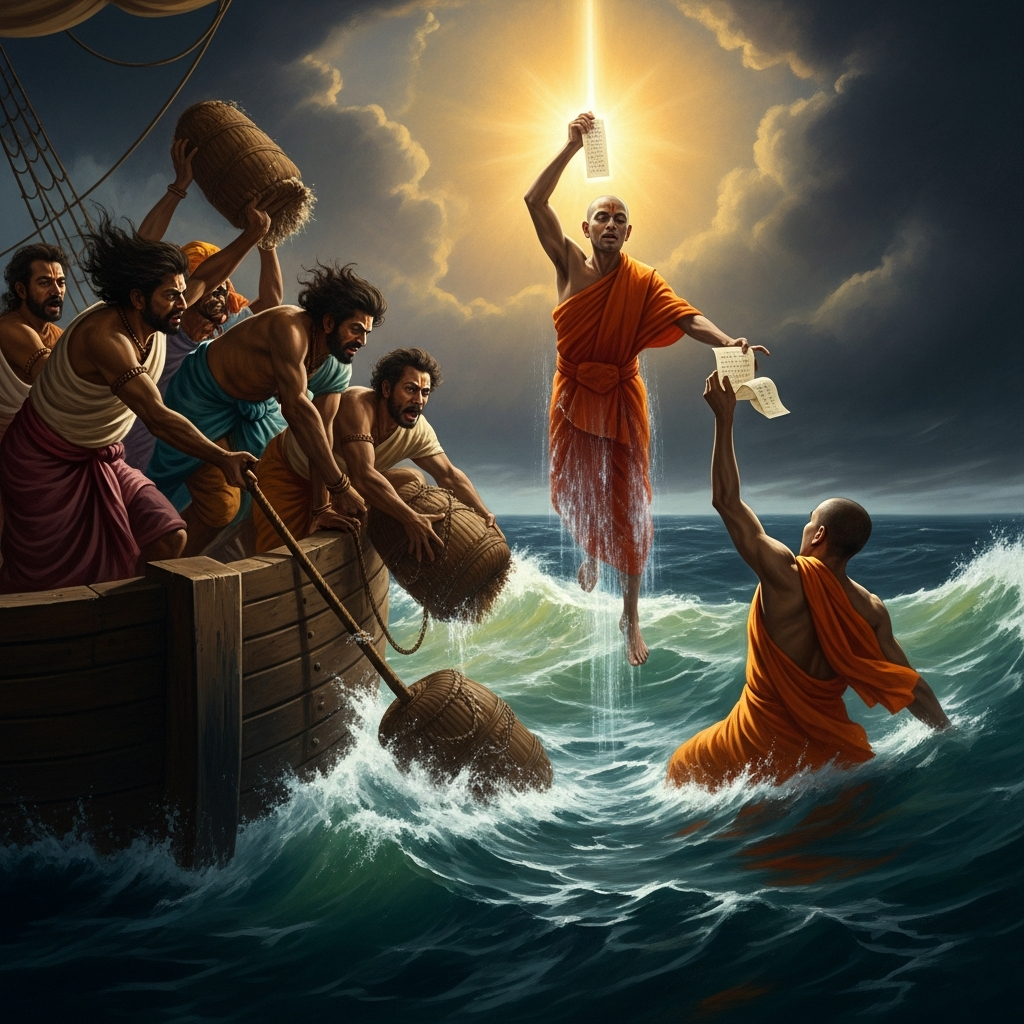
For thirteen days the ship is hammered by wind and rain. The merchants, terrified, throw the cargo overboard to lighten the vessel. The captain, looking at the increasingly emaciated old monk traveling with a heavy load of silk-wrapped bundles, suggests that the bundles are bringing bad luck and should follow the cargo. Faxian, seventy-three years old, holds the manuscripts to his chest and says no. I have walked across the Gobi to fetch these. I have crossed the Pamirs with them. They will not be thrown overboard. If you must throw something into the sea, throw me. The texts will go on without me. I will not allow them to be lost. The captain, faced with a man willing to drown for the manuscripts, relents.
The storm passes. The ship has been blown far off course. They make landfall, eventually, on what Faxian thinks at first is the coast of southern China but is in fact the island of Java. He spends five months there, finds another merchant ship bound north, and sets sail again. The second voyage is also stormed. The ship is blown off course a second time and finally makes landfall in the year 412 at Laoshan, on the Shandong peninsula — Qingzhou, near modern Qingdao — far to the north of where he intended to land.
He has been gone for thirteen years. He is seventy-four. He kneels on the beach and weeps.
He has not finished.
The texts must be translated. He goes to Jiankang, the southern capital, where the great translator Buddhabhadra is working. Faxian collaborates with Buddhabhadra for the rest of his life — the next nine or ten years — translating the manuscripts he has carried back. The Mahaparinirvana Sutra in his version becomes the standard Chinese text and is the document upon which the Buddha-nature controversy in fifth-century Chinese Buddhism turns. The Vinaya texts he brought reform the Chinese monastic code. The Samyuktagama enters the Chinese canon as one of the four Agamas.
While he translates, he writes the Foguo Ji — the Record of the Buddhist Kingdoms — at the request of his friends, who want to know what he saw. The book is short, pragmatic, almost unembellished. It records distances. It records monastic populations. It records local ceremonies. It records the state of relics. It is the first systematic Chinese description of the Buddhist holy land, and it is, fifteen centuries later, the primary surviving source for the geography and demographics of fifth-century Buddhist India. Without the Foguo Ji we would know almost nothing about Gupta-period Buddhism. Most of what we know about it comes through Faxian’s careful pages.
He dies in 422 CE — or possibly slightly later — at Xinsi monastery in Jingzhou. He is in his eighties. He has spent his last decade translating texts, dictating his memories, training a younger generation of monks for whom the road west is no longer mythological.
Two centuries later, Xuanzang reads the Foguo Ji.
He is a young monk in Chang’an in the early seventh century. He has the same problem Faxian had: the Chinese translations are inconsistent, partial, contested. He has been through the literature. He knows the texts. He concludes, the way Faxian concluded, that the only solution is to go to India. The road west is more developed now — the Tang dynasty controls the western marches, the Silk Road is busier, the monasteries along the route are better established — but the journey is still ferociously hard. Xuanzang makes it. He stays in India for sixteen years. He returns in 645 with hundreds of texts. He becomes the most famous Chinese pilgrim to India in history, the model for the Journey to the West novel, the figure who in the popular imagination eclipses Faxian almost completely.
But Xuanzang knew. In his own writings he refers to the elder, the man who showed that the journey was possible — and the route he himself takes is, in long stretches, the route Faxian first walked. The old monk made the road.
The Faxian story is the story of a person who decides, late in life, that the texts everyone around him has been content to use are not good enough.
He is sixty years old. He has read everything available in his country. He could have spent his last decade as an honored elder at any monastery in Chang’an. He decides instead to walk to India. The decision is not romantic. It is technical. The translations have drifted. The originals are at Pataliputra. The originals must be brought back.
He walks. He crosses the Gobi. He crosses the Pamirs. He buries his companion under a pile of stones in the high passes and goes on. He copies texts at Pataliputra for three years. He nearly drowns twice in the Indian Ocean. He lands on the wrong continent. He gets up. He walks north.
He arrives home with a load of manuscripts wrapped in oiled silk. He spends his remaining years translating them with his friend Buddhabhadra. He writes a small book about what he saw, and the small book becomes, fifteen centuries later, one of the most important historical sources we possess for the world he traveled through.
The dharma he was carrying did not depend on him. The Buddha taught it nine hundred years before he was born. But the Chinese sangha that received it would not have received it in the form it received without the seventy-four-year-old monk who, having walked sixty miles a day for thirteen years and been twice nearly drowned, walked up the beach at Laoshan, fell to his knees, and continued working.
Scenes
The Gobi at dusk
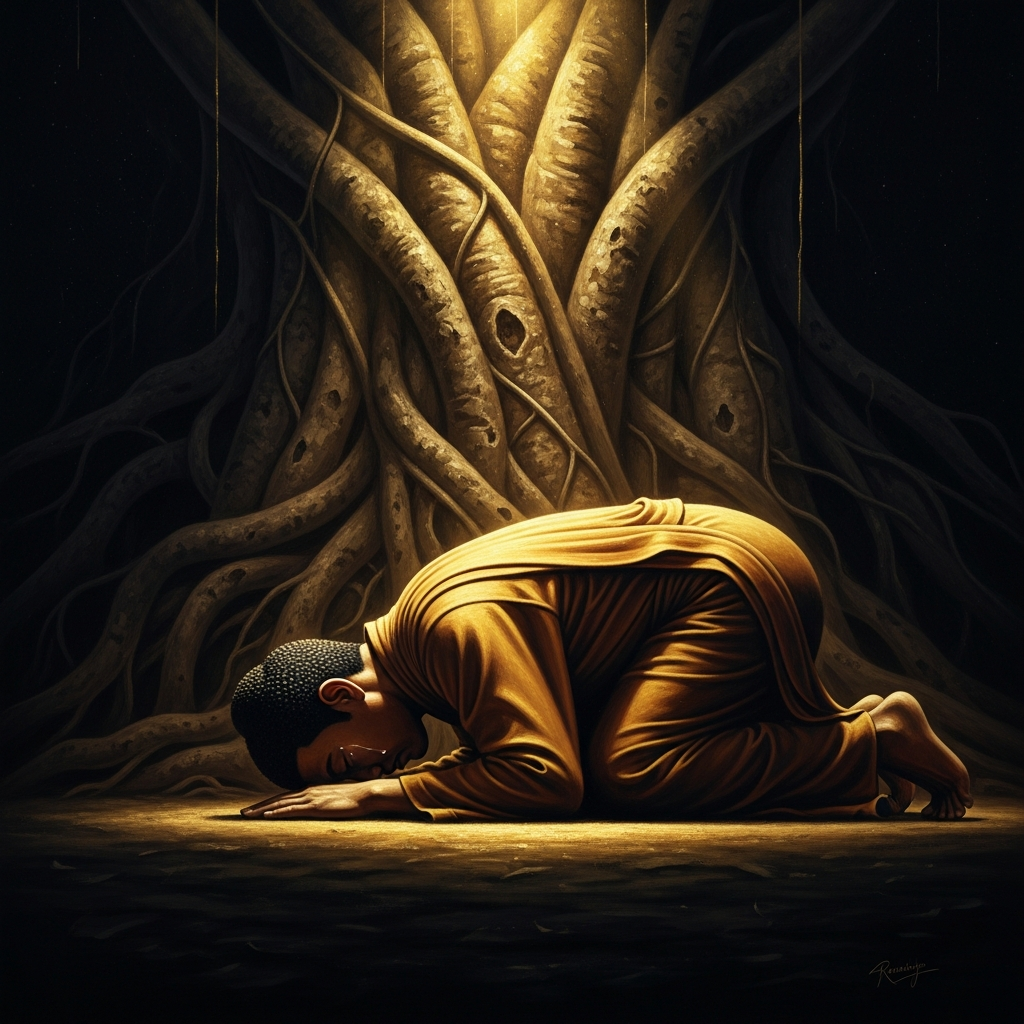
Generating art… Faxian beneath the Bodhi Tree at Bodh Gaya
 Generating art…
 The Indian Ocean
 Generating art…
 Echoes Across Traditions
Entities
- Faxian
- Chandragupta II (Gupta emperor)
- the monks at Pataliputra who help him copy texts
- the storm in the Indian Ocean
Sources
- Faxian, *Foguo Ji* / *Fo Guo Ji* (*Record of the Buddhist Kingdoms*), trans. James Legge (1886) and Herbert Giles (1923)
- Arthur Waley, *The Real Tripitaka and Other Pieces* (1952)
- Erik Zürcher, *The Buddhist Conquest of China* (1959; rev. 2007)
- Tansen Sen, *Buddhism, Diplomacy, and Trade: The Realignment of Sino-Indian Relations, 600–1400* (2003)
- Max Deeg, *Das Gaoseng-Faxian-zhuan als religionsgeschichtliche Quelle* (2005)